

Why Imported Mattresses Have Safety Gaps: 2026 Guide
Imported mattresses have safety gaps because they routinely bypass the flammability standards, dimensional requirements, and labeling rules that domestic manufacturers must follow. The US Consumer Product Safety Commission recalled imported brands Crayan and Elitespace in early 2026 for violating federal flammability rules. A National Bed Federation study found that over 65% of mattresses imported from outside the UK and EU fail essential fire safety standards. That number comes from testing 101 mattresses priced between £47 and £450. The pattern is consistent: cost-cutting in overseas production creates real hazards for American consumers.
Why imported mattresses have safety gaps in manufacturing
The root cause of most imported mattress safety issues is poor quality control during production. Overseas factories often use non-certified foam and untested fabric coverings that do not meet US or UK fire resistance thresholds. The result is a product that looks like a compliant mattress but performs like one that was never tested.
Several specific failures show up repeatedly in recalled and flagged products:
- Non-certified foam cores: Foam that has not been tested to 16 CFR 1633 (the US open-flame flammability standard) can ignite and spread fire far faster than compliant foam.
- Misleading fiber content labels: Inaccurate foam and textile labeling makes it nearly impossible for buyers or inspectors to verify compliance before purchase.
- Hidden prototype test records: Some sellers submit test results from a prototype that differs from the actual product shipped. The product on your doorstep may never have been tested at all.
- Unverified online listings: Major online platforms list noncompliant products without adequate safety verification, giving unsafe imports the same visual credibility as certified ones.
- Supply chain opacity: Multiple layers of brokers and resellers obscure where a mattress was actually made and what materials it contains.
Pro Tip: Before buying any mattress online, search the CPSC recall database by brand name. If the seller cannot provide a flammability test report number tied to the specific model you are buying, treat that as a red flag.
Understanding US mattress manufacturing standards helps you spot the difference between a compliant product and one that only looks the part.

What mattress safety regulations actually require
Mattress safety regulations are not voluntary guidelines. They are legal thresholds with real consequences for non-compliance, and they cover fire resistance, physical dimensions, and labeling.
| Standard | Jurisdiction | What it covers |
|---|---|---|
| 16 CFR 1633 | United States | Open-flame flammability for mattresses |
| 16 CFR 1632 | United States | Cigarette ignition resistance |
| ASTM F2933-25 | United States | Crib mattress dimensions and entrapment prevention |
| BS 7177 | United Kingdom | Fire resistance for domestic and contract mattresses |
| FTC Labeling Rule | United States | Accurate fiber content disclosure |
The most significant 2026 update is ASTM F2933-25, effective may 3, 2026. This standard requires compression and stability testing for crib mattresses to prevent infant entrapment and suffocation. The update reflects years of incident data showing that gaps between a mattress and a crib frame are a documented cause of infant death.
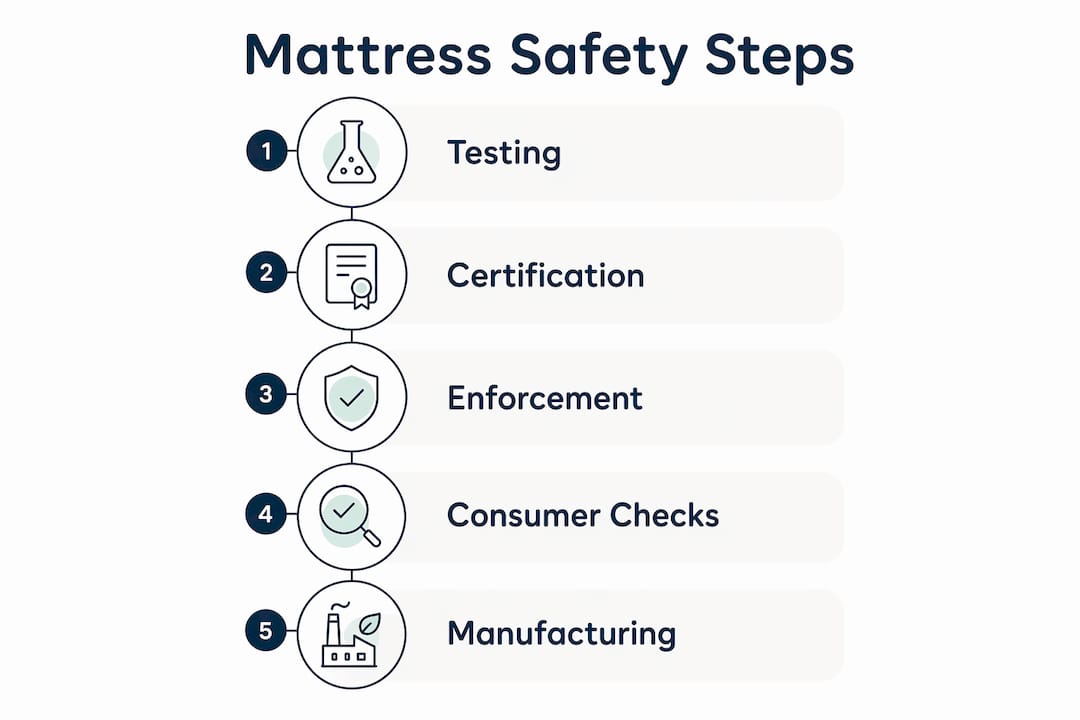
Enforcement is the weak link. The CPSC operates on a complaint and recall model, meaning a product often reaches thousands of consumers before a recall is issued. The National Bed Federation’s study confirms that non-compliant imports undermine manufacturers who invest in costly testing, creating an uneven market where cutting corners is financially rewarded until a recall forces action.
One consumer misconception worth addressing: mattress toppers and pads are not subject to the same strict flammability regulations as full mattresses. Federal standards distinguish between mattress types, so a topper that passes its own lower threshold does not make a non-compliant mattress beneath it safe.
What are the real risks of safety gaps in imported mattresses?
The risks are not theoretical. They fall into three categories: fire, physical entrapment, and chemical exposure.
Fire risk is the most documented. Mattresses that fail 16 CFR 1633 can allow a fire to grow large enough to be unsurvivable within minutes of ignition. The CPSC’s 2026 recalls of Crayan and Elitespace specifically cited this hazard, and some sellers resisted the recall process, meaning non-compliant products stayed in homes longer than they should have.
Physical entrapment is the primary concern for infant sleep. Several fatalities have been linked to gaps between non-standard crib mattresses and crib frames. ASTM F2933-25 was updated directly in response to this pattern. An imported crib mattress that is even slightly undersized creates a gap where an infant’s head or body can become trapped.
“Mandatory mattress safety standards are not optional benchmarks. They are legal thresholds essential for fire, entrapment, and chemical exposure protections.” — National Mattress Authority
Chemical exposure is the least visible risk. Mattresses containing fiberglass as a fire barrier can shed microscopic glass particles when the cover is removed or damaged. Those particles embed in skin, lungs, and household surfaces. Consumers who buy fiberglass-free mattresses avoid this risk entirely. Many imported mattresses do not disclose fiberglass use on the label, which is itself a labeling violation.
How do imported mattresses compare to domestic options?
Domestic mattresses carry a structural compliance advantage that imported products rarely match. American manufacturers must test to 16 CFR 1633 and 1632 before selling, maintain test records, and label products accurately under FTC rules. That process costs money, and it shows up in product quality.
| Factor | Imported mattresses | Domestic mattresses |
|---|---|---|
| Flammability compliance | Frequently non-compliant | Required by federal law |
| Labeling accuracy | Often inaccurate or missing | FTC-mandated disclosure |
| Fiberglass disclosure | Rarely disclosed | Typically disclosed |
| Recall history | Higher frequency | Lower frequency |
| Supply chain visibility | Opaque, multi-layer | Direct manufacturer accountability |
The National Bed Federation’s testing found that the majority of non-UK and non-EU mattresses in its 101-product sample were non-compliant. That failure rate does not reflect a few bad actors. It reflects a systemic problem with how imported mattresses are produced and sold.
Domestic manufacturers also absorb the cost of certification, which means their pricing reflects real compliance. Imported mattresses often appear cheaper because they skip that cost. That price gap is not a deal. It is the cost of the safety testing that was never done.
Consumers who want to understand how mattress materials affect health will find that domestic products are far more likely to use certified, disclosed materials than their imported counterparts.
What steps can consumers take to avoid unsafe imported mattresses?
Verification is the consumer’s best defense. The steps below are specific and actionable.
- Check the CPSC recall database. Search by brand name at cpsc.gov before purchasing any mattress. Crayan and Elitespace are recent examples, but the database is updated regularly.
- Request the flammability test report. A compliant mattress has a test report number tied to the specific model. Ask the seller for it. If they cannot provide one, the mattress likely has not been tested.
- Read the label carefully. Federal law requires fiber content disclosure. If the label omits foam type or lists vague materials, that is a compliance failure.
- Verify crib mattress dimensions. For infant sleep, confirm the mattress meets ASTM F2933-25 compression and dimensional standards. A gap of more than one inch between the mattress and crib frame is a documented entrapment risk.
- Avoid unverified marketplace listings. Platforms that list products without safety verification allow non-compliant imports to reach consumers. Buy directly from manufacturers or verified retailers who can provide documentation.
Pro Tip: Look for CertiPUR-US certification on foam mattresses. This certification confirms the foam was tested for harmful chemicals, physical performance, and durability by an independent lab. It does not replace flammability compliance, but it adds a meaningful layer of material safety verification.
Checking budget mattress quality indicators before you buy gives you a practical framework for separating compliant products from those that only look the part.
Key Takeaways
Imported mattresses have safety gaps because they frequently skip the flammability testing, dimensional standards, and labeling requirements that US law mandates for domestic manufacturers.
| Point | Details |
|---|---|
| Regulatory non-compliance is widespread | Over 65% of non-UK and non-EU mattresses fail fire safety standards like BS 7177. |
| CPSC recalls confirm real fire risk | Brands Crayan and Elitespace were recalled in 2026 for violating federal flammability rules. |
| Crib mattress gaps cause infant deaths | ASTM F2933-25, effective may 2026, mandates compression tests to prevent entrapment fatalities. |
| Labeling failures hide material risks | Inaccurate fiber content labels make it impossible to verify compliance or fiberglass use. |
| Domestic mattresses carry a compliance advantage | American manufacturers must test, label, and certify before selling, creating a safer baseline. |
The enforcement gap no one talks about
The mattress safety system in the United States is built on a reactive model. The CPSC issues recalls after products are already in homes. That is not a flaw in the agency’s intent. It is a structural limitation of how import enforcement works at scale.
What concerns me most is not the bad actors who knowingly ship non-compliant mattresses. It is the sellers who genuinely do not know what they are selling. Multi-layer supply chains mean a US retailer can list a mattress without ever seeing a test report, because the broker above them never asked for one either. That is how a mattress with no flammability testing ends up on a major marketplace with a five-star rating and free shipping.
Consumers cannot outsource their safety to platform algorithms or star ratings. The 65% non-compliance rate from the National Bed Federation study is not a UK problem. It reflects a global manufacturing pattern that affects American consumers just as directly. The CPSC’s 2026 recall actions are proof that the problem is active, not historical.
My honest view: the most effective thing a consumer can do is demand documentation before purchase. Not a vague “meets all standards” claim on a product page. An actual test report number. That one request filters out the majority of non-compliant products, because sellers who cannot produce it know exactly why they cannot.
Guestly Sleep: fiberglass-free mattresses built to American standards
Consumers who want a mattress that meets federal safety requirements without the guesswork have a direct option.
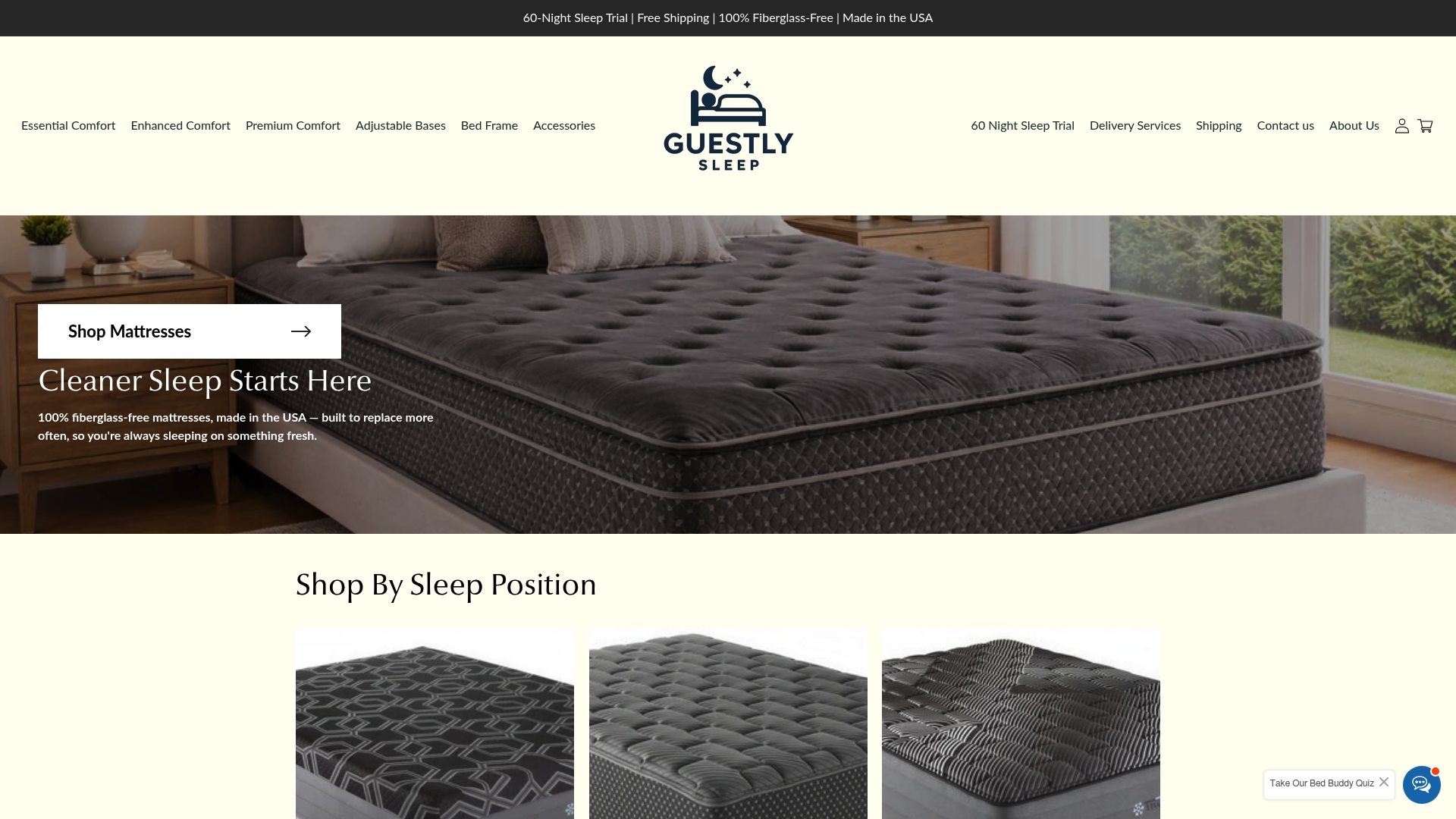
Guestly Sleep sells fiberglass-free mattresses made in the United States, using certified foam and materials that comply with US flammability and labeling requirements. Every product is free from fiberglass and undisclosed fillers, which eliminates the chemical exposure risk that plagues many imported options. Guestly Sleep offers free shipping, a 60-night sleep trial, and collections organized by sleep position and comfort level, from Essential Comfort to Premium Comfort. For consumers who have spent time researching imported mattress concerns, Guestly Sleep represents a straightforward path to verified, domestic quality.
FAQ
Why do imported mattresses fail fire safety tests?
Imported mattresses frequently fail fire safety tests because manufacturers skip the costly testing process required by standards like 16 CFR 1633. The National Bed Federation found that over 65% of mattresses from outside the UK and EU are non-compliant with fire safety requirements.
What is ASTM F2933-25 and why does it matter?
ASTM F2933-25 is the updated US safety standard for crib mattresses, effective may 3, 2026. It requires compression and dimensional testing to prevent gaps that cause infant entrapment and suffocation.
Are mattress toppers subject to the same safety rules as mattresses?
No. Federal standards distinguish between mattress types, and toppers face lower flammability requirements than full mattresses. A compliant topper does not compensate for a non-compliant mattress beneath it.
How can I tell if a mattress has been properly tested?
Ask the seller for a flammability test report number tied to the specific model. A compliant mattress has documented test records. If the seller cannot provide them, the product likely has not been tested to federal standards.
What makes domestic mattresses safer than imported ones?
Domestic manufacturers must comply with 16 CFR 1633, 16 CFR 1632, and FTC labeling rules before selling. That legal requirement creates a compliance baseline that most imported mattresses do not meet, as confirmed by CPSC recall actions in 2026.