

Budget Mattress Quality Indicators: 2026 Buyer's Guide
Budget mattress quality indicators are measurable features such as foam certifications, material density, and warranty sag thresholds that confirm a mattress is safe, non-toxic, and built to last without overspending. The industry term for this evaluation process is mattress construction assessment, but most shoppers know it as reading the specs before you buy. Sources like Sleep Foundation, Mattress Nut, and Made Safe have tested hundreds of affordable mattresses and consistently found that certifications like CertiPUR-US, foam density ratings, and warranty terms separate genuinely durable beds from cheap imitations. This guide gives you the exact benchmarks to use.
1. what certifications signal a safe, non-toxic budget mattress?
Third-party certifications are the fastest way to verify chemical safety in a budget mattress. They remove the guesswork from marketing claims and give you a documented standard to hold manufacturers to.
CertiPUR-US certification confirms that polyurethane foam is free of formaldehyde, phthalates, heavy metals, PBDE flame retardants, and ozone depleters. That list matters because these chemicals are linked to respiratory irritation and long-term health concerns, especially in enclosed sleeping environments.

The Made Safe program goes further on flame retardants specifically. Chemical flame retardants can migrate from mattress foam into household dust, raising daily exposure risks for everyone in the room. Made Safe recommends choosing mattresses made with latex or synthetic fire barriers instead of chemically treated polyurethane foam.
Key certifications to look for when comparing budget options:
- CertiPUR-US: Covers polyurethane foam chemical emissions and safety
- Made Safe: Broader program covering flame retardants and toxic substance avoidance
- OEKO-TEX Standard 100: Covers fabric and textile chemical safety
- Fiberglass-free labeling: Confirms no loose glass fiber fire barrier that can escape the cover
Pro Tip: Product tags rarely disclose flame retardant chemicals. Ask the manufacturer directly whether their fire barrier uses chemical retardants or a physical barrier like wool or a woven synthetic sock.
Avoid relying solely on product tags to check for flame retardant presence. Fire barriers made from synthetic fabrics without chemical retardants are the safer alternative, and reputable brands will confirm this in writing.
2. how to evaluate foam density and durability on a budget
Foam density is the single most reliable indicator of how long a budget mattress will hold its shape. It is measured in pounds per cubic foot (PCF), and the number tells you how much material is packed into each layer.
For memory foam comfort layers, look for a density of 3.5–5 PCF. Support core foam should hit at least 1.8 PCF. Anything below these thresholds compresses faster, sags sooner, and loses support within the first year of regular use.
Many cheap mattresses cut corners with lower-density foams and thinner comfort padding, causing more rapid sag and loss of support. That tradeoff is invisible at the point of purchase but becomes obvious within 12–18 months.
Durability and material quality, more than price, are the strongest drivers of long-term mattress value in the budget category. Sleep Foundation filtered hundreds of cheap mattresses down to 40 finalists using durability and material construction as the core criteria. That process confirms density specs are worth your attention.
3. coil specs that matter in budget hybrid mattresses
Hybrid mattresses combine foam comfort layers with a coil support system. The coil system determines how well the mattress supports your body, transfers motion, and holds up over time.
Higher coil count and lower coil gauge improve support and durability in hybrid mattresses even at budget price points. For a queen-size bed, 600 or more coils is a reasonable baseline. Coil gauge refers to wire thickness; a lower gauge number means thicker wire and firmer, more durable support.
Coil type matters as much as count. Pocketed coils wrap each spring individually, which reduces motion transfer significantly compared to Bonnell coils, where springs are connected. For couples or light sleepers, pocketed coils are worth prioritizing even in a budget hybrid.
| Coil Feature | Budget Minimum | Better Standard |
|---|---|---|
| Coil count (queen) | 600 | 800+ |
| Coil gauge | 15 gauge | 13–14 gauge |
| Coil type | Bonnell | Pocketed |
| Foam base under coils | 1 inch | 1.5–2 inches |
Evaluating coil system type and gauge alongside dense supportive foam layers underneath is the right approach, rather than coil count alone. A mattress with 1,000 thin Bonnell coils will underperform a well-built 800-coil pocketed hybrid every time.
Pro Tip: Zoned coil systems, where the center third of the mattress uses firmer coils for lumbar support, are rare under $600 but worth the premium if back pain is a concern.
4. why warranty sag thresholds are a quality signal
A mattress warranty is not just legal protection. It is a direct signal of how much confidence the manufacturer has in their own product. The specific number to focus on is the sag threshold.
The warranty sag threshold typically requires a 1–1.5 inch measurable body impression before a claim is valid. Impressions below that threshold are not covered, even if they are affecting your sleep quality. That gap between “noticeable sag” and “covered sag” is where most budget mattress complaints live.
A 0.75-inch sag threshold versus a 1.5-inch threshold can be the difference between a successful warranty claim and sleeping on a compromised mattress for years. Use the threshold as a risk gauge, not just fine print.
A more lenient sag threshold, such as 0.75 inches, provides better protection and reflects higher product quality standards. Manufacturers who set a tighter threshold are betting their mattress will not sag that fast.
How to measure sag accurately at home:
- Remove all bedding and place a rigid straightedge across the mattress surface
- Use a ruler to measure the gap between the straightedge and the lowest point of the impression
- Measure in multiple spots, including where you sleep most often
- Document with photos and measurements before contacting the manufacturer
Prorated warranties reduce the brand’s replacement cost over time, meaning you pay more as the mattress ages. Non-prorated warranties cover full replacement regardless of age. Non-prorated coverage is the stronger protection and a better indicator of manufacturer confidence.
5. budget mattress comparison: foam vs. hybrid under $1,000
Choosing between foam and hybrid comes down to your sleep priorities and which quality features matter most to you. Both types can deliver real value under $1,000 if you know what to check.
| Feature | All-Foam | Hybrid |
|---|---|---|
| Motion isolation | Excellent | Good (pocketed coils) |
| Edge support | Weaker | Stronger |
| Cooling | Depends on foam type | Better airflow through coils |
| Durability indicator | Foam density (PCF) | Coil gauge + foam density |
| Typical price range | $300–$700 | $500–$1,000 |
| Best for | Solo sleepers, side sleepers | Couples, back/stomach sleepers |
Trial periods and return policies act as indirect indicators of mattress quality and manufacturer confidence. Longer trial periods suggest the brand expects consistent comfort over time. A 60-night or longer trial is a meaningful signal that the brand stands behind its product.
Focusing on one or two specific mattress features like cooling or edge support can help you avoid premium markups on features you do not need. A solo side sleeper does not need edge support. A hot sleeper does not need extra motion isolation. Match the features to your actual sleep habits.
The affordable mattress features checklist from Guestlysleep breaks this down further for shoppers who want a structured comparison before buying.
6. tradeoffs budget shoppers face and how to manage them
Every budget mattress involves tradeoffs. The goal is not to avoid them but to choose the ones that matter least to you.
The most common tradeoffs in affordable mattresses:
- Durability vs. immediate comfort: Softer comfort layers feel great on day one but compress faster. A medium-firm feel with quality foam density lasts longer.
- Chemical safety vs. cost: Certified foams cost more to produce. Brands that absorb that cost and still price competitively are worth the attention.
- Cooling features vs. price: Gel-infused foam and copper-infused covers add cost. If you do not sleep hot, skip them.
- Motion isolation vs. support: All-foam beds isolate motion well but can lack edge support. Hybrids offer better support but transfer slightly more movement.
Pro Tip: Always check whether the mattress cover is removable and washable. A non-removable cover that hides a fiberglass fire barrier is one of the most common hidden risks in budget mattresses. If the cover says “do not remove,” ask why before you buy.
Avoiding polyurethane foam or verifying certifications reduces exposure to chemical flame retardants that migrate into household dust. That single step costs nothing and protects your household from a risk most shoppers never think to check.
You can read more about how to balance these tradeoffs in Guestlysleep’s dedicated guide for budget shoppers.
Key takeaways
Reliable budget mattress quality indicators come down to three things: certified materials, measurable construction specs, and warranty terms that reflect real manufacturer confidence.
| Point | Details |
|---|---|
| Prioritize certifications first | CertiPUR-US and fiberglass-free labeling confirm chemical safety before anything else. |
| Check foam density numbers | Memory foam comfort layers need at least 3.5 PCF; support cores need at least 1.8 PCF. |
| Read the warranty sag threshold | A 0.75-inch threshold offers better protection than the standard 1.5-inch industry default. |
| Match coil specs to your needs | Pocketed coils with 600+ count and lower gauge wire outperform coil count alone in hybrids. |
| Use trial periods as a quality signal | A 60-night or longer trial shows the brand expects its mattress to perform consistently. |
What i’ve learned after years of evaluating budget mattresses
Most budget shoppers walk into a mattress decision focused on price and feel. That is the wrong order. Feel changes within weeks as foam breaks in. Price tells you nothing about what is inside the mattress. The specs are what matter, and most brands bury them.
The biggest misconception I see is that a higher price automatically means better quality in the budget tier. A $700 mattress with vague foam specs and a 1.5-inch sag threshold is a worse buy than a $450 mattress with published density numbers, CertiPUR-US certification, and a 0.75-inch warranty threshold. The numbers tell the real story.
Chemical safety is the indicator I see shoppers skip most often. Fiberglass fire barriers and chemical flame retardants are not visible, not labeled clearly, and not discussed in most buying guides. But they are present in a surprising number of budget mattresses. Asking one direct question to the manufacturer about their fire barrier material takes 30 seconds and can save you from a serious problem.
My honest advice: pick three indicators and evaluate every mattress against them before you look at the price. Use foam density, warranty sag threshold, and certification status. If a mattress clears all three, the price is worth discussing. If it fails one, move on regardless of the deal.
The mattress materials health comparison guide from Guestlysleep is the resource I point people to when they want to go deeper on material safety without getting lost in industry jargon.
Find a certified, fiberglass-free mattress at Guestlysleep
If you have worked through these quality indicators and want a mattress that already clears every benchmark, Guestlysleep has done the filtering for you. Every mattress in their catalog is fiberglass-free and certified, made in the United States with materials that meet the chemical safety standards covered in this guide.
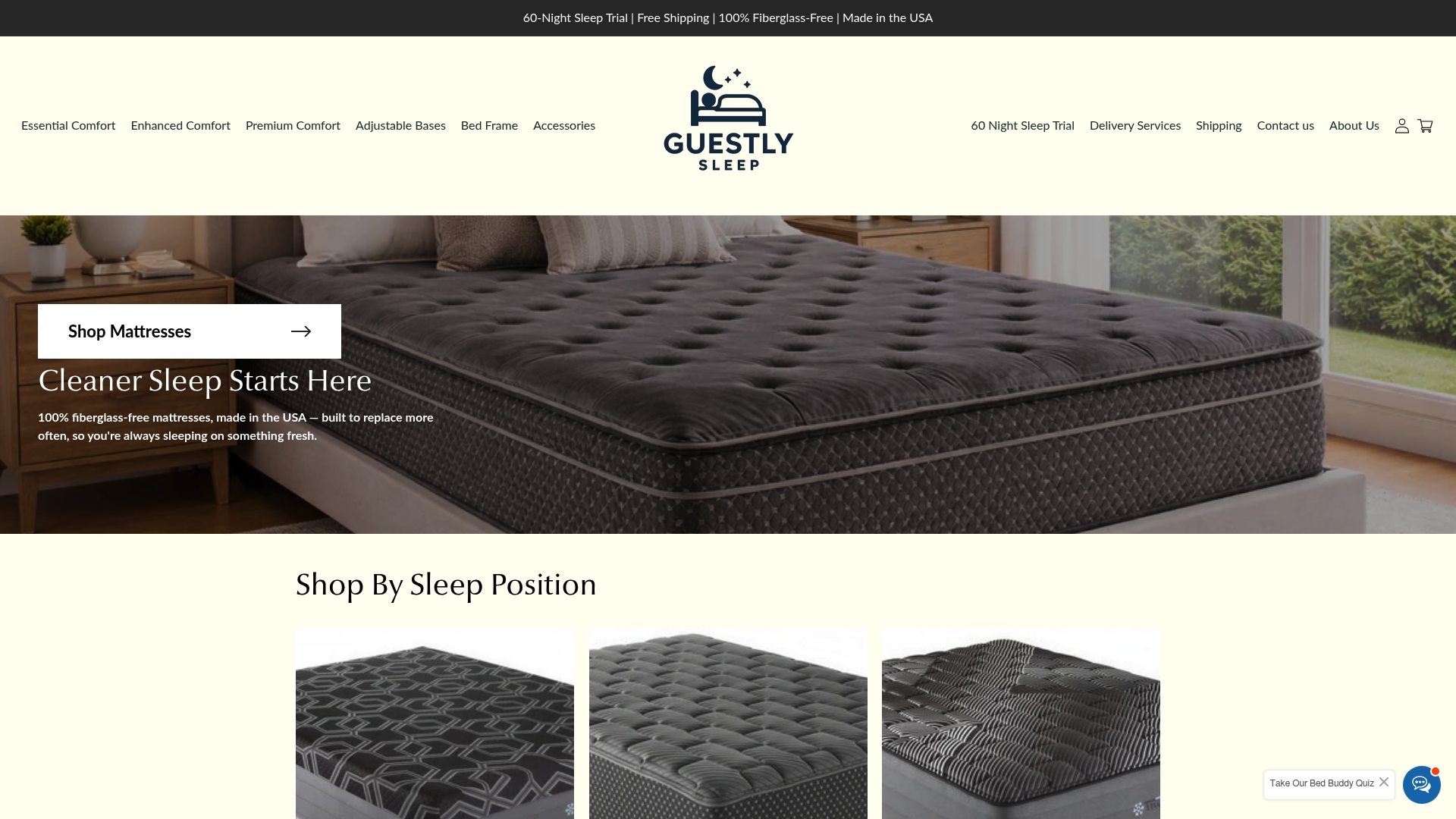
Their mattress comparison chart puts hybrid and memory foam options side by side so you can evaluate coil specs, foam density, and warranty terms in one place. Guestlysleep also offers a 60-night sleep trial and free shipping, which means the trial period quality signal is built into every purchase. Browse their full mattress collection to find a certified, affordable option matched to your sleep position and comfort preference.
FAQ
What is CertiPUR-US and why does it matter?
CertiPUR-US certifies that polyurethane foam is free of formaldehyde, phthalates, heavy metals, and PBDE flame retardants. It is the most widely recognized chemical safety standard for mattress foam in the United States.
What foam density should a budget mattress have?
Memory foam comfort layers should be at least 3.5 PCF, and support cores should reach at least 1.8 PCF. Foam below these thresholds compresses faster and loses support within the first year of use.
How do i check for fiberglass in a budget mattress?
Look for an explicit “fiberglass-free” label or ask the manufacturer directly about their fire barrier material. A cover that says “do not remove” is a common sign that a fiberglass barrier is present underneath.
What warranty sag threshold should i look for?
A sag threshold of 0.75 inches offers stronger protection than the standard 1–1.5 inch threshold. The lower the threshold, the sooner you can file a valid warranty claim if the mattress begins to sag.
Are trial periods a reliable quality indicator?
Yes. A 60-night or longer trial period signals that the brand expects consistent comfort and durability over time. Short or nonexistent trials often indicate lower manufacturer confidence in the product.