

US Mattress Manufacturing Standards: What You Need to Know
U.S. mattress manufacturing standards are legally mandated safety requirements combined with voluntary certification programs that together govern flammability, material safety, and sustainability in every mattress sold in America. The Consumer Product Safety Commission (CPSC) enforces federal flammability rules under 16 CFR Parts 1632 and 1633, while voluntary programs like CertiPUR-US, GOTS, and OEKO-TEX STANDARD 100 address chemical content and environmental criteria. For consumers and industry professionals alike, understanding what are U.S. mattress manufacturing standards means recognizing that no single certification covers an entire mattress. These standards operate in layers, each targeting a specific material, process, or product stage.
What are the mandatory federal mattress safety regulations in the U.S.?
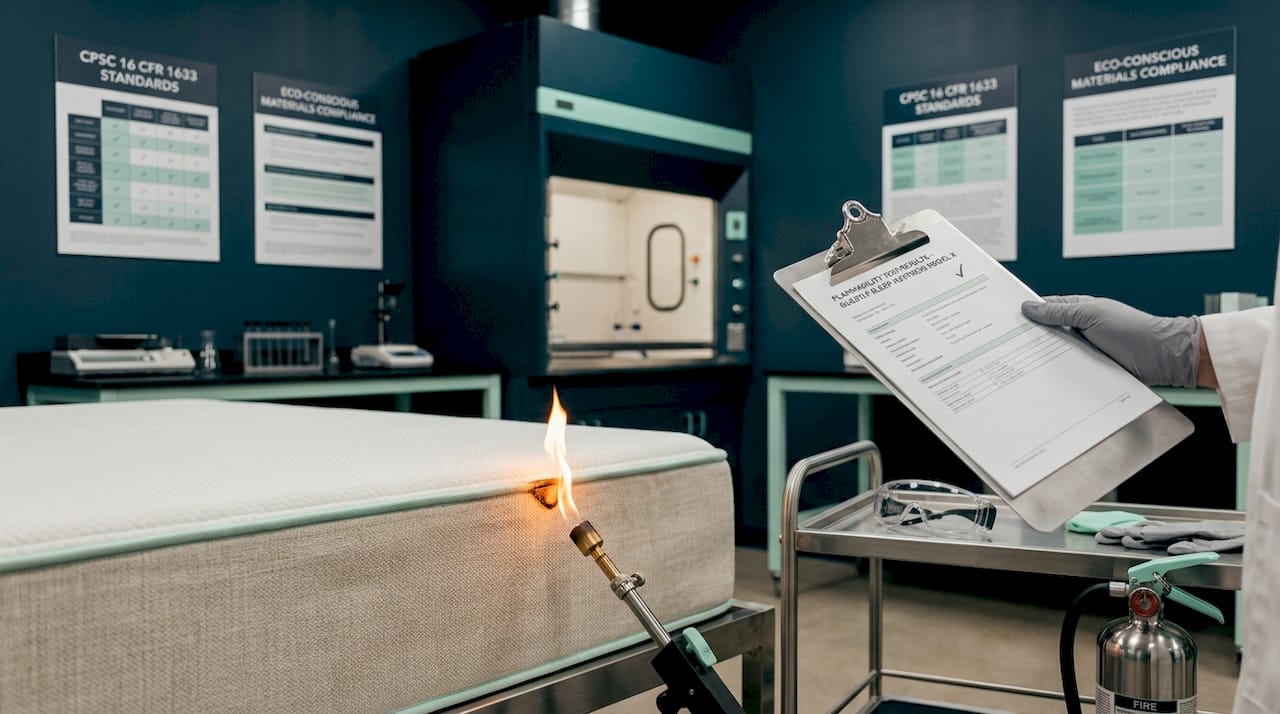
Every mattress sold in the United States must comply with two federal flammability standards enforced by the CPSC: 16 CFR Part 1632 and 16 CFR Part 1633. Part 1632 is the cigarette ignition standard, requiring mattresses to resist smoldering when a lit cigarette is placed on the surface. Part 1633 is the open flame standard, which is significantly more stringent and uses T-shaped burners to simulate burning bedclothes. Part 1633 drove widespread material reformulations across the industry starting in 2007, pushing manufacturers to rethink their fire barrier strategies from the ground up.
How manufacturers meet the open flame test
Manufacturers have two primary paths to pass Part 1633. The first is using flame-resistant barrier fabrics made from inherently fire-resistant fibers. The second is treating foam with FR chemicals. Consumer preference is shifting toward barrier layers over FR-treated foam due to growing concerns about chemical exposure. Barrier materials include silica, modacrylic blends, and natural wool, with wool being the preferred option in the organic segment. Fiberglass is also used as a barrier fiber, which is why many health-conscious buyers now specifically seek fiberglass-free mattresses.
Compliance requirements beyond testing
Passing the flammability test is not enough on its own. Manufacturers must test a prototype of each mattress model, maintain records for at least three years, and attach a mandatory law label to every unit. That law label is the small tag you are legally prohibited from removing before purchase. It identifies the materials inside and confirms the product meets federal standards. Special product categories carry additional requirements: futons, mattress pads, and crib mattresses each fall under distinct regulatory frameworks.
California adds another layer with Technical Bulletin 603, which parallels federal open-flame standards but applies to a broader range of sleep products and includes state-specific documentation requirements. For manufacturers distributing nationally, this creates overlapping compliance obligations that require careful tracking.
- 16 CFR Part 1632: Cigarette smolder resistance test; applies to all mattresses and mattress pads
- 16 CFR Part 1633: Open flame test using T-shaped burners; more stringent; effective since 2007
- Law label requirement: Mandatory on every unit; identifies fill materials and confirms compliance
- Record keeping: Prototype test records must be retained for a minimum of three years
- California TB 603: State-level standard with broader product scope and additional documentation
Pro Tip: If you are a manufacturer distributing in California, build your compliance documentation to meet TB 603 from the start. Retrofitting documentation after the fact costs significantly more time and money than building it into your quality system upfront.
Which voluntary certifications complement U.S. manufacturing standards?
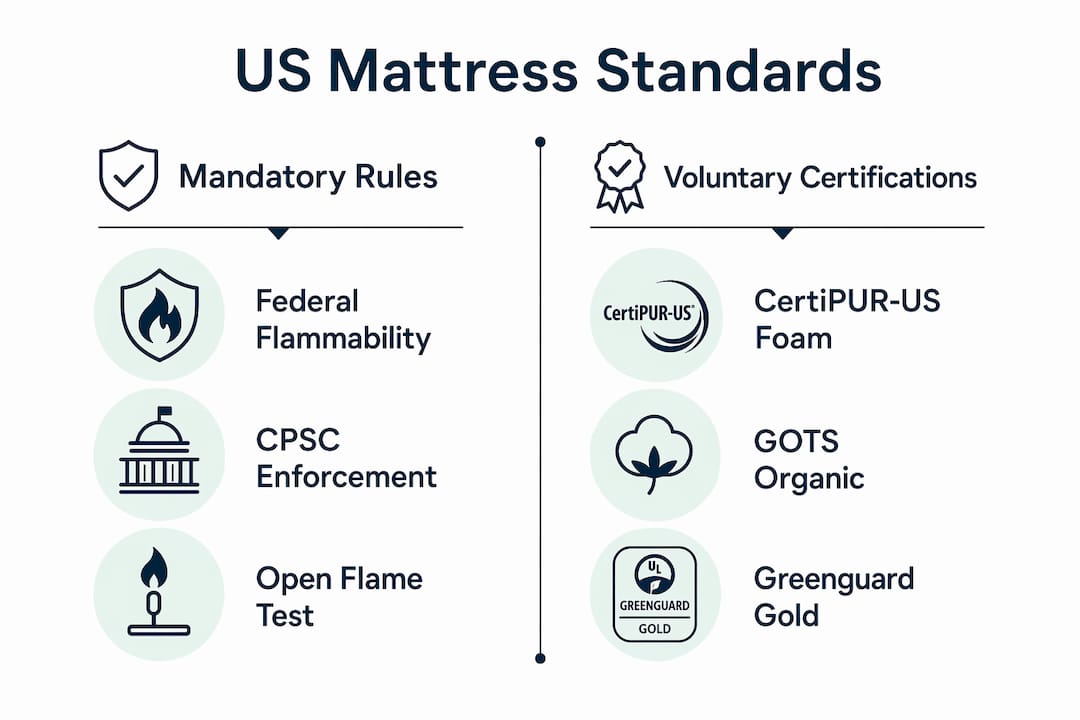
Voluntary certifications address what federal law does not: chemical content, VOC emissions, organic material sourcing, and finished product residue levels. These programs are not required by law, but they carry real market weight and provide consumers with a layer of transparency that mandatory standards alone cannot deliver. The critical insight here is that certifications target distinct supply-chain layers, meaning a mattress with multiple certification logos has separate approvals for separate components, not one unified stamp of approval for the whole product.
CertiPUR-US: the foam standard
CertiPUR-US is the most recognized voluntary certification in the U.S. mattress industry. It applies exclusively to polyurethane foam and sets a VOC emissions limit of 0.5 ppm, with annual re-testing and triennial on-site audits. The program tests for prohibited substances including ozone depleters, PBDE flame retardants, and heavy metals like lead and mercury. Annual lab testing combined with three-year audits means certification is not a one-time event. It is an ongoing compliance obligation that must be built into a manufacturer’s quality calendar.
GOTS, GOLS, and textile certifications
GOTS (Global Organic Textile Standard) governs the organic fiber content and processing of mattress covers and textile components. Grade 1 GOTS labels require at least 95% certified organic fibers, while Grade 2 labels require 70% organic fiber content. GOTS also restricts harmful chemical inputs throughout the finishing process, covering everything from fiber to finished fabric. GOLS (Global Organic Latex Standard) applies the same logic to latex processing, certifying that the latex used in a mattress meets organic sourcing and processing criteria.
OEKO-TEX STANDARD 100 and Greenguard Gold operate at the finished product level, testing for harmful substance limits and chemical emissions across the complete item. Greenguard Gold is particularly relevant for products used in sensitive environments like children’s bedrooms and healthcare settings.
| Certification | Scope | Key criteria |
|---|---|---|
| CertiPUR-US | Polyurethane foam only | VOC limit 0.5 ppm; no PBDE, heavy metals, ozone depleters |
| GOTS | Organic textiles and covers | 95% organic fiber (Grade 1); chemical processing restrictions |
| GOLS | Organic latex | Organic sourcing and processing of latex components |
| OEKO-TEX STANDARD 100 | Finished product or components | Harmful substance limits across full product |
| Greenguard Gold | Finished product emissions | Strict chemical emission thresholds; suited for sensitive environments |
How do crib mattress standards differ from general mattress standards?
Crib mattresses are subject to a separate and more stringent mandatory standard than adult mattresses. The CPSC’s updated rule under 16 CFR Part 1241 incorporates ASTM F2933-25, the most current version of the crib mattress safety specification, with specific modifications that go beyond what general mattress regulations require. This updated standard became effective May 3, 2026, and reflects the CPSC’s recognition that infant sleep environments carry unique hazards that standard flammability testing does not address.
The key safety criteria under ASTM F2933-25 include:
- Mattress dimensions: Precise size requirements to prevent dangerous gaps between the mattress edge and crib frame
- Corner gap limits: Specific maximum gap measurements to reduce entrapment risk for infants
- Play yard compatibility: Testing procedures that confirm safe fit in non-full-size cribs and play yards
- Stability requirements: Standards that prevent mattress shifting or deformation under infant weight and movement
- Labeling requirements: Mandatory labels that identify compliance with the updated standard and provide safe sleep guidance
The distinction between crib and adult mattress standards matters for manufacturers who produce both product types. A compliance program built for adult mattresses does not transfer to crib mattresses. Separate prototype testing, separate record keeping, and separate label language are all required. For consumers, the practical takeaway is straightforward: always verify that a crib mattress explicitly states compliance with 16 CFR Part 1241 and ASTM F2933-25, not just general flammability standards.
What sustainability requirements shape U.S. mattress production today?
Sustainability in U.S. mattress manufacturing is driven by a combination of state-level regulation, voluntary certification, and consumer demand rather than a single federal environmental standard. The result is a fragmented but increasingly consequential set of sustainability pressures on manufacturers, including higher production costs, complex compliance tracking, and growing expectations for material transparency.
Mattress disposal is one of the most pressing environmental challenges in the industry. A standard mattress contains steel, foam, fiber, and fabric that are difficult to separate and recycle. Several states have enacted extended producer responsibility (EPR) laws that require manufacturers and retailers to fund and participate in mattress recycling programs. California, Connecticut, and Rhode Island operate the most established programs, with other states moving toward similar frameworks.
On the materials side, manufacturers pursuing sustainability credentials are incorporating:
- Organic cotton and wool: Used in covers and fire barriers; eligible for GOTS certification
- Organic latex: Sourced and processed under GOLS certification criteria
- Recycled steel: Used in innerspring and hybrid coil systems to reduce raw material demand
- Low-VOC adhesives: Reduce chemical off-gassing during and after production
- Fiberglass-free fire barriers: Replace silica-based barriers with wool or modacrylic alternatives
CertiPUR-US and GOTS both support sustainability claims, but they address chemical safety and organic sourcing respectively, not carbon footprint or end-of-life recyclability. Manufacturers who want to make credible environmental claims need to address all three dimensions: material sourcing, chemical safety, and disposal. Consumers can support responsible production by choosing brands that disclose their certification scope, use recyclable or organic materials, and partner with mattress disposal services that divert products from landfills.
Key takeaways
U.S. mattress manufacturing standards combine mandatory federal flammability rules with voluntary material certifications, and no single certification covers an entire mattress.
| Point | Details |
|---|---|
| Federal flammability is mandatory | All mattresses must pass 16 CFR Parts 1632 and 1633 before sale in the U.S. |
| Certifications are component-specific | CertiPUR-US covers foam only; GOTS covers textiles only; no unified whole-mattress certification exists. |
| Crib mattresses have stricter rules | ASTM F2933-25 under 16 CFR Part 1241 sets dimension, gap, and stability criteria beyond adult standards. |
| Sustainability is state-driven | EPR recycling laws in California, Connecticut, and Rhode Island lead national sustainability compliance. |
| Compliance is ongoing | CertiPUR-US requires annual lab testing and triennial audits, not one-time approval. |
Why the certification gap is the most misunderstood part of mattress safety
The single most common misconception I encounter, from both consumers and industry professionals, is treating CertiPUR-US as a whole-mattress safety certification. It is not. CertiPUR-US applies only to polyurethane foam and says nothing about the cover fabric, adhesives, fire barrier, or any other component. A mattress can carry a CertiPUR-US logo and still contain fiberglass in its fire barrier layer. That is not a loophole. It is a direct consequence of how the certification system is structured.
What I find more troubling is how this gap plays out in marketing. Brands routinely describe their mattresses as “certified safe” based on foam certification alone. That framing is not technically false, but it is incomplete in a way that matters to anyone with chemical sensitivities or young children. The multi-dimensional nature of mattress certifications means that a genuinely transparent brand will tell you exactly which component each certification covers, not just list logos on a product page.
For industry professionals building compliance programs, the practical implication is that certification retesting schedules must be tracked separately for each certified component. Annual foam testing, triennial audits, GOTS renewal cycles, and flammability prototype records all run on different timelines. Treating any of these as a one-time approval is how compliance lapses happen. Build these schedules into your quality management system from day one, not as an afterthought when a renewal notice arrives.
Sleep better knowing your mattress meets the standard
If you want a mattress that goes beyond the minimum federal requirements, Guestlysleep builds every mattress in the United States using fiberglass-free materials and certified components. The 14" Lux Hybrid Firm is a strong example: no fiberglass fire barrier, no harmful fillers, and construction designed to meet or exceed U.S. mattress quality standards. Guestlysleep also offers a mattress haul away service for responsible disposal that keeps your old mattress out of a landfill. Browse the full fiberglass-free mattress collection with free shipping and a 60-night sleep trial.
FAQ
What federal agency regulates mattress safety in the U.S.?
The Consumer Product Safety Commission (CPSC) enforces federal mattress flammability standards under 16 CFR Parts 1632 and 1633, which apply to all mattresses sold in the United States.
Is CertiPUR-US certification required by law?
CertiPUR-US is a voluntary certification, not a legal requirement. It applies only to polyurethane foam and does not certify the safety of the entire mattress or its non-foam components.
What makes crib mattress standards stricter than adult mattress standards?
Crib mattresses must comply with 16 CFR Part 1241, which incorporates ASTM F2933-25 and includes specific corner gap limits, size requirements, and play yard compatibility testing that adult mattress standards do not address.
How do I know if a mattress meets U.S. manufacturing standards?
Every legally sold mattress must carry a law label confirming compliance with federal flammability standards. For additional material safety, look for component-level certifications like CertiPUR-US for foam or GOTS for organic textile covers.