

Affordable Mattress Features Checklist for Budget Buyers
An affordable mattress features checklist is a structured evaluation tool that helps budget-conscious shoppers match verified performance criteria to their sleep needs without overspending. The NCOA’s mattress evaluations show that quality picks range from $64 to over $2,000 for a queen, proving that price alone tells you nothing about value. What separates a smart purchase from buyer’s remorse is knowing exactly which features to verify before you commit. This guide walks you through every checkpoint, from sleep position to warranty fine print, so you shop with confidence instead of guesswork.
1. Start with your sleep profile
Sleep position is the first filter in any mattress buying guide, and skipping it wastes time comparing features that may never matter to you. The National Mattress Authority recommends sequential decision-making: identify your sleep profile first, then evaluate materials and construction.
Here is how position maps to features:
- Side sleepers need pressure relief at the shoulder and hip. A medium to medium-soft firmness with a thick comfort layer (3 inches or more) prevents joint pain.
- Back sleepers need lumbar support and a flatter surface. Medium-firm options work best for maintaining spinal alignment without sinking.
- Stomach sleepers need a firmer surface to prevent the hips from dropping and straining the lower back. Soft mattresses are a poor fit for this position.
- Combination sleepers need responsive materials that allow easy repositioning. Latex or hybrid constructions outperform dense memory foam here.
Pain and discomfort modify these priorities. If you have shoulder pain, pressure relief outranks firmness. If you have lower back pain, lumbar zoning or targeted support layers become a non-negotiable feature to check.
Pro Tip: If you share a bed, both partners should identify their sleep positions and find the overlap. A medium-firm hybrid often satisfies the widest range of needs without compromise.

2. Understand mattress types and their budget trade-offs
The three mattress types you will realistically find at affordable price points are foam, innerspring, and hybrid. Each has a different performance profile.
Foam mattresses offer the best motion isolation at low price points. Foam beds outperform innersprings on motion isolation, which matters if a partner’s movement wakes you. The trade-off is heat retention, which is a real concern for warm sleepers.
Innerspring mattresses are the most widely available budget option. They sleep cooler than foam and offer strong edge support, but they transfer motion more easily and wear faster at lower coil counts.
Hybrid mattresses combine a coil support core with foam or latex comfort layers. They cost more than basic innersprings but deliver better pressure relief and durability. For most budget shoppers, a hybrid in the $400 to $700 range for a queen represents the strongest value.
| Mattress type | Motion isolation | Cooling | Durability at budget price |
|---|---|---|---|
| Foam | Excellent | Below average | Moderate |
| Innerspring | Poor | Excellent | Moderate |
| Hybrid | Good | Good | Strong |
Use this comparison as a starting filter, not a final verdict. Your sleep position and comfort needs should confirm which type fits your profile.
3. Evaluate construction quality, not just price
The specs that predict durability in affordable mattresses are foam density and coil gauge. Higher foam densities and lower coil gauges strongly correlate with long-term performance, making these the objective metrics to check instead of relying on marketing language.
For foam, look for a density of at least 1.8 pounds per cubic foot in the support core. Comfort layer foam should be 3 to 5 pounds per cubic foot for meaningful durability. For innerspring and hybrid mattresses, coil gauge runs from 12 (thicker, firmer, more durable) to 18 (thinner, softer, less durable). A coil gauge between 13 and 15 is a reasonable target for budget hybrids.
Comfort layer thickness also matters. A 2-inch comfort layer on a budget foam mattress will compress faster than a 3-inch layer on a comparable model. Ask for the spec sheet or check the product page before purchasing.
Cooling features are worth checking if you sleep hot. Gel-infused foam, open-cell foam construction, and breathable cover fabrics all reduce heat buildup. These are not luxury add-ons. They are construction choices that affect sleep quality directly.
4. Verify certifications before you buy
CertiPUR-US certification confirms that polyurethane foam meets VOC emission standards at or below 0.5 parts per million and excludes specific harmful substances. For budget shoppers, this is the minimum certification to require on any foam-containing mattress.
The critical detail most shoppers miss: certification scope varies. A CertiPUR-US label on a hybrid mattress may apply only to the foam layers, not the fabric cover or fire barrier. GOTS (Global Organic Textile Standard) covers organic textiles separately. You need to verify what each certification actually covers on the specific product you are evaluating.
To verify, look up the brand directly on the CertiPUR-US database at certipur.us. A legitimate certification will list the manufacturer and the specific foam formulations covered. If a brand claims certification but does not appear in the database, treat that as a red flag.
Pro Tip: Fiberglass is a common fire barrier material in budget mattresses. It is not covered by CertiPUR-US. Ask manufacturers directly whether their fire barrier is fiberglass-free, or look for brands that disclose this on their product pages. Guestlysleep, for example, builds this disclosure into every product listing.
For a deeper look at US mattress manufacturing standards, including what certifications actually protect you from, that resource breaks down the regulatory landscape clearly.
5. Test comfort and alignment before committing
Consumer Reports recommends spending 10 minutes testing a mattress in-store using a pillow to check spinal alignment in your actual sleep position. Testing with a pillow is more predictive of real sleep comfort than an immediate firmness impression because it replicates your actual sleeping posture.
Here is a practical in-store or home trial testing sequence:
- Lie in your primary sleep position with your pillow for at least 5 to 10 minutes.
- Check whether your spine feels neutral. Your ear, shoulder, and hip should form a straight line on your side, or your lower back should feel supported without arching when on your back.
- Roll to your secondary sleep position and repeat the alignment check.
- Sit on the edge of the mattress and stand up. Strong edge support means the perimeter does not collapse under your weight.
- Ask a partner to move on the other side of the mattress while you lie still. Noticeable movement signals poor motion isolation.
For home trials, Consumer Reports’ 30,000-roll durability test simulates 8 to 10 years of use with a weighted roller. You cannot replicate that at home, but you can assess early compression signals after 30 to 60 nights. This is exactly why a generous sleep trial matters.
6. Read the warranty terms with precision
Most mattress warranties cover visible permanent body impressions only when they exceed 1 to 1.5 inches measured without weight on the mattress. Smaller sags are classified as normal wear and excluded from coverage. This threshold is the single most misunderstood term in mattress warranties.
Key warranty terms to check before purchase:
- Sag threshold: Confirm the exact measurement required to qualify a claim. Lower thresholds (1 inch) offer better protection than higher ones (1.5 inches).
- Prorated vs. non-prorated: Non-prorated warranties cover full replacement or repair for the entire warranty period. Prorated warranties reduce coverage over time, often leaving you paying most of the replacement cost after year five.
- Foundation compatibility: Warranty exclusions commonly include use on non-approved foundations. A box spring that the manufacturer does not approve can void your warranty even if the mattress is defective.
- Stain exclusions: Any stain, regardless of cause, typically voids coverage. Use a mattress protector from day one.
Document your mattress condition with photographs at purchase and periodically thereafter. If you ever need to file a claim, documented sag evidence under specified conditions is required to qualify.
7. Correct the most common affordable mattress misconceptions
Budget shoppers carry several persistent myths into the buying process. An informed checklist corrects them before they cost you money.
- Myth: Good mattresses must be expensive. Consumer Reports frames mattress value as a combination of performance and durability, not price. Many mattresses in the $400 to $700 range for a queen outperform models costing twice as much on durability and pressure relief tests.
- Myth: All certifications guarantee full product safety. As noted above, certification scope is limited. A CertiPUR-US label does not certify the entire mattress, only the foam components it covers.
- Myth: Firmness labels are consistent across brands. A “medium-firm” from one manufacturer may feel like a “firm” from another. Always test or use a sleep trial rather than relying on label language.
- Myth: Warranties cover comfort dissatisfaction. Warranties cover manufacturing defects and significant sagging. They do not cover a change in your comfort preference or normal softening over time.
“The checklist is not about finding the cheapest mattress. It is about finding the mattress that delivers the most sleep quality per dollar spent.” This reframe protects budget buyers from both overspending and under-buying.
For a broader look at best budget mattress features and how to match them to your needs in 2026, that guide covers current pricing and model comparisons in detail.
Key takeaways
A mattress buying checklist works because it replaces marketing-driven decisions with verified performance criteria matched to your specific sleep position and health needs.
| Point | Details |
|---|---|
| Sleep position comes first | Identify your primary position before evaluating any material or firmness feature. |
| Verify certification scope | CertiPUR-US covers foam only; confirm what each label actually certifies on the full product. |
| Check foam density and coil gauge | These specs predict durability more reliably than price or brand name. |
| Understand sag thresholds | Warranties require impressions above 1 to 1.5 inches unweighted to qualify for coverage. |
| Use the full sleep trial | Test alignment in your actual sleep position for at least 30 nights before deciding. |
What I have learned from evaluating budget mattresses
I have spent years reviewing mattresses across every price tier, and the pattern I see most often is this: budget shoppers get burned not by buying cheap mattresses, but by buying the wrong mattress at any price. They skip the sleep position step, grab a “medium-firm” because it sounds safe, and then wonder why their back hurts after three months.
The certification piece is where I see the most confusion. Shoppers assume a CertiPUR-US badge means the whole mattress is safe. It does not. I have seen budget mattresses with certified foam sitting on top of a fiberglass fire barrier that sheds particles if the cover is ever removed. That is a real health risk, and no certification label on the foam layer protects you from it.
My honest recommendation: prioritize fiberglass-free construction and verified foam certifications over thread count, pillow tops, or any other surface-level feature. Then match firmness to your sleep position using a real sleep trial, not a five-minute showroom test. A 60-night trial is the minimum I would accept. Anything shorter does not give your body enough time to adapt and give you an honest verdict.
The checklist approach works because it forces you to ask specific questions instead of reacting to marketing. Use it as a filter, not a shopping list. Every feature you verify is one fewer surprise after delivery.
— Justin
How Guestlysleep meets your mattress checklist criteria
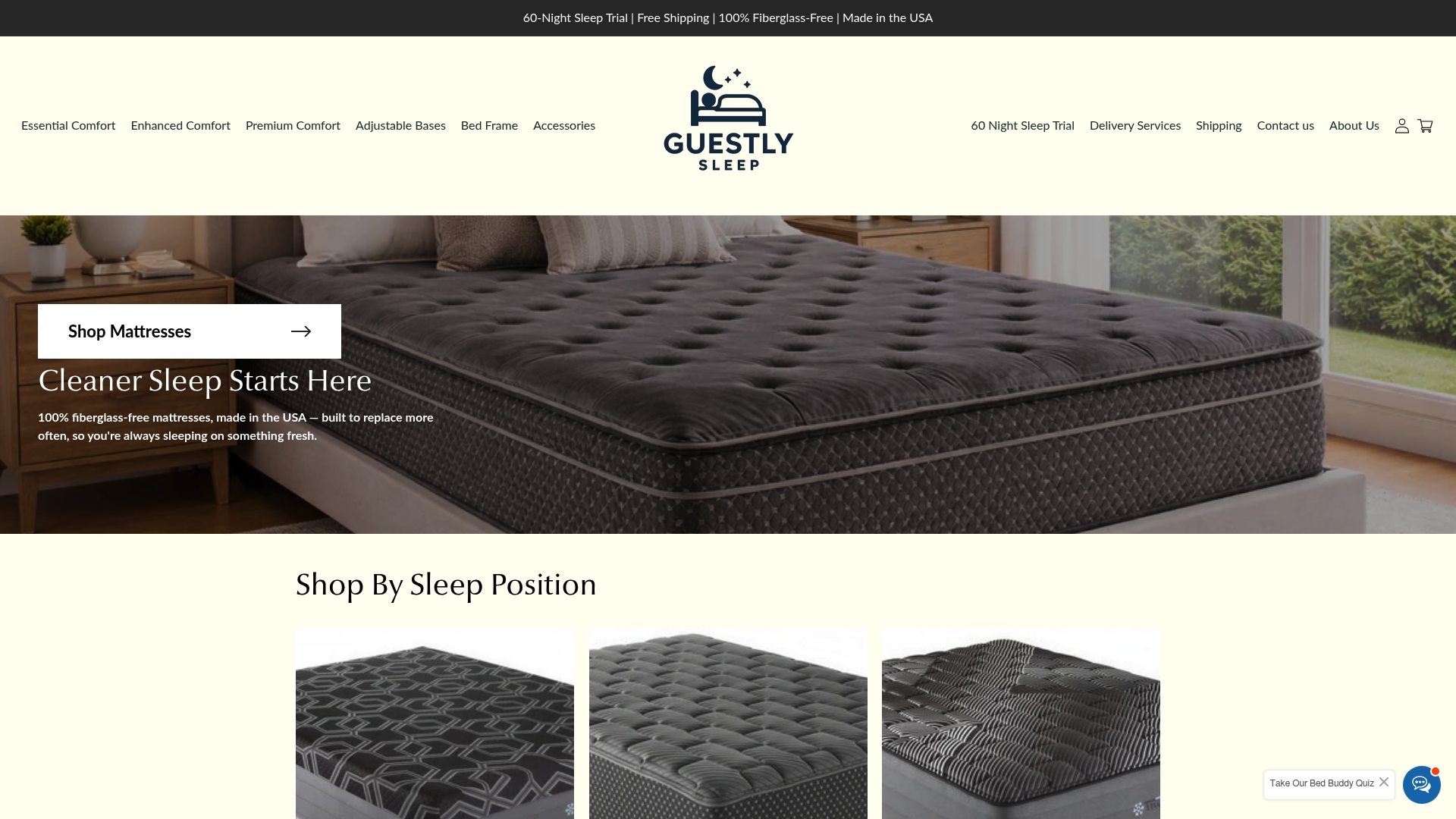
Guestlysleep builds every mattress in the United States using fiberglass-free materials and certified foam components, which means the two most commonly overlooked checklist items are already handled. The product line covers side, back, and stomach sleeper profiles across Essential Comfort, Enhanced Comfort, and Premium Comfort tiers, so you match your sleep position to a specific construction rather than guessing. Every purchase includes free shipping and a 60-night sleep trial, giving you the real-world testing window that a showroom visit cannot replicate. Browse the full fiberglass-free mattress collection or compare constructions side by side with the hybrid vs. memory foam chart to find the right fit for your budget and sleep profile.
FAQ
What is the most important feature on a budget mattress checklist?
Sleep position is the first and most important filter. The National Mattress Authority places sleep position before materials or price in their buying guide because it determines which firmness and support features actually matter for your body.
Does CertiPUR-US certification mean the whole mattress is safe?
No. CertiPUR-US certifies specific polyurethane foam formulations, not the entire mattress. Fire barriers, fabric covers, and other components require separate certifications, so always verify what each label covers on the specific product.
How do I know if a budget mattress will last?
Check foam density (at least 1.8 pounds per cubic foot for support cores) and coil gauge (13 to 15 for hybrids). These construction specs predict durability more accurately than price or brand claims.
What does a mattress warranty actually cover?
Most warranties cover permanent body impressions that exceed 1 to 1.5 inches measured without weight on the mattress. Comfort changes, stains, and use on non-approved foundations are typically excluded from coverage.
How long should a mattress sleep trial be?
A minimum of 60 nights gives your body enough time to adapt and provide an honest comfort assessment. Shorter trials, especially under 30 nights, do not account for the adjustment period most sleepers experience with a new mattress.