

Mattress Materials Health Comparison: 2026 Guide
A mattress materials health comparison evaluates how the physical composition of your mattress affects chemical exposure, sleep quality, and long-term well-being. The materials inside your mattress determine whether you’re sleeping on natural latex, organic cotton, and wool or on petroleum-based memory foam with a fiberglass flame barrier. Federal fire resistance standards under 16 CFR 1633 require all US mattresses to withstand 70 seconds of open-flame exposure, and how manufacturers meet that requirement separates healthy sleep products from potentially harmful ones. Certifications like GOTS, GOLS, GREENGUARD Gold, and CertiPUR-US exist precisely because material choices vary so widely across price points.
1. How natural mattress materials compare for health
Natural latex, organic cotton, and wool represent the gold standard in any organic mattress materials comparison. These materials minimize chemical exposure, support breathability, and carry certifications that verify their safety from fiber to finished product.
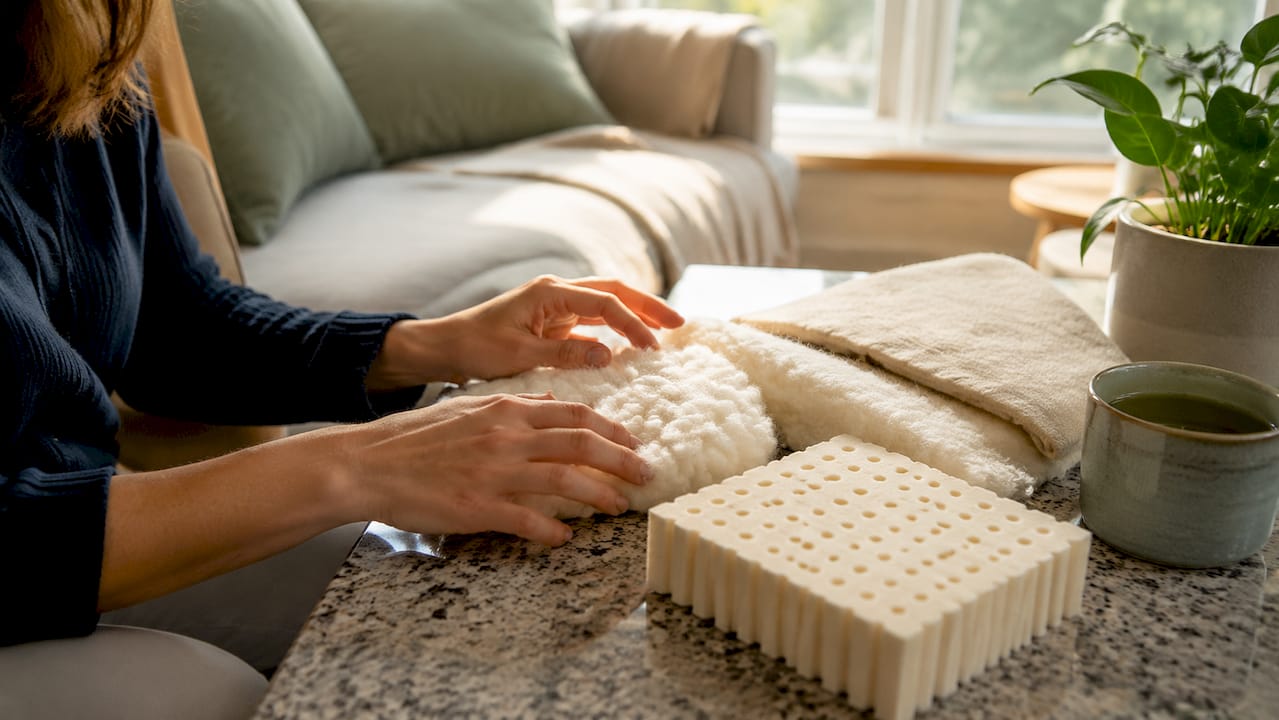
Natural latex is harvested from rubber trees and vulcanized into a resilient foam core. GOLS (Global Organic Latex Standard) certification confirms the latex contains at least 95% certified organic raw material. Latex resists dust mites and mold naturally, making it a strong choice for allergy sufferers. Replacing synthetic foam with natural latex, wool, and organic cotton delivers net positive health benefits by reducing toxic off-gassing, particularly for children and chemically sensitive individuals.
Organic cotton and wool serve dual roles as comfort layers and natural flame barriers. Wool’s natural lanolin content chars rather than burns, meeting federal fire standards without any chemical treatment or fiberglass. GOTS (Global Organic Textile Standard) certification covers the entire supply chain for these fibers, from farming practices through manufacturing. This matters because a mattress labeled “organic cotton cover” without GOTS certification may still use conventionally grown cotton processed with synthetic dyes and finishing agents.
- Natural latex: GOLS-certified, dust mite resistant, 12 to 15 year lifespan
- Organic cotton: GOTS-certified, breathable, chemical-free processing
- Wool: natural flame barrier, moisture-wicking, temperature regulating
- All three: low VOC emissions, no petroleum-based chemicals
Pro Tip: Look for mattresses carrying both GOTS and GOLS certifications simultaneously. A GOTS cover over a non-certified latex core still leaves your primary sleep surface unverified.
2. What synthetic materials like memory foam mean for your health
Memory foam is the most widely sold mattress material in the United States, and it carries real health trade-offs worth understanding before you buy. Most conventional memory foam is petroleum-based and contains polyurethane compounds that off-gas volatile organic compounds (VOCs) when new. The chemical off-gassing from traditional mattresses is a minor concern for healthy adults but rises to a moderate concern for children and people with respiratory sensitivities.
The bigger issue is the flame barrier. Budget mattresses priced $300 to $600 frequently use fiberglass as their fire-resistant layer because it’s inexpensive and effective. Fiberglass is not regulated as a disclosure item, so manufacturers are not required to list it on labels. You must infer its presence from price point and brand transparency. When a mattress cover is removed or damaged, fiberglass particles can escape and cause skin irritation and respiratory problems. One documented case involved a child’s health issues from fiberglass contamination that required disposing of the mattress and surrounding property.
- Memory foam: petroleum-based, off-gasses VOCs, lifespan of 7 to 10 years
- Synthetic latex: less breathable and durable than natural latex
- Fiberglass flame barriers: present in most mattresses under $600, not disclosed on labels
- CertiPUR-US foam: certified for low emissions and absence of heavy metals, but not organic
Pro Tip: CertiPUR-US certification confirms a foam meets emissions and chemical safety thresholds, but it does not verify organic content. If chemical sensitivities are a concern, pair CertiPUR-US foam with GREENGUARD Gold certification for the strictest indoor air quality assurance.
3. How innerspring and hybrid mattresses compare from a health perspective
Innerspring and hybrid mattresses introduce a structural variable that purely foam beds lack: coil systems. The coil gauge and zoning in a mattress directly affect spinal alignment, pressure distribution, and long-term back health. Zoned coil constructions use varying gauges, typically 12 to 14 gauge steel, to provide firmer support under the hips and softer response under the shoulders. This engineering reduces pressure points more effectively than uniform coil systems or all-foam cores.
Traditional innerspring mattresses use fewer foam layers, which means less off-gassing overall. The trade-off is that comfort layers are often thin and wear faster. Hybrid mattresses combine a coil base with foam or latex comfort layers, which improves pressure relief but reintroduces the material quality question. A hybrid with a natural latex comfort layer and a wool flame barrier performs very differently from one using polyurethane foam and fiberglass.
| Mattress type | Coil gauge | Flame barrier | Health consideration |
|---|---|---|---|
| Budget innerspring | 14 gauge, uniform | Fiberglass | Low foam off-gassing, fiberglass risk |
| Premium innerspring | 13 gauge, zoned | Wool or cotton | Strong airflow, natural fire barrier |
| Budget hybrid | 14 gauge, uniform | Fiberglass | Foam off-gassing plus fiberglass risk |
| Premium hybrid | 12 to 13 gauge, zoned | Wool or cotton | Best support and lowest chemical load |
High-quality hybrids use varying coil gauges and natural resilient latex rather than synthetic additives. This simplicity is intentional. Well-engineered mattresses with fewer, better materials consistently outperform complex synthetic constructions in durability and user health outcomes. You can explore a mattress comparison chart to see how coil types and comfort layers stack up across fiberglass-free options.
4. Which certifications actually indicate a healthy mattress
Certifications are the most reliable tool for verifying health claims, but each one covers a different scope. No single certification covers all safety aspects of a mattress. Multiple certifications together provide the best health assurance, which is why the most trusted mattresses carry three or more.
Here is what each major certification actually verifies:
- GOTS (Global Organic Textile Standard): Certifies organic fiber content in covers, quilting, and fabric layers. Covers the full supply chain from farming to manufacturing.
- GOLS (Global Organic Latex Standard): Certifies that latex cores contain at least 95% certified organic raw latex. Without this, a “natural latex” claim is unverified.
- CertiPUR-US: Certifies that foam is made without ozone depleters, heavy metals, formaldehyde, or phthalates, and meets low VOC emission thresholds. Does not address organic content.
- GREENGUARD Gold: Certifies strict VOC emission limits for products used in sensitive environments like schools and children’s hospitals. The most stringent indoor air quality standard available for mattresses.
- OEKO-TEX Standard 100: Tests finished textiles for over 100 harmful substances. Covers a broader chemical range than GOTS but does not verify organic farming practices.
Layered certification is the key concept here. A GOTS-certified cover over a GOLS-certified latex core over CertiPUR-US foam gives you verified safety at every layer. Absence of any one certification leaves a gap in the health story. When shopping, ask brands to provide certification numbers you can verify directly on the certifying body’s website.
5. How to choose mattress materials based on your health needs and budget
The right mattress material depends on your specific health profile, not just your price range. Here is how to match materials to common health priorities.
For chemical sensitivities and allergies: Natural latex with GOLS certification combined with a GOTS-certified wool and organic cotton cover is the safest combination. These materials are well-suited for allergy and respiratory concerns because they resist dust mites and mold without chemical treatments. Avoid any mattress that does not disclose its flame barrier material.
For back pain: Zoned coil hybrids with a natural latex comfort layer provide the best spinal support. Dual-layer coil construction with ergonomic zoning reduces pressure points and improves spinal alignment better than uniform coils or all-foam cores.
For hot sleepers: Natural latex and coil-based mattresses outperform memory foam significantly. Memory foam traps body heat by design. Wool and organic cotton covers add moisture-wicking properties that regulate temperature through the night.
Budget realities: Premium organic mattresses priced $1,200 to $2,500 use natural fire barriers like wool and organic cotton, while budget beds in the $300 to $600 range typically rely on fiberglass. If a fully organic mattress is out of reach now, a GOLS-certified natural latex topper over your existing mattress reduces your chemical exposure meaningfully while you save for a full replacement. Latex lasts 12 to 15 years, quality hybrids 10 to 12 years, and cheap foam beds only 3 to 5 years. The cost-per-year math often favors spending more upfront.
Pro Tip: Many mattress brands offer financing or payment plans that make $1,500 organic mattresses accessible at $50 to $75 per month. Factor in the longer lifespan and the cost difference from a $400 replacement every 3 to 5 years shrinks considerably.
Key takeaways
The healthiest mattress materials are certified natural options like GOLS latex, GOTS organic cotton, and wool because they eliminate fiberglass, reduce VOC exposure, and provide verified safety from fiber through core.
| Point | Details |
|---|---|
| Natural materials win on health | GOLS latex, GOTS cotton, and wool minimize chemical exposure and resist allergens without synthetic treatments. |
| Fiberglass is the hidden risk | Most mattresses under $600 use fiberglass flame barriers that are not disclosed on labels and can cause health issues if released. |
| No single certification is enough | Combine GOTS, GOLS, and GREENGUARD Gold to verify safety at every layer of the mattress. |
| Durability affects long-term health cost | Natural latex lasts 12 to 15 years versus 3 to 5 years for cheap foam, making the per-year cost and health trade-off favorable for premium materials. |
| Budget options exist | A GOLS-certified latex topper improves an existing mattress’s health profile while you save for a full organic replacement. |
What I’ve learned from years of evaluating mattress materials
The most consistent mistake I see health-conscious buyers make is trusting marketing language over certification documentation. “Natural,” “eco-friendly,” and “non-toxic” are unregulated terms. Any brand can print them on a label. The only claims that carry legal and third-party weight are the certification numbers you can verify on GOTS.org, GOLS.org, or the CertiPUR-US database.
The second thing I’ve learned is that “Made in USA” is a starting point, not a conclusion. A mattress assembled in the US from imported synthetic foam and undisclosed fiberglass is not a health-conscious product. The brands worth trusting are the ones that publish their full material sourcing, name their certification bodies, and disclose their flame barrier method without you having to ask.
I also want to push back on the idea that healthy sleep requires a $2,000 mattress. A well-chosen hybrid with CertiPUR-US foam, a wool flame barrier, and a GOTS-certified cover sits in the $800 to $1,200 range and covers the most critical health bases. Add a natural latex topper and you’ve addressed the off-gassing concern at the comfort layer level without rebuilding your entire sleep setup.
The one thing I will not compromise on is the flame barrier. Fiberglass contamination is not a theoretical risk. It has caused real property damage and real health consequences. Any mattress that will not disclose its flame barrier material is not worth buying at any price.
Finally, replace your mattress on a schedule. A sagging mattress that no longer supports your spine is a health problem regardless of what it’s made from. Guestly sleep recommends replacement every 2 to 4 years for optimal sleep health, and that frequency makes the case for affordable, certified options even stronger.
Sleep healthier with Guestly sleep’s fiberglass-free mattresses
Guestly sleep builds every mattress in the United States without fiberglass, using certified materials and natural flame barriers that meet federal fire standards safely. If you’ve spent time researching how mattress materials affect breathing and sleep health, Guestly sleep’s product line is built around exactly those concerns. Every mattress comes with free shipping, a 60-night sleep trial, and transparent material sourcing. When it’s time to replace your current mattress, the mattress disposal service handles responsible haul-away so your old bed doesn’t end up in a landfill. Browse the full range of fiberglass-free mattresses and find the certified, health-focused option that fits your sleep position and budget.
FAQ
What mattress materials are safest for health?
Natural latex (GOLS-certified), organic cotton (GOTS-certified), and wool are the safest mattress materials because they avoid synthetic chemicals, resist allergens, and use natural flame barriers instead of fiberglass.
Does memory foam off-gas harmful chemicals?
Memory foam off-gasses VOCs when new, which is a minor concern for healthy adults but a moderate concern for children and people with respiratory sensitivities. CertiPUR-US certification confirms the foam meets low-emission thresholds.
How do I know if my mattress contains fiberglass?
Fiberglass is not required to be disclosed on mattress labels. Mattresses priced under $600 commonly use it as a flame barrier. Contact the manufacturer directly and ask for the flame barrier material before purchasing.
What is the difference between GOTS and GOLS certification?
GOTS certifies organic textile fibers like cotton and wool used in mattress covers and quilting layers. GOLS certifies organic latex rubber used in mattress cores. Both are needed to verify a fully organic mattress.
How long do healthy mattress materials last?
Natural latex lasts 12 to 15 years, quality hybrids last 10 to 12 years, and memory foam lasts 7 to 10 years. Cheap synthetic foam mattresses last only 3 to 5 years before sagging creates spinal support problems.