

Sustainable Mattress Materials: GOLS and GOTS Aren’t Enough
If you want a genuinely sustainable mattress, prioritize GOLS-certified organic latex, GOTS-certified organic cotton and wool, hemp, kapok, and recyclable steel coils. These materials beat conventional foam because they renew faster, use fewer petrochemicals, and biodegrade or recycle at the end of their life. The single rule that matters most when you shop: look for third-party certification and a design you can actually take apart for disposal.
TL;DR:
- GOLS certified latex must contain at least 95% certified organic content, while GOTS textiles require at least 70% certified organic natural fibers.
- Certifications apply to specific materials, so verify certificate numbers and check whether the cover, core, and batting are each certified.
- Foam certification tests chemical content and volatile emissions, but it does not verify organic sourcing or trace raw materials through the supply chain.
- Removable covers and separable layers make mattresses easier to refurbish or recycle; ask about take back and local recycling before buying.
- On a modest budget, prioritize certified cotton covers and recycled steel coils over premium latex throughout.
Table of Contents
- Natural and Certified Materials That Actually Hold Up
- Why Memory Foam and Polyurethane Raise Sustainability Flags
- How to Read Mattress Certifications Without Getting Fooled
- Why End-of-Life Handling Outweighs Material Choice Alone
- A Practical Checklist for Choosing a Sustainable Mattress
- Where Guestly Sleep Fits the Sustainability Checklist
- Replacing Your Mattress on the Right Schedule
- A Straight Take on What Actually Moves the Needle
- Guestly Sleep: Fiberglass-Free Options Built for Replacement Cycles
- FAQ
- Sources
Natural and Certified Materials That Actually Hold Up
Natural latex sits at the top of most sustainability rankings, and for good reason. GOLS-certified organic latex requires at least 95% certified organic content, which means the supply chain behind your mattress has been checked, not just claimed. Dunlop latex is denser and firmer, processed in a way that keeps more natural minerals in the final foam. Talalay latex goes through an extra freeze-and-vacuum step that makes it lighter and more consistent in feel, though slightly more resource-intensive to produce. Both outlast synthetic foam by a wide margin when cared for properly.
Organic cotton, certified under GOTS, typically shows up in mattress covers and quilting layers rather than the core. Conventional cotton farming relies heavily on pesticides and irrigation, so the organic version cuts a meaningful amount of chemical input even in the small quantities a mattress cover requires.
Organic wool earns its place for a different reason: it is naturally flame-resistant, which lets manufacturers skip the chemical fire retardants required in synthetic-heavy builds. Wool also wicks moisture, keeping the sleep surface drier. Traceable wool should come with documentation on animal welfare standards, not just an “organic” label.
Hemp and kapok round out the natural lineup as low-input, breathable fibers often used in batting or pillow-top layers. Both grow with minimal water and pesticide use compared to cotton.
- Organic latex: GOLS-certified, long-lasting, high resilience.
- Organic cotton: GOTS-certified, used in covers and quilting.
- Organic wool: natural fire resistance, moisture control.
- Hemp and kapok: low-input fibers for batting and topper layers.
- Recycled steel coils: structural support with recyclable content.
Pro Tip: Ask for the certificate number on any “organic” or “natural” label and look it up directly with the certifying body before you buy.
Why Memory Foam and Polyurethane Raise Sustainability Flags
Polyurethane foam, the backbone of most memory foam mattresses, starts as a petrochemical reaction between polyols and isocyanates. That origin creates two problems: the foam depends on fossil fuel inputs, and it can emit volatile organic compounds (VOCs) as it cures and breaks down, which is the source of the “off-gassing” smell new mattresses are known for.
- CertiPUR-US testing checks for VOC emissions, heavy metals, and certain flame retardants in the foam itself.
- It does not verify organic claims or trace raw material sourcing further up the supply chain.
- Foam-heavy mattresses are difficult to recycle because the layers are often glued together, so most end up in landfills at disposal.
- Blended latex, which mixes natural and synthetic latex, can be marketed as “natural” even when synthetic content dominates.
If synthetic foam is unavoidable in your choice, insist on independent low-VOC testing and ask the retailer what disposal or take-back option exists before you buy. Our guide to polyurethane foam safety covers off-gassing timelines in more detail.
How to Read Mattress Certifications Without Getting Fooled
Labels are easy to print and hard to verify, so knowing what each certification actually covers matters more than the logo itself.
GOTS applies to textiles made from at least 70% certified organic natural fibers and includes facility-level environmental and social audits, not just a raw-material checkbox. CertiPUR-US, by contrast, only measures emissions and chemical content in foam. It says nothing about whether the raw materials upstream were sourced organically or ethically, which is a distinction worth remembering when a product carries both labels.
- Request the certificate number and verify it with the certifying body’s public database.
- Be skeptical of vague phrases like “eco-friendly foam” with no named certification attached.
- Check whether the cover, the core, and the batting each carry separate certifications, since one certified layer does not certify the whole mattress.
Our breakdown of natural versus organic mattress certifications walks through these distinctions in more depth.
Why End-of-Life Handling Outweighs Material Choice Alone
The biggest lever in mattress sustainability isn’t always the raw material, it’s what happens when the mattress is thrown away. Research compiled by the EPA on end-of-life scenarios shows that refurbishment, component reuse, and recycling reduce greenhouse gas emissions far more than swapping one material for another while still landfilling at disposal. A mattress built for disassembly, with a removable cover and distinct, separable layers, is far more likely to get refurbished or recycled than one with glued, inseparable components.
- Ask whether the manufacturer offers a take-back program before you buy.
- Favor mattresses with layer-based, separable construction over fully bonded builds.
- Check for local municipal recycling options, since many regions now accept mattresses for breakdown.
- Consider chemical recycling research, including glycolysis and pyrolysis methods for polyurethane, as an emerging disposal pathway for foam components.
Pro Tip: Keep your mattress’s original packaging documentation. Many take-back and donation programs require proof of purchase date to confirm eligibility.
Local sourcing also factors into the footprint: shorter supply chains mean less transport-related emissions, a point covered in our piece on local mattress sourcing.
A Practical Checklist for Choosing a Sustainable Mattress
Before you buy, run through a short list rather than relying on marketing copy.
- Request certification numbers for GOTS, GOLS, or CertiPUR-US and verify them independently.
- Ask what percentage of the mattress is certified organic, not just “contains organic materials.”
- Confirm third-party VOC testing results are available in writing.
- Check expected lifespan and warranty length against the price.
- Ask directly whether a take-back or haul-away disposal option exists.
- Find out where core components are manufactured.
- Prioritizing biodegradability: choose organic latex and wool with minimal synthetic bonding.
- Prioritizing long lifespan: look at durable latex cores with strong warranties.
- Working with a modest budget: focus on certified cotton covers paired with recycled steel coil support rather than premium latex throughout.
Watch for red flags: bonded petrochemical barriers marketed as “waterproof protection,” vague supply-chain language, and no stated end-of-life option. Our carbon footprint reduction guide expands on comparing cost-per-year against upfront price.
Where Guestly Sleep Fits the Sustainability Checklist
Our mattresses are built fiberglass-free and manufactured in the United States, which shortens the supply chain compared to overseas production. We organize products into Essential Comfort, Enhanced Comfort, and Premium Comfort lines based on sleep position and comfort preference, which helps you match replacement cycles to actual use rather than guesswork.
- Fiberglass-free construction across every comfort line.
- Domestic manufacturing for a shorter, more traceable supply chain.
- Haul-away disposal service to support responsible end-of-life handling.
- Comfort-based product organization that makes it easier to choose the right replacement cycle.
We encourage checking certifications and product specs directly on each listing before you decide. Our recycled materials guide explains how recycled steel content shows up in modern builds.
Replacing Your Mattress on the Right Schedule
A mattress that sits past its usable life does more than sag, it collects allergens, loses support, and can quietly undermine sleep quality for months before anyone notices. We recommend replacement every two to four years, a window that balances material degradation against the environmental cost of making a new mattress too often.
That timing cuts both ways for sustainability. Replace too rarely and you sleep on a mattress that’s accumulated dust mites, lost its support structure, and likely contributes to disrupted sleep. Replacing a mattress too often without arranging proper disposal adds to landfill volume. The key is to balance replacement timing with choosing a mattress designed for easy disassembly and having a disposal plan ready before the old mattress is removed.

Durability also changes the math. A natural latex mattress built to certified standards tends to hold its shape and support longer than a foam-heavy equivalent, which means fewer replacements over a decade even within a healthy replacement window. Our materials health comparison guide walks through how different cores hold up over years of regular use, and our disposal options guide covers what to arrange before your next mattress arrives.
A Straight Take on What Actually Moves the Needle
The industry talks a lot about “eco-friendly” labels and not nearly enough about what happens to a mattress after it’s thrown out. Certified natural materials matter, but a mattress you can’t take apart at the end of its life undoes most of that benefit. Verify certifications yourself rather than trusting a logo, and ask about disposal before you ask about thread count.
— Justin
Guestly Sleep: Fiberglass-Free Options Built for Replacement Cycles
Our mattresses come in comfort lines organized by sleep position so you can match the right build to how you actually sleep.
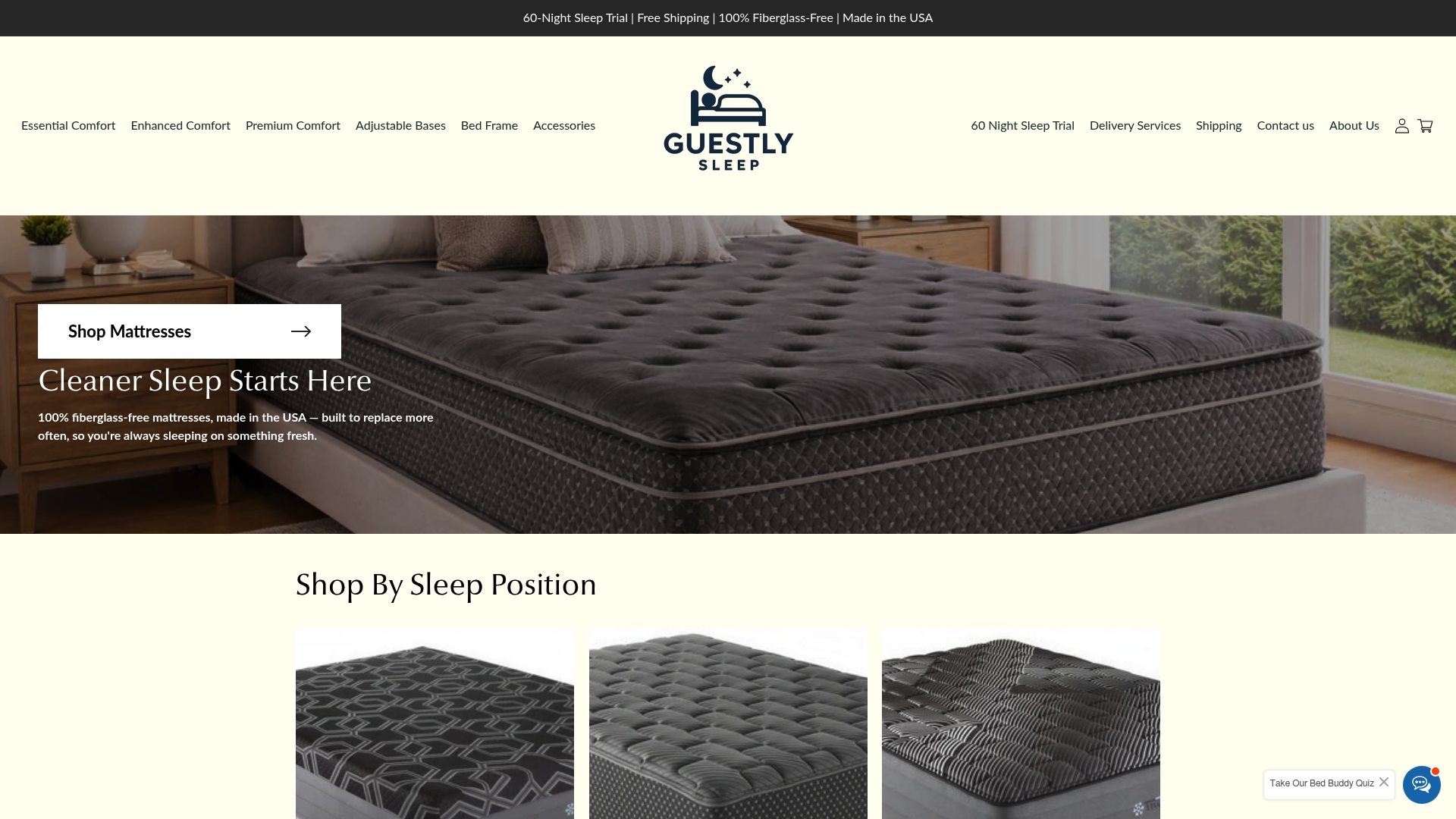
- All mattress lines are fiberglass-free and domestically manufactured.
- Installation and haul-away services are available to pair replacement with responsible disposal.
- Comfort categories make it simple to find a mattress suited to various sleep positions.
These details line up directly with the checklist in this guide: domestic sourcing, non-toxic materials, and a clear disposal path. Browse our full mattress and bed frame collection to see current options and arrange delivery with haul-away included.
FAQ
What is the most environmentally friendly mattress?
A mattress built from GOLS-certified organic latex paired with GOTS-certified organic cotton and wool generally scores highest for sustainability, since these materials renew faster and biodegrade more readily than synthetic foam. The strongest overall choice also includes a design you can disassemble at disposal, since end-of-life handling significantly affects the total environmental impact.
What’s the healthiest material for a mattress?
Certified organic latex, cotton, and wool are considered the healthiest core materials because they avoid the VOC emissions associated with polyurethane foam production. Fiberglass-free construction also matters for indoor air quality, since fiberglass fire barriers can shed fibers if a mattress cover is removed or damaged.
Why are people no longer buying memory foam?
Growing awareness of VOC off-gassing and the petrochemical origin of polyurethane foam has pushed many buyers toward natural alternatives. Foam-heavy mattresses are also harder to recycle because their layers are typically glued together, which limits end-of-life options.
What do Amish communities use for mattresses?
Amish-made mattresses commonly use natural materials such as cotton batting, wool, and horsehair rather than synthetic foam, reflecting a general preference for simpler, less processed materials. Exact construction varies by maker, since there is no single standardized Amish mattress design.
Sources
- The Best Natural Mattress Materials Explained - LeafScore
- How do end of life scenarios influence the environmental impact of product supply chains? - HERO/EPA
- Review of polyurethane recycling and industrial-scale processes - HERO/EPA reference