

Health First Natural vs Organic Mattresses: Which Certifications Matter
“Organic” means a third party audited the materials and verified the claim. “Natural” just means the ingredient came from nature at some point, with no guarantee of what happened to it afterward. If you have chemical sensitivities, asthma, or you’re buying for a kid or a pregnant partner, pay the premium for certified organic. If you’re budget-conscious and mainly want cooling and durability, a well-built natural latex mattress can serve you fine.
TL;DR:
- Certified organic latex mattresses are typically priced between $1,100 and $3,499 for queen sizes, mainly due to higher material costs and certification fees.
- Only third-party certifications like GOLS and GOTS reliably verify organic content, so lack of these labels should raise suspicion of false organic claims.
- Off-gassing from natural latex is mild and dissipates within days, while synthetic polyurethane foam can emit VOCs longer without independent certification.
- Wool used in mattresses naturally resists flames without chemical retardants, but some “natural” beds layer synthetics or blends, complicating transparency.
- For those with sensitivities or asthma, choosing a mattress with GOLS, GOTS, and GREENGUARD Gold certifications provides the strongest assurance of low chemical exposure.
Table of Contents
- What “Natural” and “Organic” Really Mean in Mattress Labels
- Materials: Latex, Cotton, Wool, and Where Synthetics Still Hide
- Certifications That Matter and How to Verify Them
- Health, Off-Gassing, and Meeting U.S. Safety Standards
- Durability and Expected Lifespan: What Materials Tell You
- Price and Value: Expected Ranges and Where to Compromise
- How to Choose: Decision Checklist, Questions to Ask, and Red Flags
- Guestlysleep’s Take on Non-Toxic Mattress Shopping
- Why Guestlysleep Is Worth Comparing Against a Fully Organic Bed
- Sources
- FAQ
What “Natural” and “Organic” Really Mean in Mattress Labels
Natural means a material originated from a plant, animal, or mineral source. Organic means that source was grown or processed under a verified standard, with paperwork to prove it.
Marketing copy blurs this constantly. A brand can call a mattress “natural” while it’s actually a blend of natural and synthetic latex, since only third-party certification reliably confirms organic content. That’s the gap you’re paying to close when you choose certified organic over natural.
Latex processing matters here too. Dunlop latex is denser and springs from a single pour, cure, and wash cycle. Talalay latex gets vacuum-sealed and flash-frozen mid-process, producing a lighter, more consistent foam. Neither process determines organic status on its own. What matters is whether the rubber tree sap was grown and harvested under a certified organic protocol before it ever reached either process.
Before buying, confirm on the product page:
- The exact percentage of natural or organic latex (not just “contains natural latex”)
- Specific certification names and logos, not vague phrases like “eco-friendly” or “chemical-free”
- A full list of every layer’s material, not just the top comfort layer
Materials: Latex, Cotton, Wool, and Where Synthetics Still Hide
Natural or organic latex is the backbone of most mattresses in this category, supporting principles of wellness by design that promote healthier living environments. It’s naturally resistant to dust mites, springs back quickly, and sleeps cooler than most memory foam. Expect a mild rubber smell for a few days after unboxing, which fades with airing and isn’t the same as the chemical odor synthetic foam can carry.
Organic cotton covers matter more than shoppers realize. Cotton grown without synthetic pesticides means less chemical residue against your skin, and the weave tends to breathe better than conventional cotton blends treated with finishing agents.

Wool shows up for a reason beyond softness: it’s a natural moisture regulator and a legitimate flame barrier, letting manufacturers skip chemical retardants entirely.
Where things get murky:
- Some “natural” mattresses layer synthetic polyurethane foam underneath a thin natural latex top, then market the whole bed as natural.
- Polyester often appears in quilting or cover backing even on otherwise natural-labeled products.
- Blended latex (part natural, part synthetic) is common and legal to call “natural latex,” which is exactly why percentage disclosure matters more than the word itself.
If off-gassing or allergies are a concern, ask what’s in every layer, not just the one facing you.
Certifications That Matter and How to Verify Them
Five certifications do the real work in this category, and each one confirms something different.
- GOLS (Global Organic Latex Standard): Certifies that latex itself was grown and processed organically, covering the rubber source through manufacturing.
- GOTS (Global Organic Textile Standard): Covers fiber components like cotton and wool covers, and requires at least 70% certified organic fiber content plus restrictions on processing chemicals.
- GREENGUARD Gold: Tests the finished product for chemical emissions and VOCs, making it the most direct way to verify low off-gassing regardless of whether materials are natural or synthetic.
- CertiPUR-US: Applies specifically to polyurethane foam, certifying it’s made without certain flame retardants, heavy metals, or ozone depletes. It doesn’t make foam organic, just cleaner synthetic foam.
- OEKO-TEX: Screens textiles for harmful substances, commonly seen on covers and pillows.
GOLS and GOTS together are the real organic stack. A mattress claiming “organic” without at least one of these should raise a flag.
Health, Off-Gassing, and Meeting U.S. Safety Standards
Off-gassing severity tracks closely with material type. Natural latex releases a mild rubber odor that dissipates within days of airing. Synthetic polyurethane foam can release volatile organic compounds for longer, which is why GREENGUARD Gold certification matters as an independent check on emissions rather than trusting the word “natural” alone.
Certified organic mattresses tend to be particularly beneficial for groups such as children, pregnant people, and anyone with chemical sensitivities or asthma. For a healthy adult without sensitivities, a GREENGUARD or CertiPUR-US certified natural latex mattress may deliver comparable air-quality benefits at a lower price point than a fully certified organic bed.
On fire safety, U.S. law requires every mattress sold to pass testing under 16 CFR 1632 and 1633, the federal flammability standards that also mandate manufacturers keep compliance records on file. Manufacturers can meet this requirement with chemical flame retardants or with a physical barrier, and wool is the standard natural option here since it’s naturally flame-resistant without added chemicals.
If you want to avoid chemical retardants entirely, ask specifically what the fire barrier is made of. “Compliant” doesn’t tell you which method was used.
Durability and Expected Lifespan: What Materials Tell You
Latex, natural or organic, tends to outlast conventional polyurethane foam by a wide margin. Industry testing puts latex mattress lifespans in the 10 to 25 year range depending on density, construction quality, and how the mattress is used and maintained.
That’s the manufacturer’s durability story. It’s not the whole health story.
- Higher latex density and thicker comfort layers generally extend usable life.
- Body weight, humidity, and lack of rotation shorten it.
- Warranty length is a decent proxy. A 20-year warranty signals a maker confident in construction quality; a 10-year warranty on a “natural” bed is worth questioning.
The mattress industry’s standard advice is to replace a mattress every 10 to 12 years based purely on structural wear. Guestly Sleep recommends a shorter cycle of every 2 to 4 years, and the reasoning isn’t about foam breaking down. It’s about allergens, dust mite buildup, and accumulated moisture that structural longevity numbers don’t capture. A mattress can still be structurally sound at year eight and be a worse sleep environment than it was at year two.
Price and Value: Expected Ranges and Where to Compromise
Certified organic mattresses cost more, and the gap is real. Queen-size organic mattresses commonly run $1,100 to $3,499, while natural (uncertified or partially certified) options typically land lower.
Three things drive that price difference:
- Certified latex content. GOLS-certified latex costs more to produce than blended or conventional latex.
- Audit and certification fees. Manufacturers pay for GOTS and GOLS inspections, and that cost gets passed through.
- Manufacturing origin. Domestic assembly with certified inputs generally costs more than overseas production with looser sourcing.
If full organic certification is out of budget, a hybrid with GREENGUARD Gold or CertiPUR-US certified foam layers can cut chemical exposure substantially without the full organic price tag. The trade-off is you lose the organic farming and pesticide-avoidance benefits, keeping only the emissions-testing benefit.
How to Choose: Decision Checklist, Questions to Ask, and Red Flags
Match your priorities to the label before you shop. Someone with chemical sensitivities should skip straight to GOLS/GOTS certified beds. A budget-focused side sleeper who mainly wants pressure relief and cooling can reasonably consider a certified-natural hybrid instead.
- Identify your sensitivity level. Sensitive skin, asthma, or pregnancy pushes you toward certified organic; no known sensitivities opens up natural latex with GREENGUARD or CertiPUR-US components.
- Set your budget band. Know whether you’re shopping the $1,100 to $3,499 organic range or a lower natural-mattress tier before you start comparing models.
- Ask for certificate numbers, not logos. Request the certifying body’s name and the specific certificate number for both latex (GOLS) and textile covers (GOTS).
- Ask what the fire barrier is made of. Wool and other physical barriers meet the same federal standard as chemical retardants, so you can request one specifically.
- Confirm the latex percentage. “Natural latex” on the label can mean anywhere from 30% to 100% natural content in a blend.
- Check sleep position fit. Latex tends to sleep firmer than memory foam. Side sleepers may want a plusher comfort layer regardless of certification status.
Red flags worth walking away from: vague phrases like “eco-friendly” or “chemical-free” with no certification named, no disclosure of what the flame barrier is made from, and no willingness to share a component-level material list.
Guestly Sleep’s Take on Non-Toxic Mattress Shopping
Most of the confusion in this category comes from brands treating “natural” as a marketing synonym for “safe.” It isn’t. Guestly Sleep sells every mattress fiberglass-free and assembled in the United States, addressing a contamination risk in budget mattresses posed by unlabeled fiberglass fire barriers that can shed into a home when a cover is unzipped.
On replacement cycles, hygiene matters as much as structural wear. A mattress that’s still supportive at year six has still absorbed six years of sweat, skin cells, and dust mites, which is why a 2 to 4 year replacement window makes more sense for sleep health than waiting for foam to physically fail.
Why Guestly Sleep Is Worth Comparing Against a Fully Organic Bed
If certified organic pricing is stretching your budget, Guestlysleep offers mattresses that are fiberglass-free and assembled in the United States, removing a common hidden contaminant found in some budget-tier synthetic beds without requiring full organic certification pricing.
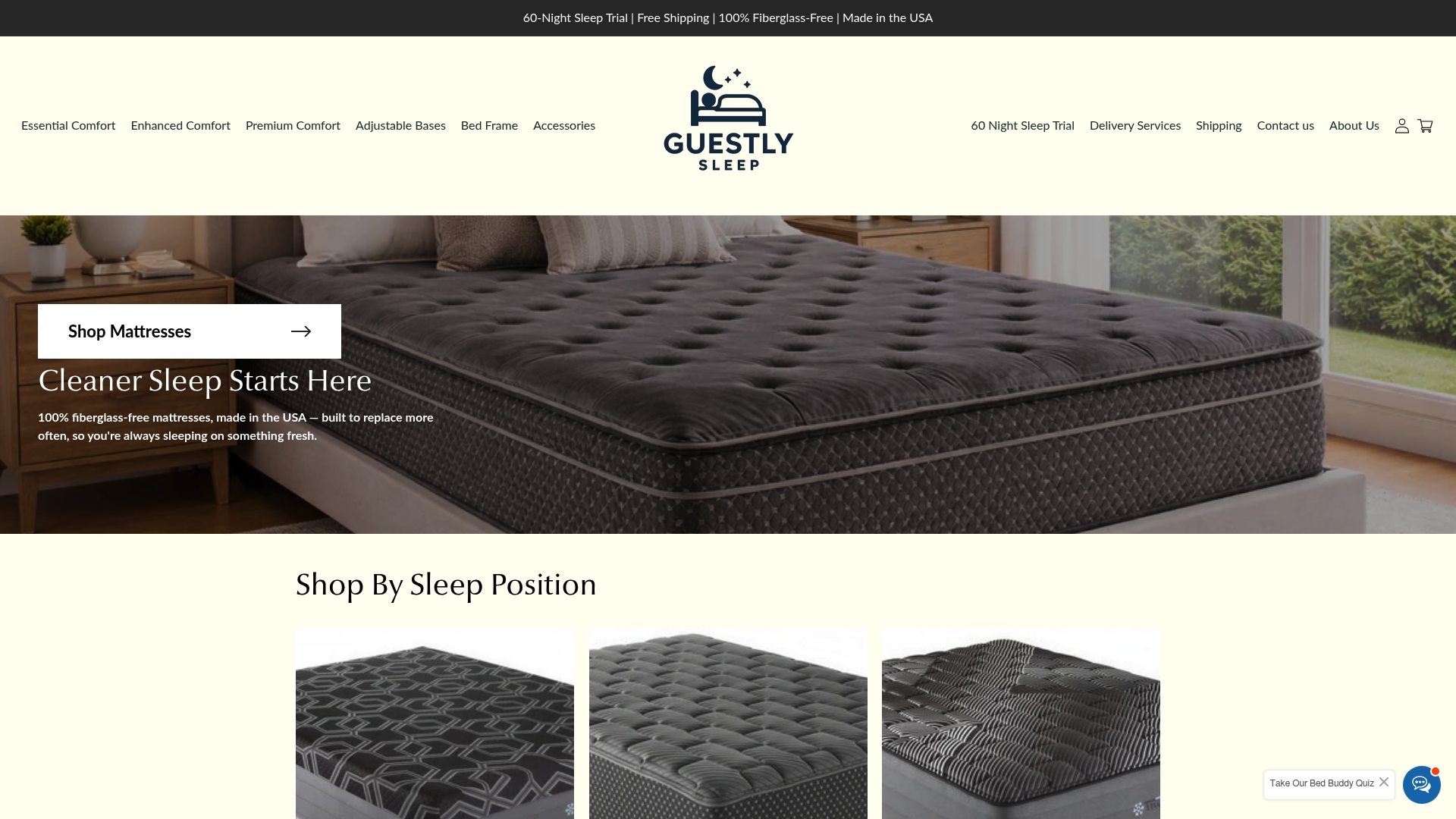
The lineup runs across Essential Comfort, Enhanced Comfort, and Premium Comfort collections, organized by comfort level and sleep position rather than by material buzzwords. If you’re replacing a mattress on the shorter, hygiene-driven cycle rather than waiting a decade for structural failure, Guestly Sleep also offers professional mattress and bed frame installation with haul away, so the old mattress doesn’t sit in your garage for six months.
Before you buy anything, from Guestly Sleep or anyone else, ask for the component sheet and any certificate documentation the way this guide outlines. Every order includes a sleep trial and free shipping, allowing customers to verify comfort and off-gassing expectations firsthand before committing. Check the full collection to compare options by comfort level.
Sources
- U.S. Consumer Product Safety Commission — Mattress flammability standard (preamble and final rule)
- Global Organic Textile Standard (GOTS) — Standard and Manual
- NCOA — Best Organic Mattresses 2026
- Sleep Foundation — Best latex mattresses and certification guidance
FAQ
Do Organic Mattresses Really Make a Difference?
For people with chemical sensitivities, asthma, or skin reactions, yes. Certified organic materials undergo audited processing that reduces pesticide residue and chemical inputs compared to conventional or loosely labeled “natural” mattresses. For sleepers without sensitivities, a GREENGUARD or CertiPUR-US certified natural mattress can deliver similar air-quality benefits at a lower cost.
What Is the Healthiest Mattress to Have?
The healthiest option combines certified organic latex (GOLS), certified organic textile covers (GOTS), and independent emissions testing through GREENGUARD Gold. That stack covers material sourcing, fiber processing, and finished-product off-gassing, which is more assurance than any single certification provides alone.
What Mattress Should You Stay Away From?
Avoid any mattress labeled “natural” or “eco-friendly” with no certification name attached, no disclosed fire-barrier material, and no willingness from the seller to provide a certificate number on request. Those are the three most reliable red flags for vague or misleading marketing.
What Mattress Has the Least Amount of Chemicals?
Mattresses certified under GOLS, GOTS, and GREENGUARD Gold together carry the strongest documented evidence of low chemical content, since each certification screens a different stage of production. Guestlysleep’s fiberglass-free construction also removes a specific contamination source, unlabeled fiberglass fire barriers, that isn’t covered by any of those three certifications.
How Much Does a Certified Organic Queen Mattress Cost?
Queen-size certified organic mattresses commonly range from $1,100 to $3,499, driven mainly by certified latex content and audit costs. Guestlysleep’s Essential, Enhanced, and Premium Comfort collections don’t publish organic certification pricing tiers directly on site, so current pricing for specific models is available on guestlysleep.com.