

0.5 ppm VOC, Foam Only: What CertiPUR-US Means for Mattress Buyers
CertiPUR-US is a nonprofit certification program that independently verifies flexible polyurethane foam meets strict standards for content, emissions, and durability. It’s administered by the Alliance for Flexible Polyurethane Foam, and it means the foam inside a mattress has been lab-tested for harmful substances and low chemical emissions. What it does not do is certify the entire finished mattress, since covers, adhesives, and fire barriers fall outside its scope.
TL;DR:
- CertiPUR-US certifies foam for the presence of harmful substances and low VOC emissions, but only for the foam itself, not the whole mattress.
- Certification requires foam to be free of formaldehyde, ozone-depleting chemicals, heavy metals, carcinogens, and phthalates, with emissions below 0.5 ppm.
- Many products falsely claim the entire mattress is certified or use banned phrases like “chemical-free,” which are not permitted by the program.
- Off-gassing and initial odors are common in new mattresses, but CertiPUR-US foam reduces VOCs that cause these smells; proper ventilation helps mitigate discomfort.
- Verification requires checking the public certification directory and asking retailers for current proof, as certification must be renewed annually and claims should be transparent.
Table of Contents
- What Does CertiPUR-US Mean for the Foam You Sleep On?
- What CertiPUR-US Doesn’t Cover (and Where Marketing Gets Misleading)
- Off-Gassing, VOCs, and What Certification Actually Changes
- How to Verify a CertiPUR-US Claim Before You Buy
- How Guestly Sleep Approaches CertiPUR-US When Sourcing Materials
- Where CertiPUR-US Falls Short and Where It Earns Its Reputation
- Shopping for a Foam Mattress That Backs Up Its Safety Claims
- Sources
- FAQ
What Does CertiPUR-US Mean for the Foam You Sleep On?
CertiPUR-US began in 2008 as a response to a real problem: shoppers had no reliable way to know what was actually inside their foam mattresses and pillows. The program covers flexible slabstock and molded polyurethane foam, including memory foam, and requires every certified batch to pass through independent, accredited laboratory testing rather than self-reported manufacturer claims.
The technical criteria are specific, not vague marketing language. Certified foam must be made without:
- Formaldehyde
- Ozone-depleting chemicals
- Phthalates regulated by the Consumer Product Safety Commission
- Lead, mercury, and other heavy metals
- Chemicals classified as carcinogens, mutagens, or reproductive toxins
On top of the exclusion list, certified foam has to meet a low-VOC emissions threshold of less than 0.5 parts per million, measured through chamber testing that mimics real indoor air conditions. Labs pull samples at the manufacturing stage using internationally recognized testing methods, which keeps the results consistent across different foam producers. CertiPUR-US treats its technical guidelines as living documents, updating them as science and regulations shift, so a certification earned five years ago reflects the same rigor as one earned today.
What CertiPUR-US Doesn’t Cover (and Where Marketing Gets Misleading)
CertiPUR-US certifies foam, full stop. A finished mattress can carry a CertiPUR-US logo for its foam layer while still including a cover fabric, glue, or fire-resistant barrier that’s never been tested under the program at all. That gap is where a lot of confusing marketing lives, and it’s worth knowing the rules before you trust a product page.
- Correct wording says “foam inside.” Legitimate listings state that the foam is CertiPUR-US certified, not that the mattress as a whole is certified.
- “Chemical-free” and “non-toxic” are banned claims. Program rules explicitly prohibit these phrases in connection with certification, since no foam is literally free of all chemistry.
- Logo pairing needs pre-approval. Brands can’t just slap the CertiPUR-US name next to whatever additional copy they want without sign-off from the program.
- Look for complementary certifications on other components. OEKO-TEX Standard 100 covers textile safety, while GREENGUARD or Intertek programs assess emissions from the whole finished product, not just the foam.
If a retailer’s description skips these distinctions entirely, that’s usually a sign the copy was written by marketing, not by anyone who read the program’s actual overview.
Off-Gassing, VOCs, and What Certification Actually Changes
New foam mattresses often carry a noticeable smell when you first unbox them. That’s off-gassing: the release of volatile organic compounds (VOCs) trapped in the foam during manufacturing. For most sleepers it fades within a few days, but for sensitive individuals it can trigger headaches, eye irritation, or respiratory discomfort in the short term.
CertiPUR-US testing directly addresses this by capping VOC emissions at the source. A foam that meets the 0.5 ppm threshold has already been screened for the chemical classes most likely to cause that new-mattress odor, which cuts down one of the biggest contributors to indoor air complaints tied to bedding.
Certification isn’t a full guarantee, though. Covers, glues, and fire barriers aren’t tested under CertiPUR-US, so a certified-foam mattress can still off-gas from other components. Independent coverage from Tom’s Guide makes this point clearly: certified foam reduces a major VOC source, but it doesn’t eliminate every possible one.
A few practical steps help regardless of certification status:
- Unbox and ventilate a new mattress in a well-aired room before sleeping on it.
- Air new memory foam out for a day or two to let initial odors dissipate.
- Choose textile covers with their own certifications when you want fuller peace of mind.
Pro Tip: If you’re sensitive to smells or chemicals, set up a new mattress in a spare room or garage for a day before moving it into the bedroom. It costs you nothing but a little patience, and it noticeably cuts down on what you’ll notice once you actually sleep on it.
How to Verify a CertiPUR-US Claim Before You Buy
Don’t take a product listing’s word for it. CertiPUR-US maintains a public directory specifically so shoppers can cross-check whether a manufacturer is actually registered and current, since certification requires annual renewal rather than a one-time approval.
Before you check out, run through this short list:
- Search the manufacturer or product name in the CertiPUR-US online directory or mobile app.
- Confirm the listing says the foam is certified, not the mattress as a whole.
- Check that the logo appears correctly, without extra unauthorized claims attached to it.
- If a listing is vague, ask the retailer directly for the manufacturer’s registration number or a lab test reference.
- Treat banned phrases like “chemical-free” as a red flag, along with any brand that can’t produce current directory listing.
A brand that’s actually certified will have nothing to hide here. If you want a more detailed walkthrough of the shopping process, Guestly Sleep’s guide to finding certified foam covers the search step by step.
How Guestly Sleep Approaches CertiPUR-US When Sourcing Materials
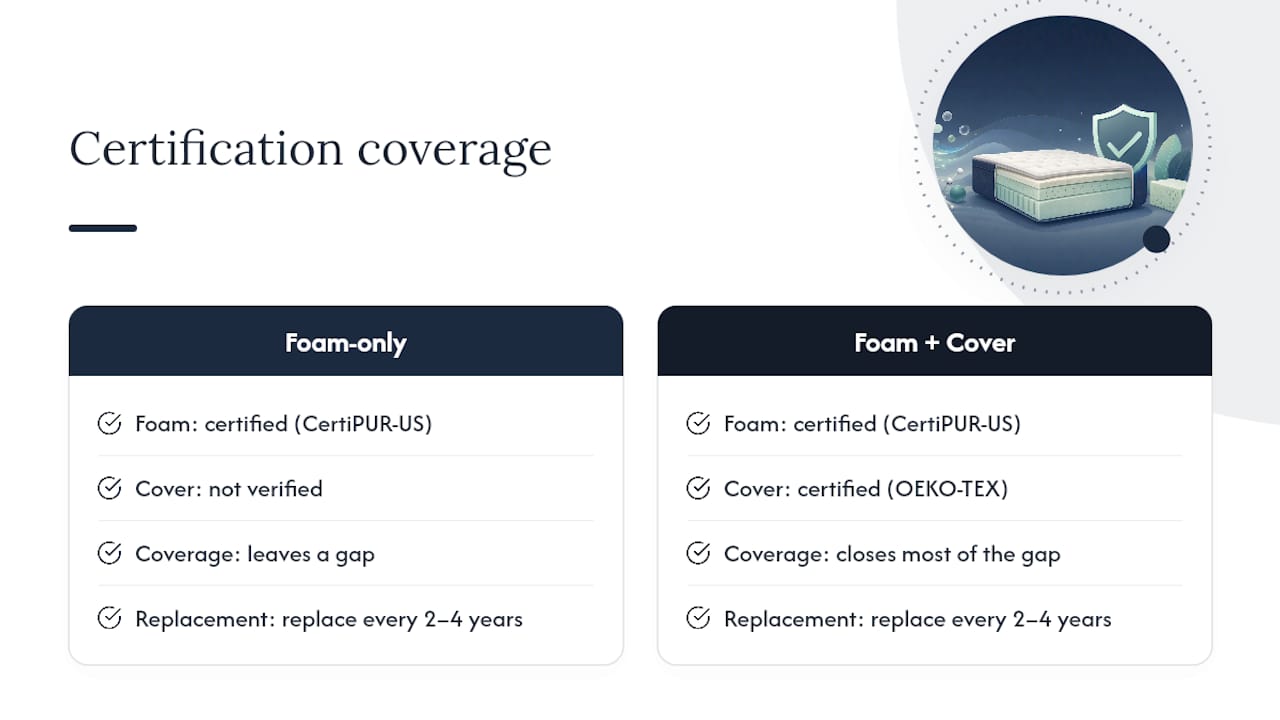
Some mattresses are built around fiberglass-free, certified-safe materials, starting with treating foam certification as a baseline, not a bonus feature. We also recommend replacing mattresses every 2 to 4 years, since foam and other components degrade over time regardless of how clean they started out.
Foam certification alone doesn’t cover everything in a mattress, which is why pairing CertiPUR-US with textile-level verification like OEKO-TEX gives a fuller picture of what you’re actually sleeping on. When you’re comparing options, it’s worth asking for both: certified foam and a certified cover. That combination closes most of the gap that foam-only certification leaves open. For background on what off-gassing actually feels like and how long it typically lasts, this breakdown of memory foam ventilation walks through the timeline in plain terms.
Where CertiPUR-US Falls Short and Where It Earns Its Reputation
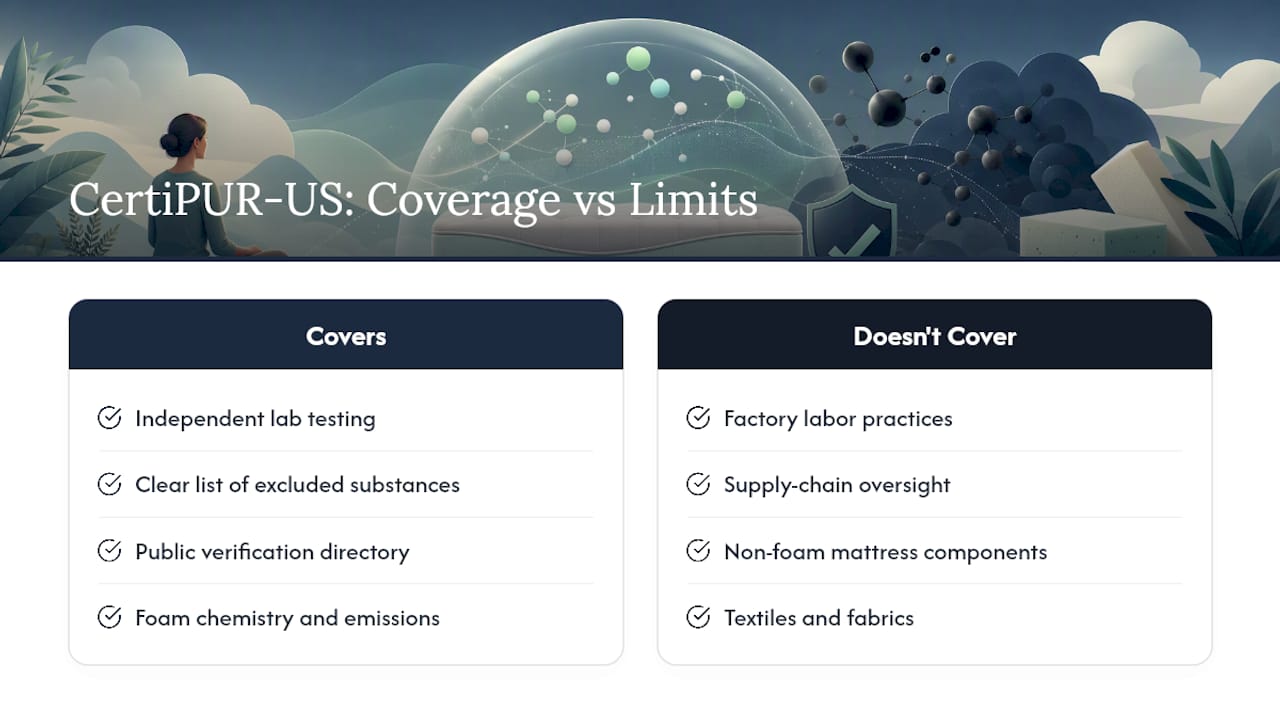
CertiPUR-US does the thing it claims to do well: independent lab testing, a clear list of excluded substances, and a public directory that lets anyone verify a claim rather than trust it blindly. That transparency is rare in an industry full of vague “eco-friendly” labeling.
Where it falls short is scope. It’s a material-level check on foam chemistry and emissions, not an audit of factory labor practices, supply chains, or the rest of a mattress’s construction. Treat it as one strong signal among several, not the whole verdict. Verify the foam, then ask about the textiles and fire barrier separately.
— Justin
Shopping for a Foam Mattress That Backs Up Its Safety Claims
This service is built for shoppers who don’t want to guess whether “certified” actually means something.
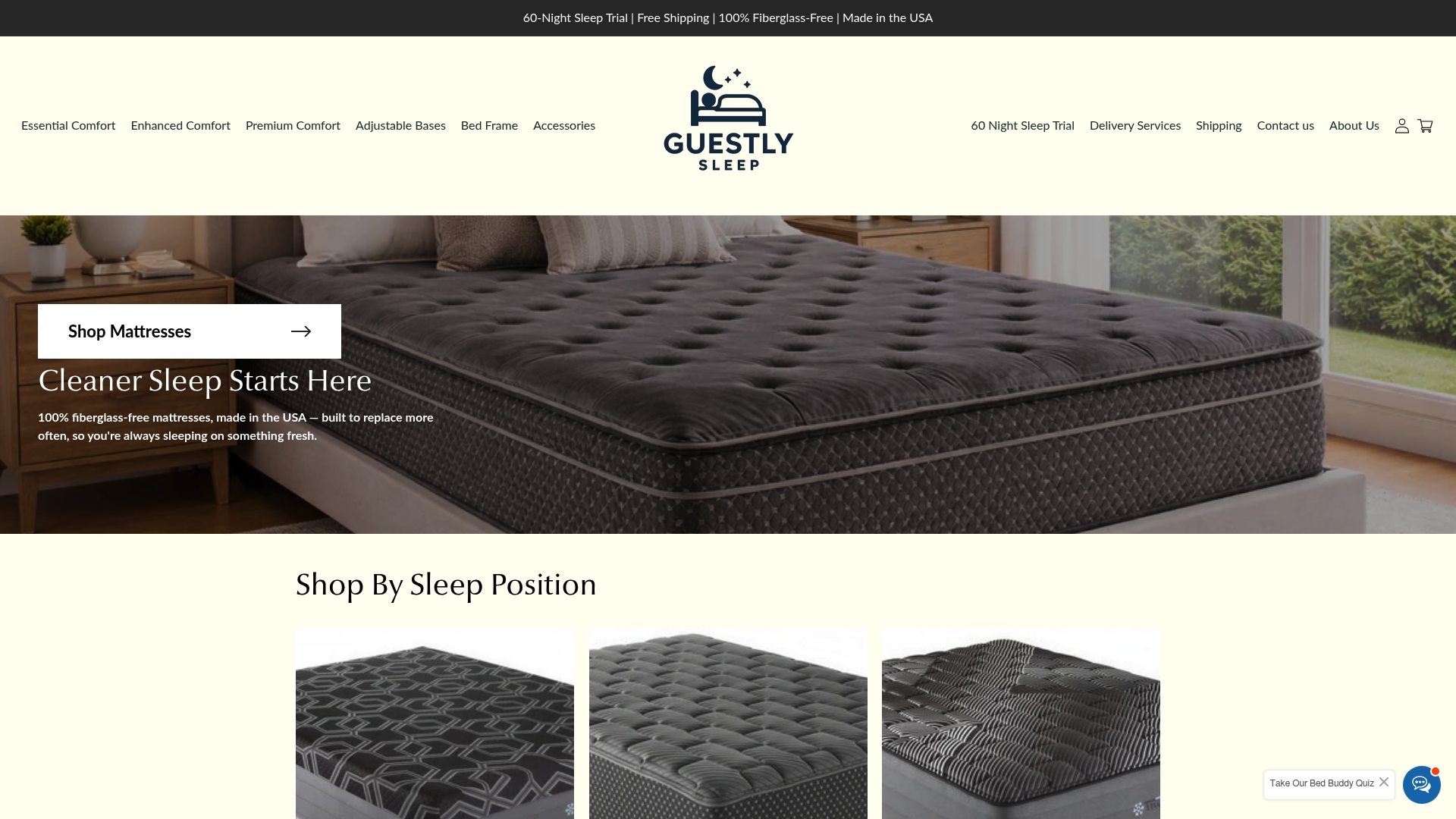
Comparing foam certification alongside textile verification is exactly the kind of homework we think shoppers should do, and we’ve tried to make that easier by being upfront about what’s inside our own products. Browse our full collection of mattresses and accessories to see comfort options organized by sleep position and budget, backed by a 60-night sleep trial and free shipping. If you’re replacing an old mattress, our mattress and bed frame installation with haul away service handles setup and disposal in one visit, so getting rid of your old off-gassing foam is as easy as getting your new one delivered.
Sources
FAQ
Is CertiPUR-US Certification Actually Safe?
Yes. CertiPUR-US certified foam has passed independent lab testing for excluded substances and low-VOC emissions, though the certification only covers the foam component, not the entire mattress.
Can Memory Foam Cause Health Problems?
New memory foam can cause short-term irritation like headaches or odor sensitivity from off-gassing, though CertiPUR-US certified foam has already been screened to reduce a major source of those emissions.
Why Are Some Shoppers Moving Away From Memory Foam?
Concerns usually center on off-gassing odors and heat retention rather than certification itself; choosing CertiPUR-US certified foam addresses the emissions half of that concern directly.
Is CertiPUR-US a Legitimate Certification?
Yes. It’s a nonprofit program administered by the Alliance for Flexible Polyurethane Foam, with testing done by independent accredited labs and a public directory for verification.
How Much Does a CertiPUR-US Certified Mattress From Guestly Sleep Cost?
Guestly Sleep’s current mattress pricing across Essential Comfort, Enhanced Comfort, and Premium Comfort collections is available on the Guestly Sleep site.