

Wait 24–72 Hours: Polyurethane Foam Safety and Mattress Risks
Polyurethane foam is generally safe once fully cured, and consumer products meeting voluntary limits like CertiPUR carry very low measured risk. The danger sits almost entirely in the uncured stage, especially during spray foam installation, where airborne isocyanates can trigger permanent sensitization. Follow guidance from the EPA, keep people out of the work zone during application, and choose certified low-emission foam for anything you sleep or sit on.
TL;DR:
- During spray foam application, airborne isocyanates can cause sensitization, with safety guidelines recommending full containment, respirators, and evacuation of non-protected personnel.
- Full cure of polyurethane foam typically takes days, and off-gassing posed by finished products is much lower than during installation, especially if certified as low-emission.
- Regulatory limits on isocyanate exposure are strict, with OSHA’s ceiling at 0.02 ppm and NIOSH’s recommended average at 0.005 ppm to prevent sensitization.
- Certified mattresses pose a significantly smaller health risk, as off-gassing occurs mainly in the first days and margins of safety for sleep exposure reach into the hundreds of thousands or millions.
- Proper containment, ventilation, and verification are crucial for safe foam installation, and buyers should prioritize certified products and ask contractors for safety data sheets and containment plans.
Table of Contents
- What Polyurethane Foam Actually Is: Cured vs. Uncured
- Health Risks From Isocyanates, VOCs, and Flame Retardants
- Why Spraying Foam Is the Riskiest Moment, and How to Do It Safely
- Mattresses and Household Foam: A Much Smaller Risk Category
- Your Exposure-Reduction Checklist for Foam at Home or on the Job
- When Foam Exposure Needs Medical Attention
- What Guestlysleep Thinks Consumers Get Wrong About Foam Safety
- Choosing a Lower-Emission Mattress Without the Guesswork
- Where to Verify This Information Yourself
- Sources
What Polyurethane Foam Actually Is: Cured vs. Uncured
Every polyurethane foam starts as a chemical reaction between two components. The “A-side” contains diisocyanates, most commonly MDI or TDI. The “B-side” is a blend of polyols mixed with catalysts, blowing agents, and often flame retardants. When the two sides combine and cure, they form the solid or flexible foam you recognize in a mattress, a couch cushion, or a wall cavity.
The finished chemistry differs quite a bit depending on the product:
- Spray polyurethane foam (SPF) is mixed and expanded on-site, which means the riskiest chemical reaction happens in your home or building.
- Rigid board insulation is manufactured and cured in a factory, so it arrives chemically stable.
- Flexible foam used in mattresses and furniture is also factory-cured, but often includes flame retardants and softening agents that behave differently than rigid foam.
The distinction that matters most is curing status, not product category. “Tack-free” is a common trap. A sprayed surface can feel dry to the touch within hours while still releasing unreacted isocyanates for days. Full cure, where the chemical reaction has essentially finished, is what actually determines whether the material is largely inert. A finished, aged mattress and a freshly sprayed wall cavity are not remotely comparable from a health standpoint, even though both started from the same basic chemistry.
Health Risks From Isocyanates, VOCs, and Flame Retardants
The core hazard in polyurethane chemistry is isocyanate exposure, and the mechanism is worth understanding because it changes how you should think about risk. Isocyanates can cause simple irritation of the eyes, skin, and airway on first contact. But repeated exposure can also trigger sensitization, an immune response where the body starts reacting to even trace amounts of the chemical it previously tolerated. Once someone is sensitized, there is no recognized safe exposure level, according to the EPA’s guidance on spray polyurethane foam. That is the single most important fact in this entire topic: sensitization is not dose-dependent the way ordinary irritation is.
Symptoms range from immediate coughing, throat irritation, and skin rashes to delayed asthma-like episodes that can appear hours after exposure ends. Someone can walk away from a spray job feeling fine and develop chest tightness that night.
Regulatory limits reflect how seriously agencies take this risk. OSHA sets a ceiling limit of 0.02 ppm for MDI, while NIOSH’s recommended exposure limit is far stricter at 0.005 ppm as an 8 to 10 hour time-weighted average. The gap between those two numbers exists because OSHA sets legally enforceable floors, while NIOSH recommends the level actually needed to prevent chronic sensitization, not just acute injury.
Beyond isocyanates, foam products introduce a second category of concern: volatile and semi-volatile organic compounds released by catalysts, blowing agents, and flame retardants. A systematic review from University College London found that flame retardants such as TCPP and TDCPP are frequently not chemically bound to the foam matrix, meaning they can migrate into household dust and air over years rather than degrading quickly. The same review noted that isocyanate concentrations measured near sprayers during application can exceed occupational limits even in ventilated spaces.
Despite those hazards during manufacturing and installation, the consumer-product picture looks considerably better. A 2012 risk assessment on toluene diisocyanate exposure from flexible polyurethane foam modeled realistic sleeping and sitting scenarios and found margins of safety for non-cancer health effects ranging from 200 to 3,000,000, with a theoretical excess lifetime cancer risk no higher than 1.5 in 10 million. That is a wide gap between installation-phase risk and finished-mattress risk, and it is the reason regulators and researchers treat spraying and sleeping as fundamentally different exposure categories.
Why Spraying Foam Is the Riskiest Moment, and How to Do It Safely
Spray application is where isocyanate concentrations spike hardest, because the chemical reaction is happening in real time, in open air, right next to the person holding the gun. Ventilation helps clear the air afterward, but it does not eliminate the concentrated exposure zone during the spray itself.
Protecting people during an SPF job comes down to a short list of non-negotiable steps:
- Applicators need supplied-air respirators, not just half-mask cartridge respirators, along with disposable suits and gloves rated for isocyanate work.
- The work area needs full containment with plastic sheeting and negative-air machines pulling contaminated air outward, not just open windows.
- HVAC systems must be isolated during application so ductwork doesn’t pull isocyanate-laden air into other parts of the building.
- Everyone except trained, protected applicators evacuates the structure during spraying and for the duration of the manufacturer’s recommended cure window.
- Re-entry timing varies, typically falling somewhere between 24 and 72 hours for professional two-component high-pressure systems, longer if ventilation was inadequate or the job used a lower-grade kit.
Pro Tip: A “tack-free” surface is not proof it’s safe to move back in. Manufacturer cure claims describe surface chemistry, not air quality, so confirm ventilation time separately from cure time before returning occupants to the space.
If odors linger for days, or anyone in the household develops coughing, wheezing, or skin irritation after a spray job, that is not a normal part of the process. It usually points to a faulty application, insufficient ventilation, or a batch mixing error, and it warrants contacting the contractor immediately rather than waiting it out.
Mattresses and Household Foam: A Much Smaller Risk Category
Sleeping on a certified polyurethane mattress carries a vastly smaller risk profile than being present during a spray foam job, and the data backs that up clearly. The same TDI risk assessment referenced above modeled sleep exposure specifically and found margins of safety in the hundreds of thousands to millions for non-cancer effects. That is the kind of number toxicologists consider a comfortable buffer, not a borderline result.
Finished foam still off-gasses a little, especially in the first days after unboxing, which is why new mattresses often carry a faint chemical smell. This comes from residual VOCs and blowing agents leaving the foam matrix, a process that drops off sharply after initial airing, unlike the sustained isocyanate exposure during spraying. For anyone shopping with health in mind, a few practical filters make comparison shopping easier:
- Look for CertiPUR-US or equivalent voluntary certification, which caps trace impurities like certain aromatic diamines and restricts specific flame retardant classes.
- Treat marketing terms like “green” or “soy-based” with some skepticism. Soy-based foam still relies on the same core polyurethane chemistry; the soy content typically replaces only a portion of the petroleum-based polyol.
- Unbox and air out a new mattress in a ventilated room for a day or two before regular use, which lets initial off-gassing dissipate faster.
- Use a breathable mattress protector, which helps limit dust and particulate exposure over the mattress’s lifespan.
- Replace mattresses on a defined cycle rather than indefinitely, since materials break down and can shed more particulate as they age.
Your Exposure-Reduction Checklist for Foam at Home or on the Job
Reducing your risk from polyurethane foam comes down to timing and verification more than any single product choice. Whether you’re hiring an SPF crew or shopping for a new mattress, the steps break into three clear phases.
- Before the work starts: Request the safety data sheet from your contractor, ask specifically how they’ll contain and ventilate the space, and confirm the applicator has isocyanate-specific training. For sensitive household members, ask whether medical surveillance is standard practice for their crew.
- During application: Everyone but trained, protected workers leaves the structure. HVAC systems get isolated, negative-air machines run continuously, and nobody cuts or trims foam before it’s fully cured, since that releases fresh unreacted material into the air.
- After the job: Ventilate thoroughly beyond the manufacturer’s minimum cure time, wait the full recommended re-occupancy window before moving back in, and clean up any overspray dust with wet methods rather than dry sweeping, which can aerosolize particles.
- When buying foam products: Prioritize certified, lower-emission options, ask what flame-retardant approach the manufacturer uses, and consider fiberglass-free alternatives if anyone in the household has asthma or chemical sensitivities.
Pro Tip: If a contractor can’t produce a safety data sheet or explain their containment plan in specific terms, that’s a bigger red flag than any single material choice you could make. Process failures cause most of the serious exposure incidents, not the chemistry itself.
When Foam Exposure Needs Medical Attention
Seek emergency care immediately for difficulty breathing, chest tightness, or swelling of the face or throat after any foam exposure. These symptoms can escalate fast, particularly in anyone with existing asthma or a prior sensitization history.
Less urgent but still important: recurring cough, wheezing, or asthma-like episodes that show up specifically after exposure to foam products or spray jobs suggest possible sensitization and deserve a pulmonology or occupational health evaluation. Bring documentation to that appointment.
- Save the safety data sheet from the job or product involved.
- Write down the exposure timeline, including symptom onset and duration.
- Note ventilation conditions and how long after application symptoms began.
For faulty installations, contact the contractor first, then your state consumer protection office if the response is inadequate. Serious or unresolved cases can be reported to the Consumer Product Safety Commission, and households with sensitized members may need to consider replacing affected foam materials entirely rather than remediating in place.
What Guestly Sleep Thinks Consumers Get Wrong About Foam Safety
Most people treat “polyurethane foam” as one risk category, when it’s really two very different situations wearing the same chemical name. The installation phase, where isocyanates are actively reacting in open air, deserves genuine caution. The finished consumer product, aged and cured for weeks before it reaches your bedroom, is a different animal entirely, and the peer-reviewed margins of safety back that distinction up.
Some mattress makers build fiberglass-free, non-toxic mattresses in the United States because material choice is one lever, among several, that health-conscious households can actually control. Replacing mattresses every two to four years matters too, since materials degrade and off-gassing profiles shift over a product’s lifespan.
Choosing a Lower-Emission Mattress Without the Guesswork
If the spray foam risks above make you rethink what’s inside your own mattress, you’re asking the right question. Some mattresses are built fiberglass-free in the United States, using certified materials chosen specifically to avoid the harmful fillers that show up in cheaper imported foam.

Some mattresses ship with a few things that make the decision easier to reverse if it doesn’t work out, such as a sleep trial, free shipping, and direct manufacturer pricing without the retail markup.
Before you buy any mattress, foam or otherwise, check the certifications and material list against what you learned here. Browse the fiberglass-free mattress collection to compare comfort levels and see which build fits your sleep position, or pair your new mattress with the cooling bedding bundle if temperature regulation is part of your decision too.
Where to Verify This Information Yourself
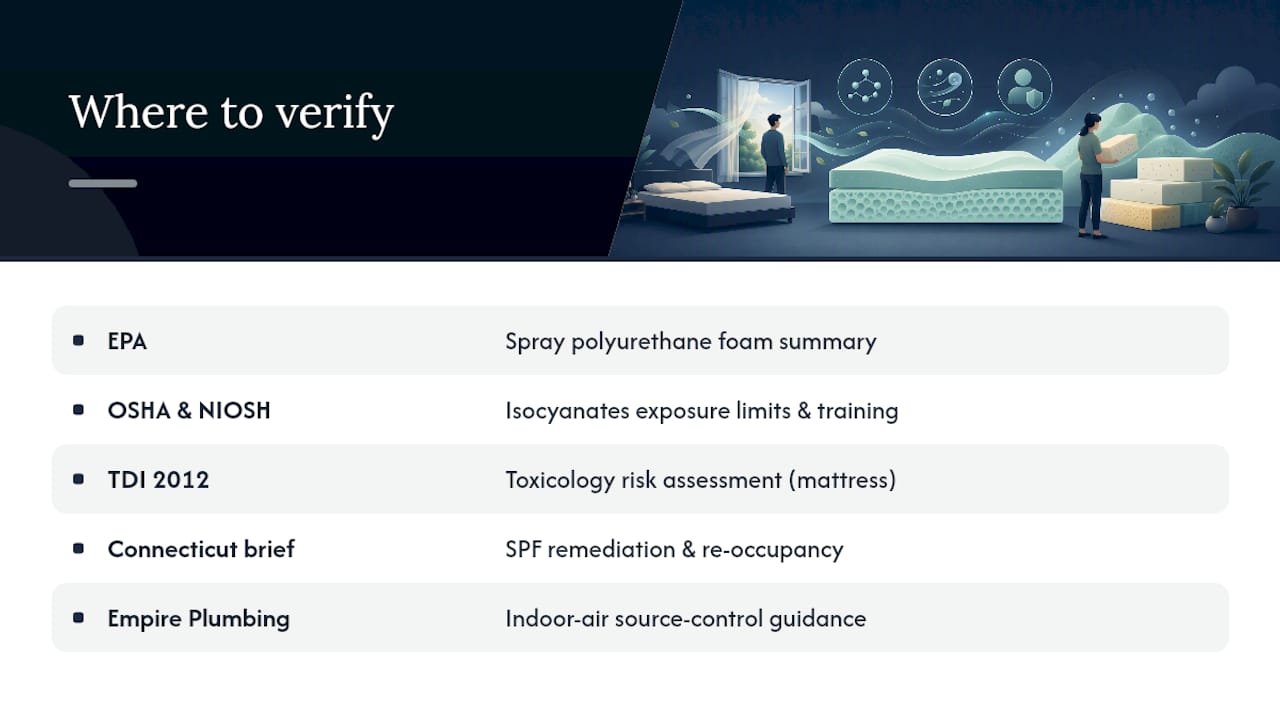
For the federal government’s own summary of health concerns, start with the EPA’s page on spray polyurethane foam. Workers and contractors should reference OSHA and NIOSH’s guidance and alerts on isocyanates for exposure limits and training standards. For the toxicology behind mattress safety margins, the 2012 TDI risk assessment offers the clearest peer-reviewed modeling available. Homeowners dealing with a faulty installation should consult the Connecticut technical brief on SPF health effects for remediation and re-occupancy specifics, and general indoor air quality troubleshooting is covered well by Empire Plumbing & AC’s source-control guidance.
This article is general information, not a substitute for advice from a qualified doctor. Consult a qualified healthcare professional about your own circumstances before acting on anything here.
Sources
- Health Concerns about Spray Polyurethane Foam | US EPA
- Risk assessment for consumer exposure to toluene diisocyanate (TDI) derived from polyurethane flexible foam (2012)
- Systematic review: polyurethane insulation and household products — emissions and health implications (UCL)
- Technical brief: health effects associated with faulty application of spray polyurethane foam