

Why US Mattress Regulations Are Stricter Than Most
US mattress regulations are among the strictest globally because federal law mandates specific flammability performance standards that force manufacturers to reformulate materials and document compliance. The Consumer Product Safety Commission enforces two binding rules, 16 CFR Part 1632 and 16 CFR Part 1633, covering every mattress sold in the country. Voluntary programs like CertiPUR-US then fill the chemical safety gap that federal law leaves open. For health-conscious consumers and safety advocates, understanding why US mattress regulations are stricter matters because it directly shapes what ends up inside the product you sleep on every night.
Why are US mattress flammability standards so demanding?
The US federal government treats mattress fire safety as a non-negotiable baseline. Every mattress sold in the US must comply with both 16 CFR Part 1632 and 16 CFR Part 1633. These are not voluntary guidelines. They are enforceable federal rules with real consequences for non-compliance.
16 CFR Part 1632 tests resistance to smoldering ignition, specifically from a lit cigarette placed on the mattress surface. 16 CFR Part 1633 goes further. It simulates an open-flame scenario, such as burning bedclothes, and sets specific heat release rate limits that a mattress must not exceed. Part 1633 has been enforced since 2007, and its introduction triggered industry-wide material reformulation. Manufacturers could no longer use the same foam and fabric combinations they had relied on for decades.
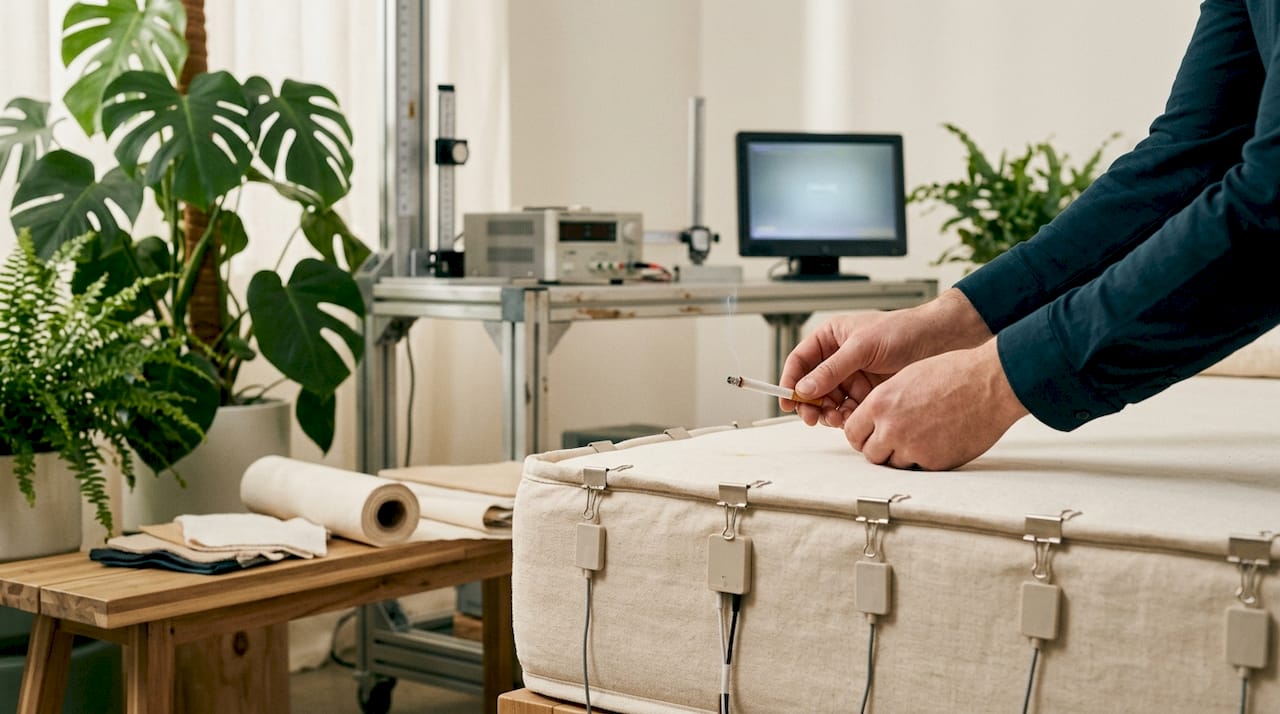
The standard is performance-based by design. 16 CFR Part 1633 lets manufacturers choose their own fire barrier strategy, as long as the mattress passes the heat release test. That means some brands use chemical flame retardants, while others use natural barriers like wool batting or rayon and silica blends. Fire protection layers such as wool, rayon/silica blends, and modacrylic fibers are common solutions that meet the standard while reducing chemical reliance.
Compliance is not a one-time event. Manufacturers must run prototype tests for each mattress model and retain those test records for 3 years per CFR 1633. The CPSC conducts periodic audits and can issue recalls for non-compliant products. Imported mattresses face the same requirements as domestically produced ones.
- Prototype testing for every model before sale
- Heat release rate testing under open-flame simulation
- Cigarette ignition resistance testing under Part 1632
- Three-year record retention for all test documentation
- CPSC audit authority and recall power for violations
How do voluntary certifications fill the chemical safety gap?
Federal law focuses entirely on fire performance. It does not regulate what chemicals go into a mattress or how much a mattress off-gasses into your bedroom. Voluntary certification programs were created specifically because this gap exists. CertiPUR-US is the most recognized of these programs in the US market.
CertiPUR-US restricts volatile organic compound (VOC) emissions to 0.5 parts per million for foam and requires annual retesting and triennial audits of certified manufacturers. The program also tests for prohibited substances including certain flame retardants, heavy metals, and formaldehyde. Brands that carry the CertiPUR-US seal have submitted their foam to independent laboratory testing.
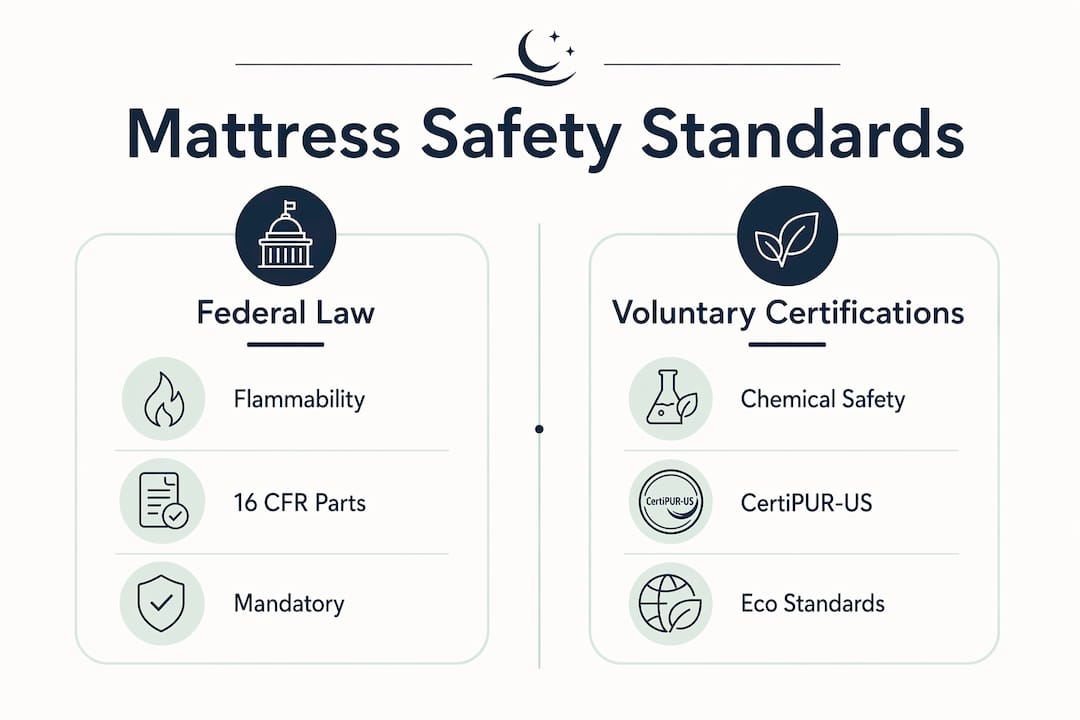
The Global Organic Latex Standard (GOLS) addresses a different material category. GOLS certifies that latex content meets organic content thresholds, covering the supply chain from raw rubber to finished product. Consumers shopping for mattress certifications and standards often encounter both labels, but they measure different things and apply to different materials.
A critical misconception surrounds these programs. CertiPUR-US certification signals that materials passed below set exposure thresholds. It does not mean the mattress is free of all chemical exposure. The distinction matters because many consumers treat “certified” as equivalent to “non-toxic,” which is not accurate. Certification means controlled exposure levels, not zero exposure.
Key facts about voluntary certifications:
- CertiPUR-US applies to polyurethane foam only, not to all mattress materials
- GOLS applies to latex content and requires organic certification of the supply chain
- Neither program is enforced by a government agency
- Certification audits happen on a schedule, not continuously
- Consumers cannot independently verify compliance without manufacturer transparency
Pro Tip: When reviewing a CertiPUR-US certified mattress, check whether the certification applies to all foam layers in the mattress or only to specific components. Some brands certify only one layer while using uncertified foam elsewhere.
What makes crib mattress rules even stricter?
Infant safety triggers a separate and more detailed layer of US regulation. Crib mattresses are not covered by the same rules as adult mattresses alone. The CPSC has established 16 CFR Part 1241, a dedicated safety standard for crib mattresses that incorporates ASTM F2933-25 and takes effect in 2026.
| Requirement | Standard | Purpose |
|---|---|---|
| Stability testing | 16 CFR Part 1241 | Prevents mattress collapse or shifting inside the crib |
| Vertical displacement limits | ASTM F2933-25 | Reduces suffocation risk from mattress compression |
| Cord and strap length limits | 16 CFR Part 1241 | Prevents infant entrapment and strangulation |
| Flammability compliance | 16 CFR Parts 1632/1633 | Applies in addition to crib-specific rules |
The crib mattress safety standard adds testing that adult mattress rules do not require. Stability tests check whether the mattress holds its position under stress. Vertical displacement tests measure how much the mattress compresses under an infant’s weight, since excessive softness creates a suffocation hazard. Cord and strap length limits address entrapment risks from mattress covers and accessories.
These rules reflect a straightforward principle. Infants cannot reposition themselves when a sleep surface becomes dangerous. The regulatory response is to make the surface safer by design, not to rely on caregiver intervention. US mattress manufacturing standards for cribs represent some of the most specific product safety requirements the CPSC has issued in recent years.
How do US mattress regulations compare to other countries?
The US mandatory flammability framework has no direct equivalent in most other markets. The US open-flame test is among the toughest globally, and its mandatory status is what separates the American system from approaches taken elsewhere. Many countries rely on voluntary standards or less rigorous testing protocols for mattress fire safety.
The European Union, for example, uses EN 597 standards for mattress flammability, but enforcement and testing requirements differ by member state. There is no single binding EU-wide rule that mirrors the specificity of 16 CFR Part 1633. Countries without mandatory open-flame testing allow mattresses that would fail US standards to reach consumers legally.
Chemical safety presents a similar gap internationally. The US voluntary certification ecosystem, including CertiPUR-US, has no direct government-mandated equivalent in most markets. Some countries rely on broader chemical regulations like REACH in the EU, which covers substances across product categories but does not set mattress-specific VOC emission limits comparable to CertiPUR-US thresholds.
The practical impact on imports is significant. Any mattress entering the US market must meet 16 CFR Parts 1632 and 1633 regardless of its country of origin. This creates a floor that raises the safety baseline for all products sold domestically, including those manufactured abroad. The result is that US consumers benefit from fire safety protections that consumers in many other markets do not receive by default.
Key Takeaways
US mattress safety is defined by mandatory federal flammability standards enforced by the CPSC, supplemented by voluntary chemical certifications that fill gaps federal law does not address.
| Point | Details |
|---|---|
| Mandatory flammability rules | 16 CFR Parts 1632 and 1633 apply to every mattress sold in the US, with no exceptions. |
| Voluntary chemical standards | CertiPUR-US restricts VOC emissions and prohibited substances but is not government-enforced. |
| Certification misconception | Certified does not mean non-toxic. It means materials tested below set exposure thresholds. |
| Crib mattress rules | 16 CFR Part 1241 adds stability, displacement, and entrapment testing beyond adult mattress requirements. |
| Global comparison | The US open-flame test is among the strictest globally, and its mandatory status is rare internationally. |
The gap between fire safety and chemical safety is where consumers get lost
The US regulatory framework is genuinely strong on fire safety. Part 1633 forced real change in how mattresses are built, and the results show up in fire statistics. But the framework has a structural weakness that most consumers never learn about. Federal law stops at the flame. It says nothing about what chemicals are present in the foam, the adhesives, or the cover fabric once the fire test is passed.
Voluntary programs like CertiPUR-US exist because the industry recognized this gap, not because the government closed it. That distinction matters. When a certification is voluntary, a manufacturer can choose not to pursue it, and there is no legal consequence. Consumers who assume that any mattress sold legally in the US is also chemically safe are working from an incomplete picture.
The harder truth is that compliance records are manufacturer-held and not publicly accessible. You cannot look up a specific mattress model and verify its test results the way you can check a car’s safety rating. This puts the burden on consumers to ask the right questions and on brands to be transparent without being required to. That is not a comfortable position for anyone who takes sleep health seriously.
My view is that the voluntary certification system works best when consumers treat it as a starting point, not a finish line. Ask what certifications apply to which specific layers. Ask whether the fire barrier uses chemical or natural materials. Demand the answer in writing. The brands that answer clearly are the ones worth trusting.
Guestly Sleep mattresses built for US safety standards
Consumers who want a mattress that meets strict US flammability requirements without relying on fiberglass as a fire barrier have a clear option in Guestlysleep. Every mattress in the Guestlysleep lineup is made in the United States and built without fiberglass, a material that many budget mattresses use to pass CFR 1633 but that creates serious health and cleanup risks when the cover is removed.
Guestly Sleep uses certified, fiberglass-free materials across its full range of comfort levels, from Essential Comfort to Premium Comfort, covering side, back, and stomach sleeper configurations. The brand ships free, offers a 60-night sleep trial, and sources directly from manufacturers to keep prices accessible. For consumers who want to replace their mattress every 2–4 years as part of a cleaner sleep routine, the fiberglass-free mattress options at Guestlysleep make that practice affordable without cutting corners on safety.
FAQ
What federal laws govern mattress safety in the US?
Two federal rules apply to all US mattresses: 16 CFR Part 1632, which tests cigarette ignition resistance, and 16 CFR Part 1633, which tests open-flame resistance with specific heat release limits enforced since 2007.
Is CertiPUR-US certification required by law?
CertiPUR-US is a voluntary program, not a legal requirement. It restricts VOC emissions to 0.5 ppm for foam and requires annual retesting, but manufacturers can sell mattresses legally without it.
Does a certified mattress mean it is non-toxic?
Certification means the materials tested below set exposure thresholds, not that the mattress contains zero chemicals. This is a common misunderstanding that leads consumers to overestimate what certification guarantees.
Are crib mattresses regulated differently than adult mattresses?
Yes. Crib mattresses must meet 16 CFR Part 1241, which incorporates ASTM F2933-25 and adds stability, vertical displacement, and entrapment testing on top of the standard flammability requirements.
Why do US mattress rules differ from those in other countries?
The US mandates open-flame performance testing for every mattress sold domestically, including imports. Most other countries use voluntary or less specific standards, making the US framework stricter by design and by enforcement.