

Local Mattress Sourcing Cuts Emissions and Waste
Locally sourced mattresses generally lower lifecycle transportation emissions and give you far better options for recycling and take-back when the mattress dies. Shorter supply chains mean fewer diesel miles, and domestic factories are easier to hold accountable for what actually goes inside the mattress.
- Fewer transport miles: local delivery skips ocean freight and long-haul trucking legs entirely.
- Easier take-back: nearby manufacturers can run their own recycling or donation pipelines.
- Clearer material sourcing: domestic factories can document exactly where cotton, latex, or steel came from.
- Stronger oversight: certifications like GOTS and GOLS are easier to verify when the supply chain is short and local.
Key Takeaways
Locally sourced mattresses lower lifecycle transportation emissions and improve access to recycling and take-back, but only when paired with verified certifications and quality materials.
| Point | Details |
|---|---|
| Transportation is the clearest win | Local sourcing skips ocean freight and long-haul trucking legs that add up fast. |
| Certifications beat marketing words | Look for GOTS, GOLS, CertiPUR-US, and OEKO-TEX Standard 100 before trusting “eco” claims. |
| Proximity improves end-of-life options | Nearby manufacturers make take-back, donation, and recycling logistically simpler. |
| Local isn’t automatically greener | A carbon-heavy local grid or low-quality materials can offset transport savings. |
| Guestlysleep applies this model directly | Fiberglass-free, domestically assembled mattresses with disclosed materials and disposal support. |
Table of Contents
- Environmental Benefits of Local Mattress Sourcing Start With Transportation
- Local Manufacturing Means Cleaner Materials and Better Oversight
- How Do You Spot Greenwashing in Mattress Marketing?
- Why Local Sourcing Makes Mattress Recycling and Take-Back Easier
- When Local Sourcing Isn’t the Greener Choice
- A Quick Checklist Before You Buy a Locally Made Mattress
- A Fiberglass-Free, American-Made Option Worth a Look
- Frequently Asked Questions
- Sources
Environmental Benefits of Local Mattress Sourcing Start With Transportation
The biggest lever local sourcing pulls is logistics. A mattress made overseas typically travels by container ship, then switches to long-haul trucking, then goes through a regional distribution hub before it ever reaches a last-mile carrier. Each handoff adds fuel burn, and ocean freight plus inland trucking together rack up far more cumulative distance than a mattress that ships once from a nearby factory to your door.
Local manufacturing shortens that chain to often just one or two legs. A factory within a few hundred miles of a metro area can ship directly to a regional warehouse or straight to the customer, cutting out the container port, the customs clearance delay, and one or two truck transfers.
That said, “local” doesn’t automatically mean “efficient.” The compressed bed-in-a-box shipping model reduces upstream shipping volume since a compressed mattress takes up less truck space than an unpacked one, but it can increase per-unit last-mile emissions when parcel carriers handle individual home deliveries instead of consolidated freight. A consolidated retail delivery route, or a white-glove service that drops off a new mattress and hauls away the old one on the same trip, often beats both models on a per-unit basis.
Pro Tip: Before you buy, ask the manufacturer where the mattress is actually assembled and what shipping method they use to reach you. A company that can answer both questions specifically, not vaguely, is usually the one doing the shorter, cleaner route.
Local Manufacturing Means Cleaner Materials and Better Oversight
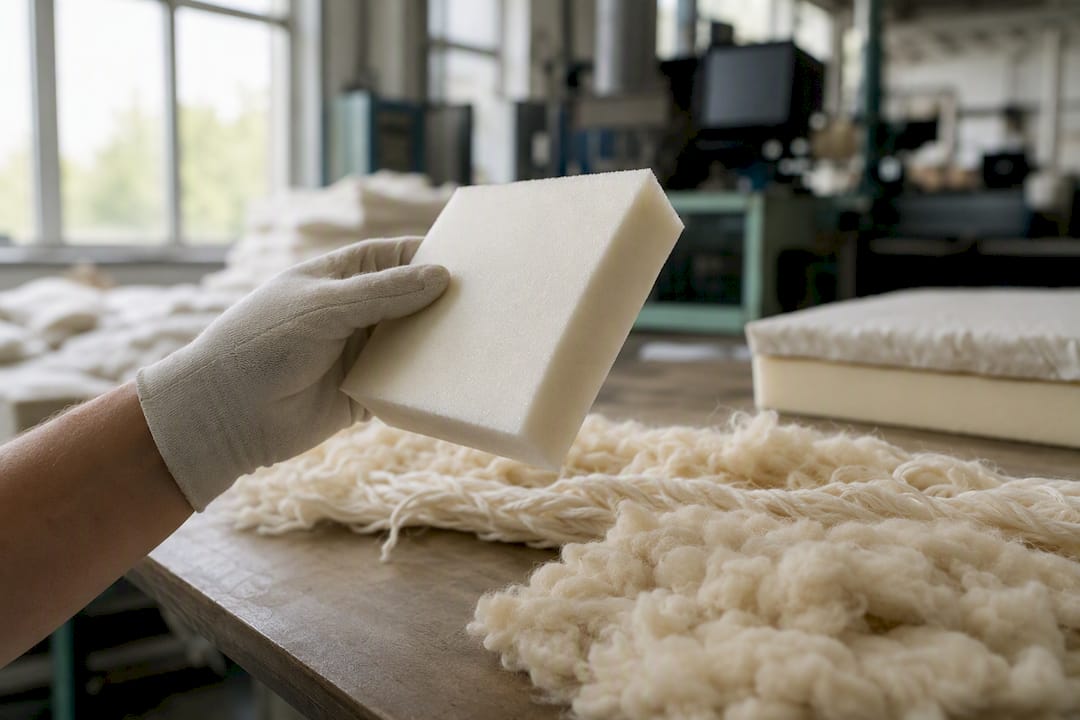
Local factories tend to allow better oversight of both materials and processes, mostly because a buyer, auditor, or journalist can actually walk the floor. That accessibility changes incentives. A factory that knows it might get inspected behaves differently than one hidden behind three layers of overseas subcontracting.
Material choice matters just as much as location. A full lifecycle assessment found that natural latex mattresses sourced from certified rubber-tree operations generally carry lower lifecycle carbon footprints than all-polyfoam alternatives, which also tend to have worse end-of-life profiles since foam doesn’t biodegrade or recycle cleanly.
- Natural latex: renewable source, biodegrades faster, but only if certified through GOLS.
- Recycled steel coils: reduces new mining and smelting demand; check for recycled-content documentation.
- GOTS-certified cotton: grown without synthetic pesticides, verified through supply-chain audits.
- Polyfoam: cheapest to produce, but the hardest material to recycle or break down later.
Domestic manufacturers are also more likely to disclose their factory’s energy source, worker conditions, and raw material origin, since that information lives a phone call away instead of buried in an overseas subcontractor’s paperwork.
How Do You Spot Greenwashing in Mattress Marketing?
Look for third-party certifications, not marketing adjectives. Terms like “eco” or “natural” carry no legal definition in the mattress industry, but GOTS, GOLS, CertiPUR-US, OEKO-TEX Standard 100, and Rainforest Alliance all require independent audits before a company can use the label.
Each certification verifies something specific. GOTS covers organic textile processing from fiber to finished product. GOLS does the same for natural latex. CertiPUR-US screens foam for heavy metals, formaldehyde, and ozone depleters. OEKO-TEX Standard 100 tests for harmful substances in the finished textile. Rainforest Alliance focuses on sustainable land management for raw material sourcing.
Watch for these red flags:
- Vague claims (“eco-friendly,” “green,” “natural”) with no certification logo attached.
- Supply-chain statements that can’t be verified independently.
- Self-designed “seals” that look official but aren’t issued by a real third-party body.
- No published lab test results for VOC emissions or off-gassing.
Industry testing groups have repeatedly found widespread greenwashing in the mattress category, which is exactly why reviewers rely on certification filters instead of brand copy when evaluating organic claims. Ask any manufacturer for full materials disclosure, third-party lab test reports, their factory’s actual address, and proof of a take-back program before you trust the word “sustainable” on a product page.
Why Local Sourcing Makes Mattress Recycling and Take-Back Easier
Local production usually improves your access to take-back programs, donation partners, and specialized recyclers, mainly because the logistics of getting a bulky mattress back to a processing site get dramatically simpler when the factory or retailer is nearby.
- Retailer take-back: some manufacturers pick up your old mattress when they deliver the new one.
- Municipal and state recycling programs: channels like Bye Bye Mattress operate in several states and break mattresses into steel, foam, and fiber for reuse.
- Donation: local shelters and reuse organizations often accept mattresses in good condition, something a detailed disposal guide can walk you through.
- Component reuse: steel coils and wood frames get pulled and resold into new products when a local recycler exists.
Where take-back programs and state recycling infrastructure exist, diversion rates climb sharply; without that infrastructure, most mattresses still end up in landfills. Before buying, ask the seller three things: what happens to your old mattress, whether there’s a disposal fee, and which recyclers they actually partner with.
When Local Sourcing Isn’t the Greener Choice
Local is usually the better bet for transportation emissions and factory oversight, but it isn’t automatically the lower-impact choice across a mattress’s full lifecycle. A local factory running on a carbon-heavy regional power grid, or cutting corners on materials, can still produce a worse overall footprint than a certified import shipped efficiently.
Watch for these tradeoffs:
- A local factory with no third-party certifications, despite proximity.
- Low-quality foam or fillers that wear out in three years instead of eight.
- Materials with high embodied emissions regardless of where they’re assembled.
- A cheaper local option that needs replacing twice as often as a certified, well-built import.
Weigh transport savings against manufacturing emissions and expected lifespan together. A mattress that lasts twice as long usually beats one with a slightly shorter supply chain but a shorter life, since replacement frequency drives most of a mattress’s lifetime carbon footprint.
A Quick Checklist Before You Buy a Locally Made Mattress
Ask for origin, certifications, a materials breakdown, the factory address, and the take-back policy before you hand over a card number. Any manufacturer proud of its process will have these answers ready, not buried in fine print.
- Request proof of GOTS, GOLS, CertiPUR-US, or OEKO-TEX certification, not just a logo on the box.
- Ask to see independent VOC and off-gassing test results.
- Confirm whether steel coils or foam contain recycled or reclaimed content.
- Check what the packaging is made from and whether it’s recyclable.
- Ask directly what happens to your old mattress at delivery.
Pro Tip: A brand willing to name its factory’s city and state, not just “Made in the USA,” is almost always the more transparent one. Vague geography is often a sign the sourcing story is thinner than the marketing suggests.
A Straightforward Take on Buying Local
I favor local sourcing paired with real certification checks over anything marketed as simply “eco” or “natural,” because proximity alone doesn’t guarantee low impact. The most consistently lower-impact path combines a domestically made mattress, verified certifications like GOTS or GOLS, and a manufacturer with an actual take-back program.
A Fiberglass-Free, American-Made Option Worth a Look
If you’ve made it this far, you already know the pattern: shorter supply chains, verifiable materials, and a real disposal plan beat vague “eco” marketing every time. Guestlysleep builds around exactly that logic, with mattresses assembled in the United States using fiberglass-free materials instead of the flame barriers that make so many mattresses impossible to recycle cleanly.
That domestic assembly means shorter delivery routes than an imported mattress shipped across an ocean, plus a materials list you can actually verify instead of a marketing paragraph. A few specifics worth knowing:
- Full materials transparency on every mattress collection, no vague “proprietary foam” language.
- Domestic assembly, which shortens the delivery chain compared to overseas shipping.
- Setup and disposal add-ons available, so your old mattress doesn’t just end up at the curb.
- A 60-night sleep trial, giving you time to confirm fit before committing long-term.
If you’re ready to compare fiberglass-free options built around these same principles, browse the current mattress collections or check out the Tranquility II adjustable base if you’re upgrading your whole sleep setup at once.
Frequently Asked Questions
Does buying a locally made mattress always mean a smaller carbon footprint? Not always. Local sourcing typically cuts transportation emissions and improves oversight, but a factory using carbon-heavy energy or low-grade materials can still produce a higher total footprint than a well-certified import.
What certifications should I look for to avoid greenwashing? Ask for GOTS, GOLS, CertiPUR-US, OEKO-TEX Standard 100, or Rainforest Alliance documentation, plus independent lab test reports for VOC emissions.
How does local sourcing help with mattress recycling? Nearby manufacturers can run their own take-back programs and partner with local recyclers, which is far more efficient than shipping a mattress back overseas or relying on limited municipal programs.
Is fiberglass-free the same thing as eco-friendly? Not automatically, but removing fiberglass improves recyclability and end-of-life handling since fiberglass contaminates recycling streams and complicates component separation.
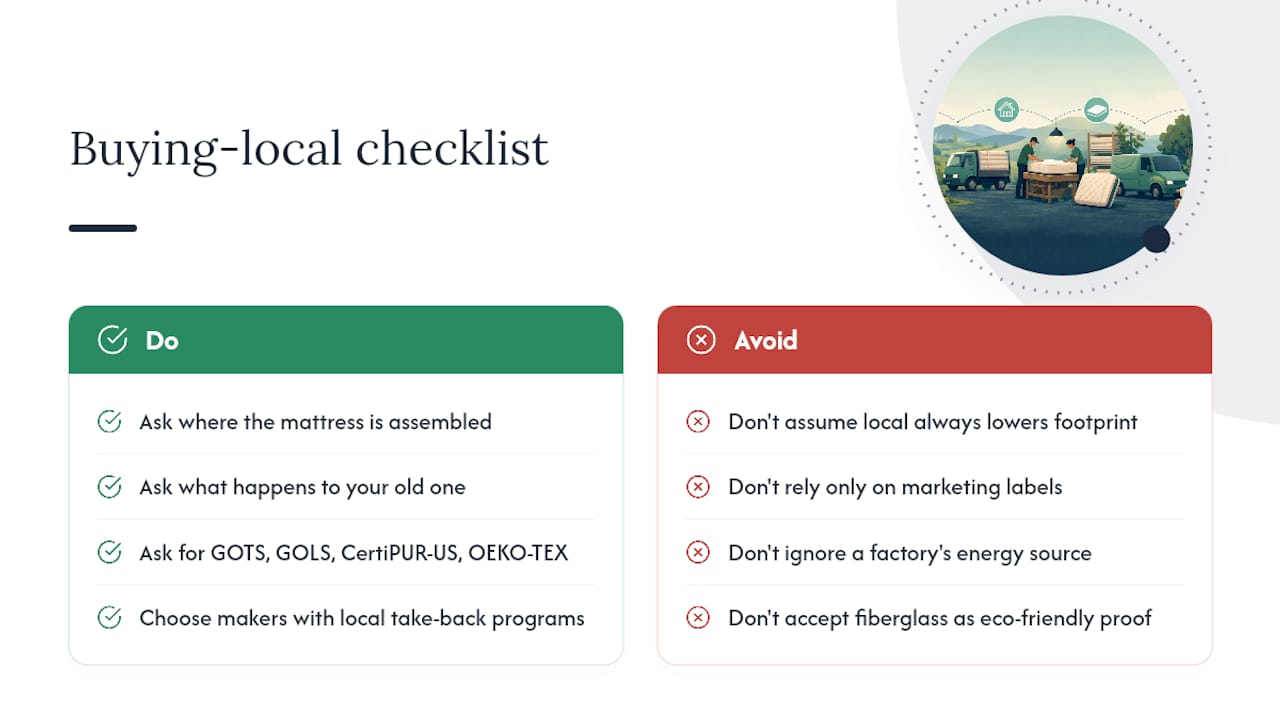
What’s the single most useful question to ask before buying? Ask where the mattress is assembled and what happens to your old one at delivery. Those two answers reveal more about real sustainability than any marketing label.
Sources
- Best Organic Mattress - 44+ Mattresses Objectively Tested | WIRED
- Mattress environmental impact — The full lifecycle assessment | MattressNut