

11 Ways to Save on Your Mattress Purchase in 2026
Buying a mattress at full retail price is one of the most avoidable financial mistakes you can make. The best ways to save on mattress purchases combine smart timing, online shopping, and negotiation tactics that most shoppers never use. Online buyers spend an average of $258 less than in-store shoppers and report higher satisfaction with both cost and features. The strategies below cover every angle, from holiday sale calendars to floor model inspections, so you walk away with a quality mattress and money still in your pocket.
1. Time your purchase around major holiday sales
Holiday sales are the single most reliable way to cut mattress costs. Major holiday discounts typically run 20–35% off, with the deepest cuts landing on Memorial Day, Labor Day, Presidents’ Day, and Black Friday or Cyber Monday. That means a $900 mattress could drop to $585 or lower during peak sale windows.
The reason these sales run so deep is inventory. Retailers clear old stock before new models arrive, and manufacturers push volume during high-traffic shopping periods. Both motivations work in your favor.
- Memorial Day and Labor Day consistently deliver the steepest discounts across most mattress categories.
- Presidents’ Day (february) is underrated. Fewer shoppers know about it, which means less competition for limited sale inventory.
- Black Friday and Cyber Monday favor online shoppers most, since direct-to-consumer brands run their biggest promotions of the year.
- New Year’s sales in january clear holiday overstock and often match summer sale pricing.
Pro Tip: Set a price alert on the mattress model you want at least 60 days before a major holiday. That way you know the real pre-sale price and can confirm the discount is genuine.
For more on optimal buying timing, the seasonal breakdown matters more than most shoppers realize.
2. Buy online to cut out showroom costs
Online mattress shopping grew 12% in 2025, and the reason is straightforward. Direct-to-consumer brands carry no showroom overhead, no commissioned sales staff, and no retail markup. Those savings pass directly to you in the form of lower prices and better materials at the same price point.

The average online mattress buyer spends $984 versus $1,242 in-store. That $258 gap is not a coincidence. It reflects the structural cost difference between a warehouse-to-door model and a traditional retail chain.
Online buying also gives you access to longer sleep trials. Sleep trials from online brands run 90 to 365 nights, compared to the few minutes you get lying on a showroom floor. Research shows it takes 4–8 weeks to physically adjust to a new mattress, so a longer trial period is not just a perk. It is a genuine protection against a bad purchase.
Pro Tip: Before buying online, read at least 20 verified reviews and check the brand’s return policy in writing. Shoppers who research deeply before purchasing report significantly higher satisfaction with online mattress buying.
3. Use affiliate coupon codes year-round
You do not need to wait for a holiday to get a strong discount. Affiliate coupon codes offering 10–30% off run year-round on many online mattress brands. These codes often match or exceed holiday sale pricing.
Coupon codes appear on deal aggregator sites, sleep review blogs, and brand newsletters. Signing up for a brand’s email list before you buy is one of the fastest ways to access a welcome discount. The savings are real, and the effort is minimal.
4. Negotiate in-store prices directly
Most shoppers assume mattress prices are fixed. They are not. 63% of shoppers who negotiated at retail locations succeeded, with a median saving of $258. The most effective tactic is price matching: show the salesperson the same or equivalent model listed for less on the manufacturer’s website.
Retailers have room to move on price because their margins are built to absorb negotiation. The key is to be specific. Pull up the online price on your phone, name the model number, and ask directly if they can match it.
Pro Tip: If the salesperson cannot lower the price, ask for free delivery, a free pillow set, or old mattress removal instead. Negotiating extras like these can add $100–$200 in total value to your purchase.
5. Inspect floor models for steep discounts
Floor models sell at 20–40% below retail and often still carry manufacturer warranties. That discount range is significant. On a $1,000 mattress, you could pay as little as $600.
The catch is condition. Floor models get tested by hundreds of shoppers. Before buying, check for stains, sagging edges, or any structural deformation in the center. Bring a flashlight if you need to. A clean floor model in good structural shape is one of the best deals in discount mattress shopping.
6. Verify model numbers before you buy
Retailers sometimes sell store-exclusive versions of popular mattresses with reduced materials or fewer comfort layers at a lower price. These look identical to the flagship model but perform differently. Always verify the exact model number against the brand’s official website before committing.
This step takes two minutes and can save you from buying a mattress that looks like a deal but underdelivers on support and durability. Checking mattress materials side by side is the clearest way to confirm you are getting what you paid for.
7. Factor in delivery fees before comparing prices
White-glove delivery and old mattress haul-away services are commonly charged as add-ons by online retailers. These fees can run $100–$200 and quietly erase the savings you calculated. Always calculate the total delivered cost, not just the sticker price.
Some brands, including Guestly Sleep, include free shipping as a standard feature. That difference matters when you are comparing two mattresses priced similarly before fees.
8. Target the $500–$700 price range for best value
Mattresses priced below $400 suffer severe quality and durability drops based on testing across 69+ models. The $500–$700 range is where value and performance converge for most shoppers. You get adequate support layers, better foam density, and longer usable life.
Spending less than $400 often means replacing the mattress within a year, which costs more over time. The $500–$700 target is not a compromise. It is the price point where budget and quality actually meet.
| Price Range | Quality Level | Typical Lifespan | Best For |
|---|---|---|---|
| Under $400 | Poor to fair | Under 2 years | Temporary use only |
| $500–$700 | Good | 3–5 years | Budget-conscious buyers |
| $700–$1,000 | Very good | 5–7 years | Long-term investment |
| Over $1,000 | Premium | 6-7 years | Luxury or specialty needs |
9. Choose all-foam mattresses for lower prices
All-foam mattresses are consistently the most affordable category that still delivers real sleep support. They cost less to manufacture than hybrid or innerspring models and are lighter to ship, which keeps prices lower. For shoppers focused on affordable mattress options, all-foam is the most reliable starting point.
Memory foam and polyfoam models in the $500–$700 range regularly outperform innerspring models at the same price because the materials age more predictably. You know what you are getting.
10. Evaluate sleep trials and warranties as part of the price
The sticker price is misleading without factoring in sleep trial length, warranty coverage, and return policies. A $650 mattress with a 365-night trial and a 10-year warranty is a better financial deal than a $550 mattress with a 30-night trial and no warranty. The total value equation changes completely.
A longer sleep trial also protects you from a costly mistake. If the mattress does not work for your body after 60 days, a strong return policy means you lose nothing. Understanding sleep trial versus warranty terms before you buy is one of the most underused money-saving moves available.
11. Replace your mattress on a regular schedule
Replacing your mattress every 2–4 years with an affordable, high-quality model is a smarter long-term strategy than buying one expensive mattress and sleeping on it for a decade. An aging mattress loses support, accumulates allergens, and affects sleep quality in ways that compound over time. The health logic behind regular replacement is well-supported by sleep hygiene research.
Buying in the $500–$700 range every few years costs less than a single $1,500 purchase stretched past its useful life. You also sleep better throughout, which has real health and productivity value.
Key Takeaways
The most effective way to save on a mattress purchase combines holiday sale timing, online direct-to-consumer buying, and active negotiation to cut costs without sacrificing quality or health.
| Point | Details |
|---|---|
| Best timing for discounts | Memorial Day and Labor Day deliver the deepest discounts, typically 20–35% off. |
| Online buying saves money | Online shoppers spend an average of $258 less than in-store buyers and report higher satisfaction. |
| Negotiation works | 63% of in-store shoppers who negotiated succeeded, saving a median of $258. |
| Avoid the under-$400 trap | Mattresses below $400 drop sharply in quality; the $500–$700 range offers the best value. |
| Total cost matters | Factor in delivery fees, trial length, and warranty before comparing prices across brands. |
Why I think most shoppers leave money on the table
Most people treat a mattress purchase like buying a car: they walk in, feel a few models, and accept whatever price the salesperson quotes. That approach costs hundreds of dollars every single time.
The shoppers who save the most are the ones who treat the purchase like a research project before they ever set foot in a store or click “add to cart.” They know the model number, the online price, the trial length, and the warranty terms before the conversation starts. That preparation is what makes negotiation work and what makes online buying so much more effective.
I have also seen shoppers obsess over getting the lowest possible price and end up with a mattress that wrecks their sleep within six months. The $400 floor is real. Going below it to save $80 is a false economy. The better move is to target the $500–$700 range, buy during a holiday sale or with a coupon code, and negotiate delivery fees or extras on top of that. You can realistically land a $700 mattress for $500 all-in if you combine those three moves.
The other thing most articles skip: a mattress that supports your body correctly reduces back pain, improves sleep depth, and has downstream effects on your energy and health. A mattress that improves sleep quality is not a luxury. It is a health purchase. Spending a little more upfront to get the right support often costs less than the chiropractor visits that follow a bad one.
Guestly Sleep offers fiberglass-free mattresses built for budget-conscious buyers
Saving money on a mattress should not mean compromising on what goes inside it. Guestly Sleep sells fiberglass-free, American-made mattresses designed for shoppers who want clean, non-toxic sleep without paying premium prices.
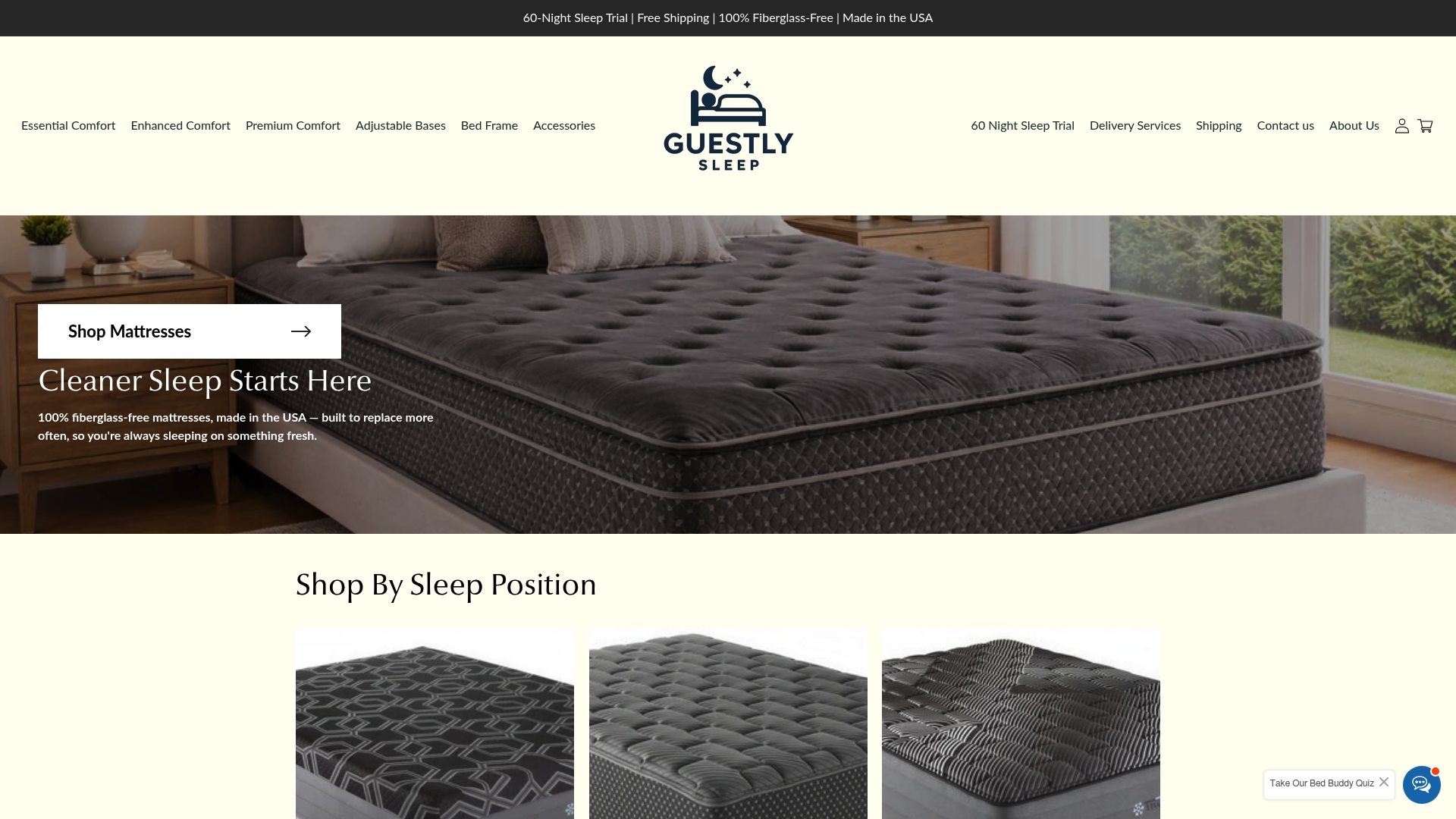
Every mattress at Guestlysleep comes with free shipping and a 60-night sleep trial, so you can test it at home with no financial risk. The product range covers Essential Comfort, Enhanced Comfort, and Premium Comfort tiers, organized by sleep position and budget. For shoppers who want a health-conscious mattress at a price that makes regular replacement realistic, Guestly Sleep is built exactly for that.
FAQ
When is the best time to buy a mattress?
Memorial Day and Labor Day are the best times to buy a mattress, with typical discounts of 20–35%. Presidents’ Day and Black Friday also deliver strong savings.
How much do online mattress buyers save compared to in-store?
Online mattress buyers spend an average of $258 less than in-store buyers, based on a 2025 survey of 1,751 mattress shoppers.
Can you negotiate mattress prices in-store?
Yes. 63% of shoppers who negotiated in-store succeeded, with a median saving of $258, most often through price matching online listings.
What is the minimum price for a quality mattress?
Avoid mattresses priced below $400. Testing across 69+ models shows severe quality and durability drops at that price point. The $500–$700 range delivers the best value for most buyers.
Are floor model mattresses worth buying?
Floor models can be worth buying at 20–40% off retail, provided you inspect them carefully for stains, sagging, or structural damage before purchasing.