

Best Time to Buy a Mattress for the Lowest Price
The best time to purchase a mattress for the best price is during major holiday sales, specifically Presidents’ Day, Memorial Day, Labor Day, and Black Friday/Cyber Monday, when discounts range from 20% to 60% off retail. That said, timing alone should never override mattress condition. If your current mattress is causing pain or disrupting sleep, waiting months for a sale will cost you more in health and lost rest than any discount saves you. This mattress buying guide covers the exact sale windows to target, what price ranges deliver real value, and how to avoid the pricing tricks retailers use year-round.
What are the best months to buy a mattress for the lowest prices?
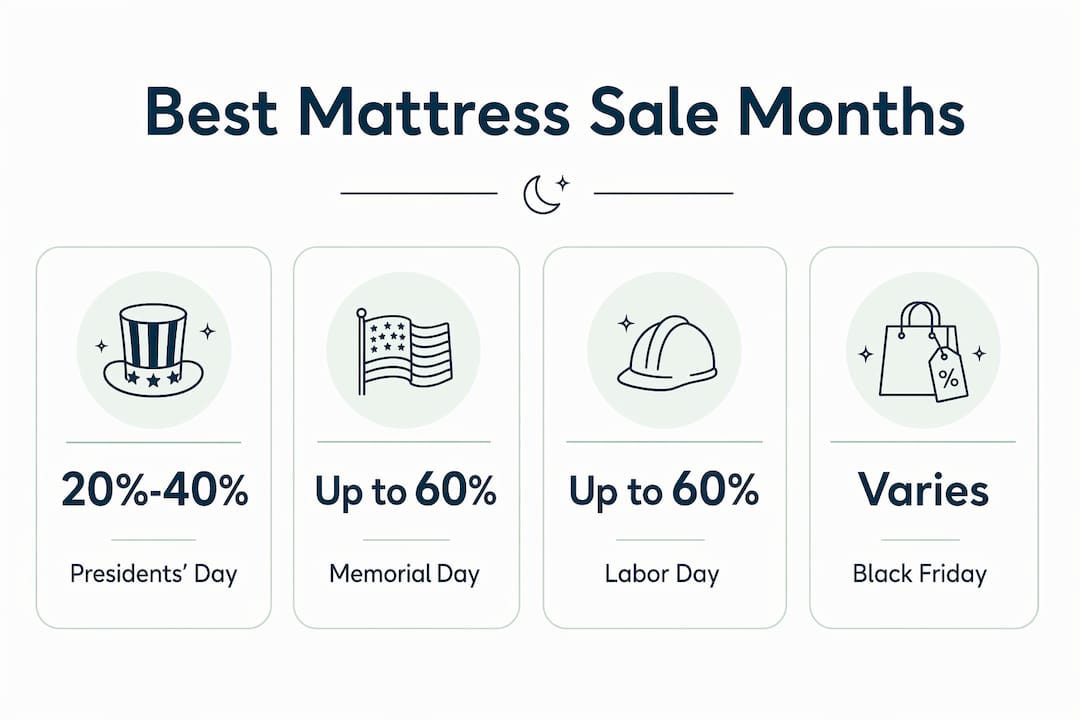
Four holiday windows consistently produce the deepest mattress deals and discounts. Knowing when they hit and what to expect from each one puts you in control of the buying process.
The four major sale windows:
- Presidents’ Day (February): The first big sale of the year. Retailers use this weekend to move winter inventory and attract early-year shoppers. Discounts are real and often match what you see in May.
- Memorial Day (late May): The most reliable sale window in the mattress industry. Retailers rotate inventory in late spring to clear older models before new lines arrive, which means you get genuine markdowns rather than manufactured ones.
- Labor Day (September): A second inventory rotation period. Retailers push remaining summer stock before the holiday shopping season begins. Discounts here often match Memorial Day levels.
- Black Friday and Cyber Monday (November): The highest-traffic sale period of the year. Online mattress brands run their most aggressive promotions. Cyber Monday specifically favors online-only brands, which often have lower overhead and can offer steeper cuts.
Pro Tip: Memorial Day and Labor Day are the two windows where inventory rotation and holiday discounts overlap. That combination produces the most genuine savings of the year.
The difference between Memorial Day and Labor Day is mostly about product availability. By Labor Day, some models from the spring lineup are already sold out or discontinued. Memorial Day gives you the widest selection at deep prices. Labor Day is better if you missed the spring window and need to move quickly.

| Sale Window | Typical Discount | Best For |
|---|---|---|
| Presidents’ Day (February) | 20%–40% off | Early-year buyers, winter clearance |
| Memorial Day (late May) | 30%–60% off | Widest selection, inventory rotation |
| Labor Day (September) | 25%–50% off | Late-summer clearance, remaining stock |
| Black Friday/Cyber Monday | 30%–60% off | Online brands, aggressive pricing |
One more timing insight most buyers miss: the period right after Thanksgiving, outside of Black Friday itself, often produces clearance pricing on older models. Post-Thanksgiving inventory clearing creates a secondary discount window that gets far less attention than the headline sale days.
How does mattress condition affect when you should buy?
Sale timing is a tool, not a rule. Experts advise replacing a mattress when it is worn out or causing pain, regardless of where the calendar sits relative to the next holiday weekend.
“Sleeping on a sagging mattress negatively impacts health more than potential savings from a discounted replacement. Immediate replacement is advised if the mattress is painful.” — Yahoo Health
The math here is straightforward. If your mattress is causing back pain, you are losing sleep quality every single night. Waiting three months for a Memorial Day sale to save $200 means three months of poor spinal support. That tradeoff rarely makes sense. Poor mattress support and spinal alignment affect more than comfort. They affect recovery, mood, and long-term musculoskeletal health.
Signs your mattress needs immediate replacement:
- Visible sagging or indentations deeper than one inch
- Waking up with back, hip, or shoulder pain that fades during the day
- Mattress is over 8–10 years old and no longer feels supportive
- Noticeable coil noise or uneven surface when lying down
- Allergies or respiratory issues that worsen at night
Pro Tip: If your mattress passes the sag test but feels less supportive than it used to, place a firm board under it temporarily while you shop. This buys you a few weeks without compounding the damage to your sleep.
Guestly sleep recommends replacing mattresses every 2–4 years for optimal sleep health. That frequency is higher than most mainstream advice, but it reflects the reality that mattress materials degrade faster than most people realize, especially foam layers under regular body weight.
What price ranges offer the best value for budget buyers?
The recommended budget sweet spot for a queen mattress is $700–$1,000, with quality options available under $700 when you focus on core materials rather than premium add-ons. That range applies to full retail pricing. During major holiday sales, you can often access $1,500 quality at $900–$1,100.
Mattress materials and what they mean for your budget:
- Memory foam: The most affordable entry point. Good pressure relief for side sleepers. Tends to retain heat, which matters if you sleep warm.
- Hybrid (foam plus coils): Better airflow and edge support than all-foam. Slightly higher price, but the durability often justifies the difference.
- Latex: The most durable material. Also the most expensive. Natural latex is worth the cost if you plan to keep the mattress for many years.
Matching mattress firmness to your sleep position is as important as price. Side sleepers need softer surfaces to relieve shoulder and hip pressure. Back and stomach sleepers need firmer support to keep the spine neutral. Buying the wrong firmness at a great price still means a bad mattress.
Luxury add-ons like cooling covers and organic textiles can raise the price by hundreds of dollars. Most budget buyers do not need them. The better move is to prioritize CertiPUR-US certified foams, which confirm the core materials meet safety and durability standards without paying for surface features you may not notice after the first week.
| Mattress Type | Price Range (Queen) | Best For |
|---|---|---|
| Memory foam | $400–$900 | Side sleepers, tight budgets |
| Hybrid | $700–$1,500 | Most sleep positions, durability |
| Latex | $1,200–$2,500 | Long-term investment, allergy-sensitive |
| Luxury plush | $1,000–$2,000+ | Comfort-focused buyers |
For buyers under $1,000, the affordable mattress features checklist from Guestly sleep is a practical starting point. It identifies which features matter at lower price points and which ones you can skip without sacrificing support.
What buying strategies maximize savings beyond timing?
Timing is the biggest lever, but it is not the only one. Several strategies consistently produce savings regardless of the calendar.
-
Track baseline prices before any sale. Many mattress discounts are permanent or artificially inflated, meaning “40% off” often reflects a price that was never real. Use tools like Google Shopping or CamelCamelCamel (for Amazon listings) to track price history over 4–6 weeks before a sale event. Real discounts show a clear drop from a stable baseline.
-
Consider floor models and discontinued lines. Buying floor models or discontinued mattresses can produce deep discounts outside of holiday windows. A floor model from a reputable brand at 40% off is often a better deal than a new budget mattress at full price.
-
Test in-store, then buy online. Testing firmness and comfort in-store before purchasing online during a sale combines the best of both worlds. You know exactly what you are getting, and online pricing during holiday events typically beats in-store pricing for the same or comparable models.
-
Factor in all fees before comparing prices. Delivery and mattress removal fees must be included in your total cost calculation. A mattress listed at $799 with $150 in delivery and removal fees costs $949. A $899 mattress with free shipping and free removal is the better deal.
-
Use trial periods as a safety net. Most online mattress brands offer 60–120 night trials. Guestly sleep offers a 60-night sleep trial. Buy during a sale, sleep on it for 30 nights, and you will know whether the firmness and support are right before the return window closes.
Pro Tip: Never buy a mattress the same day you walk into a store. Retailers are trained to close same-day sales. Take 24 hours, compare the model online, and check whether a holiday sale is within 4–6 weeks. The price will almost always still be there with the exception of price locked items which you should never buy anyway.
For a deeper look at how to evaluate cost over time, the mattress price-per-night guide from Guestly sleep breaks down how to calculate true value across a mattress’s lifespan.
Key takeaways
The best time to buy a mattress for the lowest price is during Presidents’ Day, Memorial Day, Labor Day, or Black Friday, but mattress condition, firmness fit, and total cost always outweigh timing alone.
| Point | Details |
|---|---|
| Best sale windows | Presidents’ Day, Memorial Day, Labor Day, and Black Friday deliver 20%–60% discounts. |
| Condition overrides timing | Replace immediately if your mattress causes pain; waiting for a sale costs more in lost sleep. |
| Sweet spot pricing | Quality queen mattresses fall in the $700–$1,000 range; good options exist under $700. |
| Verify real discounts | Track baseline prices for 4–6 weeks before sales to confirm markdowns are genuine. |
| Total cost matters | Add delivery and removal fees to any listed price before comparing deals. |
Why I stop chasing sales when sleep is already broken
I have watched people wait four months for a Labor Day sale on a mattress that was already causing them lower back pain every morning. They saved $300. They also spent those four months sleeping poorly, which affected their work, their mood, and their energy. That tradeoff is not rational, but it feels rational because the discount is visible and the sleep debt is invisible.
The retail pricing game is also more cynical than most shoppers realize. Retailers often inflate prices before discounts to simulate larger markdowns. A mattress “on sale” for $999 from a “regular price” of $1,499 may have never sold at $1,499 in any meaningful volume. The baseline was manufactured to make the discount look impressive. Tracking prices for a few weeks before a sale event is the single most underused tactic in mattress shopping.
My honest recommendation: if your mattress is fine and you have flexibility, wait for Memorial Day or Labor Day. If your mattress is hurting you, buy now and buy right. Focus on firmness for your sleep position, CertiPUR-US certified materials, and a brand that offers a real trial period. The budget mattress tradeoffs you make should be about skipping luxury add-ons, not skipping core support. Price is a factor. It should never be the only one.
Sleep better for less with Guestly sleep
If you are ready to act on what you have learned, Guestly sleep makes the search for affordable mattress options straightforward. Every mattress in the lineup is fiberglass-free and made in the United States, which matters if you care about what you are sleeping on night after night.
The range covers Essential Comfort, Enhanced Comfort, and Premium Comfort tiers, with options matched to side, back, and stomach sleepers. The 15" TRU Luxury Plush delivers premium feel without the premium markup. For buyers who want to compare materials and support levels side by side, the mattress comparison chart lays out every key spec in one place. Free shipping, a 60-night sleep trial, and direct manufacturer pricing mean you get real value without waiting for a sale to make the numbers work.
FAQ
When is the cheapest time for a mattress sale?
Memorial Day and Labor Day are the cheapest times for mattress sales, with discounts reaching 60% off retail. Black Friday and Cyber Monday match those levels for online brands.
Should I wait for a sale if my mattress is causing pain?
No. Replacing a worn mattress immediately is the right call when it is causing pain. Months of poor spinal support outweigh any potential discount savings.
What is a fair price for a quality queen mattress?
The recommended sweet spot is $700–$1,000 for a quality queen mattress. Good options under $700 exist when you prioritize certified core materials over luxury features.
How do I know if a mattress discount is real?
Track the baseline price for 4–6 weeks before a sale event. If the price drops clearly from a stable number, the discount is genuine. If it was already “on sale” before the event, the markdown is likely inflated.
Is buying a floor model mattress a good idea?
Yes, in most cases. Floor models and discontinued mattresses offer deep discounts outside of holiday windows. Confirm the model’s condition and ask about any remaining warranty before purchasing.