

Mattress Price-per-Night: Your 2026 Value Guide
Disclaimer: This article gives a good explanation of how the price of a mattress should be viewed. However, the chances of a mattress lasting 8 to 10 years regardless of materials or price is highly unlikely. Having spent many years in the mattress industry, here at Guestly Sleep we have seen the true longevity of all types of mattresses and 5 years is the average lifespan.
The mattress price-per-night concept is the calculation of a mattress’s total purchase cost divided by its expected number of nights of use, revealing the true nightly expense of your sleep investment. Most shoppers fixate on the sticker price and miss this more honest measure of affordability. A $1,200 mattress that lasts 10 years costs you roughly $0.33 per night. A $400 mattress replaced every 3 years costs closer to $0.37 per night. The math alone reframes every mattress purchase decision you will ever make.
What is the mattress price-per-night concept?
The mattress price-per-night concept is the industry’s preferred cost-per-use metric applied to sleep products. Financial analysts call it “cost-per-use,” and it works the same way for mattresses as it does for cars, appliances, or any durable good. The core formula is straightforward: divide the purchase price by the total number of nights you expect to use the mattress. That single number cuts through marketing language and tells you what your sleep actually costs each night.
The concept matters because upfront price is a poor proxy for value. A mattress is used every single night, which means even small differences in nightly cost compound dramatically over years. Guestlysleep builds its entire pricing philosophy around this idea, offering fiberglass-free, American-made mattresses at price points designed to deliver strong nightly value across realistic replacement cycles.
How to calculate your mattress nightly cost
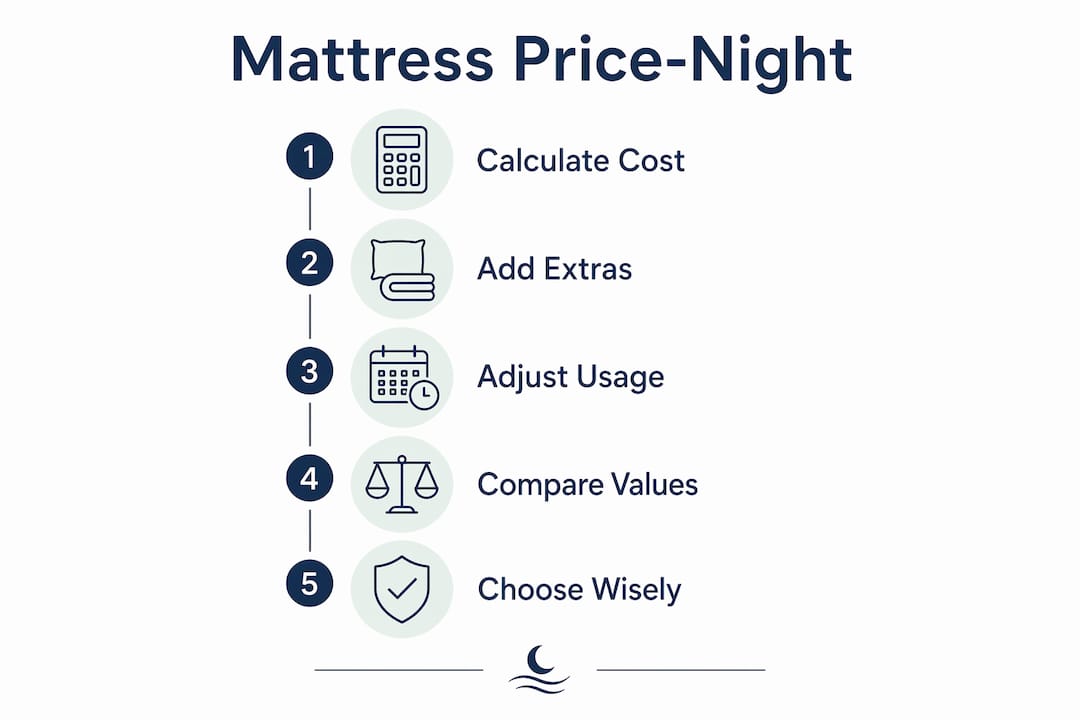
The standard formula for mattress nightly cost is: Purchase Price ÷ (Lifespan in Years × 365). That gives you a cost-per-night figure you can compare across any mattress at any price point. A realistic lifespan for a quality consumer mattress runs 8 to 10 years, though Guestlysleep recommends replacement every 2 to 4 years for optimal sleep hygiene and a cleaner sleep environment.

Adding ancillary costs like a mattress protector, bed frame installation, or disposal fees gives you a truer all-in nightly figure. A $50 mattress protector added to a $1,000 mattress changes your cost-per-night from $0.27 to $0.29 over 10 years. That difference is small, but it matters when comparing two mattresses that appear similarly priced.
Pro Tip: If you travel frequently or use a guest room mattress only part of the year, replace “365” in the formula with your actual annual nights of use. A guest room mattress used 60 nights per year at $800 costs $2.22 per night over 6 years, which is far higher than it looks on the shelf.
The table below shows how price and lifespan interact to produce very different nightly costs:
| Mattress price | Lifespan (years) | Nightly cost |
|---|---|---|
| $400 | 3 | $0.37 |
| $700 | 5 | $0.38 |
| $1,000 | 8 | $0.34 |
| $1,200 | 10 | $0.33 |
| $1,500 | 10 | $0.41 |
The pattern here is not that cheaper is better or that expensive is better. The pattern is that durability relative to price is what drives nightly value. A $1,000 mattress lasting 8 years beats a $700 mattress lasting 5 years by a small but real margin.
Why nightly cost beats sticker price for mattress value
Premium mattresses lasting roughly 10 years can be cheaper on a cost-per-use basis than lower-priced mattresses replaced after 4 years. This is the central insight that the price-per-night metric delivers. Sticker price creates what behavioral economists call “sticker shock,” a cognitive bias that makes a $1,200 mattress feel three times more expensive than a $400 one, even when the math says otherwise.
Lifecycle cost thinking also captures what replacement frequency does to your wallet. Every time you replace a mattress, you absorb not just the new purchase price but also disposal fees, installation costs, and the time cost of shopping again. Mattress disposal and haul-away services add a real dollar figure to each replacement cycle that most buyers never factor in.
Here is what the price-per-night metric captures that a sticker price never can:
- Durability value: A mattress that holds its support for 8 years costs less per night than one that sags after 3.
- Replacement frequency: Frequent replacements multiply your total spending faster than a higher upfront price.
- Ancillary costs: Protectors, installation, and disposal all belong in the true cost calculation.
- Sleep quality impact: Poor sleep from a worn mattress carries indirect costs including reduced productivity and potential health consequences.
- Trial and warranty value: A 60-night sleep trial, like the one Guestlysleep offers, reduces the risk that a mattress fails to deliver on its promised lifespan.
The quality proxies that matter most for sleep outcomes include comfort stability, pressure relief consistency, and motion isolation. These are not captured in a nightly cost figure, but they determine whether that nightly cost actually buys you restorative sleep.
How price-per-night differs between consumers and hospitality
The mattress price-per-night calculation works differently in hotel and Airbnb settings than it does in a private home. Hotels and short-term rental operators divide mattress costs across a much higher number of use nights per year, often 200 to 300 nights annually versus the 365 nights a home mattress experiences. That higher usage compresses the effective lifespan of a commercial mattress significantly.
Hotel costing methodology separates fixed costs, which occur regardless of occupancy, from variable costs, which scale with rooms sold. A mattress purchase is typically a fixed cost, but its per-night contribution to room economics depends entirely on occupancy rates. A hotel running at 60% occupancy spreads that mattress cost across far fewer nights than one running at 90%, making the effective nightly cost higher for the lower-occupancy property.
The table below compares typical price-per-night scenarios across consumer and hospitality contexts:
| Context | Mattress price | Annual nights used | Lifespan (years) | Nightly cost |
|---|---|---|---|---|
| Home consumer | $1,000 | 365 | 8 | $0.34 |
| Guest room (occasional) | $800 | 60 | 6 | $2.22 |
| Airbnb host (busy) | $1,200 | 250 | 4 | $1.20 |
| Hotel (mid-range) | $1,500 | 300 | 3 | $1.67 |
The Airbnb context adds another layer of complexity. Poor mattress quality can generate negative reviews that reduce booking rates, which means a cheaper mattress with a lower nominal nightly cost can actually cost more in lost revenue than a premium option. This is the clearest example of why cost-per-night alone cannot capture the full economic impact of mattress quality on user satisfaction.
For home consumers, the calculation is simpler and more favorable. Full nightly usage across a realistic lifespan keeps the denominator large, which keeps the nightly cost low. This is why a $1,000 home mattress often delivers better nightly value than a $400 hotel mattress used at partial occupancy.
Common pitfalls when using price-per-night for mattress decisions
The biggest mistake buyers make is using an unrealistically long lifespan in their calculation. Assuming a 15-year lifespan for a budget mattress to make the nightly cost look attractive is a form of wishful math. Most mattresses show measurable support degradation well before that point, and US mattress manufacturing standards provide useful benchmarks for realistic lifespan expectations by construction type.
A second common error is ignoring the cost denominator entirely. Calculation accuracy depends on whether you use nights available or nights actually slept. For a guest room or vacation rental, using 365 nights per year dramatically overstates usage and understates the true nightly cost. Always use your actual expected usage nights, not a theoretical maximum.
A third pitfall is treating price-per-night as the only variable that matters. The metric is a financial tool, not a comfort guarantee. A mattress with an excellent nightly cost figure that does not match your sleep position, body weight, or firmness preference will still deliver poor sleep. Essential comfort features like zoned support, pressure relief layers, and temperature regulation all affect whether the nightly cost you are paying translates into actual rest.
Pro Tip: Use price-per-night to narrow your shortlist to two or three mattresses, then let a sleep trial make the final call. A 60-night trial gives you real-world data that no formula can replicate.
The metric also does not account for health-related costs. A mattress that contains fiberglass or harmful fillers may carry an invisible cost in the form of skin irritation, respiratory issues, or disrupted sleep. Guestlysleep’s commitment to non-toxic, fiberglass-free construction means the nightly cost figure you calculate actually reflects the full value of what you are getting, with no hidden health trade-offs.
Key takeaways
The mattress price-per-night concept is the most reliable way to compare mattress value across price points, because it converts a one-time purchase into a daily cost that reflects real usage and lifespan.
| Point | Details |
|---|---|
| Core formula | Divide total purchase price by lifespan in years multiplied by 365 nights. |
| Include all costs | Add protectors, installation, and disposal fees for an accurate all-in nightly figure. |
| Lifespan accuracy matters | Use realistic lifespan estimates; inflating them produces misleading nightly cost figures. |
| Hospitality differs from home use | Hotels and Airbnb hosts use fewer annual nights, which raises effective nightly cost significantly. |
| Pair cost with quality | Price-per-night is a financial filter, not a substitute for comfort, support, and material safety evaluation. |
Why I think most mattress buyers are doing the math wrong
I have spent years watching people walk into a mattress decision armed with a budget and a vague sense that “more expensive means better.” The price-per-night framework flips that logic in a way that actually holds up. When I applied it to my own last mattress purchase, I passed on a $600 option that looked like a deal and chose a $1,050 fiberglass-free model instead. The nightly cost difference was less than $0.05, and the durability and material quality gap was enormous.
What most people miss is that the formula only works if you are honest about two things: how long the mattress will actually last, and what you are actually paying in total. I have seen buyers calculate a beautiful $0.28 per night figure and then forget to add the $80 disposal fee for their old mattress, the $60 protector, and the $75 installation service. Those additions push the real figure closer to $0.35, which changes the comparison entirely.
My honest recommendation is to run the numbers, then ignore them for 60 nights. Use the trial period your mattress comes with. Sleep on it. Track how you feel in the morning. The math tells you whether a mattress is financially rational. Your body tells you whether it is actually working. You need both signals to make a decision you will not regret three years from now.
— Justin
Sleep better for less with Guestlysleep
Guestlysleep designs every mattress in its lineup with the price-per-night calculation in mind. Each fiberglass-free, American-made mattress is built for durability, which means the nightly cost you calculate on day one stays accurate across the full lifespan of the product. The full mattress collection spans Essential Comfort, Enhanced Comfort, and Premium Comfort tiers, so you can find the right nightly value at your actual budget. Free shipping, a 60-night sleep trial, and direct manufacturer pricing all work together to keep your all-in cost as low as possible. If you are replacing an old mattress, the installation and haul-away service handles the full transition in one step, so disposal costs never catch you off guard.
FAQ
What is the mattress price-per-night formula?
The formula is purchase price divided by lifespan in years multiplied by 365. For a $1,000 mattress lasting 8 years, that equals roughly $0.34 per night.
Does a cheaper mattress always have a lower nightly cost?
No. A cheaper mattress replaced more frequently can produce a higher nightly cost than a premium mattress with a longer lifespan, as lifecycle economics consistently show.
Should I include extra costs in my mattress nightly cost calculation?
Yes. Adding the cost of a mattress protector, installation service, and disposal fee gives you a more accurate all-in nightly figure and prevents underestimating the true cost of ownership.
How does mattress rental pricing differ from consumer price-per-night?
Mattress rental pricing typically spreads a fixed cost across a contracted number of nights, similar to how hotels calculate cost per room per night. Consumer calculations use full-year usage, which generally produces a lower nightly cost than rental or hospitality models.
How often should I replace my mattress to optimize nightly value?
Guestlysleep recommends replacement every 2 to 4 years for the cleanest, healthiest sleep environment. Pairing that replacement cycle with a durable, fairly priced mattress keeps your nightly cost competitive while maintaining sleep quality.