

Sustainable Mattress Disposal Options: 9 Best Ways
The best sustainable mattress disposal options in the U.S. are: retailer haul-away when you buy new, certified recycling through the Mattress Recycling Council’s Bye Bye Mattress program, donation if the mattress is clean and structurally sound, municipal bulky-item pickup, and eco-focused private haulers. Roughly 50,000 mattresses enter U.S. landfills every single day, so the choice you make actually matters.
Quick-pick guide:
- Buying a new mattress? Ask the retailer to haul away the old one at delivery.
- Mattress is clean and under 10 years old? Try donation first.
- Mattress is soiled or worn but not infested? Use a certified recycling drop-off.
- No recycler nearby? Call 211 or check your municipal waste authority for bulky-item pickup.
- Need it gone fast? Book a private hauler, but ask where the mattress ends up.
Your first move: check the Bye Bye Mattress locator for a free drop-off near you, then call 211 if nothing comes up.
Table of Contents
- 1. Donate it: which charities accept mattresses and how to arrange pickup
- 2. Recycle it: how certified programs recover up to 75% of materials
- 3. Retailer haul-away is often the simplest sustainable route
- 4. Municipal bulky-item pickup and transfer-station drop-off
- 5. Third-party junk removal and social-enterprise haulers
- 6. How to prepare a mattress for donation, recycling, or pickup
- 7. What does each option actually cost and how long does it take?
- 8. How to choose the right disposal option for your situation
- 9. Why sustainable mattress disposal matters: the environmental and social case
- Key Takeaways
- The disposal problem starts before you buy
- Guestlysleep makes responsible disposal easier from day one
- Useful sources and further reading
1. Donate it: which charities accept mattresses and how to arrange pickup
Donation is the highest-value option when it works, because a usable mattress goes directly to a family in need. The catch is that charities are strict.
Organizations that commonly accept mattresses:
- Habitat for Humanity ReStores — accepts gently used mattresses in select locations; call ahead since policies vary by store.
- The Salvation Army — pickup available in many cities, but condition standards are firm.
- Furniture banks — the National Furniture Bank Association connects donors with local member banks; the Houston Furniture Bank, for example, picks up mattresses and recycled over 30,000 in 2024 alone.
- Local shelters and transitional housing programs — often the most flexible on age, but still require pest-free items.
Condition checklist before you call:
- No visible stains, tears, or sagging
- No history of bedbugs or other pests
- Structurally intact (no broken springs poking through)
- Law tag still attached
- Under roughly 8–10 years old (varies by organization)
Charities routinely reject mattresses with even minor stains or any pest history, so be honest when you call. Arranging pickup is straightforward: contact the organization directly, confirm they serve your zip code, ask whether pickup is free or carries a small fee, and request a written receipt for your tax records. The Houston Furniture Bank, for reference, charges $65 per pickup visit and $25 for drop-off. Use 211 to find local furniture banks and shelters that accept mattresses in your area.
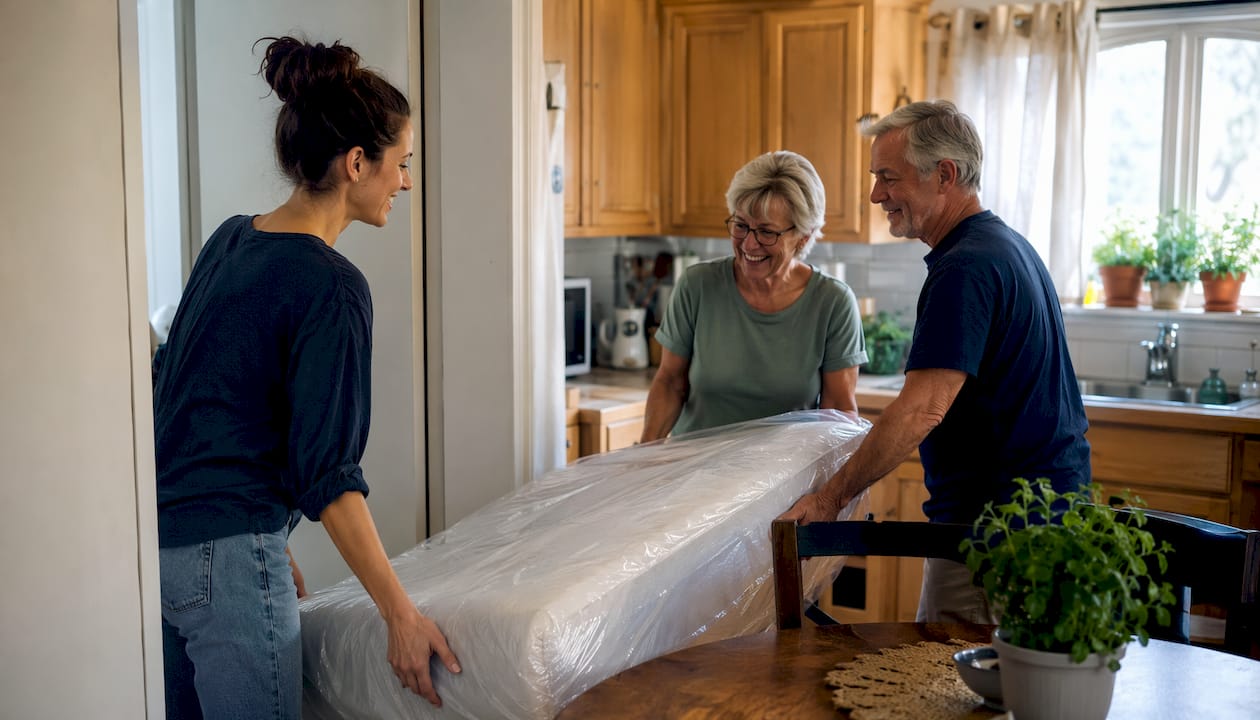
2. Recycle it: how certified programs recover up to 75% of materials
Certified mattress recycling is the right call when donation isn’t an option. Up to 75% of mattress materials — steel springs, foam, fiber, and wood — can be recovered and resold when processed at a certified facility. That’s not a rounding error; it’s most of what’s in the mattress.
The process is manual and labor-intensive. Workers cut mattresses open by hand, separate steel coils for scrap metal markets, bale foam for carpet underlayment or padding, and recover fiber and wood for industrial reuse. Most centers require mattresses to arrive dry and reasonably clean.
What gets recycled:
- Steel innerspring coils (high scrap value)
- Polyurethane and memory foam (carpet padding, gym mats)
- Fabric ticking and fiber fill (industrial insulation)
- Wood foundations and frames
What gets rejected: wet, moldy, heavily soiled, or bedbug-infested mattresses. If yours falls into any of those categories, recycling centers will turn it away.
How to find a program:
- Bye Bye Mattress (MRC): The Mattress Recycling Council’s Bye Bye Mattress program operates free drop-off in California, Connecticut, Oregon, and Rhode Island, with 240+ locations and regular collection events. California law requires all mattress retailers to offer free take-back at delivery.
- Earth911: Search Earth911 by material and zip code for recyclers outside MRC states.
- Municipal partners: Many county programs, including LA County’s Countywide Mattress Recycling Program, partner directly with MRC to offer no-cost drop-off.
Statistic callout: A 2024 life-cycle assessment from the Mattress Recycling Council found that organized recycling systems produce net environmental gains across greenhouse gas emissions, energy use, and water savings, even after accounting for the energy needed to process each mattress.
3. Retailer haul-away is often the simplest sustainable route
When you’re buying a new mattress, retailer haul-away is usually the lowest-effort path to responsible disposal. Many premium brands include it with delivery; others charge a small fee. Either way, it removes the logistics problem entirely.
Questions to ask at checkout:
- Is haul-away included, or is there an extra fee?
- Is it white-glove (they come inside) or curbside only?
- Where does the old mattress go — recycling partner, donation, or landfill?
- Do they handle box springs separately?
Common policy variations:
- Free with purchase (standard at many direct-to-consumer brands)
- Small fee, typically $25–$50
- State-mandated take-back (California requires it by law for all retailers, including online sellers)
- White-glove removal vs. curbside-only pickup
Action step: confirm haul-away in writing at checkout, not on delivery day. Ask specifically whether the mattress goes to a recycling partner. If the retailer can’t answer that question, that’s worth knowing before you buy.
4. Municipal bulky-item pickup and transfer-station drop-off
Many municipalities offer curbside bulky-item pickup or low-cost transfer-station drop-off, and this is often the cheapest option available. The challenge is that rules vary significantly by city and county.
How to find your local program:
- Visit your municipal waste authority’s website and search “bulky item pickup”
- Call or text 211 for local referrals
- Check county public works pages
- Use the Bye Bye Mattress locator, which lists municipal partners
Typical requirements:
- Schedule in advance (lead times of 1–4 weeks are common)
- Some municipalities require mattresses to be wrapped in plastic or placed in a mattress bag
- Items must be at the curb by a specific time on pickup day
- Bedbug-infested mattresses usually require a separate special-pickup request
Cost range: $0–$50 depending on your municipality. Many areas offer free bulky pickup as part of standard waste service. King County, Washington, for example, charges a $30 handling fee per mattress at transfer stations. Some cities include one or two free bulky pickups per year per household.
Pro Tip: Schedule municipal pickup the same week you schedule new mattress delivery so you’re not storing the old one for weeks.
5. Third-party junk removal and social-enterprise haulers
Private haulers are a reliable fallback when other routes aren’t available or when you need fast removal. Typical cost ranges run $75–$250 for a single mattress, depending on your location, the hauler, and whether same-day service is involved.
Questions to ask before booking:
- Where does the mattress go after pickup? Get a specific answer (recycling facility name, not just “we recycle when possible”).
- Are fees itemized, or is it a flat rate?
- How do you handle bedbug-infested items?
- Can you provide written confirmation of responsible disposal?
Service models to look for:
- On-demand junk haulers with recycling partnerships
- Recycling-focused pickup services that route materials to certified processors
- Local social-enterprise programs that combine mattress diversion with job training
Pro Tip: Prioritize haulers that provide a written disposal destination. Organizations like St. Vincent de Paul operate mattress recycling centers that both recover materials and create entry-level jobs and training programs — that’s a better outcome than a hauler who quietly sends everything to the landfill.
6. How to prepare a mattress for donation, recycling, or pickup
Prepare the mattress by removing all bedding, making sure it’s completely dry, and disclosing any pest history before scheduling. That one step prevents most rejections.
Step-by-step prep checklist:
- Strip all sheets, pillows, and mattress protectors.
- Vacuum both sides to remove dust and debris.
- Document any stains with photos (useful for donation eligibility questions).
- Check that the law tag is still attached (some recyclers and charities require it).
- If your municipality requires it, encase the mattress in a mattress bag or heavy-duty plastic wrap before placing it at the curb.
- If you suspect bedbugs, seal the mattress in thick plastic immediately, label it clearly as “INFESTED,” and contact a specialized disposal channel. Do not donate it or bring it to a standard recycling drop-off.
Safety notes for moving day: use gloves, get a second person for lifting, and avoid dragging a potentially contaminated mattress through living spaces. If your mattress contains fiberglass, take extra care — disturbing the cover can release fibers into your home. Seal it in plastic before moving it.
7. What does each option actually cost and how long does it take?
The fastest option costs the most; the cheapest requires the most lead time. Here’s a realistic breakdown:
| Option | Typical cost | Effort level | Usual lead time |
|---|---|---|---|
| Retailer haul-away | Free–$50 | Very low | Scheduled with delivery |
| Bye Bye Mattress drop-off | Free (MRC states) | Low | Same day (drop-off) |
| Municipal bulky pickup | $0–$50 | Low | 1–4 weeks |
| Donation pickup | Free–$65 | Low–medium | 1–2 weeks |
| Transfer-station drop-off | $0–$30 | Medium | Same day |
| Private hauler | $75–$250 | Low | Same day |
Regional variability is real. State-funded programs in California, Connecticut, Oregon, and Rhode Island make recycling free. Rural areas often have fewer recyclers, which pushes private hauler costs toward the higher end. Same-day or next-day private pickup is available in most metro areas but typically costs more than scheduled service.
8. How to choose the right disposal option for your situation
Decision rule: if you’re buying new, use retailer haul-away. If the mattress is clean and under 10 years old, try donation. If it’s soiled or worn but not infested, use certified recycling. If it’s infested, use sealed specialized disposal.
Decision checklist:
- Condition — Is it clean, dry, and pest-free? Donation or recycling. Soiled or infested? Recycling or specialized hauler only.
- Location — Are you in a Bye Bye Mattress state? Free recycling is available. Outside those states? Check Earth911 and 211.
- Timeline — Need it gone this week? Private hauler or transfer-station drop-off. Can you wait? Municipal pickup saves money.
- Budget — Free options exist in most areas; paid options offer speed and convenience.
- Sustainability priority — Certified recycling and social-enterprise haulers keep materials out of landfills and support local jobs.
Red flags that mean your mattress will likely end up in a landfill:
- The hauler can’t name a specific recycling facility
- Vague answers like “we try to recycle when possible”
- No written receipt or disposal confirmation offered
- Unusually low price with no explanation of where items go
When none of the above options work — the mattress is severely contaminated, infested, or no program will accept it — landfill disposal through your municipal waste service is the legal and safe fallback. It’s not the preferred outcome, but it’s better than illegal dumping.
9. Why sustainable mattress disposal matters: the environmental and social case
Structured recycling and responsible take-back systems produce clear environmental benefits and local economic advantages. The MRC’s 2024 life-cycle assessment confirms that recycling systems generate net gains across greenhouse gas emissions, energy use, and water savings compared to landfill disposal. With roughly 50,000 mattresses entering U.S. landfills daily, the aggregate impact of individual choices adds up fast.
The social dimension is just as concrete. St. Vincent de Paul operates mattress recycling centers that recover materials and create entry-level jobs and training programs for people facing employment barriers. Goodwill of Silicon Valley recycles most mattress materials at its San Jose facility, a program launched in partnership with the City of San Jose and the U.S. Department of Labor. These aren’t side benefits; they’re core to why certified programs outperform a hauler who just drives to the nearest transfer station.
The disposal equation also starts at purchase. Choosing fiberglass-free, non-toxic mattresses reduces end-of-life contamination risk and makes recycling easier. A mattress with fiberglass in the cover creates a hazard during disassembly that certified recyclers have to manage carefully. A clean, non-toxic mattress moves through the recycling process without that complication.
Key Takeaways
Certified recycling and retailer haul-away are the most practical sustainable mattress disposal options for most U.S. households, with free programs available in California, Connecticut, Oregon, and Rhode Island through Bye Bye Mattress.
| Point | Details |
|---|---|
| Start with retailer haul-away | Ask at checkout whether haul-away is included and where the mattress goes after pickup. |
| Use Bye Bye Mattress for free recycling | Free drop-off is available in CA, CT, OR, and RI; 240+ locations nationwide through the MRC. |
| Donation requires a clean, pest-free mattress | Charities reject items with stains, structural damage, or any pest history — check condition first. |
| Municipal pickup is cheapest but slowest | Schedule 1–4 weeks ahead; costs range from $0–$50 depending on your city or county. |
| Guestlysleep supports responsible disposal | Guestlysleep sells fiberglass-free mattresses and offers disposal add-ons at checkout, reducing end-of-life friction. |
The disposal problem starts before you buy
Most disposal guides focus entirely on what to do with the mattress you already have. That’s useful, but it misses the upstream decision that shapes every downstream option.
A mattress with fiberglass in the cover is genuinely harder to dispose of responsibly. Recycling workers have to handle it differently. Donation channels won’t touch it if the cover is damaged. Even a private hauler faces complications. The material that was supposed to be a cheap fire-retardant solution becomes a disposal liability the moment the mattress leaves your home.
Choosing a fiberglass-free, non-toxic mattress doesn’t just protect your household during use. It makes the mattress easier to donate, easier to recycle, and safer for every person who handles it after you. That’s not a marketing angle; it’s a straightforward material reality. The mattress materials health comparison between fiberglass-containing and fiberglass-free construction makes this difference clear.
The other thing most guides understate: the social-enterprise recycling programs are genuinely worth seeking out over generic haulers. When you route your mattress through a certified program like St. Vincent de Paul or Goodwill of Silicon Valley, you’re not just keeping foam out of a landfill. You’re funding job training for people who need it. That’s a better outcome than paying $150 to a hauler who can’t tell you where the mattress ends up.
Guestlysleep makes responsible disposal easier from day one
Replacing a mattress shouldn’t mean adding to a landfill. Guestlysleep sells fiberglass-free mattresses made in the United States, built with non-toxic materials that simplify end-of-life handling for recyclers and donation programs alike. No fiberglass contamination risk, no hazardous disassembly complications.
At checkout, disposal add-on services are available where offered, so your old mattress can be removed when the new one arrives. Free shipping and a 60-night sleep trial come standard. Regional availability for haul-away varies, so confirm the option at checkout for your zip code. If you’re ready to replace your current mattress and want the cleanest possible path from purchase to disposal, browse the full collection at Guestlysleep.com.
Useful sources and further reading
- Bye Bye Mattress / Mattress Recycling Council — The primary locator for free certified drop-off sites in MRC states; also lists collection events and commercial recycling options.
- Earth911 — Search by material and zip code to find recyclers, drop-off points, and donation centers outside MRC program states.
- 211 — Call or text 211 to reach a local information referral service that can connect you with furniture banks, shelters, and municipal waste programs in your area.
- St. Vincent de Paul Mattress Recycling — Details on SVdP’s recycling centers, which combine material recovery with job training and local employment programs.
- MRC 2024 LCA Annex Executive Summary — The life-cycle assessment confirming net environmental benefits of organized mattress recycling versus landfill disposal.
- MattressHelp: How to Dispose of an Old Mattress — Practical overview of disposal routes, condition rules, and program options across the U.S.
- Guestlysleep: How recycled materials appear in new mattresses — Explains how recycled inputs are used in mattress manufacturing and why material choices at purchase affect recyclability at end of life.
- Guestlysleep: How to reduce carbon footprint with mattress choice — Product selection strategies that reduce lifecycle emissions, relevant for readers connecting disposal decisions to purchase decisions.