

Mattress Replacement Health Benefits: Your 2026 Guide
Replacing your mattress regularly is one of the most direct, underappreciated steps you can take to protect your sleep quality and long-term health. The mattress replacement health benefits are measurable: reduced chronic pain, lower allergen exposure, deeper sleep architecture, and better cardiovascular recovery overnight. Most Americans replace a mattress every 8.3 years on average, yet all-foam models degrade in as few as 3 to 5 years. That gap between actual lifespan and replacement timing is where health quietly erodes. This guide covers what the research says, how to read your body’s signals, and how to choose a replacement that actually moves the needle.
How mattress aging affects your health and sleep quality
A degraded mattress does not just feel uncomfortable. It actively disrupts the physiological processes your body depends on during sleep. Understanding this mechanism is the first step toward doing something about it.
The heat problem
Mattress degradation traps heat, preventing the body cooling necessary for deep, restorative sleep. Your core temperature needs to drop roughly 1 to 2 degrees Fahrenheit to enter slow-wave sleep. When compressed foam loses its cell structure and airflow channels collapse, that cooling process stalls. The result is increased risk of heart disease and immune impairment tied directly to chronic sleep fragmentation. Orthopedic surgeon Dr. Hooman Melamed emphasizes that mattress degradation cycles harm sleep and long-term health in ways most patients never connect to their mattress.

The pain and micro-arousal cycle
Sustained pressure on joints from poor mattress support activates pain receptors, causing micro-arousals during sleep that fragment sleep architecture without waking you consciously. You feel the damage the next morning as grogginess, stiffness, and reduced cognitive sharpness, not as a memory of waking up. The National Mattress Authority identifies structural mattress failure as a hidden cause of pain and fragmented sleep through this exact nociceptor activation pathway. These micro-arousals impair sleep architecture significantly even when the sleeper perceives a full night of rest.
Allergens you cannot see
Old mattresses become dense reservoirs of dust mites, dead skin cells, and mold spores. Most mattresses contain high dust mite counts after 7 to 8 years, contributing to allergy flare-ups and asthma symptoms that improve when sleeping away from the mattress. If your allergies are worse in the morning and better by midday, your mattress is the likely source. This is also why mattress materials affect breathing and respiratory health in ways that go far beyond simple comfort.
Pro Tip: If your allergy symptoms improve when you sleep in a hotel or on a couch, do not blame the season. Blame your mattress. That contrast is one of the clearest diagnostic signals available.
- Heat retention from compressed foam disrupts core temperature regulation
- Nociceptor activation from poor support causes unperceived sleep fragmentation
- Dust mite accumulation triggers respiratory symptoms and skin reactions
- Degraded edge support increases partner movement transfer, reducing total sleep time
What are the signs you should replace your mattress?
Age alone is a poor indicator of when to replace a mattress. A 6-year-old foam mattress can be functionally dead. Relying on the calendar instead of your body and the mattress itself leads to sleeping on a degraded surface longer than necessary.
Experts recommend assessing mattress health by symptoms and measurable sag rather than relying on outward appearance or age alone. Here is a practical diagnostic sequence:
- Measure the sag. Lay a straightedge or rigid board across the mattress surface. Visible sagging over 1.5 inches is a reliable industry indicator for warranty replacement and functional decline of mattress support. This is the threshold most manufacturers use in warranty claims.
- Track morning stiffness. If you wake with lower back, hip, or shoulder pain that resolves within 30 minutes of getting up and moving, the mattress is the cause, not your age or activity level.
- Test the allergy pattern. Allergy flare-ups that improve when you sleep away from home point directly to allergen buildup in your mattress.
- Assess partner disturbance. If you feel every movement your partner makes, the foam or coil system has lost its motion isolation capacity. This is a structural failure, not a preference issue.
- Check the warranty status. Mattress warranties often cover 10 years, reflecting expected functional lifespan. If your mattress is past warranty and showing any of the above signs, replacement is overdue.
Pro Tip: Sleep on a different surface for three consecutive nights, whether a guest bed, a hotel, or an air mattress. If your pain and sleep quality improve noticeably, your current mattress is the variable. No other test is more reliable.
Appearance can mislead consumers. Key diagnostic signs include morning stiffness, allergy flare-ups improving off the mattress, and partner movement sensitivity. A mattress that looks fine from across the room can be causing measurable health damage every night.
How to choose a mattress replacement to maximize health benefits
Not all replacement mattresses deliver equal health returns. The type, firmness, and material composition of your next mattress determine how much of the benefit you actually capture.
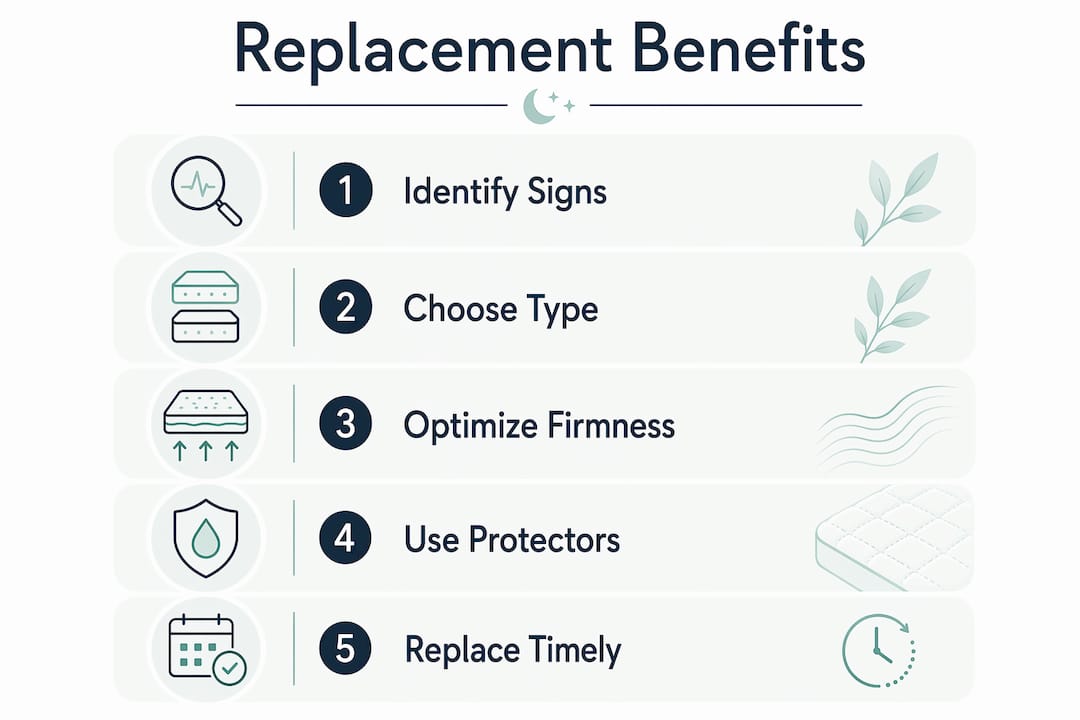
Mattress type comparison
| Mattress type | Typical lifespan | Key health benefit | Price range |
|---|---|---|---|
| Budget all-foam | 3 to 5 years | Pressure relief, low motion transfer | $200 to $600 |
| Hybrid (foam + coils) | 5 to 6 years | Airflow, balanced support, edge support | $700 to $1,800 |
| Premium latex | 6 to 7 years | Hypoallergenic, durable support, cooling | $1,200 to $3,000 |
| Memory foam (mid-tier) | 5 to 6 years | Contouring pressure relief, pain reduction | $500 to $1,200 |
Medium-firm mattresses reduce chronic low back pain more effectively than firm models, due to balanced support that avoids hyperextension and pressure points. This finding applies across mattress types: the firmness level matters as much as the material. Side sleepers typically need softer pressure relief at the shoulder and hip, while back and stomach sleepers benefit from firmer lumbar support. You can explore a detailed mattress type breakdown to match your sleep position with the right construction.
When evaluating replacement options, prioritize these features:
- Fiberglass-free construction. Fiberglass is used as a fire barrier in many budget mattresses and can shed into your sleeping environment, causing skin and respiratory irritation.
- Certified materials. Look for CertiPUR-US certified foam, which confirms the absence of harmful chemicals including formaldehyde and heavy metals.
- Zoned support layers. Mattresses with differentiated firmness zones provide targeted lumbar support without sacrificing shoulder pressure relief.
- Breathable cover materials. Tencel, organic cotton, and phase-change fabric covers actively manage heat at the sleep surface.
Using mattress protectors and rotating mattresses regularly can extend mattress longevity and preserve health benefits between replacements. A quality waterproof protector prevents moisture and allergen penetration, which is the primary driver of premature degradation in foam layers. Rotating a non-pillow-top mattress 180 degrees every three months distributes wear evenly and delays sagging. These steps do not replace timely replacement, but they protect your investment between cycles. For a deeper look at how materials affect your breathing and sleep, the guide on comfort mattress features covers the specifics worth knowing before you buy.
How often should you replace your mattress for optimal health?
The average U.S. replacement cycle is 8.3 years, but that figure reflects consumer behavior, not optimal health outcomes. Guestlysleep recommends a 2 to 4 year replacement cycle for mattresses specifically because their materials degrade faster than most consumers realize.
Here is a practical replacement schedule by mattress type:
- Budget all-foam: Replace every 3 to 5 years. These mattresses lose meaningful support density within 2 to 3 years of regular use.
- Mid-tier memory foam: Replace every 5 to 6 years, or sooner if morning stiffness or sag appears.
- Hybrid: Replace every 5 to 6 years. Coil systems maintain support longer, but foam comfort layers degrade on the same timeline as all-foam models.
- Premium latex: Replace every 6 to 7 years. Natural latex resists compression and allergen buildup better than any other material.
The benefits of a shorter replacement cycle are not just theoretical. Fresher foam means better pressure relief, lower allergen load, and more consistent thermal regulation every night. For consumers balancing cost against health outcomes, the mattress cost per year calculation often reveals that frequent replacement of a mid-priced mattress costs less annually than holding onto a premium model past its functional life.
Pro Tip: Divide the mattress price by the number of nights in its expected lifespan. A $600 foam mattress replaced every 4 years costs roughly $0.41 per night. A $1,500 hybrid lasting 8 years costs about $0.51 per night. The health math often favors more frequent replacement of mid-range options.
Key takeaways
Replacing your mattress on a schedule matched to its material type is the single most controllable factor in your nightly sleep quality and long-term physical health.
| Point | Details |
|---|---|
| Replacement timing by type | Budget foam lasts 3 to 5 years; hybrids 5 to 6; latex 6 to 7. |
| Sag is the clearest signal | Sagging over 1.5 inches indicates functional failure regardless of mattress age. |
| Allergens accumulate invisibly | Dust mite buildup after 7 to 8 years drives allergy and asthma symptoms that improve off the mattress. |
| Medium-firm wins for pain | Medium-firm support reduces chronic low back pain more effectively than firm mattresses. |
| Frequent replacement pays off | Shorter replacement cycles deliver fresher support, lower allergens, and better sleep at comparable annual cost. |
Why I stopped trusting mattress age as the only rule
People ask me constantly how often they should replace their mattress, expecting a single number. The honest answer is that the number depends on what you paid, what it is made of, and what your body is telling you every morning. I have seen people sleeping on 8-year-old latex mattresses with minimal sagging and I have seen 6-year-old foam models that were functionally destroyed.
The mistake most consumers make is waiting for obvious physical evidence: a visible dip, a broken spring, a stain they cannot ignore. By the time the mattress looks bad, it has usually been harming your sleep for 18 months or more. Morning stiffness that you attribute to aging, allergies you blame on the season, fatigue you chalk up to stress. These are often mattress problems wearing other disguises.
My practical advice: stop thinking of a mattress as furniture and start thinking of it as a health tool with a service life. You would not use a worn-out running shoe because it still technically covers your foot. The same logic applies here. If you want to go deeper on how budget mattress tradeoffs affect long-term sleep health, that resource lays out the real cost of holding on too long.
Sleep better with Guestly Sleep’s fiberglass-free mattresses
If the research in this article has you reconsidering what you are sleeping on tonight, Guestlysleep makes the replacement decision straightforward. Every mattress in the Guestlysleep lineup is manufactured in the United States, certified fiberglass-free, and built without harmful fillers that degrade air quality in your bedroom.
Guestlysleep organizes its fiberglass-free mattress collection by comfort level and sleep position, so you are not guessing at firmness. The 60-night sleep trial removes the risk from the decision entirely. If you need to remove your current mattress before the new one arrives, the mattress disposal and haul away service handles eco-friendly removal without the hassle. Not sure which construction fits your sleep style? The mattress comparison chart puts hybrid and memory foam options side by side with health benefit breakdowns.
FAQ
What are the main health benefits of replacing your mattress?
Replacing your mattress reduces chronic pain by restoring proper spinal support, lowers allergen exposure from accumulated dust mites, and improves sleep architecture by eliminating heat retention and pressure-induced micro-arousals.
How often should you replace your mattress?
Replacement frequency depends on mattress type: budget all-foam every 3 to 5 years, mid-tier memory foam every 5 to 6 years, hybrids every 5 to 6 years, and premium latex every 6 to 7 years.
How do you know when a mattress needs replacing?
Measure sag with a straightedge. Sagging over 1.5 inches signals functional failure. Morning stiffness that resolves after getting up, allergy symptoms that improve away from home, and increased partner movement sensitivity are equally reliable indicators.
Does mattress firmness affect health outcomes?
Medium-firm mattresses reduce chronic low back pain more effectively than firm models by balancing lumbar support with pressure relief at key joints. Firmness needs also vary by sleep position, with side sleepers requiring softer surfaces at the shoulder and hip.
Can a mattress protector delay the need for replacement?
A quality waterproof protector slows allergen buildup and prevents moisture from degrading foam layers, extending functional lifespan. It does not reverse existing compression or restore lost support, so it supplements but does not replace timely mattress replacement.