

What Is Mattress Cost per Year? A 2026 Breakdown
Mattress cost per year is defined as the purchase price of a mattress divided by its expected lifespan in years, giving you a practical metric to evaluate true long-term value. A $1,000 mattress lasting 7 years costs roughly $143 per year, which changes the conversation entirely when you’re comparing a budget option to a premium one. Most consumers focus on sticker price alone, which leads to poor decisions. Brands like Nectar, Saatva, Helix, and Tempur-Pedic all sit at wildly different annual costs once you run the numbers. This guide breaks down the full mattress cost breakdown so you know exactly what you’re paying for each year of sleep.
What is mattress cost per year and how do you calculate it?
The formula is straightforward: divide the total purchase price by the number of years you expect to use the mattress. That’s it. The complexity comes from choosing the right lifespan assumption, because that single number drives the entire result.
Most industry guidance uses 7 years as a standard lifespan, though quality mattresses often last 8 to 10 years. The difference matters more than most people realize. A $1,500 mattress costs about $214 per year over 7 years but drops to $150 per year over 10 years. That’s a 43% swing in perceived annual cost from one assumption. Choosing the wrong lifespan inflates or deflates your estimate significantly.
Here’s how to run the calculation yourself:
- Find the total purchase price. Include any delivery, setup, or disposal fees you’ll pay at the time of purchase.
- Determine a realistic lifespan. Use 7 years for budget foam, 8 to 10 years for mid-tier hybrids, and up to 15 years for latex.
- Divide price by lifespan. A $900 mattress with a 9-year lifespan costs $100 per year.
- Add recurring annual costs. Mattress protectors, cleaning, and eventual disposal fees can add $15 to $30 per year.
- Compare across options. Run the same calculation for two or three mattresses before deciding.
Pro Tip: Never assume you’ll replace your mattress every year. Annual replacement is a common miscalculation that makes every mattress look far more expensive than it actually is. Use the realistic lifespan, not your purchase frequency.
How mattress type and quality affect annual costs
The type of mattress you buy determines both the upfront price and how long it lasts. Those two variables together set your annual cost, which is why type and quality are the most important inputs in any mattress investment calculator.
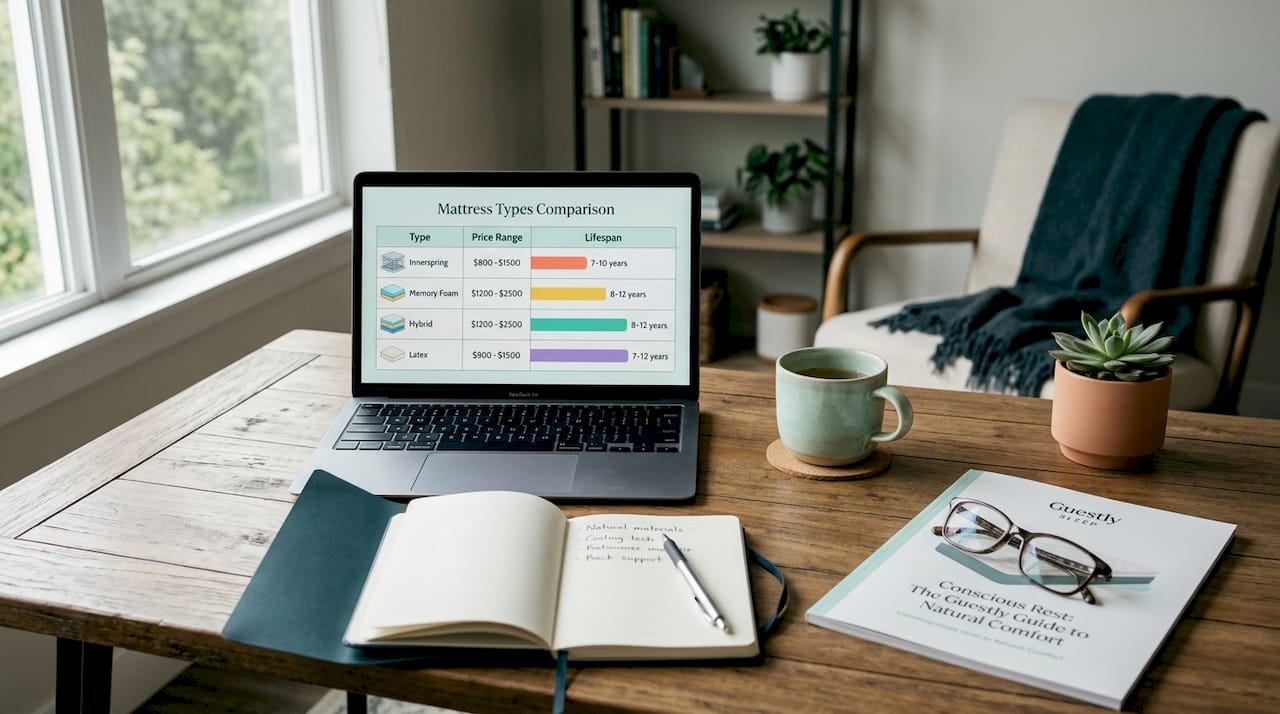
| Mattress Type | Average Price Range | Typical Lifespan | Estimated Annual Cost |
|---|---|---|---|
| Budget innerspring | $300 to $600 | 5 to 6 years | $50 to $120/year |
| Memory foam (mid-tier) | $800 to $1,500 | 7 to 9 years | $90 to $215/year |
| Hybrid (mid to premium) | $1,200 to $2,500 | 8 to 10 years | $120 to $310/year |
| Latex | $1,500 to $3,500 | 12 to 15 years | $100 to $290/year |
| Luxury/smart beds | $3,000 to $5,500+ | 8 to 10 years | $300 to $690/year |
Latex stands out as the most cost-efficient type over time. Latex mattresses last 12 to 15 years, which lowers their cost per year by 20 to 40% compared to shorter-lifespan alternatives. A $2,400 latex mattress spread over 14 years costs about $171 per year, which beats most mid-tier foam options.
Mid-tier mattresses averaging $1,500 and lasting 8 to 10 years consistently deliver a lower cost per night than cheap mattresses replaced every 5 years. The math rewards quality. Spending more upfront on a durable mattress almost always reduces the annualized cost, even before you factor in the sleep quality difference.
Pro Tip: When comparing two mattresses at similar price points, ask the retailer for the warranty length. A longer warranty often signals a longer expected lifespan, which directly reduces your annual cost calculation.
Additional factors that drive up mattress yearly expenses
Purchase price is only part of the story. Several add-on costs inflate the true annual mattress cost, and most consumers don’t account for them until after checkout.
The most common overlooked expenses include:
- Delivery and shipping fees. Some brands charge $50 to $150 for standard delivery. Sleep Number, for example, includes a $250 delivery charge on certain models, which adds $25 to $35 per year to a 7 to 10-year ownership period.
- White glove setup fees. Brands like Helix charge $99 for professional setup, which covers in-home delivery, assembly, and old mattress removal. That fee is a one-time cost but still factors into your total ownership calculation.
- Mattress disposal. Getting rid of an old mattress averages $75 in disposal fees when using a third-party service. Spread over a 7-year lifespan, that’s about $11 per year added to your cost.
- Mattress protectors. A quality waterproof protector from brands like SafeRest or Protect-A-Bed runs $30 to $80 and should be replaced every 2 to 3 years. That adds roughly $15 to $25 per year.
- Warranties and trial periods. These are value factors, not costs, but they affect the equation. A brand offering a lifetime warranty and free removal, like Saatva, reduces your future disposal and replacement costs.
Consider two mattresses priced at $1,200 each. Brand A includes free shipping and a 10-year warranty with free removal. Brand B charges $150 for delivery and $75 for disposal, with a 5-year warranty. Brand A’s true 10-year cost is $1,200, or $120 per year. Brand B’s true cost is $1,425 over 5 years, or $285 per year. Same sticker price, more than double the annual cost. Disposal and setup fees are critical inputs for any accurate cost per year calculation, especially with direct-to-consumer brands.
Real 2026 mattress models: cost per year compared
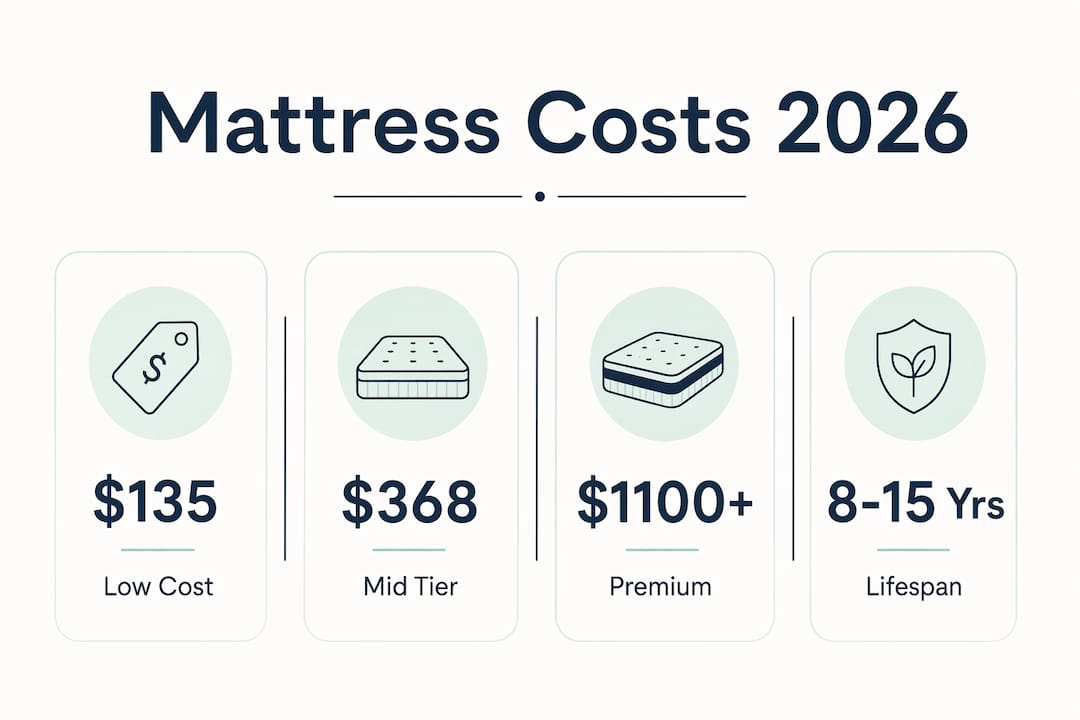
Putting real numbers to the formula makes the concept concrete. The following table uses 2026 market prices and realistic lifespan assumptions to show how annual mattress costs vary across popular models.
| Mattress Model | Purchase Price | Assumed Lifespan | Add-On Fees | Total Cost | Annual Cost |
|---|---|---|---|---|---|
| Nectar Original | $799 | 7 years | $0 (free shipping) | $799 | ~$114/year |
| Helix Midnight | $1,099 | 8 years | $99 setup | $1,198 | ~$150/year |
| Amerisleep AS3 | $1,299 | 9 years | $0 (free shipping) | $1,299 | ~$144/year |
| Saatva Classic | $1,995 | 10 years | $0 (free removal included) | $1,995 | ~$200/year |
| Tempur-Adapt | $2,199 | 10 years | $75 disposal | $2,274 | ~$227/year |
| Sleep Number 360 i10 | $4,999 | 8 years | $250 delivery + $75 disposal | $5,324 | ~$666/year |
2026 mattress prices range from $599 to $5,499, with annual costs spanning from roughly $135 to over $1,100 depending on model, lifespan, and fees. The Nectar Original delivers one of the lowest annual costs in the market. The Sleep Number 360 i10, despite its smart-bed features, costs nearly six times more per year once delivery and disposal are included.
Saatva stands out for a different reason. The $368 per year Saatva Classic cost includes a lifetime warranty and free white glove removal, which eliminates future disposal fees entirely. That warranty changes the long-term math in ways the sticker price never shows. Replacement timing based on physical wear, like sagging or persistent discomfort, also affects how long any of these models actually last in your home.
Key takeaways
Mattress cost per year equals purchase price plus all ownership fees divided by realistic lifespan, and that single number exposes the true value of any mattress you’re considering.
| Point | Details |
|---|---|
| Use the right formula | Divide total ownership cost, including fees, by realistic lifespan in years. |
| Lifespan changes everything | Shifting from 7 to 10 years cuts perceived annual cost by up to 43%. |
| Latex wins long-term | Latex mattresses last 12 to 15 years, making them cost-efficient despite higher upfront prices. |
| Add-on fees add up fast | Delivery, setup, and disposal can add $300 or more to total ownership cost. |
| Warranties reduce future costs | Free removal and lifetime warranties lower your true annual cost over time. |
Why most people get this calculation wrong
I’ve spent years looking at how consumers evaluate mattress purchases, and the same mistake shows up constantly. People treat the purchase price as the annual cost. They see $1,200 and mentally register “this costs $1,200 a year to sleep on.” That framing makes every mattress feel expensive and pushes buyers toward the cheapest option available.
The cheap option almost always costs more per year. A $400 innerspring that needs replacing in 4 years costs $100 per year before fees. A $1,200 hybrid lasting 10 years costs $120 per year before fees, but delivers meaningfully better sleep the entire time. The difference in annual cost is $20. The difference in sleep quality is not small.
What I find most underappreciated is the disposal and setup cost angle. Most people budget for the mattress and forget about getting rid of the old one. That $75 disposal fee, spread over a 7-year lifespan, is only $11 per year. But if you’re replacing a mattress every 4 years because you bought cheap, that same $75 becomes $19 per year. Small numbers, but they compound the case for buying better.
My honest advice: run the full calculation before you buy. Include delivery, setup, a mattress protector, and an estimated disposal fee. Then divide by the realistic lifespan for that mattress type. You’ll almost always find that the mid-tier or premium option is closer in annual cost to the budget option than the sticker prices suggest. And the sleep you get in return is not comparable.
— Justin
Sleep better for less with Guestlysleep
Guestlysleep builds fiberglass-free, American-made mattresses designed to last, which directly lowers your annual mattress cost. Every mattress in the Guestlysleep collection ships free, and the brand’s direct manufacturer relationships keep prices lower than traditional retail without cutting corners on materials. If you want to reduce hidden ownership costs further, Guestlysleep offers a white glove setup service and a dedicated mattress disposal and haul away option so you’re never stuck managing the logistics yourself. With a 60-night sleep trial and no fiberglass fillers, Guestlysleep mattresses are built for consumers who want clean, safe sleep at a price that makes sense year over year.
FAQ
What is the average mattress cost per year?
The average mattress cost per year ranges from $100 to $300 for most mid-tier options, based on a purchase price of $800 to $2,500 divided by a 7 to 10-year lifespan. Add-on fees like delivery and disposal push that number higher.
How do I calculate my mattress price per month?
Divide the total ownership cost, including delivery and disposal fees, by the expected lifespan in months. A $1,200 mattress lasting 9 years equals 108 months, which works out to about $11 per month.
Does mattress type affect annual cost significantly?
Yes. Latex mattresses last 12 to 15 years and reduce annual cost by 20 to 40% compared to budget foam options that may need replacing in 5 to 6 years, even when the latex mattress costs more upfront.
What add-on fees should I include in my mattress cost breakdown?
Include delivery fees, white glove setup charges, mattress disposal costs averaging $75, and annual mattress protector replacement. These fees can add $150 to $400 to your total ownership cost over a standard lifespan.
How often should I replace my mattress to keep annual costs accurate?
Replace your mattress based on physical wear signals like sagging, lumps, or persistent discomfort rather than a fixed calendar schedule. Most quality mattresses last 7 to 10 years, and replacing too early inflates your true annual cost unnecessarily.