

Most Eco-Mattress Claims Are Marketing, Not Proof
Most “eco-friendly” and “organic” mattress claims are marketing language until a finished-product certification backs them up. That’s the blunt truth behind common eco-mattress marketing myths, and it’s the single fact that separates a real non-toxic mattress from a well-photographed one.
Three signals actually mean something: a GOTS finished-product license (not a raw materials cert), GREENGUARD Gold for VOC emissions, and a public certifier registry you can search yourself. Everything else is a claim someone typed into a product description.
The most common greenwashing pattern in this category is what industry watchers call component-only certification: a brand certifies the cover fabric or the latex core, then lets the shopper assume the whole mattress qualifies.
- Check for a GOTS or GOLS license number, not just a logo.
- Search that number in the certifier’s own public database before buying.
- Ask specifically whether the certification covers the finished mattress or a single component.
Fewer than half of “organic” mattress listings that use the word freely can actually point to a finished-product GOTS certification covering the entire product rather than one layer of it.
Key Takeaways
A mattress claim only means something when it’s backed by a finished-product certification you can independently verify through a public registry.
| Point | Details |
|---|---|
| Certification scope is everything | Confirm whether a certification covers the finished mattress or just one component. |
| GOTS verifies whole-product organic claims | Look for a finished-product license number, not just an “organic cotton” mention. |
| GREENGUARD Gold addresses air quality | Prioritize it if VOC emissions and off-gassing are your main concern. |
| CertiPUR-US is foam-only | Treat it as a baseline for foam, not proof of a non-toxic mattress overall. |
| Guestlysleep discloses materials upfront | Fiberglass-free, U.S.-made mattresses with a 60-night trial for firsthand verification. |
Table of Contents
- Common Eco-Mattress Marketing Myths, Debunked
- How to Verify Eco and Organic Claims Before You Buy
- How Guestly Sleep Handles Transparency on Its Own Listings
- Beyond Materials: The Real Environmental Footprint
- Comfort and Support: What Eco-Materials Actually Deliver
- What “Recycled Materials” Actually Means on a Mattress Label
- Editorial Take: Certification Beats Vibes Every Time
- A Mattress Built Around the Same Transparency Standard
- Frequently Asked Questions
- Sources
Common Eco-Mattress Marketing Myths, Debunked
Eco-mattress misconceptions spread because the language sounds regulated when it isn’t. Here are the eight claims you’ll see most often, and what they actually mean.
1. “Organic” on the page means the whole mattress is organic
This is the granddaddy of eco-friendly mattress myths. The word “organic” has no legal floor in mattress advertising unless it’s tied to a certification body. The only standard that verifies an entire finished mattress, not just one layer, is a GOTS finished-product license, which requires a minimum share of certified organic fiber (typically around 95% for a product-level organic claim) and shows up under a searchable license number in public certifier registries.
Shopper action: Look for the words “finished product” or “GOTS certified mattress” specifically, not just “organic cotton cover” buried in the fine print.
2. CertiPUR-US means non-toxic or organic
CertiPUR-US tests polyurethane foam for certain emissions and performance properties. It says nothing about organic content, and it doesn’t test for PFAS. It’s a foam-industry baseline, useful for ruling out the worst foam offenders, but it was never designed to certify an entire mattress as non-toxic. If a listing leans on this logo to imply the whole product is chemical-free, that’s a stretch the certification doesn’t support. Our breakdown of what CertiPUR-US certification really covers goes deeper into where the standard’s authority starts and stops.
Shopper action: Treat CertiPUR-US as a foam-only checkbox, then ask what covers the rest of the mattress.
3. Any green-looking certification logo guarantees zero off-gassing
GREENGUARD Gold measures VOC emission limits and is one of the more meaningful signals a shopper can look for, since it’s tied to independent indoor air quality research on chemical exposure. But it doesn’t guarantee organic materials or address every ingredient in a mattress. A product can pass GREENGUARD Gold and still not qualify as “organic” in any meaningful sense.
Shopper action: If air quality is your top concern, prioritize GREENGUARD Gold over vague “eco” language.
4. Natural latex attracts bed bugs or pests
This myth about eco bedding gets repeated constantly with no real backing. Pest risk comes down to storage conditions, humidity, and hygiene, not the material itself. Latex isn’t inherently more attractive to bed bugs than memory foam or innerspring construction. Good mattress hygiene practices, including safer fabric cleaning approaches, matter far more than the core material.
Shopper action: Focus on protector covers and cleaning routine, not on avoiding latex out of pest fear.
5. Eco mattresses always cost more
Some certified organic and latex mattresses are priced competitively, and price alone tells you nothing about whether a mattress is actually certified. A budget listing can carry a genuine GOTS license, and a $3,000 mattress can carry zero verifiable certification at all. Price is a marketing lever, not a safety metric.
Shopper action: Compare certification documentation across price points instead of assuming the pricier option is cleaner.
6. A higher price tag means better non-toxic credentials
Brand recognition and marketing spend drive price far more than material safety does. A well-funded startup with a slick website can charge premium prices while offering the same undocumented “eco-friendly” language as a discount retailer. What actually separates the two is documentation you can verify, not the number on the price tag.
Shopper action: Ask for the certificate, not the confidence.
7. Terms like “clean,” “non-toxic,” and “eco-friendly” are regulated
They aren’t. These are among the most common myths about eco bedding precisely because they sound official. No federal agency defines “clean” or “eco-friendly” for mattresses, and greenwashing guidance from within the industry itself confirms that shoppers need to look past the adjective and demand a certifier name and license number.
Shopper action: Treat any of these words as a prompt to ask “certified by whom, exactly?”
8. If a mattress smells like anything, it’s not eco-friendly
New mattresses can carry a faint odor from adhesives, foam, or packaging compression, regardless of how “natural” the marketing sounds. Smell alone doesn’t confirm or deny eco credentials. GREENGUARD Gold testing and a few days of ventilation address the actual VOC concern far better than a sniff test does.
Shopper action: Judge by emissions testing, not by nose.
How to Verify Eco and Organic Claims Before You Buy
The gap between “certified” and “certified-sounding” is where most eco-mattress misconceptions live. Certification scope confusion, mistaking a material-level cert for a finished-product one, is the core lever behind most greenwashing in this category, and closing that gap takes about five minutes per listing.
Each certifier tests something different, and knowing which one matches your actual concern saves you from chasing the wrong logo:
- GOTS verifies organic textile content and supply chain for the finished product, when licensed at that level.
- GOLS certifies the latex material itself, not automatically the finished mattress. Supplier certification documents show this scope clearly.
- GREENGUARD Gold measures VOC emission limits, the strongest signal for indoor air quality concerns.
- OEKO-TEX tests textiles for harmful substances, useful for shoppers focused on fabric safety.
- CertiPUR-US tests polyurethane foam content and emissions, a foam-specific baseline rather than a whole-mattress guarantee.
Verify claims directly rather than trusting a logo: search the license number in GOTS’s global-standard.org registry or the GREENGUARD product database before you check out. Ask the seller directly whether the certification is component-level or finished-product, whether adhesives are disclosed, and what the fire barrier material is, since fire barrier compliance is required by U.S. regulation and sellers should be able to name the material without hesitation.
Pro Tip: Copy the certification license number from the product page and paste it directly into the certifier’s public registry search. If it doesn’t return a match, the claim isn’t verified, no matter how official the logo looks.
Red flags worth walking away from: vague phrases with no certifier named, a logo with no visible license number, claims of “chemical-free” with zero documentation, and a seller who won’t name the adhesive or fire barrier material when asked directly.
| Verification Step | What to Do |
|---|---|
| Confirm certification scope | Ask if it’s finished-product or component-level before trusting the claim. |
| Search the license number | Check GOTS or GREENGUARD’s own public registry, not the brand’s marketing page. |
| Request material disclosure | Ask what adhesives and fire barrier materials are used, by name. |
How Guestly Sleep Handles Transparency on Its Own Listings
Transparency isn’t a slogan; it’s a set of specific, checkable facts on a product page. Guestly Sleep builds its listings around exactly the kind of documentation the verification checklist above asks for:
- Fiberglass-free construction, stated plainly rather than implied.
- U.S.-made products, with manufacturing kept close to the supply chain instead of outsourced.
- A 60-night sleep trial, giving buyers time to notice off-gassing or comfort issues before committing.
- Product collections organized by comfort level and sleep position, so shoppers aren’t guessing.
A transparent seller answers the same three questions every time: what’s the certification scope, where’s the documentation, and what’s actually inside the mattress. If a brand can’t answer those without a marketing detour, that’s the real red flag, more than any word choice on the label.
Guestly Sleep also recommends replacing a mattress every two to four years, a practical guideline tied to hygiene and material breakdown rather than a sales push. Pairing that timeline with clear documentation, the kind you’d expect to see as a linked certificate or a materials spec sheet, is what separates a listing you can verify from one you have to take on faith.
Beyond Materials: The Real Environmental Footprint
Eco-mattress marketing loves to talk about materials and stops there, but the material list is only one slice of the actual environmental impact. Manufacturing location changes the footprint substantially: a mattress built and shipped from overseas carries transportation emissions that a domestically produced one doesn’t, regardless of how “natural” its foam is. Our comparison of American versus imported mattress quality covers how sourcing distance affects both emissions and disclosure standards.
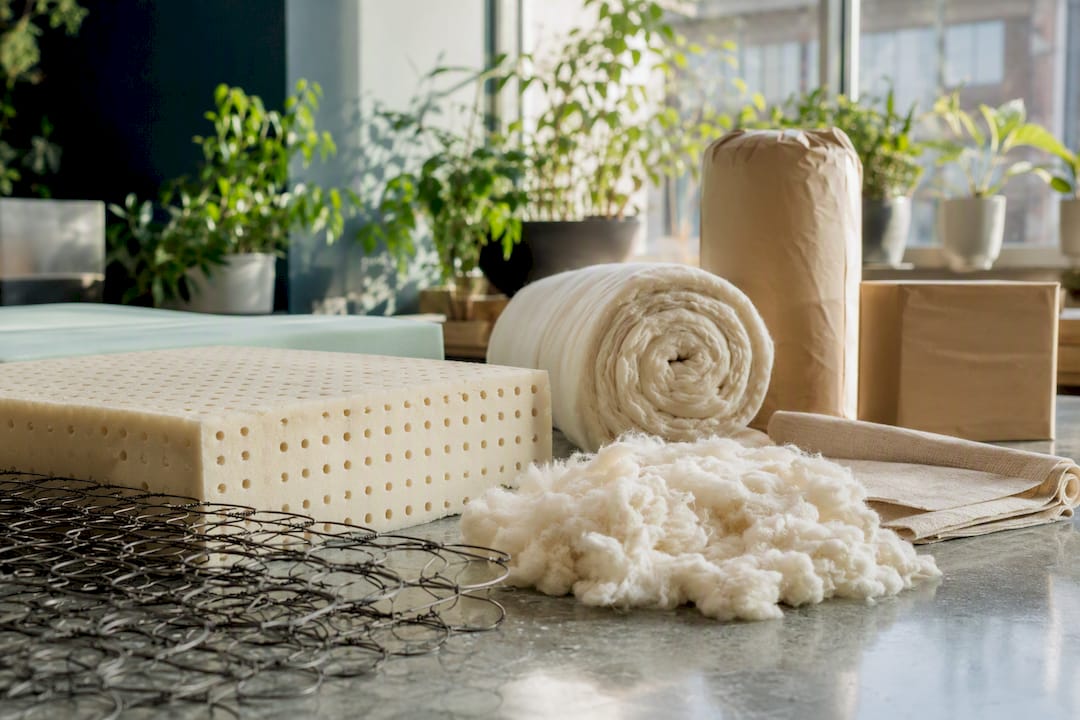
End-of-life disposal is the part almost no marketing page mentions. Conventional foam mattresses are notoriously hard to recycle and often end up in landfills for decades, while some organic latex and natural fiber components break down faster or feed into established recycling streams for foam and steel. But “natural materials” alone don’t guarantee easier disposal. A mattress glued together with heavy adhesives can be just as landfill-bound as a synthetic one, certified organic cover or not.
Manufacturing energy use matters too. A mattress assembled closer to its point of sale, under U.S. manufacturing standards that govern fire safety and material disclosure, typically involves fewer shipping legs and less packaging waste than one crossing oceans in a compressed box. The real environmental comparison has to include the whole lifecycle, not just what’s inside the cover.
Comfort and Support: What Eco-Materials Actually Deliver
A persistent myth among eco-mattress misconceptions is that “natural” automatically means “softer” or, conversely, that certified organic mattresses can’t provide real support. Neither assumption holds up. Natural latex, when built with the right density and layering, provides support comparable to memory foam, and in some cases more responsive bounce, since latex doesn’t trap heat and compress the way some synthetic foams do over time.
The confusion usually comes from lumping all “eco” mattresses into one comfort category, as if certification dictates feel. It doesn’t. A GOLS-certified latex core can be firm or plush depending on how it’s manufactured, the same way a conventional foam mattress varies by density and layer count. Certification tells you about material sourcing and chemical content; it tells you nothing about firmness level or how a mattress will feel for a side sleeper versus someone who sleeps on their back.
Shoppers who assume eco options are automatically less supportive often end up overpaying for a conventional mattress out of caution, when a properly constructed certified option would have matched their comfort needs for less; for deeper insight, see this clear guide on sleep apnea treatment for understanding broader sleep health factors. The fix is simple: shop by comfort level and sleep position the same way you would with any mattress, and treat certification as a separate, parallel decision.
What “Recycled Materials” Actually Means on a Mattress Label
Recycled content claims are creeping into eco-mattress marketing alongside organic and natural language, and they deserve the same scrutiny. A mattress advertised as containing “recycled steel” or “recycled fiber padding” is making a component-level claim, not a statement about the whole product’s environmental impact.
The significance of recycled materials in this category is real but narrow. Recycled steel coils reduce raw material demand in the innerspring layer. Recycled polyester fiber, often made from plastic bottles, can replace virgin synthetic fill in comfort layers. Both are legitimate sustainability improvements, but neither one makes a mattress “eco-friendly” as a whole, and neither replaces the need for emissions testing or organic certification if those are also being claimed.
The same greenwashing pattern from certification claims shows up here: a brand highlights the recycled component in bold marketing copy while staying vague about everything else in the mattress. Ask the same question you’d ask about organic or GOLS claims: does the recycled content apply to one layer, or is there documentation covering the finished product’s overall recycled material percentage? If a brand can cite a specific percentage and back it with a supplier document, that’s a stronger signal than a general “made with recycled materials” line with no numbers attached.
Editorial Take: Certification Beats Vibes Every Time
The conventional advice on this topic tells shoppers to “trust their instincts” or “look for natural language.” That advice is backward. Instincts can’t detect PFAS, and language has no enforcement mechanism behind it. What actually protects you is a license number you can type into a database.
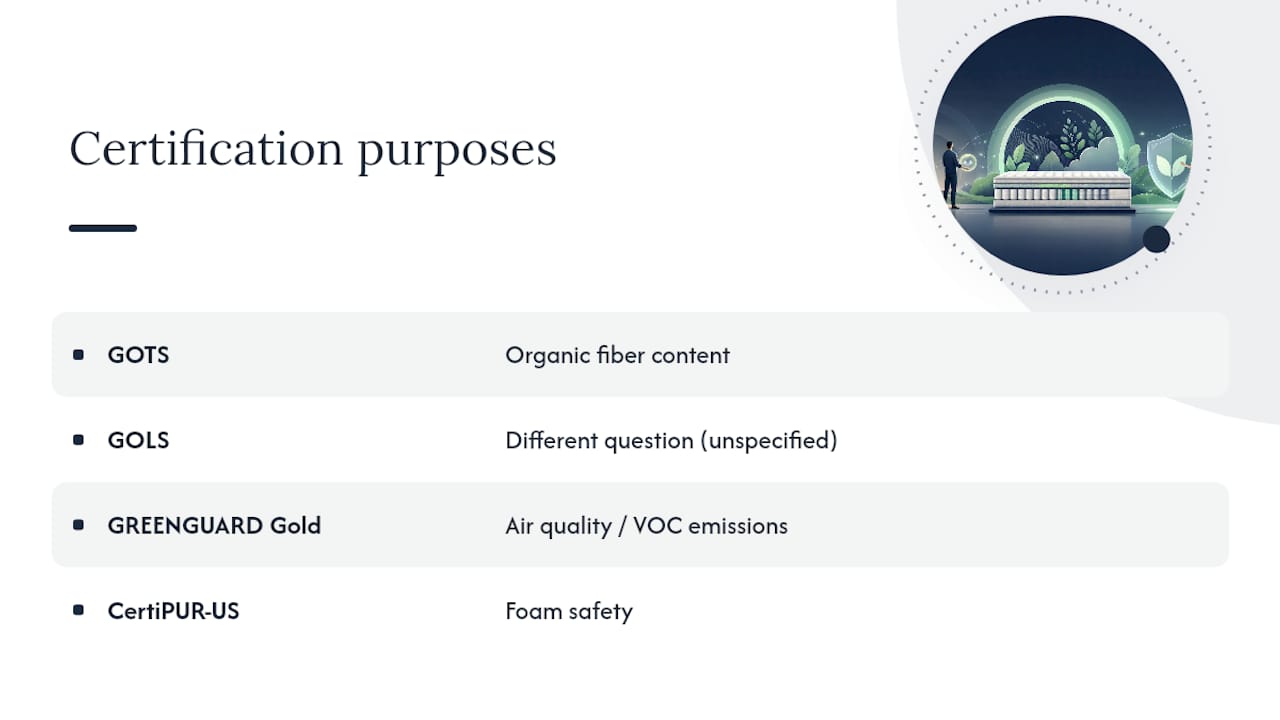
Where most guides fall short is treating all certifications as interchangeable proof of the same thing. They’re not. GOTS, GOLS, GREENGUARD Gold, and CertiPUR-US each answer a different question, and confusing them is exactly how component-only claims slip past careful shoppers. Prioritize based on your actual concern: air quality points you toward GREENGUARD, organic content points you toward GOTS, foam safety points you toward CertiPUR-US.
If there’s one habit worth building, it’s this: before you read another word of marketing copy, find the license number and search it yourself. That single step does more to protect you than any amount of label-reading ever will.
A Mattress Built Around the Same Transparency Standard
Guestly Sleep exists for exactly the shopper this article is written for: someone who wants a straight answer about what’s inside their mattress, not a marketing paragraph. Every Guestly Sleep mattress is fiberglass-free and made in the United States, with materials disclosed rather than implied, and a 60-night sleep trial that gives you time to notice anything off before you’re stuck with it.
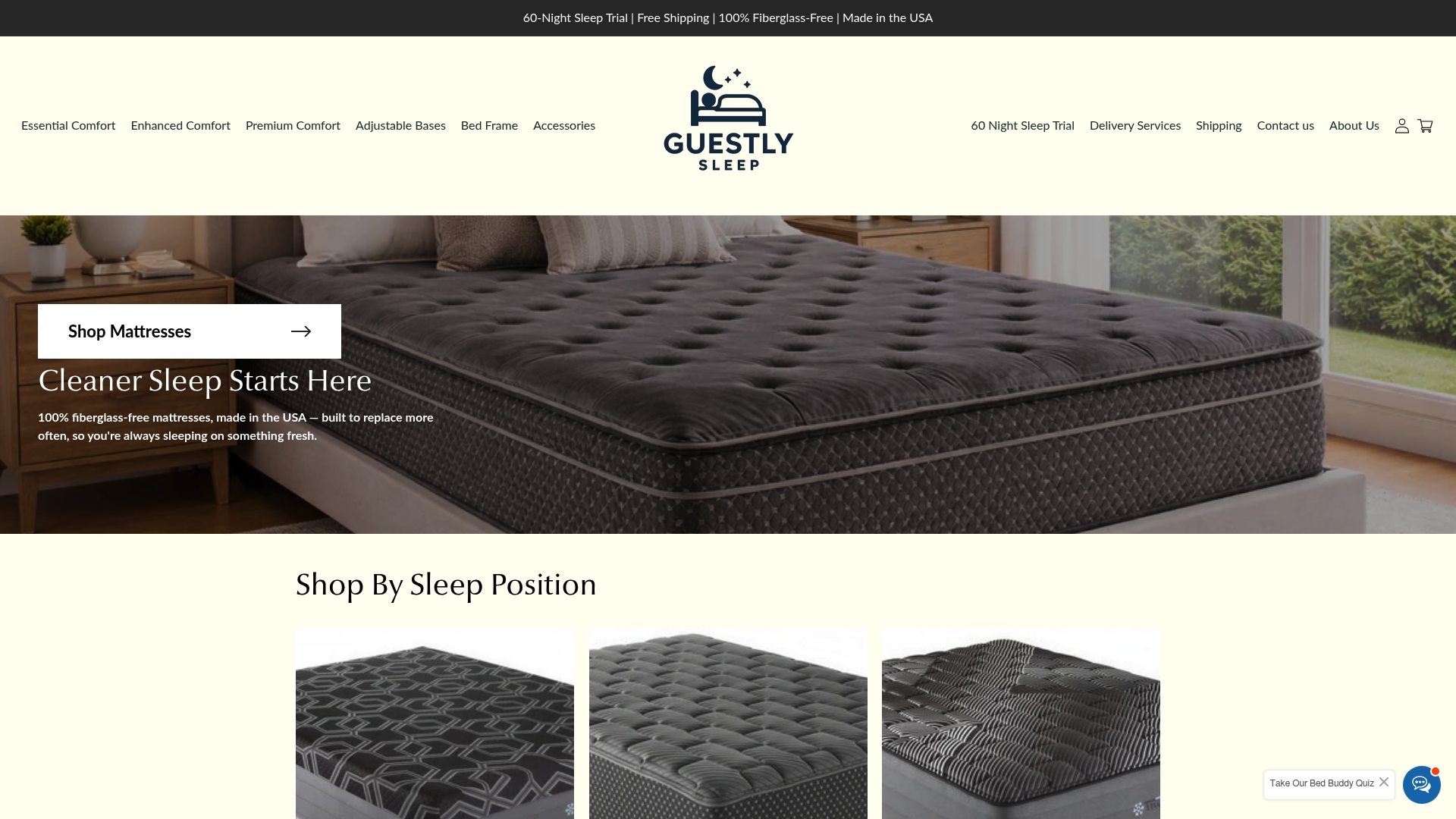
Unlike sellers who lean on vague “eco” language with no license number behind it, Guestly Sleep organizes its lineup by comfort level and sleep position, so you’re choosing based on how you actually sleep, not on which logo looks the greenest. Collections span Essential, Enhanced, and Premium Comfort tiers, with free shipping built into every order. If you’re ready to stop parsing certification logos and just want a mattress with documented, fiberglass-free materials, browse the current Guestly Sleep collection and start your 60-night trial today.
Frequently Asked Questions
Is a mattress with an “eco-friendly” label automatically safe? No. “Eco-friendly” has no regulated definition in mattress marketing. Look for a specific certifier name and license number instead of trusting the phrase alone.
Does GREENGUARD Gold mean a mattress is organic? No. GREENGUARD Gold measures VOC emission limits, which matters for air quality, but it doesn’t test for organic material content.
Are eco-mattresses always more expensive than conventional ones? Not necessarily. Some certified organic and latex mattresses are priced competitively, and price alone doesn’t indicate certification status either way.
Can I trust a certification logo without a license number? Treat it skeptically. A real certification includes a searchable license number in the certifier’s public registry, and that’s what actually confirms the claim.
Do natural materials attract bed bugs more than synthetic ones? No credible evidence supports that. Pest risk depends on storage conditions and hygiene, not whether the core material is latex or foam.
Sources
- Decoding Mattress Claims | GoodBed
- Relevant peer-reviewed article on indoor chemical exposures (NCBI PMC)
- GOLS supplier documentation (example PDF)
- EWG: Fabric and upholstery cleaner resources