

How to Track Mattress Lifespan Properly Before It Fails You
Don’t rely on age alone. Track your mattress the way you’d track any wearing part: with measurements, not a calendar. The most reliable signals are sag deeper than 1 to 1.5 inches, morning pain that vanishes on a different bed, and noticeably better sleep on vacation. Most mattresses run 5 to 7 years before performance drops off, but that number is a starting point, not a verdict.
Here’s where to start tonight:
- Measure sag with a straightedge and a ruler, then photograph it for a written record.
- Log pain, sleep quality, and any allergy symptoms every night for two weeks.
- Note whether symptoms disappear when you sleep somewhere else.
Key Takeaways
Tracking mattress lifespan properly means measuring sag, symptoms, and firmness on a schedule instead of guessing from memory or age alone.
| Point | Details |
|---|---|
| Measure sag monthly | Use a straightedge and ruler, photograph the gap, and compare readings over time. |
| Watch the 1.5-inch threshold | Sag past this depth is the common warranty line, though health impact can start earlier. |
| Run the known-good-bed test | Two nights away from home confirms whether the mattress causes your pain or poor sleep. |
| Maintain on a schedule | Rotate every 3 to 6 months, use a protector, and keep slats no more than 3 inches apart. |
| Let Guestly Sleep handle the switch | Guestly Sleep offers a 60-night trial, breathable protectors, and same-day haul-away when it’s time to replace. |
Table of Contents
- Track Mattress Lifespan Properly With Five Diagnostic Tests
- How Mattress Materials Fail and What Lifespan to Expect
- Set Up a Simple Log to Monitor Mattress Durability
- Maintenance Habits That Extend Mattress Life
- Understand Warranty Thresholds Before You File a Claim
- When the Mattress Isn’t Actually the Problem
- Decide: Repair, Top, or Replace
- Why Measurement Beats Memory
- Let Guestly Sleep Handle What Comes Next
- Frequently Asked Questions
- Sources
Track Mattress Lifespan Properly With Five Diagnostic Tests
You don’t need lab equipment to figure out if the mattress is the problem. You need five tests, a notebook, and about two weeks.
- The known-good-bed test. Sleep on a different mattress, a hotel bed, or a guest room bed for two consecutive nights. If back pain, stiffness, or restlessness disappears and returns once you’re home, the mattress is the likely cause.
- Straightedge sag measurement. Lay a rigid board or level across the mattress where you sleep most, then slide a ruler into the gap between the board and the surface. Photograph the reading with a date visible. Repeat monthly in the same spot.
- Body-impression inspection. Press your palm into the area where your hip or shoulder rests. An indentation under 0.75 inches is usually cosmetic on memory foam; deeper than that, and you’re likely losing support, not just visual flatness.
- Noise and spring-feel check. Roll from side to side on an innerspring or hybrid bed and listen for squeaks, pings, or a hammock-like center sag. New noise that wasn’t there a year ago usually means broken or fatigued coils.
- Allergy and symptom comparison. Track congestion, itching, or sneezing for a week at home, then a week away. Improvement away from the mattress often points to dust mites, moisture buildup, or material breakdown you can’t see.
Pro Tip: Keep a single photo folder on your phone labeled by date. A month-over-month sag comparison is far more convincing than memory, and it’s the same kind of visual evidence you’d need for a warranty claim.
How Mattress Materials Fail and What Lifespan to Expect
Every mattress type breaks down differently, and knowing the failure pattern tells you what to look for before it becomes a nightly problem. Comfort and transition layers typically fail before the support core does, which is why a mattress can feel soft and worn while the base underneath is structurally fine.
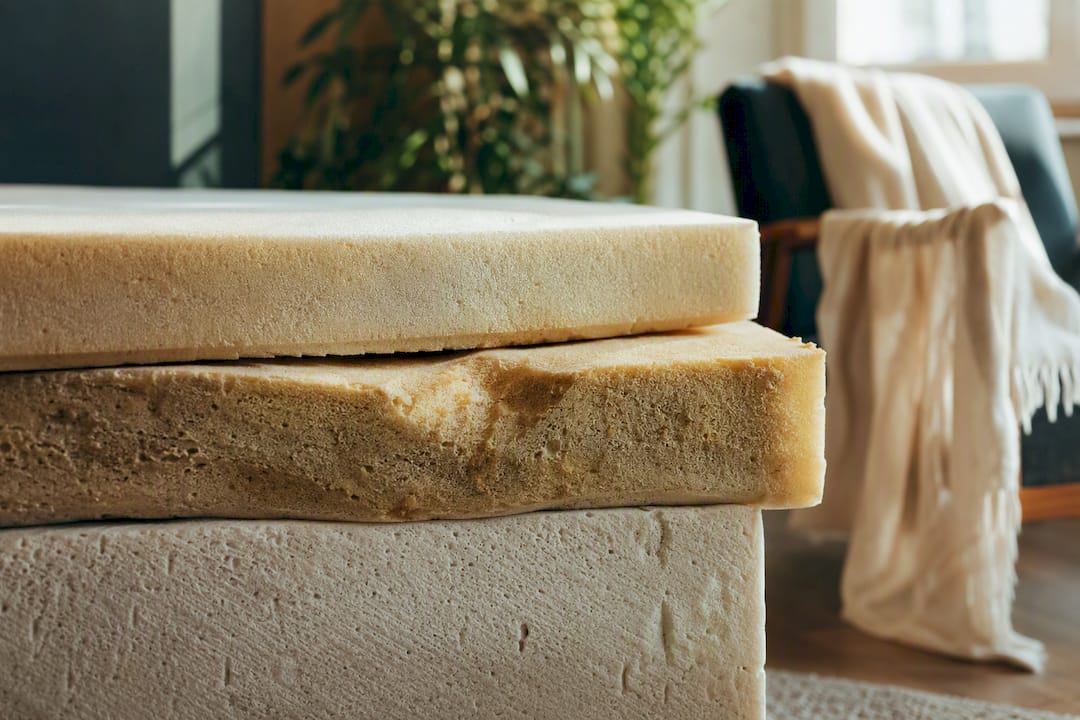
Typical lifespan ranges compiled from durability surveys and lab testing break down like this:
| Material | Typical lifespan | Common first failure | Best fit / weight sensitivity |
|---|---|---|---|
| Innerspring | 5 to 6 years | Coil sag, squeaking, edge breakdown | Budget buyers; less forgiving for heavier sleepers |
| Memory foam | 3 to 5 years | Body impressions, slow-recovery softening | Side sleepers, pressure-sensitive joints |
| Hybrid | 5 to 6 years | Comfort-layer compression over intact coils | Combination sleepers, couples with different weights |
| Latex | Often 8 to 10 years | Gradual softening, rarely deep sagging | Heavier sleepers, allergy-conscious buyers |
| Airbed | Varies widely | Pump failure, chamber leaks | Adjustable-firmness needs, dual-weight couples |
A few practical notes worth remembering:
- Higher-density foam and latex resist compression longer, but they cost more upfront.
- Warranty length often tracks material quality: latex and high-density foam mattresses frequently carry longer warranties than basic innerspring models.
- Price alone doesn’t predict durability. Some expensive mattresses fail just as fast as budget ones when the comfort layer is thin regardless of the sticker price.
Industry lab tests like ASTM F1566 simulate around 100,000 compression cycles to approximate a decade of use, but that number describes build quality in a lab, not how your specific mattress will hold up under your body weight, your sleep position, and your bedroom’s humidity.
Set Up a Simple Log to Monitor Mattress Durability
Tracking mattress condition works best as a habit, not a one-time check. A single page, whether on paper or in your phone’s notes app, is enough.
- Measure sag monthly. Lay a straightedge across your sleep zone and record the gap in inches. Sag between 0.75 and 1.5 inches deserves attention depending on the material; deeper than that on foam usually means support loss.
- Check firmness change quarterly. Press your hand into the same spot each time and compare against your notes. Gradual softening over months is normal; sudden change is not.
- Log symptoms nightly for two to four weeks. Record pain location, sleep quality on a 1 to 10 scale, partner disturbance, and any temperature or allergy complaints.
- Run a full measurement annually. Combine sag depth, firmness notes, and symptom trends into one comparison against last year’s entries.
A personalized lifespan calculator that weighs mattress type, age, sleeper weight, and visible wear gives a more accurate read than a flat calendar rule because it weights sag and new pain more heavily than age alone.
Pro Tip: Set a recurring phone reminder for the first of every month. Two minutes with a ruler beats guessing six months from now whether the sag got worse.
Maintenance Habits That Extend Mattress Life
Small habits slow down almost every common failure mode. Rotating the mattress 180 degrees every 3 to 6 months, paired with a solid base, does more to prevent uneven sag than most people expect.
- Use a waterproof, breathable protector to block moisture before it breaks down foam cells from the inside out.
- Rotate the mattress every 3 to 6 months, especially in the first two years when comfort layers are still settling.
- Check that your base uses slats spaced no more than 3 inches apart; wider gaps let unsupported foam sag between them.
- Air the mattress monthly: strip the bedding and leave it uncovered for a few hours to release trapped moisture, particularly in humid climates where ventilation matters more.
- Spot-clean stains immediately rather than letting moisture sit and soften the foam underneath.
Pro Tip: If you share the bed, rotate on a fixed date, like the first weekend of the season. It’s easy to forget otherwise, and uneven wear from one side sleeping heavier than the other adds up fast.
Understand Warranty Thresholds Before You File a Claim
Most mattress warranties use a 1.5-inch indentation as the line for a valid sag claim, but that number is a legal threshold, not a health threshold. Some materials show real support loss and body strain well before reaching 1.5 inches of visible sag.
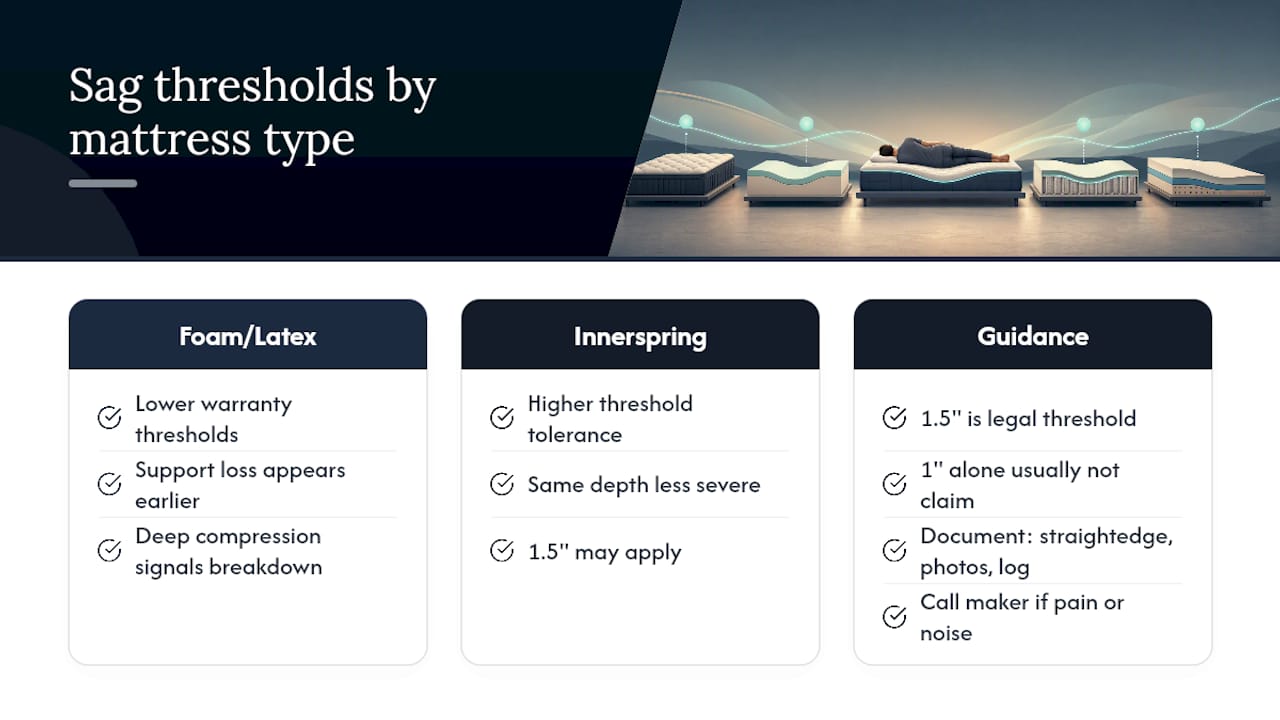
To document a claim properly: measure with a straightedge, take time-stamped photos from directly above the indentation, and keep a dated log of any pain or sleep complaints tied to the timeline. If you’re experiencing pain or poor sleep before the mattress reaches the warranty threshold, don’t wait for the number to catch up. Comfort layers can fail well ahead of the measurement that would technically qualify for a replacement.
Is a 1-inch sag worth a warranty claim? Usually not on its own, but combined with new pain or noise, it’s worth documenting and calling the manufacturer to ask.
Do all mattress types use the same warranty threshold? No. High-density foam and latex sometimes carry lower thresholds since deep compression on those materials signals more significant breakdown than the same depth on innerspring.
When the Mattress Isn’t Actually the Problem
Before you replace anything, rule out the obvious. A flattened or unsupportive pillow throws off neck alignment the same way a bad mattress does. Recent changes in activity level, stress, or a new medical condition can cause pain that has nothing to do with what you’re sleeping on.
- Check your pillow’s support and replace it if it’s lost shape.
- Review recent changes in exercise, stress, or sleep schedule.
- Try the known-good-bed test for two nights before assuming the mattress is at fault.
- See a physician or sleep specialist if pain persists despite passing the mattress tests.
Decide: Repair, Top, or Replace
Count your signs. If you’ve got three or more, from sag over 1.5 inches to pain that resolves on another bed, replacement is the smarter move.
- Check sag depth and symptom count. Three-plus signals plus a mattress past its typical lifespan range means it’s time.
- Weigh a topper against a full replacement. A topper helps for minor softening but becomes a false economy once the support core itself has sagged.
- Check warranty status before you buy anything new; you may qualify for a replacement or partial credit.
For disposal, many cities offer bulk pickup, and mattress recycling programs break components down for reuse rather than landfill. Guestly Sleep’s setup and haul-away service handles the old mattress the same day the new one arrives, which removes the logistics headache entirely.
Why Measurement Beats Memory
I’ve never trusted the “how old is it” question as a real diagnostic. It invites guessing. A straightedge, a ruler, and two weeks of honest notes tell you far more than trying to recall whether the mattress “feels newer” than it did last year.
This measurement-first approach also saves money. Plenty of people replace a mattress out of vague dissatisfaction when a $30 protector and a rotation schedule would have solved it. Track the numbers first. Replace when the numbers, not the mood, tell you to.
Let Guestly Sleep Handle What Comes Next
Once your log tells you it’s time, the harder part is usually logistics, not the decision itself. Guestly Sleep builds fiberglass-free mattresses in the United States and backs every order with a 60-night trial, so you can run the same diagnostic tests on the new mattress before committing.
The lineup includes breathable protectors sized for every mattress in the collection, solid wood frames and adjustable bases with proper slat spacing built in, and professional setup with same-day haul-away for the old mattress. That last part matters more than people expect: no dragging a decade-old mattress to the curb yourself, no guessing whether your city’s bulk pickup schedule lines up with delivery day. Browse the current mattress collections and start your 60-night trial with the old one gone the same day the new one arrives.
Frequently Asked Questions
How often should I check my mattress for sag? Run a quick straightedge check monthly, and do a full measurement and symptom review annually.
What’s the fastest way to tell if my mattress is causing my back pain? Sleep on a different, known-good bed for two nights. If the pain resolves and returns once you’re home, the mattress is likely the cause.
Does flipping help the same way rotating does? Only if the mattress is designed to be flipped. Most modern foam and hybrid mattresses have one comfort side and shouldn’t be flipped, just rotated.
Can a mattress protector really extend lifespan? Yes. A waterproof, breathable protector blocks moisture that would otherwise soften and break down foam cells over time.
Sources
- How Long Should A Mattress Last? | Sleep Foundation
- Mattress Lifespan: How to Extend the Life of Your Mattress
- Mattress Lifespan Calculator 2026: Is It Time to Replace Your Mattress? - MattressHelp