

The Role of Ventilation in Mattresses: Sleep Cooler
Mattress ventilation dissipates body heat, removes moisture, and slows material breakdown — and it does all three at the same time. If your mattress traps heat or smells musty after a few months, poor airflow is almost always the cause. Three things you can do right now:
- Check your bed base. A slatted frame improves under-mattress airflow; a solid platform blocks it.
- Swap to a breathable mattress protector. Impermeable plastic encasements seal in moisture even when the mattress itself is well-ventilated.
- Air and rotate your mattress every three months. Standing it upright near an open window for a few hours moves trapped humidity out of the core.
Guestlysleep builds its U.S.-made, fiberglass-free mattresses with these principles in mind, and every product ships with setup guidance that covers base type and protector choice. CertiPUR-US and OEKO-TEX certifications signal that the materials themselves won’t off-gas compounds that compound the problem. The National Sleep Foundation consistently points to sleep temperature as one of the top drivers of sleep quality — and ventilation is the mechanism that controls it.
Table of Contents
- How does mattress ventilation actually work?
- Why airflow matters for your sleep temperature
- How poor ventilation damages your mattress and your health
- Which materials and constructions actually improve airflow?
- How to improve ventilation in your current sleep setup
- What experts and manufacturers recommend
- How to choose a ventilated mattress: checklist and red flags
- Key Takeaways
- Why ventilation shapes every mattress decision we make
- Guestlysleep: breathable, fiberglass-free mattresses made in the U.S.
How does mattress ventilation actually work?
Ventilation in a mattress is not a single feature. It is the result of several physical processes working together — or failing to.
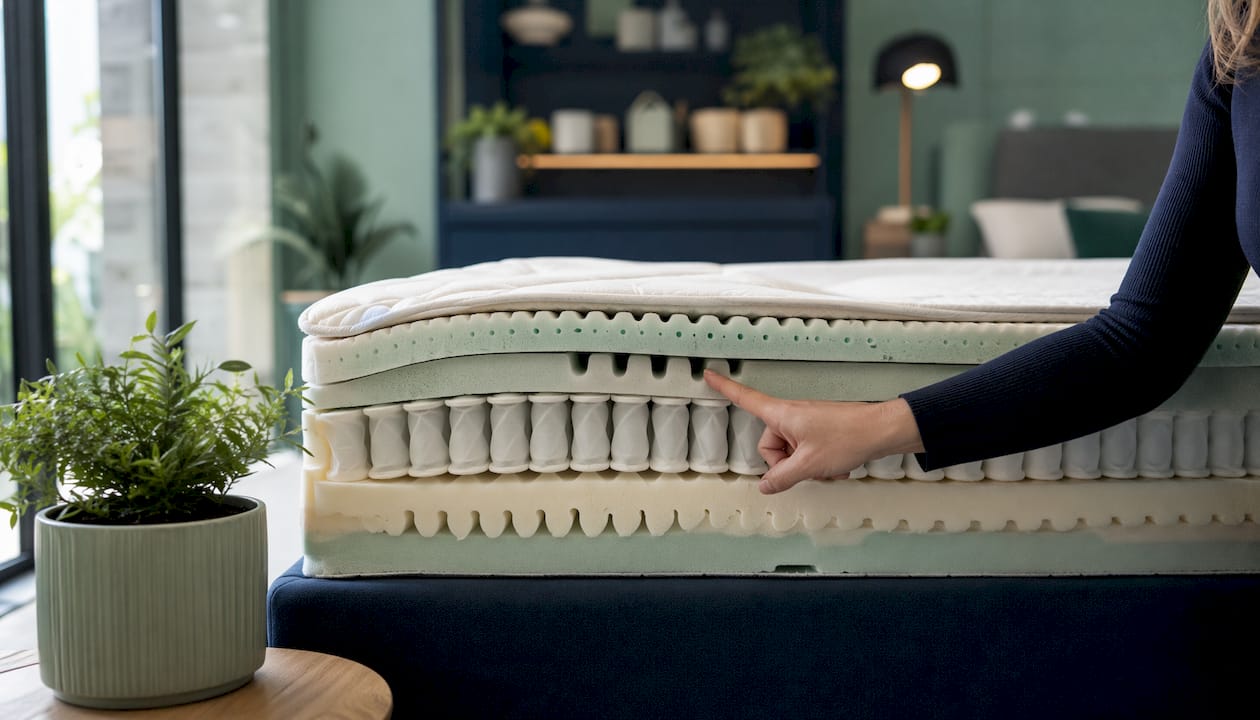
Conduction moves heat from your body into the mattress surface. A dense, closed-cell foam absorbs that heat and holds it close to your skin. An open-cell or coil-based structure conducts heat away from the surface and into the air channels below.
Convection is where ventilation really earns its keep. When warm air rises through internal channels — the gaps between pocketed coils, the interconnected pores of open-cell foam, or the three-dimensional tunnels of a spacer fabric — it carries heat and water vapor with it. That is passive convective cooling, and it happens continuously as long as the pathways stay open.
Design features that support this process:
- Pocketed coil cores: Each coil sits in its own fabric pocket, but the cavity between coils creates a continuous vertical channel. Air moves through the full depth of the mattress with almost no resistance.
- Open-cell foams: The cell walls are broken, so air can travel between cells. Movement-induced pumping — your body shifting during sleep — pushes warm air out and draws cooler air in.
- Perforations and channels: Some foam layers are needle-punched or cut with vertical channels to create deliberate airflow paths that closed-cell foam lacks by design.
- Spacer fabrics (3D knit): A woven structure with a gap layer between two face fabrics. Air moves laterally and vertically through the gap, making these covers among the most breathable options available.
- Vented covers and mesh side panels: Allow warm air to exit the mattress laterally rather than only through the top surface.
Pro Tip: Stand next to your mattress with a damp hand near the side panels after lying on it for 20 minutes. If you feel warm air escaping, passive convection is working. No airflow at all usually points to a dense foam core or a sealed encasement blocking the vents.
Research on porous mattress designs confirms that breathable cores do improve the bed microclimate — but only when the cover and bedding allow air to move. A thin cotton sheet can neutralize most of the cooling effect a ventilated mattress provides. That interaction between mattress design and bedding is one of the most underappreciated factors in sleep comfort.
Why airflow matters for your sleep temperature
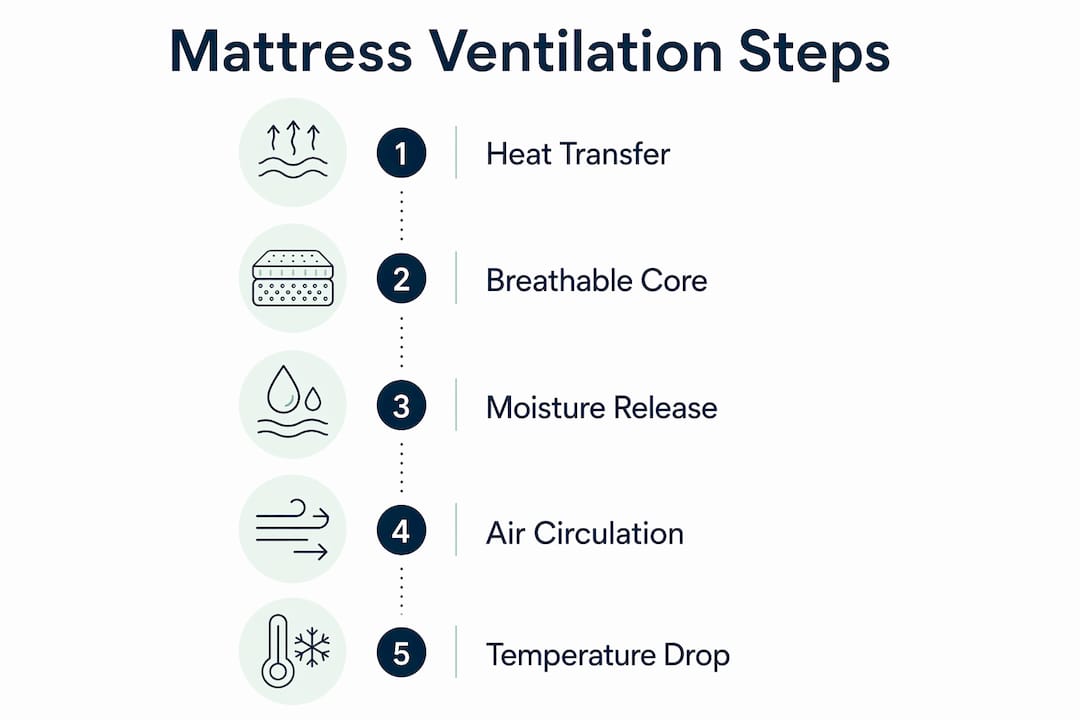
Deep sleep requires your core body temperature to drop 1–2°C. Your mattress either helps that happen or fights it. A surface that traps heat keeps your core temperature elevated, which delays sleep onset and reduces time in slow-wave and REM stages.
Convective cooling through the mattress is one of the two main pathways for that temperature drop — the other is radiant heat loss from exposed skin. When a dense foam mattress blocks convection at the sleep surface, your body relies entirely on radiant loss from your face, arms, and neck. That is not enough on a warm night.
Statistic: Lab tests comparing spacer fabrics with active airflow to viscoelastic foam found heat flux differences of 19–34 W/m² for spacer fabrics versus approximately 10.4 W/m² for foam. That gap represents a meaningful difference in how quickly heat moves away from the body during sleep.
The practical signs that your mattress is failing at temperature regulation: you wake up sweating in a room that is not particularly warm, you flip your pillow to the “cool side” multiple times a night, or you feel a noticeable heat buildup within the first hour of lying down. These are not just comfort complaints. They are signals that your sleep architecture is being disrupted at the thermoregulation level.
Porous mattress research also shows that cooling benefits are most pronounced under wet (sweating) conditions rather than dry ones. If you are a heavy sweater, ventilation matters even more — and your bedding choices matter just as much as your mattress construction. Breathable cooling mattresses for sleep pair best with natural-fiber sheets that wick moisture rather than trap it.
How poor ventilation damages your mattress and your health
Ventilation reduces trapped moisture and the biological cascade that follows from it. The chain runs like this: your body loses roughly a liter of water through perspiration and respiration during a typical night. A well-ventilated mattress moves that moisture out. A sealed or dense-foam mattress holds it.
Trapped moisture creates conditions where bacteria, dust mites, and mold thrive. Dust mites need humidity above roughly 50% to reproduce — a poorly ventilated mattress in a warm bedroom can sustain that level indefinitely. The result is odor, material breakdown, and for allergy sufferers, a measurable increase in nighttime symptoms.
Signs your mattress has a moisture problem:
- Persistent mustiness that does not clear after airing the room
- Visible dark spots on the mattress surface or sides (mold or mildew)
- Sudden sagging in areas where moisture has degraded foam or fiber fill
- Worsening allergy or asthma symptoms at night with no other obvious trigger
The timeline is faster than most people expect. In a humid climate or a poorly ventilated bedroom, moisture damage can begin within weeks of regular use on a solid-platform base with an impermeable protector. Rotating every three months and airing the mattress seasonally slows that process significantly. When odor or visible spots appear, replacing the mattress is often the only real fix — cleaning rarely reaches the core.
Mattress lifespan is directly tied to how well moisture is managed. A mattress that breathes well and is rotated regularly can maintain its structural integrity far longer than one that traps humidity. That is one reason Guestlysleep recommends replacing mattresses every 2–4 years: even a well-built mattress accumulates biological load over time that no amount of airing fully reverses.
Which materials and constructions actually improve airflow?
Pocketed coil and hybrid constructions provide the most passive internal airflow. Open-cell latex and engineered open-cell foams offer meaningful convective flow compared to standard memory foam. Here is how the main options compare:
| Construction type | Airflow mechanism | Ventilation performance | Key limitation |
|---|---|---|---|
| Coil core (pocketed) | Continuous vertical channels between coils | High passive airflow | Comfort layer on top can restrict surface breathability |
| Hybrid (coils + foam/latex) | Coil cavity airflow plus open-cell top layers | High, especially with breathable cover | Cover and protector choice critical |
| Open-cell foam | Movement-induced pumping through interconnected pores | Moderate; better than closed-cell | Relies on sleeper movement; less effective when still |
| Natural latex | Open-cell structure plus pin-core perforations | Moderate to high | Heavier density can slow airflow vs. coils |
| Perforated/channeled foam | Engineered vertical channels | Moderate | Channels compress under body weight |
| 3D spacer fabric (cover/comfort layer) | Lateral and vertical airflow through gap layer | High surface breathability | Requires active airflow for full humidity reduction |
| Dense closed-cell memory foam | None by design | Poor | Traps heat and moisture at the surface |
The cover interaction deserves its own note. Research on porous mattress samples found that even a thin cotton sheet can eliminate most of the cooling benefit a breathable core provides. A tight-weave polyester sheet over a hybrid mattress effectively seals the surface. Loose-weave cotton, linen, or Tencel sheets preserve the airflow the mattress was designed to deliver.
For readers interested in clinical-grade airflow, alternating-pressure mattress systems use active pumps to cycle air through the support surface — a level of moisture and heat control that passive designs cannot match. Lab data shows that active airflow can drop interface relative humidity from near-saturation (approximately 99% RH) to around 40% over 24 hours. Passive ventilation alone does not come close to that figure for heavy sweaters or clinical users.
Understanding how mattress materials affect breathing goes beyond just the core — the full stack from support base to sheet matters.
How to improve ventilation in your current sleep setup
You do not need a new mattress to meaningfully improve airflow. Most of the highest-impact fixes cost little or nothing.
Immediate setup changes:
- Switch to a slatted bed frame with slats no more than 3 inches apart. A solid platform traps heat and moisture under the mattress with nowhere to go.
- Use a breathable mattress protector made from cotton terry, Tencel, or a knit fabric. Avoid impermeable plastic or vinyl encasements unless a medical condition specifically requires them.
- Remove thick mattress toppers made from dense foam — they add an insulating layer that cancels out the ventilation built into the mattress below.
Maintenance schedule:
- Rotate the mattress 180° every three months. This distributes wear evenly and exposes different sections of the core to airflow.
- Air the mattress for at least two hours every season. Stand it upright near an open window or door, or lean it against a wall in a well-ventilated room.
- Vacuum the surface and sides monthly using an upholstery attachment to remove dust mite debris and surface moisture residue.
- In high-humidity rooms (above 60% RH), place moisture-absorbing packets or a small silica gel container under the bed.
Bedroom-level adjustments:
- Run a dehumidifier if your bedroom humidity stays above 55% regularly.
- A ceiling or floor fan set to low improves convective air exchange around the bed without creating a draft.
- In warmer months, switch to a lighter blanket or duvet. A heavy comforter acts as an insulating cap over the entire sleep surface, trapping heat regardless of mattress construction.
Pro Tip: After lying in bed for 30 minutes, press your palm flat on the mattress surface beside your body. If the surface feels noticeably warmer than the ambient room temperature, your mattress is retaining heat rather than dissipating it. A well-ventilated mattress on a slatted base should feel only slightly warmer than the room air.
What experts and manufacturers recommend
Experts in sleep-surface research consistently recommend combining material choice with the right setup — bed base, bedding, and room conditions all factor in. Material selection alone rarely solves a ventilation problem if the base and bedding work against it.
“Sleep thermoregulation is a primary driver of sleep depth. Mattresses that allow convective heat transfer support the necessary core temperature drop for deep sleep — and pocketed coil systems provide a passive, continuous ventilation channel through the coil cavity that foam-only designs cannot naturally match.”
Guestlysleep’s product line reflects these priorities directly. Every mattress is made in the United States without fiberglass, and the materials used carry CertiPUR-US certification — meaning the foams have been tested for harmful emissions, heavy metals, and formaldehyde. For covers and fabric components, OEKO-TEX certification confirms that no harmful chemicals are present in the textile layers that sit closest to your skin.
The brand’s recommended replacement window of every 2–4 years is grounded in the reality that even a well-ventilated mattress accumulates biological load over time. Rotating and airing extend that window, but they do not reset it. If you are noticing signs of poor sleep that correlate with heat, odor, or discomfort, the mattress age is worth checking before assuming the problem is something else.
For clinical or high-acuity situations — pressure injuries, post-surgical recovery, or severe hyperhidrosis — passive ventilation in a standard mattress is often insufficient. Active airflow systems, including hospital-grade adjustable beds designed for home use, provide a level of microclimate control that no passive design can replicate.
How to choose a ventilated mattress: checklist and red flags
If ventilation is a top priority, start with hybrid or coil-based constructions. Open-cell latex and engineered open-cell foams are the next best option. Dense closed-cell memory foam with no venting or perforations is the construction most likely to trap heat.
Buying checklist:
- Support core: Pocketed coils or hybrid construction for maximum passive airflow; open-cell foam or latex as a solid alternative.
- Cover fabric: Look for knit, mesh, or spacer-fabric covers with visible side vents or mesh panels. Tight-weave polyester covers restrict surface airflow.
- Certifications: CertiPUR-US for foam components; OEKO-TEX for textiles. Both signal that materials have been independently tested.
- Fiberglass-free assurance: Fiberglass is sometimes used as a fire barrier inside foam mattresses. It can migrate through covers and cause skin and respiratory irritation. Confirm the mattress is explicitly fiberglass-free.
- Manufacturer origin: U.S.-made mattresses are subject to domestic safety and materials standards. Confirm the manufacturing location, not just the brand’s headquarters.
- Bed base recommendation: A reputable manufacturer will specify a compatible base. If the product page says nothing about base type, that is a gap worth questioning.
Red flags:
- An opaque waterproof encasement included by default with no breathable alternative offered
- Dense closed-cell memory foam listed as the only comfort layer with no mention of venting, channels, or open-cell structure
- No material disclosure beyond a generic “foam” or “fiber” label
- No suggested bed base or slat spacing guidance
- Missing or unverifiable certifications
Three questions to ask customer support or check on the product page:
- What is the support core construction, and does it include pocketed coils or open-cell foam?
- Does the cover use a spacer fabric, mesh panel, or knit construction — and are there side vents?
- What bed base does the manufacturer recommend, and what minimum slat spacing is required?
These three questions will reveal more about a mattress’s ventilation performance than any marketing claim about “cooling technology.” For a deeper look at breathable mattress cover benefits, the cover choice alone can shift the sleep surface temperature meaningfully.
Key Takeaways
Mattress ventilation supports the 1–2°C core temperature drop needed for deep sleep while reducing moisture-related risks that shorten mattress life and affect health.
| Point | Details |
|---|---|
| Temperature regulation | Proper airflow enables the 1–2°C core temperature drop required for deep, restorative sleep. |
| Construction determines airflow | Pocketed coils and hybrid builds provide the most passive ventilation; dense closed-cell foam provides none. |
| Bedding and base matter equally | A thin cotton sheet or solid platform can cancel out a breathable mattress’s ventilation entirely. |
| Low-cost fixes work | Switching to a slatted base, breathable protector, and seasonal airing are high-impact and inexpensive. |
| Guestlysleep’s approach | Guestlysleep offers U.S.-made, fiberglass-free mattresses with CertiPUR-US certification and setup guidance for optimal airflow. |
Why ventilation shapes every mattress decision we make
The conventional wisdom on mattress ventilation tends to focus on materials — get a coil mattress, get latex, avoid memory foam. That framing is not wrong, but it misses the bigger picture. The most breathable mattress on the market will sleep hot if it sits on a solid platform under a thick polyester comforter with a vinyl protector on top. The system matters more than any single component.
What most guides also understate is how quickly moisture damage compounds. A mattress that traps humidity does not just feel warm — it actively degrades. The foam softens unevenly, the fiber fill compresses, and the biological load builds in ways that no surface cleaning addresses. That is why the replacement cadence matters as much as the initial material choice. A well-ventilated mattress that is properly maintained and replaced on a reasonable schedule is a fundamentally different product from one that is kept for a decade regardless of condition.
The other thing worth saying plainly: certifications like CertiPUR-US and OEKO-TEX are not marketing badges. They represent independent testing for specific chemical and emissions standards. In a category where “non-toxic” and “breathable” are used freely by brands with no third-party verification, those certifications are the clearest signal that the claims have been checked by someone other than the manufacturer.
Ventilation is not a luxury feature. It is the mechanism by which a mattress either supports or undermines your body’s own thermoregulation system every single night.
Guestlysleep: breathable, fiberglass-free mattresses made in the U.S.
If you want a mattress built with ventilation as a design priority rather than an afterthought, Guestlysleep’s product line is worth a close look. Every mattress is made in the United States, free of fiberglass, and certified through CertiPUR-US — so the breathability claims are backed by materials that have actually been tested.
The product range covers cooling memory foam and hybrid constructions organized by comfort level and sleep position, so you are not guessing at which build suits your needs. Setup guidance is included with every order, covering base type and protector recommendations so the ventilation built into the mattress actually works in your bedroom. Free shipping, a 60-night sleep trial, and direct customer support for setup questions make the process straightforward.
Browse the full range of fiberglass-free mattresses at Guestlysleep and use the buying checklist from this article to evaluate each option before you decide.
Useful sources and further reading
| Source | What it covers | Why it’s useful |
|---|---|---|
| Sleep thermoregulation and surface materials | Core temperature drop for deep sleep; coil vs. foam airflow | Primary evidence for the 1–2°C thermoregulation claim and coil ventilation advantage |
| Passive control of the bed micro-environment | Porous mattress tests under dry and wet conditions; cover interaction | Shows how bedding neutralizes mattress-level ventilation; key for materials and setup sections |
| Spacer fabric and airflow technologies | Heat flux and humidity data comparing spacer fabrics, foam, and active airflow | Quantifies the performance gap between passive and active ventilation systems |
| Does a mattress need air circulation? | Practical effects of poor ventilation; setup fixes including slatted bases | Accessible overview of ventilation risks and low-cost remedies |
| Sleep Foundation: cooling memory foam | Practical tips for improving airflow in memory foam setups | Authoritative consumer guidance on cooling strategies and bedding choices |
| Consumer Reports: mattress buying guide | Broad mattress evaluation criteria including materials and construction | Independent testing context for evaluating ventilation claims in marketing |