

Latex 12–25 Years: Mattress Lifespan by Material and When to Replace
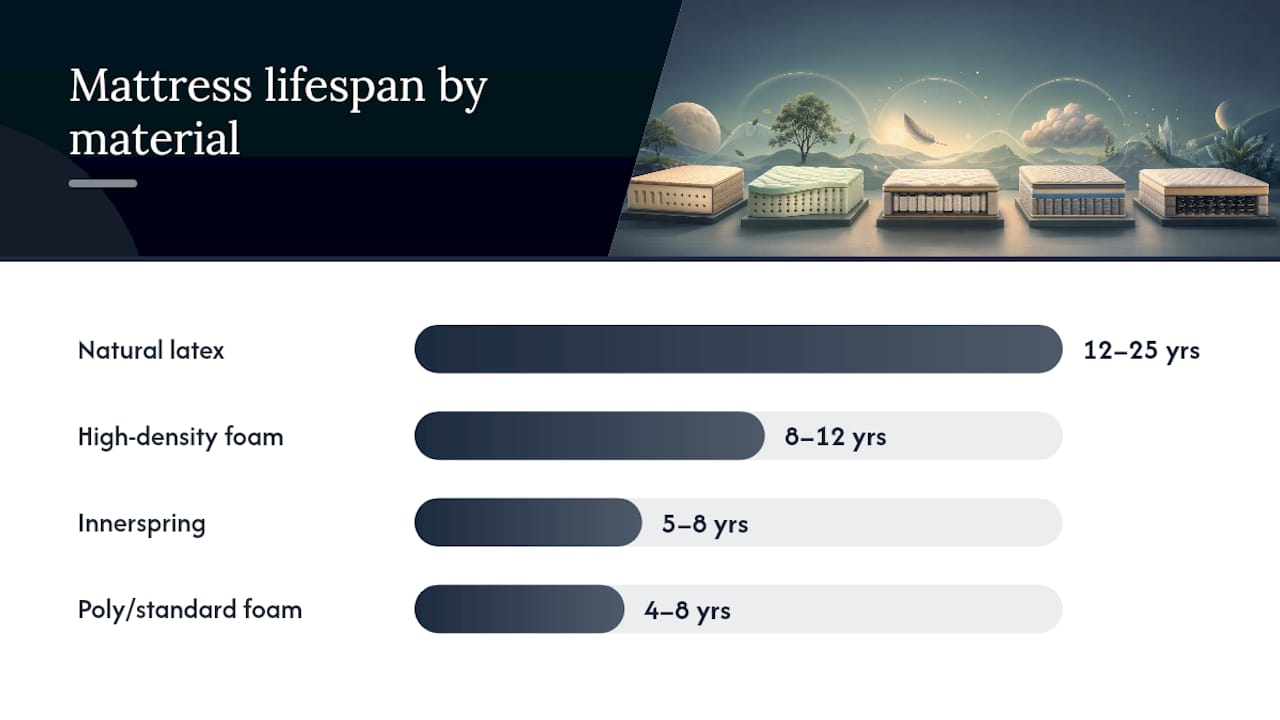
Natural latex holds up longest at 12 to 25 years, high-density memory foam runs 8 to 12 years, standard memory foam and polyfoam last 4 to 8 years, and innerspring or budget hybrid models typically wear out in 5 to 8 years. Those windows assume nightly use by an average-weight sleeper on a mattress of reasonable quality. If you’re already waking up sore or can see a body-shaped dip in the surface, skip the math and start shopping now.
TL;DR:
- Natural latex mattresses typically last 12 to 25 years, with Dunlop and Talalay styles being more durable than blended latex.
- High-density memory foam with at least 5 PCF comfort layers can last between 8 to 12 years, while lower-density foams often wear out faster.
- Innerspring mattresses made with pocketed coils usually endure 5 to 8 years, with coil fatigue starting at the edges and support layers showing signs of wear first.
- Regular maintenance such as rotating every 3 to 6 months, using mattress protectors, and checking foundation support can significantly extend mattress lifespan.
- Signs to replace a mattress include visible sagging, persistent pain, lumps, increased heat retention, and poor sleep quality in comparison to other beds.
Table of Contents
- Mattress Lifespan By Material: What The Numbers Actually Mean
- How Each Material Actually Breaks Down
- What Changes Your Personal Timeline
- Care Steps That Actually Extend Mattress Life
- Five Quick Checks To Know If It’s Time To Replace
- Where Guestly Sleep Fits Into The Lifespan Conversation
- What Most Mattress Advice Gets Backward
- Ready To Replace? Here’s Where To Start
- Sources
Mattress Lifespan By Material: What The Numbers Actually Mean
The 7 to 10 year average you see cited everywhere is a blended figure. It mixes cheap polyfoam beds that die in four years with latex mattresses still going strong at 20, according to the Sleep Foundation. Knowing your specific material tells you far more than that generic range ever could.
Natural latex sits at the top of the durability chart, with a typical range of 12 to 25 years depending on how it’s built, according to MattressNut’s analysis of mattress life expectancy. Latex comes in two processing styles. Dunlop latex is denser, heavier, and slightly less consistent in feel, which actually helps it resist long-term wear in support cores. Talalay latex is processed with a vacuum-sealing step that makes it lighter and more uniform, and it’s often used in comfort layers where a softer, more breathable feel matters more than raw density. Blended latex (part natural, part synthetic) tends to land on the shorter end of that 12 to 25 year window. Full natural latex, particularly Dunlop cores paired with Talalay comfort layers, lands on the long end.
High-density memory foam is the category most shoppers misjudge, because “memory foam” gets treated as one product when density varies enormously. The metric that matters is pounds per cubic foot, or PCF. Comfort layers rated at 5 PCF or higher, paired with support cores at 1.8 to 2.0 PCF or above, typically deliver 8 to 12 years of solid performance. Below those thresholds, you’re looking at a shorter-lived product regardless of what the marketing copy claims.
Standard memory foam and polyfoam cover the middle of the market and the middle of the lifespan chart: 4 to 8 years, with the low end dominated by polyfoam under 1.8 PCF. This is the foam used in a lot of entry-level mattresses and in the cheap toppers sold at big-box retailers. It compresses fast, especially under a single consistent sleep position, and rarely recovers its original loft.
Innerspring mattresses depend heavily on coil gauge (lower gauge numbers mean thicker, sturdier wire) and coil count. A typical innerspring lasts 5 to 8 years. Pocketed coils, wrapped individually in fabric, flex independently and generally outlast older Bonnell coil systems, which link coils together and transfer motion and wear across the whole surface. Comfort layer thickness matters too. An innerspring with a thin quilted top wears out faster than one with a real foam or fiber layer buffering the coils.
Hybrid mattresses are the wildcard, because their lifespan is really a function of whichever material sits in the comfort layer. A hybrid with a latex comfort layer over pocketed coils inherits much of latex’s longevity advantage and can push toward the higher end of that innerspring window or beyond. A hybrid topped with cheap polyfoam over coils will fail closer to the polyfoam timeline, coils or no coils, because the comfort layer is what your body actually contacts every night.
Here’s the quick reference for material-specific ranges:
- Natural latex (Dunlop/Talalay): 12 to 25 years
- High-density memory foam (5+ PCF comfort, 1.8+ PCF core): 8 to 12 years
- Standard memory foam and polyfoam: 4 to 8 years
- Innerspring (pocketed coils outlast Bonnell): 5 to 8 years
- Hybrid: matches its comfort layer material, often 6 to 12 years
How Each Material Actually Breaks Down
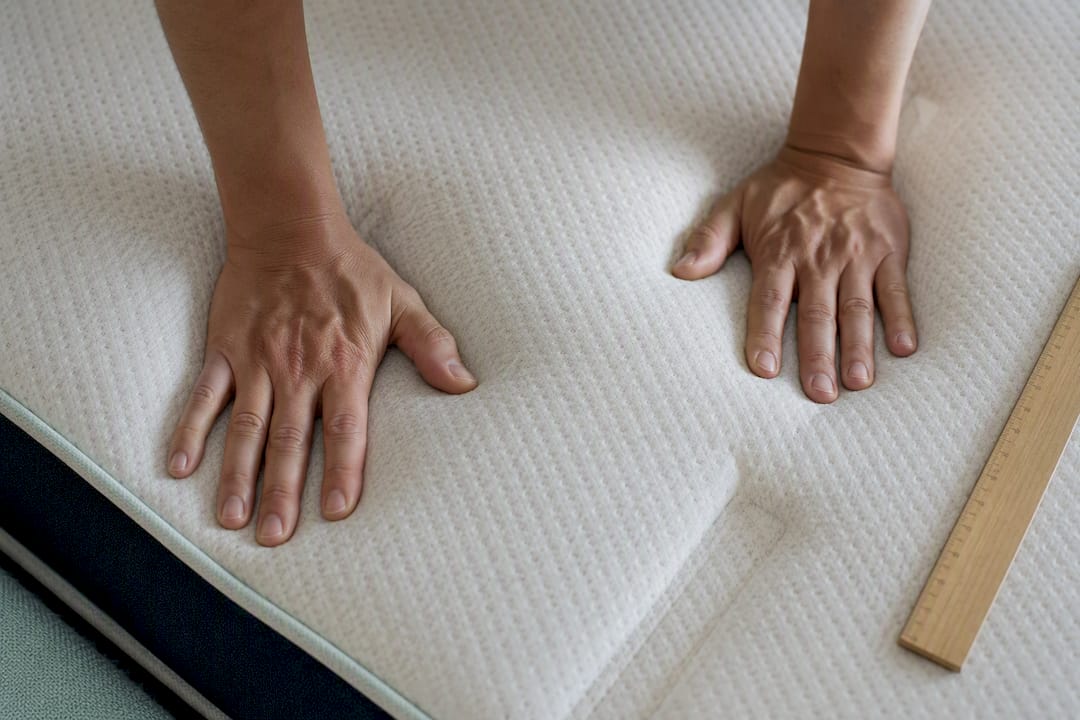
Foam doesn’t collapse suddenly. It develops what’s called compression set: a permanent loss of thickness and resilience after repeated pressure. You can test for it yourself by pressing your palm into the mattress surface away from where you normally sleep, then pressing the same spot where you do sleep. If the second spot springs back noticeably slower, or not fully at all, that’s compression set setting in.
Coil-based mattresses fail differently. Individual coils lose tension over years of load cycles, a process called coil fatigue, and the effect shows up first at the edges, where support has the least reinforcement. Sit down on the edge of an older innerspring and feel for that soft, sinking give. That’s the same fatigue mechanism, just concentrated where the frame offers the least backup.
Hybrids tend to fail in a predictable sequence: the comfort layer softens and loses loft first, usually within the timeline of whatever foam sits on top, while the coil base underneath often still has structural life left. That’s why a hybrid can feel “shot” at the surface while a straightedge test across the coil layer shows minimal sag. It also explains why a fresh topper sometimes buys a hybrid a few more good years, while the same fix does nothing for a mattress with structural coil failure underneath.
Not every reason to replace a mattress is structural. Skin cells, sweat, and moisture accumulate inside a mattress over years regardless of material, and that buildup can worsen allergy or asthma symptoms well before the foam or coils show any physical wear. If you’re sneezing more at night or waking up congested, that’s a signal worth acting on independent of how the mattress looks or feels, and it’s worth reading how mattress materials affect breathing and sleep health if allergies are part of the picture.
Signs of wear worth tracking across any material:
- Visible sagging or a body-shaped indentation you can see without lying down
- Springs you can feel or hear through the comfort layer
- Lumps or uneven firmness across the surface
- A mattress that runs noticeably hotter than it used to
Consumer Reports lists sagging, lumps, waking up sore, feeling the foundation through the mattress, and springs poking through as the clearest signals that a mattress has reached the end of its usable life.
What Changes Your Personal Timeline
The ranges above assume an average-weight sleeper using the mattress nightly. Change either variable and the math shifts.
Body weight has the biggest single effect. Sleepers in the 230 to 300 pound range typically compress foam and coils faster than lighter sleepers, pulling the lifespan toward the lower end of whatever range applies to their material. Sleepers above 300 pounds often see foam mattresses in particular wear out well before the stated range ends, since compression set accelerates with sustained higher loads. This doesn’t mean heavier sleepers need to buy new mattresses more often as a blanket rule. It means matching mattress density and support-core PCF to your actual weight matters more than chasing a brand name.
Usage frequency matters almost as much. A guest bedroom mattress used a handful of nights a month can outlast its stated range by years, simply because it’s absorbing a fraction of the load cycles a primary bed handles. Conversely, a mattress used by two people nightly, especially with different sleep positions and weights, wears faster than the same model tested by a single average sleeper.
Foundation quality is an underrated variable. A mattress placed on a foundation with slats spaced too far apart, or on a worn-out box spring, loses support unevenly and develops premature sagging regardless of how good the mattress itself is. Check your foundation’s slat spacing against the manufacturer’s recommendation. Most solid platform bases call for slats no more than 3 inches apart for foam and hybrid mattresses.
Environment plays a role too. High humidity accelerates moisture retention in foam, which can speed up material breakdown, and households with pets or young children generally see faster wear from added weight cycles, spills, and general daily impact. None of these factors change which material category you’re shopping in, but they all shift where you land inside that material’s range.
Care Steps That Actually Extend Mattress Life
Rotation habits should match the material. Foam and hybrid mattresses benefit from a head-to-foot rotation every 3 to 6 months, which redistributes body-weight impact instead of concentrating it in the same spot every night. Innerspring mattresses that are flippable (double-sided) should be flipped and rotated on the same schedule; most modern one-sided innerspring and hybrid models can’t be flipped, only rotated. Latex mattresses hold up well without frequent rotation, but a rotation every 6 months still helps even wear across dense latex cores.
Protectors do more work than most people expect. A quality mattress protector blocks moisture and skin-cell buildup from reaching the foam or fabric layers, which slows both biological accumulation and, over years, the kind of degradation that shows up as odor or discoloration. Pair that with occasional light cleaning, spot treatment for spills, and keeping the mattress away from prolonged direct sun exposure, which breaks down foam and latex faster through heat and UV.
A topper can genuinely extend comfort on a mattress that’s still structurally sound but has lost some surface softness. It cannot fix sagging, coil fatigue, or compression set in the support layer. If you press into the mattress and feel the underlying structure giving way, a topper is a temporary mask, not a repair.
Here’s a simple maintenance sequence to follow:
- Rotate foam and hybrid mattresses every 3 to 6 months; flip double-sided innerspring on the same schedule.
- Use a breathable, washable mattress protector from day one.
- Check your foundation’s slat spacing at least once a year for gaps or sagging support beams.
- Air out the mattress periodically and avoid letting it sit in direct sunlight for extended periods.
- Address spills and moisture immediately rather than letting them soak into foam layers.
For more detail on bedding upkeep across different materials, Roomie Design’s guide on extending bedding lifespan covers practical routines that pair well with the rotation schedule above.
Pro Tip: Set a recurring phone reminder for mattress rotation the same way you’d set one for changing an HVAC filter. The mattresses that last longest almost always belong to people who rotate on a fixed schedule, not when they happen to remember.
Five Quick Checks To Know If It’s Time To Replace
You don’t need a lab to figure out if your mattress is done. Run through these checks in order, and stop as soon as one gives you a clear answer.
- The straightedge test. Lay a broom handle or straight board across the mattress surface. Any gap greater than about 1.5 inches between the board and the mattress indicates real sagging, not just a soft feel.
- The away-from-bed pain test. Track whether soreness or stiffness improves noticeably within an hour of getting up and moving around. Pain that clears quickly once you’re off the mattress usually points to a support problem with the bed itself.
- The other-bed comparison. Sleep on a different mattress (a guest bed, a hotel bed, a friend’s couch bed) for a night or two and note whether sleep quality improves. A clear improvement is a strong signal your current mattress is the problem.
- The visual and manual inspection. Look and feel for lumps, indentations, or coils you can sense through the surface. Any of these findings alone are enough to justify replacement.
- The temperature check. Notice whether the mattress sleeps noticeably hotter than it used to. Foam and comfort layers that have broken down often lose their original airflow and cooling properties, a pattern WebMD flags as a common sign of material breakdown.
If two or more of these checks come back positive, a topper won’t solve the underlying problem. That’s the threshold for buying new rather than patching what you have. For more on what “end of life” actually looks like across different builds, see what mattress end-of-life means.
Where Guestly Sleep Fits Into The Lifespan Conversation
Some mattress brands build fiberglass-free mattresses in the United States, using certified materials without the chemical fillers found in a lot of budget imports. That matters directly to lifespan, since fiberglass-free construction avoids one of the more common sources of premature breakdown and contamination in cheap foam cores.
Because Guestly Sleep focuses on hygiene-conscious, health-minded sleepers, the brand recommends a more frequent replacement cadence of every 2 to 4 years for shoppers who prioritize a cleaner sleep environment over squeezing every possible year out of a mattress. That guidance runs shorter than the structural lifespan ranges covered above on purpose. It’s a hygiene standard, not a durability limit, aimed at people managing allergies or general health sensitivity who want to short-circuit the biological buildup issue before it ever becomes noticeable.
What Most Mattress Advice Gets Backward
Most articles on this topic lead with a single number, usually “7 to 10 years,” and treat every mattress as if it’s made from the same material. That’s backward. The material determines the range, and the range determines when you should even start paying attention to symptoms. A latex mattress showing minor surface softening at year 6 is fine. A polyfoam mattress showing the same softening at year 6 is on borrowed time.
The industry’s old “replace every 6 to 8 years” rule was never a scientific finding. It’s a heuristic that ignores construction quality entirely, and firmness loss correlates more strongly with back pain than calendar age does. I’d go further: age-based replacement rules exist mainly because they’re easy to market, not because they reflect how foam and coils actually degrade.
If you take one thing from this article, prioritize learning your mattress’s actual specs, PCF for foam, Dunlop versus Talalay for latex, coil gauge for springs, over trusting a generic timeline. Specs tell you which range you’re in. Symptoms tell you where you are in that range. Calendar age alone tells you almost nothing.
— Justin
Ready To Replace? Here’s Where To Start
If you’ve run the checks above and your mattress isn’t holding up, there are fiberglass-free mattress options built in the United States that aim to avoid the guesswork of decoding vague density claims from overseas manufacturers.
Every mattress ships with a 60-night sleep trial, so you’re not committing blind based on a showroom test or a few minutes on a display floor. If you want to see how latex, memory foam, and hybrid constructions stack up side by side before you decide, the mattress comparison chart breaks down materials, firmness, and pricing tier in one place. For sleepers who know they want a plush feel with the durability advantages covered in this article, the 15" TRU Luxury Plush Mattress is a solid place to start comparing specs against whatever’s currently underneath you.
Sources
- How Long Should A Mattress Last? | Sleep Foundation
- 5 Signs Your Mattress Is Shot - Consumer Reports
- Mattress life expectancy: How long does each type last? | MattressNut
- Signs you should replace your mattress | WebMD