

How to Choose a Crib Mattress: Safety-First Guide
Start with one rule: buy new, buy firm, and get a written fiberglass-free statement from the manufacturer before anything else. The Consumer Product Safety Commission sets size, thickness, and firmness requirements for full-size crib mattresses, and the American Academy of Pediatrics (AAP) reinforces that a flat, firm surface is the foundation of safe infant sleep. Marketing language about “breathability” or “organic comfort” comes second. Safety comes first.
Three checks to run before you buy:
- Snug fit: slide your hand between the mattress and crib frame. If you can fit more than two fingers, the gap is too wide. The CPSC standard is no more than a ½-inch gap.
- Firmness: press the center firmly with your palm, then release. The mattress must spring back immediately with zero lingering indentation.
- Material disclosure: ask the manufacturer directly whether the mattress and its flame barrier are fiberglass-free. A vague “meets all safety standards” is not an answer.
Table of Contents
- Seven steps to vet any crib mattress before you buy
- What core and cover materials actually mean for your baby’s health
- Exact size, fit, and firmness rules you can test yourself
- Waterproofing, mold risk, and cleaning without compromising safety
- When to replace a crib mattress and why secondhand is never worth it
- Foam vs. innerspring vs. latex: which type fits your priorities
- What to ask manufacturers about fiberglass and how to handle a recall
- Why fiberglass-free, made-in-USA mattresses are worth the specificity
- Key Takeaways
- The part most guides skip
- Guestlysleep: fiberglass-free mattresses built for health-conscious buyers
- Authoritative sources and further reading
Seven steps to vet any crib mattress before you buy
- Buy new only. A used mattress may look fine but foam and coils lose structural integrity over time in ways you cannot see. Hidden softening creates suffocation risk.
- Confirm dimensions. Full-size crib mattresses must meet CPSC minimum dimensions. The gap between mattress and crib frame must be ½ inch or less on every side.
- Run the hand-press firmness test. Press firmly in the center and near each edge. Any indentation that holds its shape means the mattress is too soft for an infant.
- Request an explicit fiberglass-free statement. Ask: “Are the mattress and its flame barrier completely free of fiberglass?” Get it in writing or find it on the product page. If the manufacturer hedges, move on.
- Check the waterproof cover. Look for PVC-free and phthalate-free language. The AAP recommends a flannel-backed waterproof cover; Consumer Reports advises avoiding vinyl due to phthalate off-gassing concerns.
- Verify certifications. CertiPUR-US for foam (low VOC emissions, no banned additives), GREENGUARD Gold for overall chemical emissions, and GOTS if organic textiles are claimed. Each certification covers different ground, so check which applies to the specific component you care about.
- Note weight, cleanability, return policy, and warranty. A mattress you can lift with one arm matters at 3 AM. Confirm the manufacturer’s replacement guidance and whether the warranty covers material defects.
Pro Tip: Write your fiberglass question in an email to the manufacturer so you have a timestamped record. If they don’t respond within 48 hours, that silence tells you something.
What core and cover materials actually mean for your baby’s health
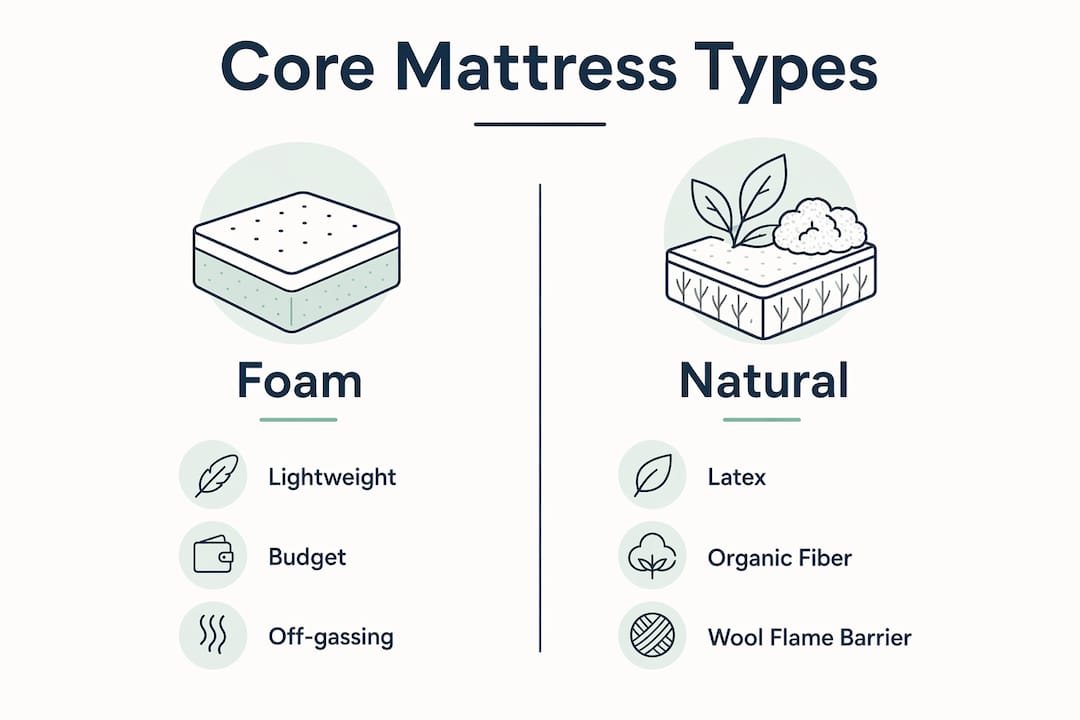
The four main core types are foam, innerspring, natural latex, and organic fiber fills. Each involves real trade-offs.
| Core Type | VOC Concern | Cleanability | Weight | Longevity |
|---|---|---|---|---|
| Polyurethane foam | Moderate (off-gassing) | Wipe-clean if waterproofed | Light | 3–5 years |
| Innerspring | Low | Wipe-clean if waterproofed | Medium–heavy | 5+ years |
| Natural latex | Low (if GOLS-certified) | Wipe-clean if waterproofed | Heavy | 5 years |
| Organic fiber (cotton/wool) | Very low | Requires washable barrier | Medium | 4–6 years |
| Open polymer / breathable core | Low | Fully washable | Very light | 3–5 years |
High-density foam with CertiPUR-US certification is a reasonable baseline for foam buyers. It screens for some harmful additives and verifies low VOC emissions, though it does not restrict every chemical used in manufacturing. GREENGUARD Gold goes further on emissions testing. GOTS certifies the entire organic textile supply chain, including which chemicals are permitted in processing. None of these certifications, however, covers fiberglass in a flame barrier. That requires a direct manufacturer statement.
The biggest marketing trap in crib mattresses is the word “breathable.” Open-core and polymer-mesh designs do improve airflow and are easier to wash, but experts are clear that breathability claims have not been proven to reduce SIDS risk. A breathable mattress that fails the firmness test is still unsafe. Fit and firmness always outrank airflow marketing.
Flame barriers deserve special attention. Wool is naturally flame-resistant and a clean alternative to chemical retardants. Some manufacturers use rayon or polyester barriers instead, which are preferable to chemical flame retardants but are not biodegradable. The problem: some fire barriers also contain fiberglass or chemical flame retardants without disclosing it on the label. Always ask. For a deeper look at how mattress materials affect breathing and VOC exposure, Guestlysleep’s resource library covers the specifics.
Exact size, fit, and firmness rules you can test yourself
- Measure the gap. With the mattress in the crib, run your fingers along every edge. More than ½ inch anywhere is a safety hazard under CPSC guidance.
- Press the center. Use your full palm and push down firmly. Release. The surface must return to flat immediately.
- Press the edges. Edge support matters because babies often roll toward the sides. Soft edges are a red flag even if the center passes.
- Check dual-sided labeling. Many mattresses have a firmer infant side and a slightly softer toddler side. The infant side must still pass the immediate spring-back test. Dual-sided mattresses do not eliminate the need to re-check firmness before reusing for a second child.
- Assess thickness against your crib rail height. A mattress that sits too high in the crib creates a climbing hazard as the baby grows. Check the manufacturer’s crib compatibility notes.
Waterproofing, mold risk, and cleaning without compromising safety
Natural fiber mattresses (organic cotton, wool) need a waterproof barrier. Moisture that reaches organic fill promotes mold and bacteria growth, which defeats the purpose of choosing natural materials. The safest approach is a PVC-free, phthalate-free waterproof layer, either integrated into the cover or as a separate fitted waterproof pad.
- Integrated wipe-clean covers are convenient and reduce the chance of moisture reaching the core, but check that the waterproofing material is polyethylene or polylactic acid (PLA), not vinyl.
- Removable waterproof covers let you wash the cover separately, which is useful for organic-fill mattresses without built-in waterproofing.
- Avoid PFAS-based waterproofing. These “forever chemicals” are not always disclosed on the label and carry serious long-term health concerns.
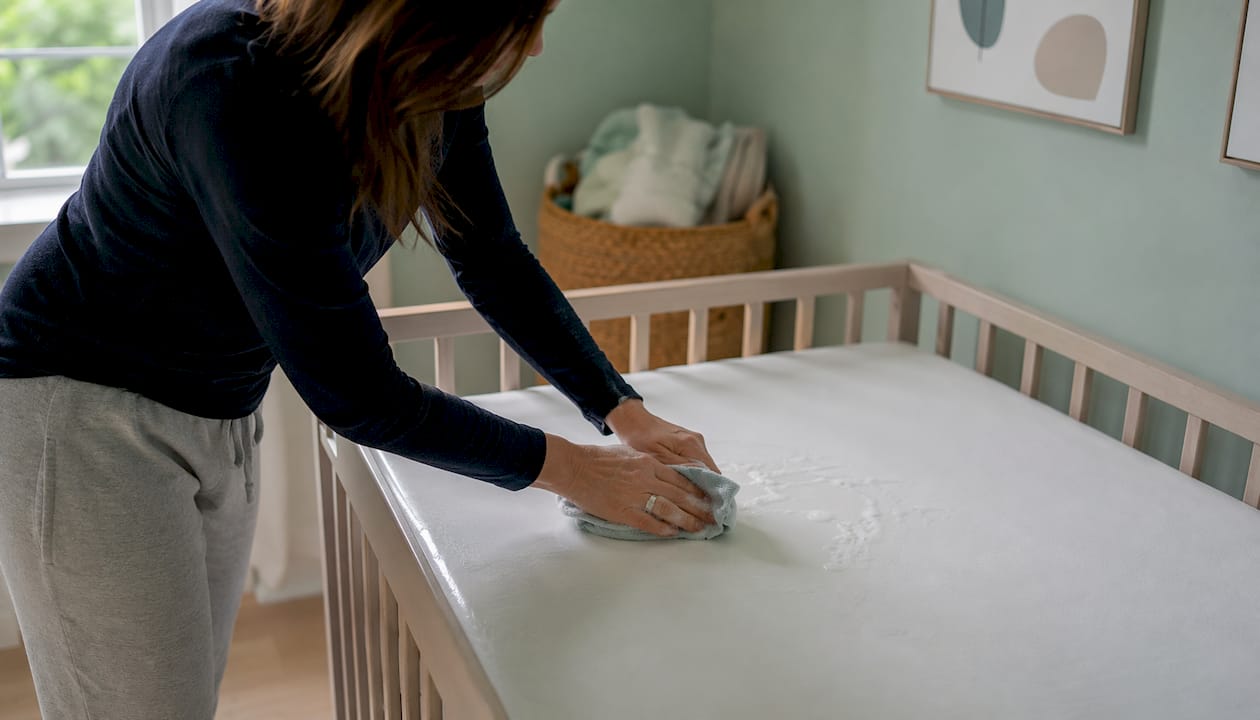
For cleaning: wipe the surface with a damp cloth and mild soap, then air dry completely before replacing bedding. Bleach degrades waterproof layers over time. Never put a crib mattress in a washing machine unless the manufacturer explicitly says it is machine-washable. How you care for mattress covers directly affects how long the non-toxic properties hold up.
Pro Tip: Keep a second waterproof fitted pad on hand. When one is in the wash at 2 AM, you will be glad you have a backup.
When to replace a crib mattress and why secondhand is never worth it
Buy new every time. A secondhand crib mattress may have foam compression, coil fatigue, or mold inside the core that is invisible from the outside. These structural changes can create soft spots that increase suffocation risk, and there is no reliable way to test for internal mold without cutting the mattress open.
Replace a crib mattress when you notice any visible dip or indentation that does not spring back, staining that has penetrated the waterproof layer, or any manufacturer recall notice. Guestlysleep recommends replacing every 2–4 years for a consistently clean, supportive sleep environment. That cadence accounts for the gradual compression of foam and fiber fills that happens even when a mattress looks fine on the surface.
Register your mattress with the manufacturer immediately after purchase. The CPSC updated its firmness testing requirements effective August 15, 2022, so verify that any mattress you buy was manufactured and sold after that date to confirm it meets current standards.
Foam vs. innerspring vs. latex: which type fits your priorities
| Type | Best For | Watch Out For |
|---|---|---|
| Foam | Lightweight handling, budget buyers | Polyurethane off-gassing; verify CertiPUR-US |
| Innerspring | Durability, firm support | Coil count and steel gauge matter; lower gauge = firmer |
| Natural latex | Non-toxic priority, longevity | Heavy; verify GOLS certification; latex allergy risk |
| Organic fiber | Lowest chemical exposure | Requires waterproof barrier; higher cost |
| Open polymer / breathable | Easy washing, light weight | Not proven safer; still must pass firmness test |
Foam and innerspring are both viable choices. The decision usually comes down to weight and cleanability rather than broad safety differences. For innerspring models, higher coil count and lower steel gauge generally indicate firmer, longer-lasting support. Dual-sided hybrids are practical for extending use into the toddler years, but always re-run the firmness test before flipping.
Natural latex is the strongest non-toxic option if budget allows. Look for GOLS-certified latex to confirm it is processed with natural ingredients rather than synthetic blends. The trade-off is weight: latex mattresses are significantly heavier, which matters when you are changing sheets at midnight.
What to ask manufacturers about fiberglass and how to handle a recall
- Ask directly: “Are the mattress and its flame barrier completely fiberglass-free?” and “Can you provide a materials disclosure or third-party lab report?”
- Ask about warranty coverage: “If fiberglass is discovered in the mattress after purchase, does the warranty cover replacement?”
- If you suspect fiberglass exposure: stop using the mattress immediately. Seal it in plastic before moving it to prevent fiber spread. Do not vacuum the area without a HEPA filter.
- Contact the manufacturer and document everything in writing.
- Check the CPSC recall database at cpsc.gov. Search by brand name and product type. If a recall is announced, follow the official CPSC guidance and the manufacturer’s specific recall instructions, which typically include a refund or replacement process.
- Register your mattress at purchase so recall notices reach you directly.
Why fiberglass-free, made-in-USA mattresses are worth the specificity
Most crib mattress labels do not list every material used in construction. That gap is where fiberglass hides. Guestlysleep was built specifically around this problem: every mattress in its lineup is fiberglass-free, manufactured in the United States, and documented with material transparency that goes beyond what standard labeling requires.
The health case for U.S.-made, fiberglass-free mattresses is straightforward. Domestic manufacturing means the product is subject to U.S. mattress safety regulations, which are among the most stringent globally. Fiberglass-free construction eliminates the risk of microscopic glass fibers entering the sleep environment if a cover is ever removed or damaged.
Guestlysleep recommends replacing mattresses every 2–4 years, ships free, and offers a 60-night sleep trial. These policies reflect a brand built around the idea that a clean, safe sleep surface should not require a research degree to verify.
Key Takeaways
A firm, new, correctly fitting crib mattress with explicit fiberglass-free material disclosure is the single most important purchase decision a health-conscious parent can make.
| Point | Details |
|---|---|
| Buy new, always | Secondhand mattresses hide structural wear and mold that visual checks cannot catch. |
| Fit and firmness first | The CPSC ½-inch gap rule and immediate spring-back test are non-negotiable safety checks. |
| Ask about fiberglass explicitly | Certifications like CertiPUR-US and GREENGUARD Gold do not cover fiberglass in flame barriers. |
| Choose PVC-free waterproofing | Vinyl and PFAS-based covers carry phthalate and “forever chemical” risks; opt for polyethylene or PLA. |
| Guestlysleep | Offers fiberglass-free, U.S.-made mattresses with a 60-night trial and a 2–4 year replacement recommendation. |
The part most guides skip
The crib mattress category is full of certifications that sound comprehensive but cover narrow ground. CertiPUR-US is widely cited, but it primarily screens for chemicals already banned in manufacturing. GREENGUARD Gold is stronger on emissions but says nothing about fiberglass. GOTS is rigorous for organic textiles but does not apply to foam or metal components. No single certification covers everything.
The practical implication: a mattress can carry three certifications and still contain fiberglass in its flame barrier. That is not a hypothetical. It has happened with products that were otherwise well-reviewed. The only reliable protection is a direct, documented statement from the manufacturer that the mattress and every component, including the flame barrier, are fiberglass-free.
Prioritize fit and firmness above every marketing claim. Then verify materials. Then check certifications as supporting evidence, not as a substitute for transparency.
Guestlysleep: fiberglass-free mattresses built for health-conscious buyers
Parents who have spent hours reading certification fine print deserve a simpler path. Guestlysleep makes fiberglass-free, non-toxic mattresses in the United States, with material documentation that answers the questions this guide told you to ask. No vinyl covers. No hidden flame retardants. No guessing about what is inside.
Every mattress ships free and comes with a 60-night sleep trial, so you can run the firmness and fit tests at home without risk. Guestlysleep also recommends replacing mattresses every 2–4 years, a standard built into the brand’s approach rather than buried in a FAQ. Browse the mattress comparison chart to see fiberglass-free options side by side, or go straight to a specific product like the 15" TRU Luxury Plush to check materials and dimensions for your crib setup.
Authoritative sources and further reading
- Consumer Reports: Safest Crib Mattresses — materials analysis, certification guide, and CPSC size and firmness rules
- Sleep Foundation: Best Crib Mattress — expert-tested picks and replacement guidance
- CPSC recall database: cpsc.gov — search by brand for active recall notices
- AAP safe sleep guidelines: healthychildren.org — firm, flat surface requirements and soft-object prohibitions
- Guestlysleep: Safe Kids Mattress Selection Guide — fiberglass-free standards and replacement cadence
- Guestlysleep: What actually makes a mattress non-toxic — label limitations and what documentation to request
This article is general information, not medical or safety advice for your specific situation. Confirm current CPSC requirements and recall status at cpsc.gov before purchasing.