

How Domestic Mattress Production Works: A Full Guide
Domestic mattress production is defined as the end-to-end manufacturing of mattresses within a single country, from raw material processing through final quality inspection. Understanding how domestic mattress production works reveals why factory location directly shapes the comfort, safety, and durability of the mattress you sleep on every night. The domestic mattress manufacturing process relies on three core pillars: material preparation, precision assembly, and multi-stage quality control. Brands like Guestlysleep build their entire product promise on these pillars, sourcing certified, fiberglass-free materials and assembling mattresses in the United States to meet strict federal safety standards.
What materials are used in domestic mattress manufacturing?
The foundation of every mattress is its foam. Polyurethane foam, the most widely used core material, is produced by mixing polyols and isocyanates at pressures between 100 and 200 bar, then curing the mixture in controlled humidity to achieve uniform density. Memory foam follows the same chemical process but uses a different polyol ratio to produce the slower, pressure-sensitive response sleepers recognize. The density and firmness of the finished foam depend entirely on the precision of this mixing stage.
Steel coil systems form the structural backbone of innerspring and hybrid mattresses. Coil gauge, coil count, and coil geometry each affect how weight is distributed across the sleep surface. Domestic manufacturers source coils from domestic or vetted North American suppliers, which shortens lead times and allows for tighter specification control compared to offshore procurement.
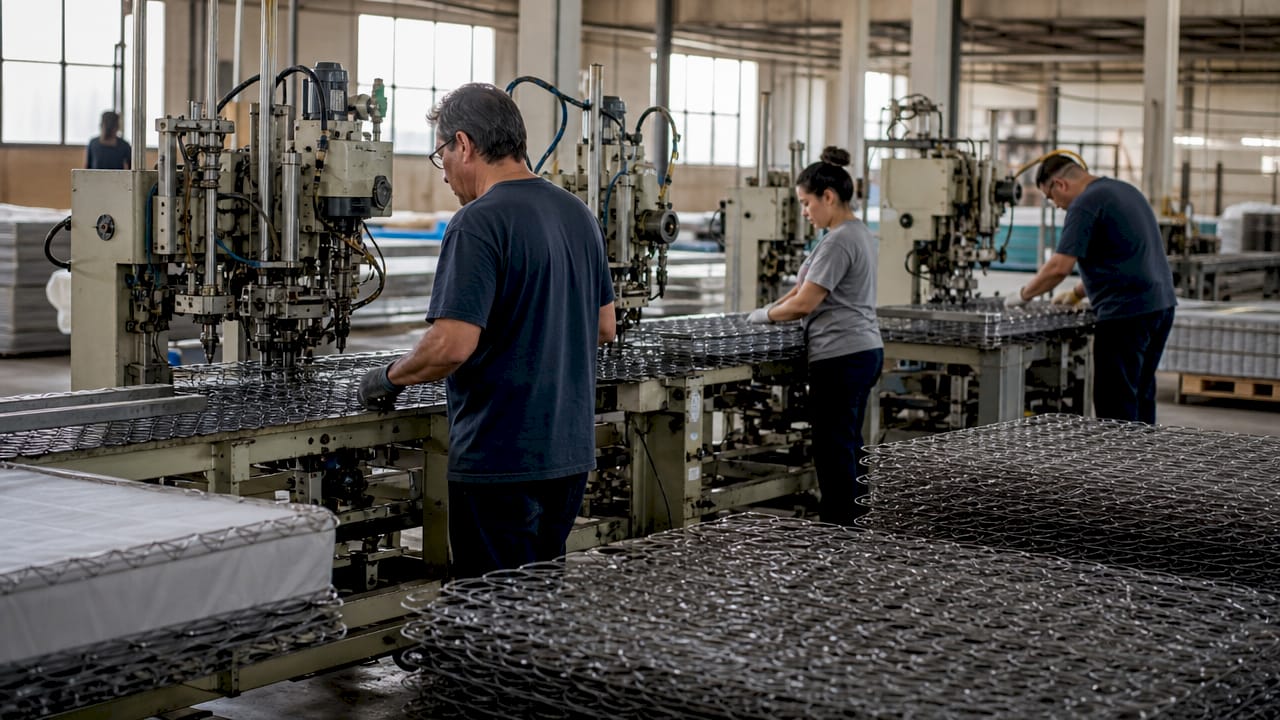
Textile covers and quilted panels complete the material stack. Quilting machines use 20 to 60 needles under CNC control to stitch complex patterns into the cover fabric. That level of mechanical precision produces consistent loft and surface texture across every unit in a production run.
Pro Tip: When evaluating a mattress, ask whether the foam carries a CertiPUR-US certification. That certification confirms the foam was made without ozone depleters, heavy metals, or formaldehyde, which are the chemical risks most common in unregulated foam production.
Key raw materials at a glance
| Material | Primary role | Domestic sourcing advantage |
|---|---|---|
| Polyurethane foam | Core support and comfort layers | Faster reorder cycles, tighter density specs |
| Memory foam | Pressure relief and contouring | Direct quality audits with domestic suppliers |
| Steel coils | Structural support and airflow | Shorter lead times, consistent gauge standards |
| Quilted fabric cover | Surface comfort and durability | Immediate replacement if defects appear |
Understanding the health impact of mattress materials is just as important as understanding how those materials are made. Domestic sourcing gives manufacturers direct visibility into what goes into each layer.
How are mattresses assembled in domestic factories?
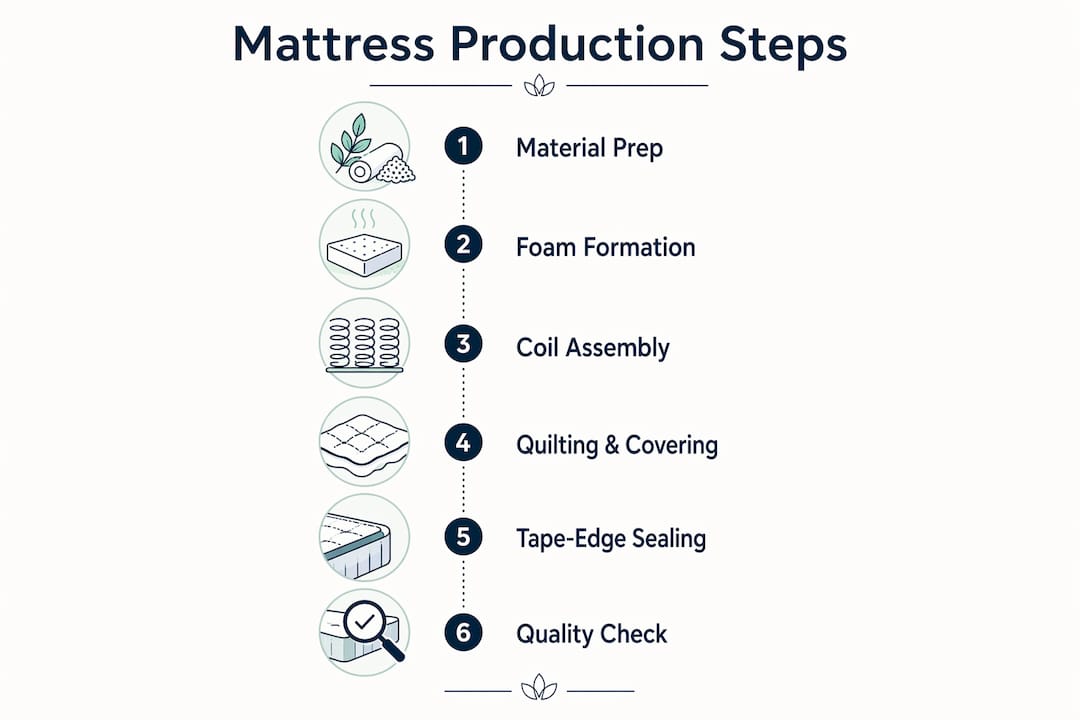
Mattress assembly follows a defined sequence. Each stage builds on the last, and skipping or rushing any step produces a mattress that fails earlier than it should. The steps in mattress creation are consistent across domestic factories, though the machinery and skill level vary.
- Core construction. Workers or automated systems build the innerspring unit or cut foam cores to specification. Coil units are tied or pocketed individually to prevent lateral movement.
- Comfort layer stacking. Foam layers are cut and stacked in a deliberate order above the core. Intentional layer stacking and coil design determine actual performance far more than marketing language does. Each layer serves a specific mechanical purpose: transition foam bridges the firm core to the softer comfort foam above it.
- Quilting the cover. The pre-quilted fabric panel is positioned over the layer stack. CNC-controlled quilting machines stitch the panel to the top comfort layer, locking the surface texture in place.
- Tape-edge stitching. Tape-edge machines wrap continuous binding tape around the perimeter of the mattress, forming the primary mechanical joint that holds all layers together. This seam is the most structurally critical point on the finished mattress.
- Handle and vent installation. Side handles and ventilation grommets are attached before final inspection. Vents regulate airflow inside the mattress and prevent moisture buildup.
- Final visual inspection. Inspectors check seam alignment, surface uniformity, and cover tension before the mattress moves to packaging.
Skilled labor remains irreplaceable at the tape-edge and quilting stages. Machines set the stitch pattern, but an experienced operator catches tension problems, material misalignment, and cover defects that automated sensors miss.
Pro Tip: Ask a manufacturer whether their tape-edge operation runs on a single machine or multiple handoffs. Single-machine tape-edging produces a more consistent seam because the binding tension stays constant throughout the full perimeter.
What quality control standards ensure mattress reliability?
Quality control in domestic mattress production runs at every stage, not just at the end of the line. Mattresses undergo 100% inspection before shipping to catch defects early and confirm compliance with domestic safety standards including OSHA regulations and federal labor laws. That inspection rate is a direct result of domestic manufacturing accountability.
The most practical quality signal in a factory is the red thread system. Colored red thread acts as an error-detection system during final inspection, making misaligned seams immediately visible against the white or cream cover fabric. A misaligned seam that would take minutes to spot under normal conditions becomes obvious in seconds. That speed matters when a factory produces dozens of units per shift.
“Simpler materials do not mean simple manufacturing. Craftsmanship and machinery play a vital role in mattress quality, and the factory floor is where that difference becomes visible.”
One-roof production is the structural advantage that makes domestic quality control work. In-house processes eliminate coordination delays that plague offshore or multi-facility setups. When a defect appears, the production manager, the materials team, and the assembly crew are all in the same building. The fix happens in hours, not weeks.
Offshore manufacturing breaks that feedback loop. A defect discovered at a distribution center in the United States may trace back to a supplier in a different country, making root-cause analysis slow and costly. Domestic production keeps the entire chain visible and correctable.
For a deeper look at how factory location shapes regulatory compliance, the US mattress manufacturing standards guide covers the specific certifications and federal requirements domestic producers must meet.
How does domestic production affect delivery times and sustainability?
Speed is one of the most underappreciated advantages of domestic mattress manufacturing. Local assembly can produce about 80 mattresses per day in a well-run facility, and production timelines can compress to as short as 3 days from order to shipping. That compares directly to the 2–6 week cycles common in traditional offshore manufacturing.
The reason domestic factories move faster is inventory control. Domestic manufacturers maintain ready inventory of foam, coils, and cover materials on-site, which means production can start within 24 hours of order approval. Offshore producers typically face 4–6 week material procurement delays before a single mattress enters assembly.
Domestic vs. offshore production: a direct comparison
| Factor | Domestic production | Offshore production |
|---|---|---|
| Production timeline | 3 days to 2 weeks | 2–6 weeks or longer |
| Material procurement | On-site inventory, 24-hour start | 4–6 week procurement lead time |
| Quality control | 100% in-house inspection | Multi-facility coordination required |
| Transportation emissions | Short domestic freight | Transoceanic shipping, higher carbon load |
| Defect resolution | Same-day, same-facility | Cross-border, multi-week process |
Sustainability benefits follow directly from shorter supply chains. Domestic freight generates a fraction of the carbon output that transoceanic container shipping produces. Domestic manufacturers also face stricter environmental regulations on foam production chemicals, fabric treatments, and waste disposal than many offshore producers do. The result is a mattress with a smaller environmental footprint from raw material to your bedroom.
Consumers who want to understand the full picture of imported mattress safety gaps will find that many of those gaps trace directly back to the production and inspection differences outlined here.
Key Takeaways
Domestic mattress production delivers measurable advantages in quality, speed, and safety because every stage, from foam chemistry to final inspection, happens under one accountable roof.
| Point | Details |
|---|---|
| Material precision matters | Polyurethane foam requires 100–200 bar mixing pressure to achieve consistent density across every unit. |
| Assembly sequence is fixed | Skipping or rushing any of the six assembly stages produces a mattress that fails earlier than designed. |
| Red thread speeds inspection | Colored thread makes seam misalignment visible in seconds, enabling 100% pre-ship inspection. |
| Domestic speed advantage | Local factories can ship in as few as 3 days versus the 2–6 week offshore standard. |
| One-roof accountability | In-house production allows same-day defect resolution that multi-facility offshore setups cannot match. |
What I learned from watching mattresses get made
The first time I walked through a domestic mattress factory, I expected to see a simple operation. Foam goes in, mattress comes out. What I actually saw was closer to a precision manufacturing environment than a furniture workshop.
The tape-edge machine surprised me most. It moves fast, wraps binding tape with consistent tension, and produces a seam that holds the entire mattress together under years of compression. One misaligned pass and the edge starts to break down within months. The operator running that machine was not just watching it. She was reading the seam in real time and making micro-adjustments that no sensor would catch.
The red thread system stuck with me too. It sounds almost too simple to work. But on a production floor where dozens of mattresses move through inspection every hour, a visual signal that takes zero interpretation is exactly the right tool. You either see red thread at the seam or you do not.
My honest advice for anyone buying a mattress: ask where it was made and whether the factory runs 100% pre-ship inspection. Those two questions cut through most of the marketing noise. A manufacturer who cannot answer them directly is telling you something important about their process.
Guestly Sleep and the domestic production standard

Guestly Sleep builds every mattress in the United States using fiberglass-free materials that meet domestic safety certifications. The production process follows the same staged assembly and 100% inspection model described throughout this article, which means the mattress you order is not assembled from offshore components and finished domestically. It is made here, start to finish.
Every order ships free, and Guestly Sleep backs each mattress with a 60-night sleep trial so you can evaluate the result of that domestic manufacturing process in your own home. For customers who want professional setup, the white glove setup service handles delivery and installation. Browse the full range of fiberglass-free mattresses to find the comfort level and sleep position match that fits your needs.
FAQ
How does domestic mattress production differ from offshore manufacturing?
Domestic production keeps material sourcing, assembly, and quality inspection under one roof, which compresses timelines to as few as 3 days and allows same-day defect resolution. Offshore manufacturing typically adds 4–6 weeks of procurement delay and requires cross-border coordination to fix quality issues.
What is the tape-edge machine and why does it matter?
A tape-edge machine wraps continuous binding tape around the mattress perimeter to form the primary mechanical joint holding all layers together. It is the most structurally critical step in the assembly process.
How do factories catch defects before a mattress ships?
Many domestic factories use a red thread system, where colored thread at seams makes misalignment immediately visible during inspection. Combined with 100% pre-ship inspection protocols, this approach catches defects before they reach the customer.
What makes polyurethane foam consistent across units?
Consistent foam density depends on mixing polyols and isocyanates at pressures between 100 and 200 bar in controlled humidity conditions. Variations in pressure or humidity produce foam with uneven density, which shortens the mattress lifespan.
Why do domestic mattresses ship faster than imported ones?
Domestic manufacturers keep foam, coils, and cover materials in on-site inventory, allowing production to begin within 24 hours of order approval. Offshore producers face 4–6 week material procurement delays before assembly even starts.