

Which Mattress Materials Are Best for Asthma?
Natural latex and GREENGUARD Gold-certified memory foam or hybrid mattresses are the safest bets for asthma sufferers, because they resist dust mites, shed less moisture, and off-gas fewer volatile organic compounds (VOCs) than uncertified polyurethane foam. That’s the short answer. The longer answer involves three things you should do the moment you’re shopping: check for certifications like CertiPUR-US, GREENGUARD Gold, or Asthma & Allergy Friendly before you buy, wrap whatever you choose in a six-sided allergen-proof encasement, and let any new foam mattress air out before you sleep on it.
Here’s what to do right now, in order:
- Shop by certification, not marketing copy. Look for CertiPUR-US, GREENGUARD Gold, or Asthma & Allergy Friendly on the product page, not just words like “hypoallergenic” or “eco-friendly.”
- Avoid unspecified fiberglass or fire-barrier layers. If a manufacturer won’t tell you exactly what’s inside the fire barrier, treat that as a dealbreaker.
- Ventilate a new foam mattress for three to seven days in a well-aired room before regular use, and add a washable, fully zippered encasement from day one.
One red flag deserves its own line: mattresses with loose fiberglass insulation or vague “proprietary fire retardant” language can shed fibers into your bedroom air if the cover is ever removed or damaged, and that’s a real respiratory hazard, not a hypothetical one.
Key Takeaways
Asthma-friendly sleep depends on choosing breathable, low-VOC, dust-mite-resistant materials and then maintaining them with encasements and humidity control.
| Point | Details |
|---|---|
| Prioritize latex or certified foam | Natural latex and GREENGUARD Gold or CertiPUR-US certified foam resist mites and limit VOC exposure. |
| Check certifications before materials list claims | Look for GREENGUARD Gold, CertiPUR-US, or Asthma & Allergy Friendly labels on the actual product page. |
| Use a six-sided encasement | A fully zippered encasement with small pore size blocks dust mites that partial covers miss. |
| Control bedroom humidity | Keep relative humidity under roughly 50% to limit mold and mite colonization. |
| Choose fiberglass-free construction | Guestly Sleep sells mattresses without fiberglass or vague fire-barrier fillers, backed by a 60-night trial. |
Table of Contents
- What Are the Best Asthma Friendly Mattress Materials?
- How Do Common Mattress Materials Compare for Asthma?
- Which Certifications Actually Matter for Asthma-Friendly Mattresses?
- What Should You Ask a Mattress Manufacturer Before Buying?
- How Do You Keep a Mattress From Becoming an Allergen Reservoir?
- What Do Allergists and Sleep Experts Recommend?
- Why Material Choice Deserves More Attention Than Firmness
- A Fiberglass-Free Option Built for Health-Conscious Sleepers
- Frequently Asked Questions
- Sources
What Are the Best Asthma Friendly Mattress Materials?
Asthma friendly mattress materials share three traits: they resist moisture, they don’t feed dust mites, and they don’t off-gas VOCs into your bedroom air while you sleep eight hours a night, face-down in the fabric. Get those three right and you’ve solved most of the problem before you even think about firmness or price.
Dust mites, mold, and chemical off-gassing are the three triggers that matter most, and each one traces back to a different property of the materials sitting underneath you.
Dust mites and mold need warmth and moisture to thrive. Your body sheds heat and sweat all night, every night. In a dense, heat-trapping mattress, that moisture has nowhere to go, so it stays close to the surface where mites feed on shed skin cells and where mold spores can take hold in humid pockets. A breathable material lets that moisture escape instead of pooling. Latex, with its naturally open cell structure, and hybrid mattresses with coil cores that allow air to circulate both reduce moisture retention compared with dense, heat-trapping foam.
Chemical off-gassing works differently. It has nothing to do with moisture and everything to do with how the foam or fabric was manufactured. Polyurethane foams, certain spray-applied flame retardants, and some adhesives release volatile organic compounds as they cure and age, and that process can continue for months after the mattress arrives at your door. This is where certifications like GREENGUARD Gold do real work, because they set emission limits specifically calibrated for children and chemically sensitive populations, not just general consumer safety thresholds.
Indoor humidity above 50% is widely cited as the tipping point where dust mites and mold both start to thrive more aggressively, which is one reason bedroom humidity control matters as much as the mattress material itself. Peer-reviewed research also ties indoor allergen exposure, including dust mite allergen in bedding, to worse asthma symptom burden, and shows that targeted avoidance measures can meaningfully reduce that burden.
Three pathways, three fixes:
- Moisture and heat → choose breathable constructions (latex, hybrid coils) and control bedroom humidity.
- Mite and mold colonization → pair breathable materials with a washable, fully sealed encasement.
- VOC exposure → buy only GREENGUARD Gold or CertiPUR-US certified foam, and ventilate before first use.
If you want a deeper look at how specific materials interact with your airway health overnight, our breakdown of mattress materials and breathing walks through the mechanics in more detail.
How Do Common Mattress Materials Compare for Asthma?
No single material is perfect, but some come a lot closer than others. Here’s how the main categories stack up.
Natural latex is the standout for dust-mite resistance. It’s naturally springy, resists moisture, and its open-cell structure doesn’t trap heat the way dense synthetic foam does. The catch: it’s derived from rubber tree sap, so if you have a diagnosed latex allergy, you need to verify whether the manufacturing process removes latex proteins entirely (some do, through a washing and processing step) or whether trace proteins remain. Best for: shoppers who want maximum dust-mite and mold resistance and don’t have a latex sensitivity.
Memory foam and polyfoam get an unfairly mixed reputation. Uncertified memory foam can retain heat and off-gas VOCs for weeks. But memory foam that carries CertiPUR-US or GREENGUARD Gold certification has already been tested for exactly those concerns, so the certification, not the material category, is what should drive your decision. Best for: shoppers who want contouring comfort and have confirmed the specific product’s VOC certification.
Hybrid and innerspring constructions combine coil support cores with a foam or latex comfort layer, and the coils create airflow channels that a solid foam block simply can’t match. That airflow helps dissipate the body heat and moisture that would otherwise pool overnight. Best for: hot sleepers and anyone prioritizing moisture control over deep contouring. Our comparison of hybrid and memory foam performance breaks down the tradeoffs in more depth, and our look at all-foam versus innerspring builds covers the airflow difference specifically.
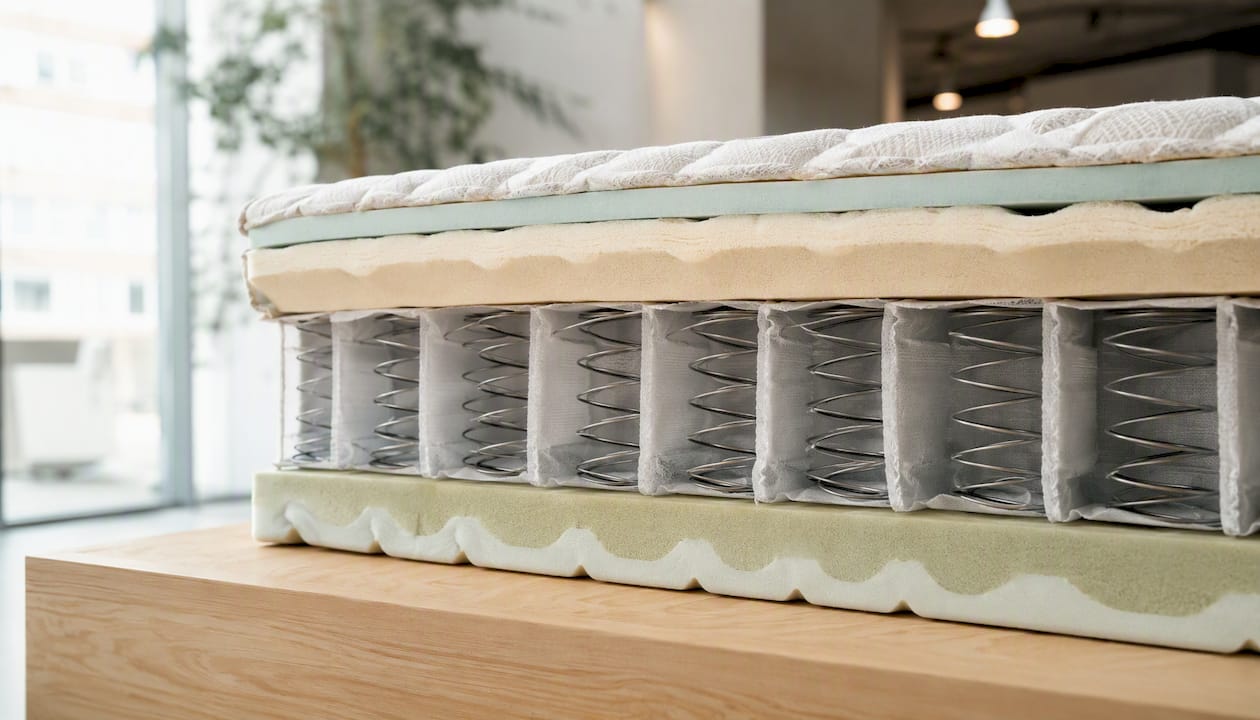
Organic cotton and wool covers add a layer of protection at the surface, where your face and skin make direct contact for hours each night. Wool has a natural moisture-wicking property, and organic cotton avoids the pesticide residues and synthetic dyes that can linger in conventional cotton. Best for: anyone layering a cover over any core material, especially if you have skin sensitivities alongside asthma.
Airbeds (adjustable air-chamber mattresses) vary widely by brand and construction, and their allergen performance depends almost entirely on the comfort layer sitting on top of the air chambers. Treat the top layer as its own material decision.
Synthetic polyester fills, common in budget pillow-tops and some cover quilting, tend to compress and trap moisture faster than natural fibers, which shortens their useful life before they become an allergen reservoir.
If a latex product doesn’t clearly state whether it’s been washed to strip residual latex proteins, ask the manufacturer directly before you buy, not after the trial period starts.
Which Certifications Actually Matter for Asthma-Friendly Mattresses?
Five labels come up constantly in mattress shopping, and they test very different things. Knowing the difference keeps you from assuming one certification covers ground it doesn’t.
- CertiPUR-US tests foam specifically for VOC emissions, heavy metals, and certain flame retardants, but it only certifies the foam layer, not the whole mattress.
- GREENGUARD and GREENGUARD Gold measure VOC emissions from the finished product, and GREENGUARD Gold applies stricter limits designed for schools and chemically sensitive populations, making it especially relevant for anyone managing asthma.
- Asthma & Allergy Friendly certification tests bedding for allergen impermeability, breathability, and cleanability, which makes it the most directly relevant label for allergen-proof covers and pillows specifically.
- OEKO-TEX Standard 100 certifies that finished textiles have been tested for a broad range of potentially harmful substances used during processing and finishing, covering fabric rather than foam.
- GOTS (Global Organic Textile Standard) and GOLS (Global Organic Latex Standard) verify organic sourcing and processing, one for textiles and one for latex.
| Certification | What it tests | Common limitation |
|---|---|---|
| CertiPUR-US | Foam VOCs, heavy metals, flame retardants | Covers foam layer only, not full mattress |
| GREENGUARD Gold | Whole-product VOC emissions | Doesn’t address organic sourcing |
| Asthma & Allergy Friendly | Allergen barrier, breathability, cleanability | Applies mainly to bedding/covers |
| OEKO-TEX Standard 100 | Harmful substances in finished textiles | Fabric-focused, not foam or latex core |
| GOTS / GOLS | Organic content and processing | Doesn’t test VOC emissions directly |
Here’s the catch that trips up a lot of shoppers: a product page can say “organic” while only the cover meets that standard, and the foam or latex core underneath carries no organic certification at all. Genuinely whole-product organic claims generally require GOTS or GOLS certification across the entire mattress, and a coherent standard is roughly 95% certified natural content, not a partial claim on one component. GREENGUARD Gold and GOTS/GOLS are complementary, not interchangeable. One addresses what the product emits into your air, and the other addresses what the product is made from. A mattress can pass one and fail to even attempt the other.
What Should You Ask a Mattress Manufacturer Before Buying?
A few direct questions on a product page or customer service chat can save you from an expensive mistake. Bring this list with you:
- Is the mattress GREENGUARD Gold certified, and can you provide the certificate?
- Is there a full, itemized materials list, layer by layer, including the fire barrier?
- Does the fire barrier contain fiberglass, and if not, what does it contain?
- Is the cover removable and machine washable?
- What is the trial length, and does it include a full refund, not just store credit?
And here are the red flags that should end the conversation:
- Vague language like “proprietary fire barrier” with no ingredient disclosure.
- Fiberglass that only becomes apparent after a customer cuts the cover open or files a return, which some investigations have documented in lower-cost mattresses.
- “Low VOC” claims with no CertiPUR-US or GREENGUARD certification attached.
- No six-sided encasement option offered or recommended by the retailer.
If you have a diagnosed latex allergy, the safest rule is simple: skip latex entirely and choose a GREENGUARD Gold certified memory foam or hybrid instead, rather than gambling on whether a specific processing method fully removed latex proteins. For a broader walkthrough of how to weigh these tradeoffs side by side, our guide to comparing mattress materials covers additional scenarios beyond asthma specifically. And if fiberglass exposure is a particular worry, our explainer on why washing certain mattress covers releases fiberglass is worth reading before you buy anything secondhand or unbranded.
How Do You Keep a Mattress From Becoming an Allergen Reservoir?
Even the best material choice degrades if you skip basic maintenance. Dust mites, dead skin cells, and moisture accumulate in any mattress over time, regardless of what it’s made from, and the maintenance habits below matter as much as the initial purchase.
- Install a fully zippered, six-sided allergen-proof encasement, not a fitted-sheet-style cover that only protects the top and sides.
- Wash all bedding weekly in hot water (130°F or higher) to kill dust mites on contact.
- Vacuum the mattress surface monthly with a HEPA-filter vacuum attachment.
- Keep bedroom relative humidity under roughly 50% using a dehumidifier or better ventilation.
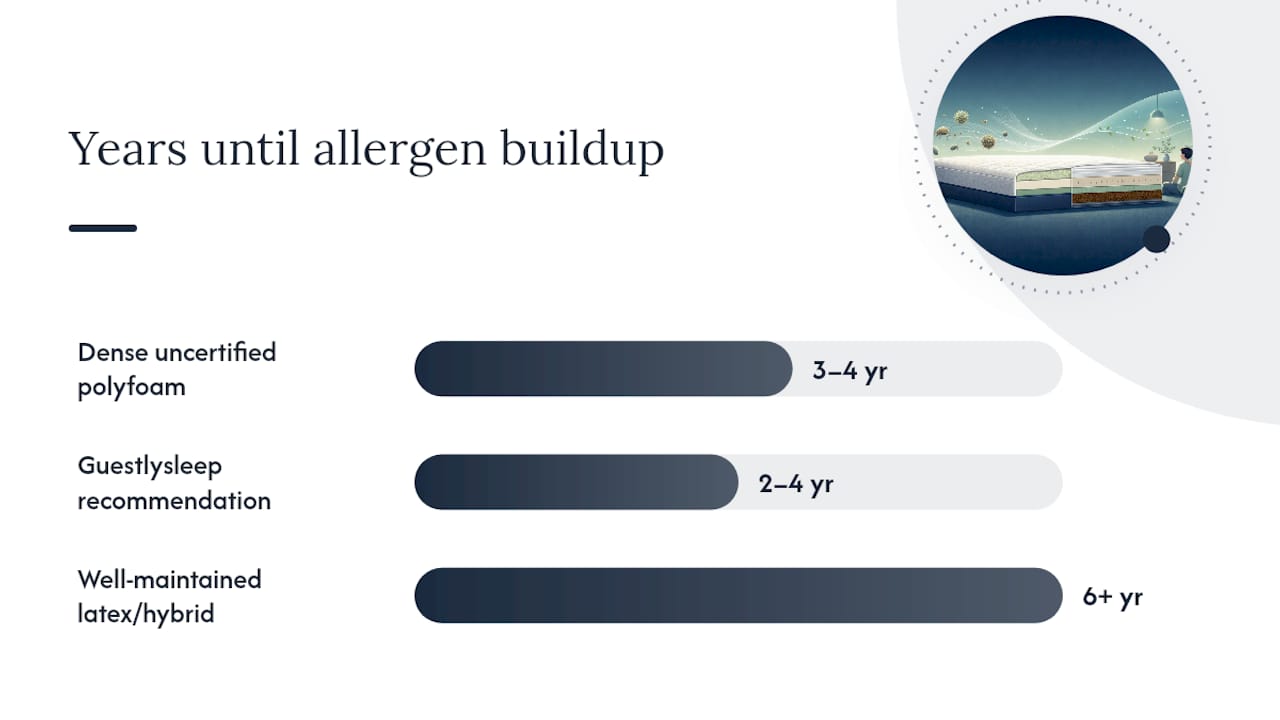
Materials age differently. A dense, uncertified polyfoam mattress can start trapping enough moisture to become a mite reservoir within three to four years. A well-maintained latex or hybrid mattress with a proper encasement can often stretch past six years before allergen buildup becomes a real concern, though the mattress itself may still need replacing for support reasons. Older mattresses accumulate allergens regardless of their original material quality, which is one reason Guestlysleep recommends replacing a mattress every two to four years rather than waiting until it visibly wears out.
Pro Tip: If you just unboxed a new memory foam mattress, let it air out in a well-ventilated room, ideally with a window cracked, for three to seven days before sleeping on it. Placing it on a slatted base or an adjustable bed base with airflow channels rather than a solid platform also helps residual off-gassing dissipate faster and keeps moisture from pooling underneath.
One more detail worth repeating: an encasement only works if it fully zips shut and has a small enough pore size to physically block dust mites. A cover with a wide weave or a partial zipper leaves the exact gap those mites need.
What Do Allergists and Sleep Experts Recommend?
Clinicians who work with allergy and asthma patients tend to agree on one thing: material choice matters, but it’s not the whole story. Hygiene and moisture control do as much of the heavy lifting as the mattress itself.
Sleep Foundation-cited clinicians Dr. Audrey Wells and Dr. Shradha Agarwal note that even the best materials can become allergen reservoirs if they trap heat and moisture, which is exactly why the maintenance steps above aren’t optional extras. Consumer Reports echoes that guidance, recommending latex or memory foam for allergy sufferers while flagging the need to check for latex sensitivity and to pair any mattress choice with allergen-proof covers and humidity control.
Mattress hygiene and moisture control matter as much as the material itself. Dust mites and mold thrive in warm, humid mattresses regardless of what they’re made from, and encasements plus regular washing are what actually keep allergen levels down over time.
A practical clinician-style checklist distilled from that guidance:
- Choose latex or certified memory foam, but verify latex sensitivity first.
- Add a six-sided, fully zippered allergen encasement immediately.
- Wash bedding weekly in hot water.
- Run a HEPA air purifier in the bedroom if symptoms persist.
- Keep humidity below 50% year-round, not just in summer.
None of this is about finding one miracle material. It’s about stacking several smaller, evidence-backed choices so no single failure point undoes the rest.
Why Material Choice Deserves More Attention Than Firmness
Most mattress shopping advice obsesses over firmness scales and sleep position, and almost none of it treats material composition as the health decision it actually is for someone managing asthma. That’s backwards. You can adjust to a mattress that’s slightly too firm or too soft. You cannot adjust to eight hours a night of VOC exposure or dust-mite allergen sitting an inch from your airway.
The uncomfortable truth is that “hypoallergenic” has become a marketing word with almost no enforceable meaning, while certifications like GREENGUARD Gold and CertiPUR-US actually test something specific and verifiable. I’d rather see a shopper cross-reference a certification database for thirty seconds than trust a product listing that uses the word “natural” six times without ever naming what’s inside the mattress.
This is exactly why Guestly Sleep sells every mattress without fiberglass and without the vague fire-barrier language that makes so many budget mattresses a gamble. Health-conscious shoppers shouldn’t have to become chemistry researchers just to sleep safely, and the fact that they often do is a real gap in how this industry sells itself. Get the materials right first. Firmness and price are real considerations, but they come second for anyone whose airway reacts to what they’re sleeping on.
A Fiberglass-Free Option Built for Health-Conscious Sleepers
If you’ve made it this far, you already know that “asthma-friendly” isn’t a marketing checkbox, it’s a materials decision backed by specific certifications and specific manufacturing choices. Guestly Sleep sells every mattress in the United States without fiberglass and without the unspecified fire-barrier layers that show up as a red flag throughout this guide.
Every mattress ships with washable covers, uses certified, safe materials, and comes with a 60-night sleep trial so you can actually test how your breathing responds before committing. That trial period matters more than most shoppers realize. VOC off-gassing and dust-mite reactions often take more than a night or two to show up, so a short return window works against you, not for you.
What to look for when you browse:
- Fiberglass-free construction as a baseline, not an upgrade.
- Non-toxic materials with documented, checkable ingredient lists.
- Washable, removable covers compatible with allergen encasements.
- Free shipping and a 60-night trial with a real return path.
If you’re ready to shop with these standards already built in, explore Guestlysleep’s mattress collections organized by comfort level and sleep position, and check the materials list on any model before you check out.
Frequently Asked Questions
Is memory foam asthma friendly? Memory foam can be asthma friendly if it carries CertiPUR-US or GREENGUARD Gold certification, which verifies low VOC emissions. Uncertified memory foam carries higher off-gassing risk and should generally be avoided.
What is the best mattress for asthma sufferers? Natural latex and GREENGUARD Gold certified hybrids or memory foam mattresses are generally the best mattress for asthma sufferers, thanks to dust-mite resistance, moisture control, and low VOC profiles.
Are hypoallergenic mattress materials the same as dust mite resistant bedding? Not exactly. Hypoallergenic mattress materials refer to the core and comfort layers, while dust mite resistant bedding usually refers to the encasement and covers layered on top. You need both for full protection.
How often should I replace a mattress for asthma management? Guestlysleep recommends replacing a mattress every two to four years, since materials gradually accumulate dust, skin cells, and moisture regardless of original quality.
Do organic or eco-friendly mattress options guarantee no chemical exposure? No. “Organic” claims can apply to just the cover while the core remains uncertified. Look for whole-product GOTS or GOLS certification rather than trusting the word “organic” alone.
This article is general information, not a substitute for advice from a qualified doctor. Consult a qualified healthcare professional about your own circumstances before acting on anything here.
Sources
- Best Hypoallergenic Mattress of 2026: Expert Tested and Reviewed
- Best Sleep Setups for Sleep Apnea, Acid Reflux, Asthma, and Allergies
- Bedding | Asthma & Allergy Friendly Certification Program
- Standard 100 by OEKO‑TEX
- UL GREENGUARD certification program
- PMC article on indoor allergens and respiratory health