

10 to 12 Inches: How Buyers Should Judge Mattress Thickness by Core
For most adults, a mattress between 10 and 12 inches thick hits the sweet spot of support and comfort. Side sleepers and heavier bodies often need 12 to 14 inches for enough cushioning, while kids, guest rooms, and bunk beds do better with 6 to 8 inches. Guestly Sleep builds across these ranges, and no matter the height you land on, plan to replace the mattress every 2 to 4 years and check your sheet depth before you buy.
TL;DR:
- Most adults should choose a mattress between 10 and 12 inches for optimal support, with thicker options of 12 to 14 inches preferred by side sleepers and heavier bodies.
- Mattress construction layers matter more than height; support cores should make up roughly half or more of total thickness to ensure durability and long-term comfort.
- Standard fitted sheets typically fit mattresses up to 12 inches, while deep-pocket sheets are necessary for mattresses over 13 inches, preventing fit issues.
- Adjustable bases and bunk beds generally support mattresses between 10 and 14 inches; thicker models may strain these frames or bases and pose safety concerns.
- For side sleepers or combination sleepers, a 12 to 14 inch mattress with deeper comfort layers is recommended, while back and stomach sleepers often find 10 to 12 inches sufficient.
Table of Contents
- Mattress Thickness Chart: From Low-Profile to Extra-Thick
- What Determines Mattress Thickness: Layer Breakdown and the 50% Rule
- How to Choose Mattress Thickness by Sleep Position, Weight, and Bed Setup
- Adjustable Bases, Bunks, RVs, and Mobility: Thickness Compatibility Rules
- Pros and Cons: When a Thicker Mattress Actually Helps
- How Guestly Sleep Maps Comfort Collections to Thickness Needs
- What Actually Matters When You’re Choosing Thickness
- Ready to Match Your Thickness to a Real Mattress?
- Sources
- FAQ
Mattress Thickness Chart: From Low-Profile to Extra-Thick
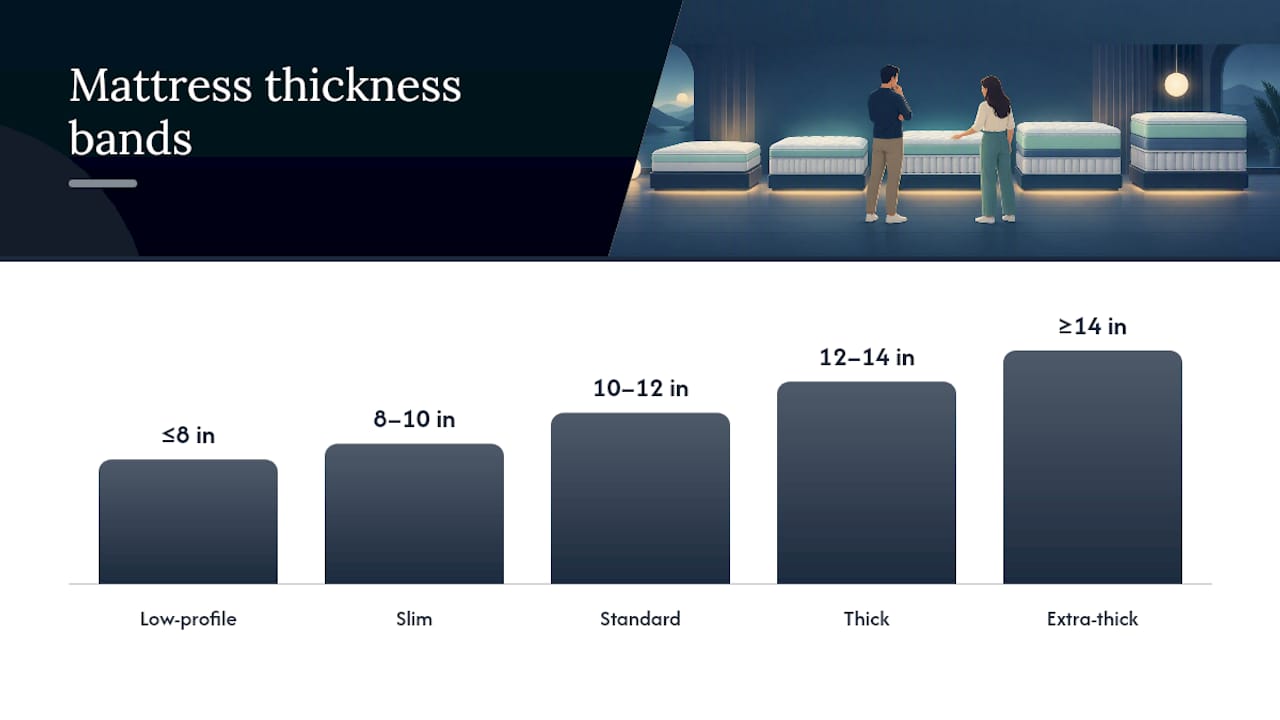
Mattress makers don’t agree on exact cutoffs, but five bands come up again and again once you shop around. Here’s what each one actually means for the person sleeping on it.
- Low-profile (8 inches or less): Built for kids’ beds, daybeds, and guest rooms where nobody’s sleeping there every night. Thin comfort layer, thin support core, minimal pressure relief. Fine for a weekend visitor, rough for a full-time back sleeper.
- Slim (8 to 10 inches): A step up, common in RVs, trundles, and budget guest setups. You get a bit more cushioning than low-profile, but the support core is still shallow enough that heavier sleepers will feel the base beneath it.
- Standard (10 to 12 inches): The range that works for the largest share of adults. A standard mattress thickness of 10 to 12 inches fits well with most foundations, frames, and average body types, which is why it’s the default recommendation across the industry.
- Thick (12 to 14 inches): Where side sleepers and larger bodies tend to land. The extra height goes almost entirely into deeper comfort layers and a more substantial support core, both of which matter for anyone over 230 pounds or anyone whose hips and shoulders need real contouring.
- Extra-thick (14 inches and up): Mostly a marketing category at this point. It can work for very heavy sleepers or couples who want maximum separation, but past 14 inches you start running into sheet, frame, and adjustable base problems faster than you gain comfort.
Sheet fit tracks these bands closely, and it’s worth checking before you fall in love with a mattress. Standard fitted sheets are cut for mattresses up to about 12 inches, while deep-pocket sheets stretch to roughly 13 to 17 inches, and extra-deep sheets cover 18 inches and beyond. Buy a 13-inch mattress expecting your existing sheets to fit, and you’ll be fighting with the fitted corners every laundry day.
Couples shopping together usually skew toward the standard-to-thick range, both for the extra support-core depth and because two people moving around at night benefit from a mattress that doesn’t telegraph every shift. Guest rooms and kids’ rooms are the one place where going thinner is a genuine advantage, not a compromise. There’s no reason to put a 14-inch mattress in a room that hosts visitors twice a year.
What Determines Mattress Thickness: Layer Breakdown and the 50% Rule
Total height is the least useful number on a mattress spec sheet. What actually determines how a bed feels and how long it lasts is what’s inside it, and that comes down to three layers stacked on top of each other.
The comfort system sits on top, usually 1 to 4 inches of foam or latex that contours to your body and absorbs initial pressure. Below that, a thin transition layer (when present) softens the jump between the plush comfort system and the firm support underneath, preventing that “sinking into a hole” feeling some cheap beds have. The support core makes up the rest, typically coils or high-density foam that keeps your spine level and stops the whole mattress from collapsing under weight over time.
Here’s the number that matters more than the one printed on the box: a mattress’s durability depends more on its support core making up roughly half or more of total thickness than on the advertised height itself. A 12-inch mattress with a 5-inch core is a worse long-term bet than a 10-inch mattress with a 6-inch core, even though the second one measures thinner.
Pro Tip: Ask any mattress seller for the layer-by-layer spec sheet before you buy, not just the total height. If they can’t tell you the support core thickness, foam density, or coil gauge, that’s a sign the company is selling on marketing numbers instead of construction quality.
When you’re comparing specs, look for:
- Memory foam density in the comfort layers, usually listed in pounds per cubic foot. Higher density (4 to 5+ PCF) resists body impressions longer than cheap 1.5 to 2 PCF foam.
- Support foam density in the core, which should generally run higher than the comfort layers above it since it’s doing the structural work.
- Coil gauge in hybrid or innerspring cores. Lower gauge numbers mean thicker, sturdier steel wire, which typically holds up better under repeated weight.
How to Choose Mattress Thickness by Sleep Position, Weight, and Bed Setup
Picking the right thickness isn’t guesswork once you know your sleep position and body weight, because both change how much cushioning and support you actually need.
By sleep position:
- Side sleepers generally do best at 12 to 14 inches. Shoulders and hips need real depth to sink into, and side sleepers benefit from the deeper contouring that a thicker mattress allows. Most side sleepers need at least 3 inches of dedicated comfort layer alone, which is usually what pushes the total profile up into the 12-inch range.
- Back and stomach sleepers usually prefer the leaner 10 to 12 inch standard band. These positions need firmer, more even support to keep the spine aligned, and too much plush cushioning on top can let the hips sink out of line.
- Combination sleepers who shift positions through the night tend to land around 12 inches. That height balances enough contouring for side sleeping with enough firmness for the stretches spent on their back.
By body weight, material choice matters as much as the number on the tape measure:
- Under 130 pounds: 10 inches is often plenty, since lighter bodies don’t compress foam as deeply.
- 130 to 230 pounds: 10 to 12 inches with a standard support core covers most people comfortably.
- 230 to 300 pounds: 12 to 14 inches with a reinforced support core and firmer foam density prevents premature sagging.
- Over 300 pounds: 14 inches or more, paired with a high-gauge coil system or extra-firm foam core built specifically for higher weight capacity.
Couples should generally aim for at least 10 inches combined support, and bump toward the thicker end if either partner falls into the higher weight bands. Anyone who shifts between side and back through the night, whether solo or paired up, should read through the best mattress for combination sleepers breakdown before committing to a height.
Before you check out, run through this quick list:
- Measure your total bed height from floor to mattress top, including the frame and foundation.
- Confirm your adjustable base’s maximum supported thickness if you’re using one.
- Check whether your existing sheets fit the new mattress’s pocket depth.
- Factor in mobility needs, especially for anyone who needs an easier seated transition getting in and out of bed.
Adjustable Bases, Bunks, RVs, and Mobility: Thickness Compatibility Rules
Not every bed frame tolerates every mattress height, and finding this out after delivery is a frustrating way to learn it.
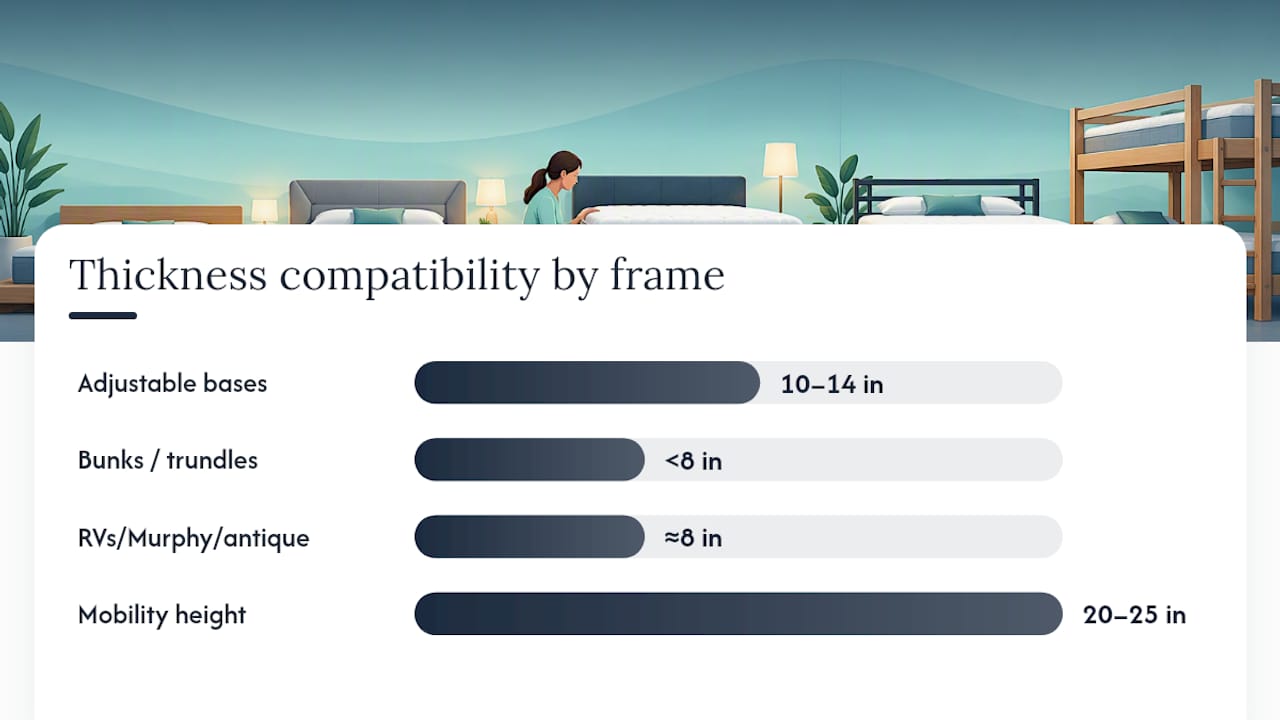
Adjustable bases work best with mattresses in the 10 to 14 inch range. Very thick or overly stiff mattresses can strain the base’s motors, flex poorly at the joints, or void the manufacturer’s warranty, so always check the base manufacturer’s stated maximum, which commonly caps out around 14 inches.
Bunk beds and trundles have hard physical limits. Guardrail clearance and slide-out fit typically call for low-profile mattresses generally under about 8 inches thick, and going thicker isn’t just uncomfortable, it can be a genuine safety issue if a mattress pushes above the guardrail height on a top bunk. Toddler beds carry their own version of this constraint, and if you’re furnishing a room for a young child, how toddler sleep needs change from age 1 to 5 is worth a read alongside the mattress decision.
RVs, Murphy beds, and antique frames all favor lower profiles too, mostly because these setups were designed around older, thinner mattress standards. Forcing a 14-inch modern mattress into an RV frame built for an 8-inch pad rarely ends well.
Mobility considerations deserve their own look, separate from frame limits. A mattress-to-floor height in the 20 to 25 inch range tends to be easiest for sitting down and standing up, which means a lower-profile mattress on a taller foundation can actually be more ergonomic than a thick mattress on a low frame.
Pros and Cons: When a Thicker Mattress Actually Helps
Thicker isn’t automatically better, and the trade-offs are worth weighing honestly before you pay more for extra inches.
Where thickness pays off:
- Deeper pressure relief for side sleepers whose shoulders and hips need room to sink in.
- A more substantial support core resists sagging longer, especially for heavier sleepers.
- Stronger edge support, which matters for anyone who sits on the bed’s perimeter to get dressed or who shares a bed and uses the full width.
Where it works against you:
- Higher price, since more material and a deeper support core cost more to manufacture.
- Heavier, bulkier mattresses are harder to move, flip, or maneuver up stairs.
- Denser foam in deep comfort layers can trap more body heat, though hybrid builds with coils tend to offset that retention.
The single most overlooked fact in mattress shopping: the industry’s push toward taller mattresses is partly a marketing trend, and shoppers get better long-term value focusing on foam density and coil gauge than on the number stamped on the box. If you want the deeper mechanics of why thickness drives price, the breakdown in how mattress thickness affects price lays out where the extra dollars actually go.
How Guestly Sleep Maps Comfort Collections to Thickness Needs
The lineup is organized around comfort level and sleep position rather than a single universal height, which is exactly the approach this guide argues for. The Essential Comfort collection generally serves buyers looking for the standard 10 to 12 inch range, the practical choice for back and stomach sleepers or anyone furnishing a guest room on a budget. Enhanced Comfort and Premium Comfort move into the thicker end of the spectrum, built with deeper comfort systems suited to side sleepers, combination sleepers, and larger body types who need more contouring and a beefier support core.
These mattresses are built without fiberglass, using certified materials chosen for health-conscious shoppers who want a non-toxic bedroom. A sleep trial and shipping options remove most of the risk of guessing wrong on thickness or firmness from a product page.
On replacement timing, it is recommended to swap your mattress every 2 to 4 years to keep your sleep environment clean and supportive. Visible sagging, waking up with new aches, or a mattress that just feels tired are all signs it’s time to act sooner rather than waiting out the calendar.
What Actually Matters When You’re Choosing Thickness
Most mattress advice treats thickness like a single number you can look up and trust, and that’s the wrong frame entirely. A 14-inch mattress with a thin, cheap support core will sag faster than a well-built 10-inch mattress, and the buyer who picks the taller box because it sounds more luxurious usually ends up disappointed within two years.
The conventional wisdom oversells thickness as a proxy for quality. It isn’t. Thickness is a proxy for potential comfort, and only the layer breakdown tells you whether that potential gets realized. If I had to give one piece of advice to someone standing in a mattress showroom right now, it’s this: ask about the support core before you ask about the total height. The number on the tag is marketing. The core is engineering.
Sleep position and body weight should drive your decision far more than trend or price tier. A side sleeper under 130 pounds and a back sleeper over 250 pounds have almost nothing in common in what they need from a mattress, even if they’re shopping the same 12 inch aisle. Match the construction to your body and your habits, not to whatever height is being marketed hardest this year.
— Justin
Ready to Match Your Thickness to a Real Mattress?
You now know the ranges, the layer math, and the compatibility rules. Guestly Sleep is the practical next step, because every mattress is built fiberglass-free and made in the USA, with the comfort system, transition layer, and support core specs listed up front instead of buried in fine print.
If you’re a side sleeper or combination sleeper eyeing the 12 to 14 inch range, Premium Comfort and Enhanced Comfort are built with the deeper comfort layers this guide recommends. Back and stomach sleepers looking at the standard 10 to 12 inch band will find Essential Comfort covers that territory without overpaying for height you don’t need. Every order comes with a 60-night sleep trial and free shipping, so you can test your thickness choice on your own bed before committing. If you’re replacing an old mattress, Guestly Sleep also offers setup and haul-away services, including installing your new mattress and bed frame together for $175 or disposing of your old mattress for $125. Browse the full lineup on the Guestly Sleep collections page and find the thickness that actually matches how you sleep.
Sources
For deeper detail beyond this guide, the Sleep Foundation covers general thickness standards, Tom’s Guide breaks down thickness by sleep position, and Mattress Recycling Guy explains construction and durability factors in more technical detail.
- How Thick Should a Mattress Be? | Sleep Foundation
- How thick should a mattress be? — Tom’s Guide
- Mattress Thickness Guide: What Actually Matters | Mattress Recycling Guy
FAQ
Is It Better to Have a 10 Inch or 12 Inch Mattress?
A 12-inch mattress usually gives more room for a substantial support core and deeper comfort layers, which benefits side sleepers and heavier bodies. A 10-inch mattress works fine for back and stomach sleepers or lighter body types, as long as the support core still makes up roughly half of that height. Neither number wins outright since it depends on your sleep position and weight, but 10 to 12 inches covers most average adults comfortably.
Is a 5-Inch Mattress Thick Enough for Adults?
A 5-inch mattress is too thin for regular adult use and falls below even the low-profile category most brands sell. It lacks the layer depth needed for a real support core or meaningful pressure relief, making it suitable mainly for temporary cots or emergency setups rather than nightly sleep.
Is a 12-Inch Mattress Too Thick for an Adjustable Base?
No, 12 inches sits comfortably within the range most adjustable bases support. Adjustable bases generally handle mattresses between 10 and 14 inches without straining the motors or affecting flexibility, though it’s worth confirming your specific base’s maximum before buying.
How Do I Know if a Mattress Is Too Thick for My Frame?
Check your frame or bed type’s stated maximum first, since bunk beds and trundles typically cap around 6 to 8 inches for guardrail safety, while adjustable bases usually top out near 14 inches. If your frame has no listed maximum, measure the total bed height from floor to mattress top and aim for the 20 to 25 inch range for comfortable sitting and standing.
What Mattress Thickness Does Guestly Sleep Recommend for Side Sleepers?
Certain mattress collections generally suit side sleepers who need the deeper 12 to 14 inch profile for shoulder and hip contouring. Current pricing for each collection is available on the Guestly Sleep website.