

Medium vs Firm Mattress: Which Is Best for Your Sleep?
For most sleepers, a medium or medium-firm mattress is the right place to start. That holds for anyone in the 130–230 lb range who sleeps on their side, back, or switches positions through the night. The main exceptions: very light side sleepers (under 130 lb) often do better on a softer surface, strict stomach sleepers usually need a firmer feel to keep their hips from sinking, and heavier sleepers above 230 lb typically need the firmer support a 7–8 on the firmness scale provides. A small PSG study found medium-firm mattresses produced shorter sleep latency and more consistent sleep efficiency than soft or firm options for participants with moderate BMI, though the 12-person sample limits how broadly that finding applies.
Quick next steps:
- Start with a medium or medium-firm (5–7 on the 1–10 scale) and use a 60-night sleep trial to judge real comfort, not a five-minute showroom test.
- In-store, lie in your actual sleep position for at least 10 minutes. Press your hand under your lower back while on your back. A gap means the mattress is too firm; sinking hips mean it is too soft.
- If shoulder or hip pain persists after 30 days, try a 2-inch memory foam topper to soften, or request a firmness swap to the next level up or down before the trial window closes.
Key Takeaways
For most sleepers in the 130–230 lb range, a medium or medium-firm mattress (5–7 on the 1–10 scale) delivers better pressure relief and more consistent sleep outcomes than a firm mattress, with firm becoming the better choice for heavier sleepers and strict stomach sleepers.
| Point | Details |
|---|---|
| Default starting point | Medium-firm (6–7/10) suits most back, combo, and average-weight side sleepers. |
| Weight changes everything | Sleepers over 230 lb compress a medium too deeply; firm (7–8) keeps the spine aligned. |
| Firmness is not support | A soft surface can sit on a supportive core; check ILD and coil gauge, not just the label. |
| Use the trial period | Give any mattress 30–60 days before judging; a topper or firmness swap can fix most mismatches. |
| Guestlysleep option | Fiberglass-free, U.S.-made mattresses organized by comfort level and sleep position, with a 60-night trial. |
Table of Contents
- What “medium” and “firm” actually mean on the firmness scale
- Which sleepers each firmness fits best
- Pros and cons: medium vs firm across the dimensions that matter
- How mattress materials and construction change perceived firmness
- A practical checklist for choosing and testing your mattress
- What the research and experts say about medium-firm performance
- Why I think most people overthink the medium vs firm decision
- Guestlysleep’s fiberglass-free mattresses, built around your firmness needs
- Sources
What “medium” and “firm” actually mean on the firmness scale
The mattress industry uses a 1–10 scale where 1 is nearly liquid-soft and 10 is a concrete slab. Most shoppers land somewhere in the middle, and the practical bands break down like this:
- Soft (3–4/10): Deep sinkage, heavy contouring, minimal pushback.
- Medium (5–6/10): Balanced feel, moderate contouring, some pushback.
- Medium-firm (6–7/10): Noticeable pushback, light contouring, good lumbar support.
- Firm (7–8/10): Minimal sinkage, flat sleeping surface, strong pushback.
Sleep Foundation maps these bands and notes that weight and position shift how any given number actually feels under your body. NCOA reinforces that the scale is comparative, not absolute, and that mattresses rated roughly 5–8 meet the needs of a wide range of sleepers.
Firmness vs. support: not the same thing. Firmness is what you feel at the surface, specifically how much the mattress pushes back against your body. Support is what the core does for your spine. As Fortune’s reporting on the firmness scale explains, a mattress can feel plush at the top while its coil or high-density foam core keeps your spine in neutral alignment. A firm surface does not automatically mean better support, and a soft surface does not mean poor support.
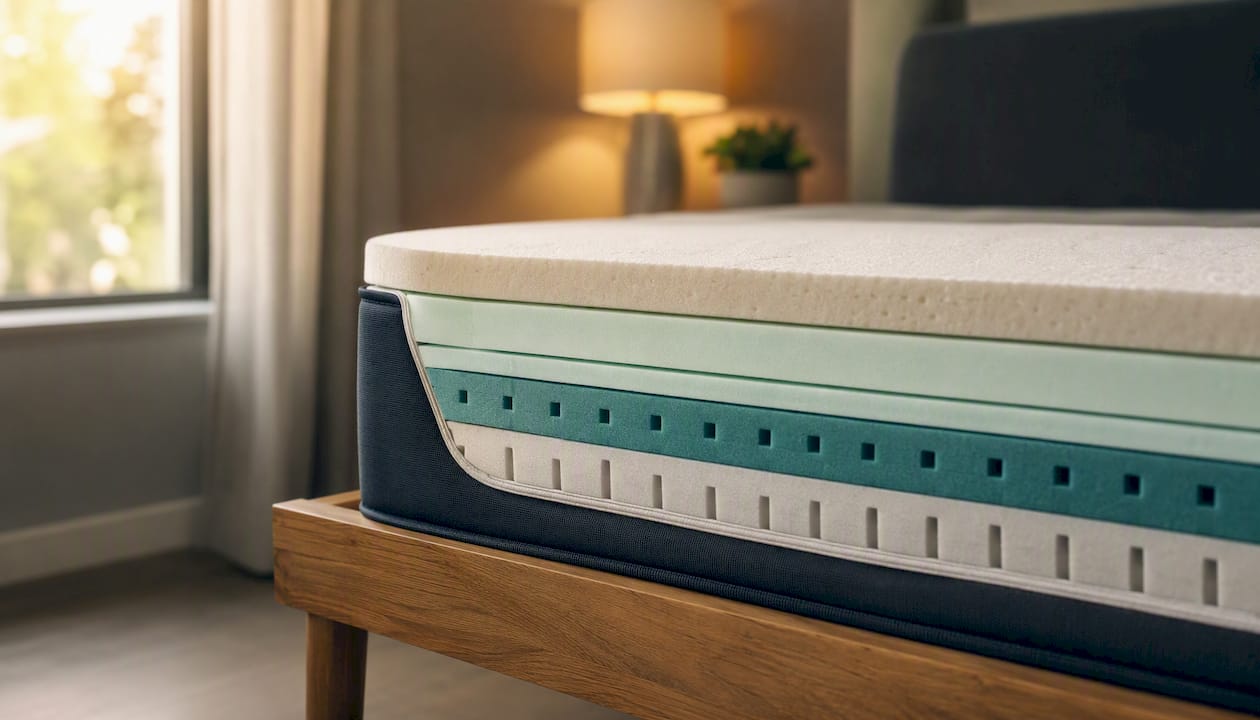
Why brand labels vary so much: A “medium” from one brand might feel like a “medium-firm” from another. ILD (Indentation Load Deflection) is the actual measurement, not the label. A foam layer rated at 25–30 ILD is medium; 30–40 ILD is firmer. Without that number, the label alone tells you little.
Pro Tip: Your bed base changes how firm your mattress feels. A solid platform base makes a mattress feel slightly firmer because it provides no flex. A slatted base with wide gaps (over 3 inches apart) lets the mattress sag slightly, making it feel softer. If you switch from a box spring to a platform base, expect your mattress to feel noticeably firmer overnight.
Which sleepers each firmness fits best
Sleep position and body weight are the two biggest variables in the medium vs firm mattress decision. Pain conditions add a third layer.
| Sleep Position | Under 130 lb | 130–230 lb | 230+ lb |
|---|---|---|---|
| Side sleeper | Soft to medium (4–5) | Medium to medium-firm (5–6) | Medium-firm to firm (6–7) |
| Back sleeper | Medium (5–6) | Medium-firm (6–7) | Firm (7–8) |
| Stomach sleeper | Medium-firm (6–7) | Firm (7–8) | Firm (7–8+) |
| Combination sleeper | Medium (5–6) | Medium-firm (6–7) | Medium-firm to firm (6–8) |
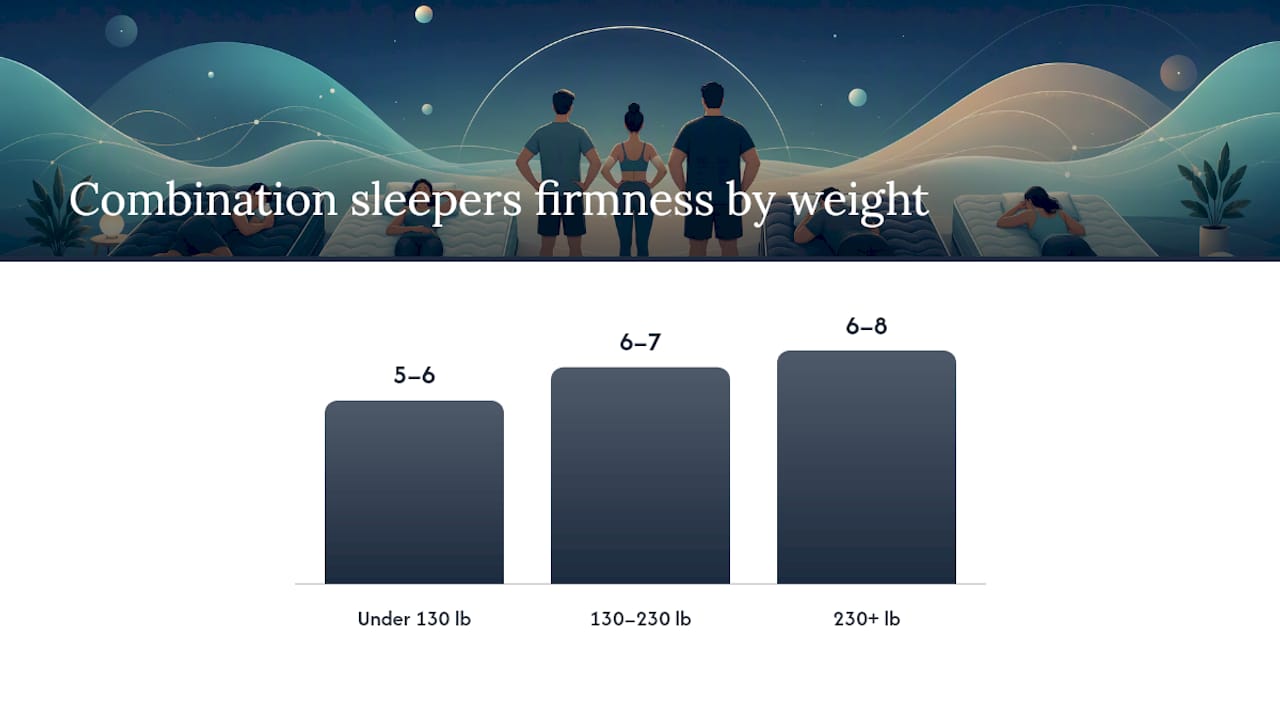
A 150-lb side sleeper needs enough surface give to let the shoulder and hip sink in slightly, keeping the spine level. A 280-lb back sleeper compresses a medium mattress so deeply that the hips drop below the shoulders, creating a hammock curve in the lower back. That same person on a firm mattress stays closer to neutral alignment.
How common pain conditions shift the choice:
- Lower back pain: A medium-firm surface tends to work better than either extreme. Firm mattresses can create a pressure gap under the lumbar curve; very soft mattresses let the hips sink too far. For a deeper look at when firmer is genuinely better for back pain, this guide on firm mattresses for back pain walks through the specifics.
- Hip pain: Side sleepers with hip pain need enough cushioning at the surface to relieve the pressure point. A firm mattress concentrates force on the greater trochanter (the bony hip protrusion), which worsens pain.
- Shoulder pain: Same principle as hip pain. Physical therapist Theresa Marko notes that side sleepers on a mattress that is too firm often develop shoulder and hip pain because the surface cannot distribute weight evenly, creating concentrated pressure points.
For couples and combination sleepers: Medium-firm is the most common compromise because it offers enough give for the lighter or side-sleeping partner while still supporting the heavier or back-sleeping one. If preferences diverge significantly, a split-firmness setup (two twin XLs or a dual-zone adjustable base) removes the compromise entirely. For more on navigating this, the combination sleeper guide covers the trade-offs clearly.
Pros and cons: medium vs firm across the dimensions that matter
| Dimension | Medium / Medium-Firm (5–7) | Firm (7–8) |
|---|---|---|
| Feel / sinkage | Moderate contouring, balanced pushback | Minimal sinkage, flat surface feel |
| Best for | Side/combo sleepers, 130–230 lb | Stomach/back sleepers, 230+ lb |
| Spinal alignment | Good for most weight ranges | Best for heavier back/stomach sleepers |
| Pressure relief | Strong at shoulders and hips | Lower; can create pressure points for side sleepers |
| Motion isolation | Good (especially all-foam medium) | Moderate; coil-based firm models transfer more motion |
| Temperature | Varies by material; hybrids sleep cooler | Firm hybrids tend to sleep cooler than firm all-foam |
| Durability / sag risk | Higher sag risk in low-density foam versions | Lower sag risk; firmer cores compress less over time |
| Typical cost and trial | Wide range; look for 60-night+ trial and 10-year warranty | Similar range; same trial/warranty standards apply |
Medium and medium-firm: top pros and cons
Pros:
- Relieves pressure at shoulders and hips for side sleepers.
- Versatile enough for most sleep positions and weight ranges.
- Easier transition for sleepers moving from a softer mattress.
Cons:
- Can feel too soft for heavier sleepers over 230 lb, leading to premature sag.
- Lower-density foam versions lose their feel faster than firm counterparts.
- May not provide enough lumbar resistance for strict stomach sleepers.
Firm: top pros and cons
Pros:
- Keeps heavier sleepers and stomach sleepers in better spinal alignment.
- Tends to resist body impressions longer in high-density or coil-based builds.
- Cooler sleeping surface in hybrid versions because less foam means more airflow.
Cons:
- Creates pressure points at the shoulder and hip for side sleepers.
- Can feel uncomfortably rigid during the first few weeks before break-in.
- Poor fit for lightweight sleepers who never compress the surface enough to feel supported.
On durability: The material matters more than the firmness label. A firm mattress built on low-gauge coils or low-density foam will sag just as fast as a poorly built medium. High-density foam (1.8 lb/ft³ or above for polyfoam, 4 lb/ft³ or above for memory foam) and tempered steel coils are the durability drivers, not the firmness number alone.
How mattress materials and construction change perceived firmness
The same firmness number feels completely different depending on what the mattress is made of. Construction is what separates a medium that sleeps like a cloud from one that bottoms out in six months.
- All-foam (memory foam or polyfoam): Memory foam creates a slow, contouring sink that feels softer than its ILD suggests. A medium all-foam mattress hugs the body closely, which is excellent for pressure relief but can trap heat and feel difficult to move on. Firm all-foam is rare because the material’s viscoelastic nature resists true firmness.
- Hybrid (pocketed coils + foam or latex comfort layers): The most common construction for both medium and firm feels. Pocketed coils provide responsive pushback and airflow; the comfort layer on top determines surface feel. A hybrid medium gives you pressure relief at the surface with bounce and support underneath. Heavier sleepers should prioritize hybrids with coil gauges of 14–15 (thicker wire, more support) over 16–17 gauge coils.
- Latex: Natural latex is durable, responsive, and breathable. It contours without the deep sink of memory foam and recovers quickly when you move. A medium latex mattress feels firmer than a medium memory foam mattress at the same ILD because latex pushes back faster. Latex also resists body impressions better than foam over time.
- Zoned coil systems: Some hybrids use zoned coils, with firmer coils under the hips and softer ones under the shoulders. This lets a mattress carry a single firmness label while actually delivering different support levels across the body. For sleepers who need both pressure relief and lumbar support, zoned construction often outperforms a single flat firmness.
For a deeper look at which construction features actually improve sleep quality, this breakdown of essential comfort mattress features covers the specifics worth checking before you buy.
Pro Tip: A pillow-top or euro-top adds 1–3 inches of soft material to the surface, which can make a firm core feel like a medium. If you buy a firm mattress with a pillow-top and find it too soft after a year (when the top compresses), you cannot firm it back up. Buy the core firmness you actually need, not the surface feel.
A practical checklist for choosing and testing your mattress
Testing a mattress properly takes more than lying on it for 30 seconds. Here is what to actually do, whether you are in a store or starting a sleep trial.
- Lie in your primary sleep position for at least 10 minutes. Your body needs time to settle. A mattress that feels fine after 60 seconds may create pressure points after 10 minutes.
- Check lumbar support while on your back. Slide your hand under your lower back. A large gap means the mattress is too firm and not filling the lumbar curve. If your hand barely fits, that is neutral alignment.
- Test shoulder and hip sinkage on your side. Your spine should stay roughly parallel to the mattress surface. If your shoulder jams up toward your ear, the mattress is too firm. If your hips sink so far that your spine curves downward, it is too soft.
- Sit on the edge. Edge support matters for getting in and out of bed, especially if you have joint pain. A mattress that collapses when you sit on the edge will also feel unstable when you sleep near the perimeter.
- Roll over and get up. A firm mattress makes it easier to change positions and push up to standing. A medium memory foam mattress can feel like moving through quicksand. If mobility is a concern, factor this in.
- Test with your partner present. Have one person roll over while the other lies still. Motion transfer that wakes you is a real problem, not a minor inconvenience.
Red flags that mean the firmness is wrong:
- Persistent hip or shoulder pain after 30 days (not just the first week of adjustment).
- Visible body impressions deeper than 1 inch in the mattress core.
- Waking up with lower back stiffness that eases within 30 minutes of standing.
- Overheating consistently, which is often a foam-density issue but can be worsened by a soft mattress that envelops the body.
On break-in: Foam and hybrid mattresses typically need 30–60 days to reach their true feel as materials compress and conform. Returning a mattress in the first week almost always means judging it before it has settled. Give it at least a month before deciding.
If the mattress feels wrong mid-trial: A 2-inch memory foam or latex topper can soften a firm mattress noticeably. Going the other direction (firming up a soft mattress) is harder. A firm mattress topper adds some resistance but cannot fix a mattress that is fundamentally too soft for your weight. In that case, use the return or exchange option before the trial window closes. For step-by-step guidance on matching firmness to your needs, this firmness selection guide is worth bookmarking.
What the research and experts say about medium-firm performance
The evidence behind the medium-firm recommendation is real, though it comes with honest caveats.
The PSG study cited at the top of this article found that participants sleeping on a medium-firm mattress had a mean sleep latency of 7.71 minutes, compared to 12.42 minutes on a soft mattress. Sleep efficiency was also more consistent across participants on the medium-firm surface. The study used polysomnography (overnight sleep lab monitoring), which is a rigorous measurement method. The limitation is the sample: 12 participants with moderate BMI. That is a coherent signal, not a definitive verdict.
Sleep Foundation’s testing positions medium-firm as the most versatile firmness for average-weight back and combination sleepers and describes it as the most common starting recommendation for shoppers who are unsure where to begin. That consensus holds across most sleep health resources.
Key points the evidence supports:
- Medium-firm tends to produce more consistent sleep outcomes for sleepers in the 130–230 lb range than either soft or firm extremes.
- The firmness-support distinction matters clinically. A soft surface with a strong core can support the spine just as well as a firm surface, which is why ILD and core construction matter more than the label.
- Side sleepers are the group most likely to be harmed by going too firm, while stomach sleepers are most likely to be harmed by going too soft.
Guestly Sleep organizes its mattress lineup by comfort level and sleep position, using fiberglass-free, U.S.-made materials across all firmness options, so you can match the evidence-backed recommendation to a product that does not carry the health risks associated with fiberglass fill.
Why I think most people overthink the medium vs firm decision
The firmness debate gets more complicated than it needs to be. Most of the anxiety comes from treating a mattress purchase like a permanent commitment, which it is not. A 60-night trial exists precisely because no amount of in-store testing replicates sleeping in your own environment, in your own sleep patterns, for weeks at a time.
The more useful frame: start with medium-firm if you are unsure, use the trial aggressively (test it, note what hurts, note what does not), and adjust from there. A topper costs $80–$150 and can meaningfully change the surface feel. A firmness swap within a trial window costs nothing. The decision is reversible.
What I find most people miss is the construction question. Two mattresses labeled “medium-firm” can feel completely different because one uses zoned latex over pocketed coils and the other uses a single layer of mid-density polyfoam. The label is a starting point, not a specification. Ask about ILD, foam density, and coil gauge before you commit. Guestly Sleep’s fiberglass-free lineup makes that transparency easier because the materials are straightforward and the comfort-level organization maps directly to sleep position guidance.
Guestly Sleep’s fiberglass-free mattresses, built around your firmness needs
Choosing between a medium and firm mattress is only half the decision. The other half is knowing what is inside the mattress you are sleeping on every night.
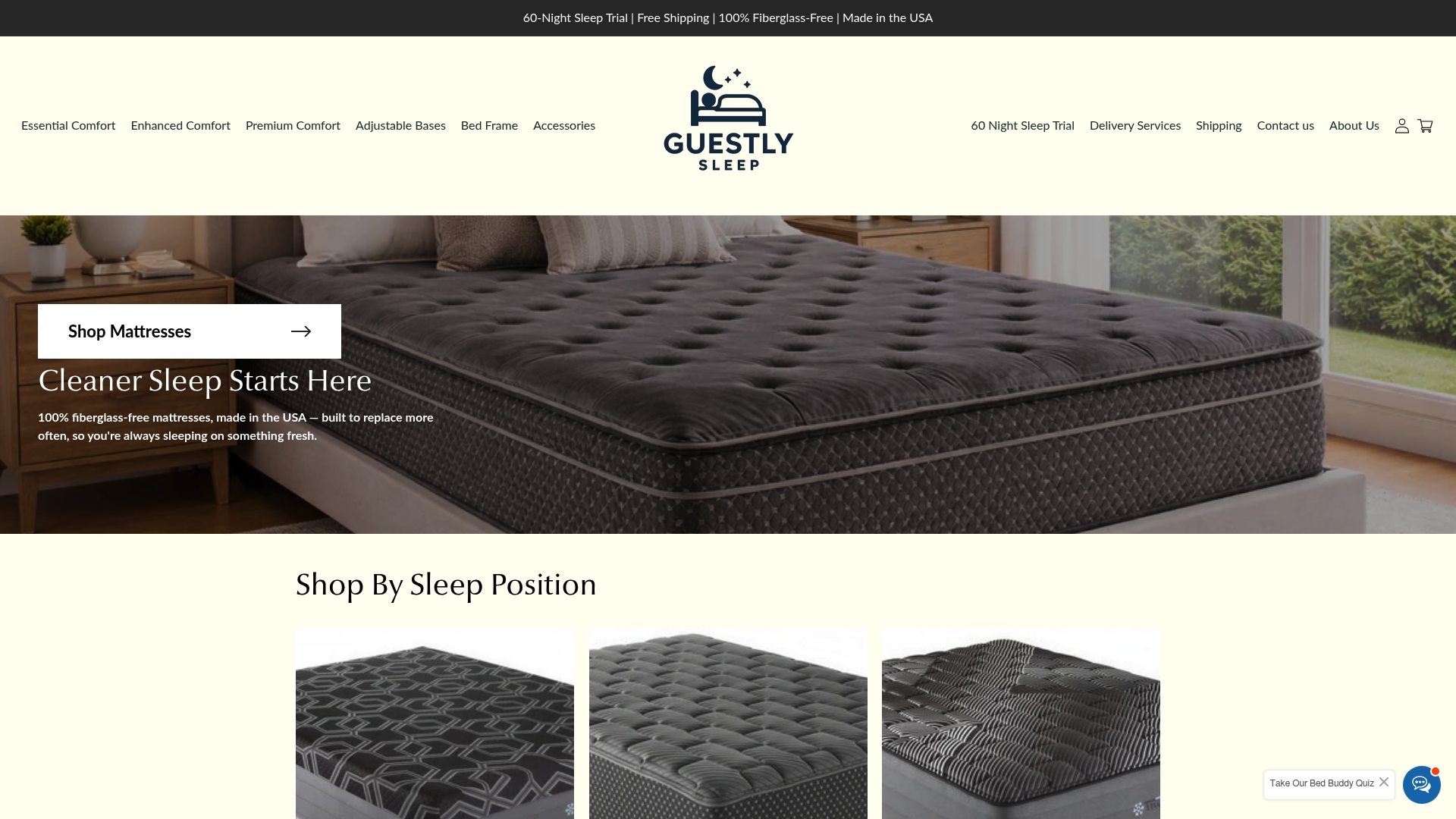
Guestly Sleep builds its mattresses in the United States without fiberglass, a filler material found in many budget mattresses that can shed into your home and cause skin and respiratory irritation. Every option in the lineup is organized by comfort level and sleep position, so whether the research points you toward medium-firm for back sleeping or firm for stomach sleeping, there is a matched option ready.
Key reasons Guestly Sleep fits what this article recommends:
- Fiberglass-free, non-toxic materials across all firmness levels.
- U.S.-made construction with certified, safe fill materials.
- 60-night sleep trial so you can test the real feel, not a showroom impression.
- Comfort collections organized by sleep position (side, back, stomach) and budget tier.
- Recommended replacement cadence of every 2–4 years for a consistently clean sleep environment.
Browse the full fiberglass-free mattress lineup to find the firmness that matches your sleep position and weight, or reach out to the Guestlysleep team directly for personalized firmness guidance before you order.