

How to Avoid Mattress Upsell Tactics and Buy on Your Terms
You can avoid mattress upsell tactics by doing three things before you ever walk into a showroom: set a firm budget, know your preferred firmness, and check at least one credible review site for the model and trial policy. The rest is just holding your ground once you’re inside. Salespeople rely on you being unprepared, not on you being difficult.
Before you leave your phone or laptop, do this:
- Write down a hard dollar ceiling for the mattress alone, separate from delivery and accessories.
- Decide on one or two firmness ranges based on your sleep position, not on marketing terms like “cloud” or “plush luxury.”
- Look up the model name (not just the brand) on a third-party review site to confirm it actually exists and check its real price history.
Pro Tip: If a salesperson says a deal “ends today” or a “manager’s discount” is only available right now, treat it as background noise. Most mattress sales are effectively permanent, just renamed every few weeks.
Key Takeaways
Avoiding mattress upsell tactics comes down to preparing your budget and questions before you shop, testing methodically in-store, and getting every policy in writing before you pay.
| Point | Details |
|---|---|
| Set your budget first | Decide your mattress-only spending limit before you enter any store or website. |
| Test for at least 10 minutes | Lie down in every sleep position you use, checking spinal alignment, not just softness. |
| Document everything | Photograph model tags and get trial, warranty, and financing terms in writing. |
| Watch for manufactured urgency | Countdown timers and “today-only” discounts are rarely tied to real inventory limits. |
| Compare channels before buying | Online retailers like Guestly Sleep often pair longer trials with transparent, fee-free pricing. |
Table of Contents
- How to Avoid Mattress Upsell Tactics Once You Recognize Them
- How to Test a Mattress in the Store Before You Buy
- Pre-Shop Checklist and In-Store Playbook to Skip the Upsell
- What to Ask Sales Staff and How to Read Their Answers
- Red Flags That Signal a Bad Mattress Deal
- Should You Buy a Mattress Online or in a Store?
- What Low-Pressure Mattress Policies Actually Look Like
- A Lower-Pressure Way to Shop for a Mattress
- Sources
How to Avoid Mattress Upsell Tactics Once You Recognize Them
Every mattress showroom runs on a handful of repeatable plays, and once you can name them, they stop working on you. The classic is top-down selling: the associate walks you straight to the higher-priced model first, so a more affordable one you were considering suddenly feels like the “smart, budget-friendly” choice. That’s anchoring, and it’s why your first stop in any store should be the price range you already decided on at home.
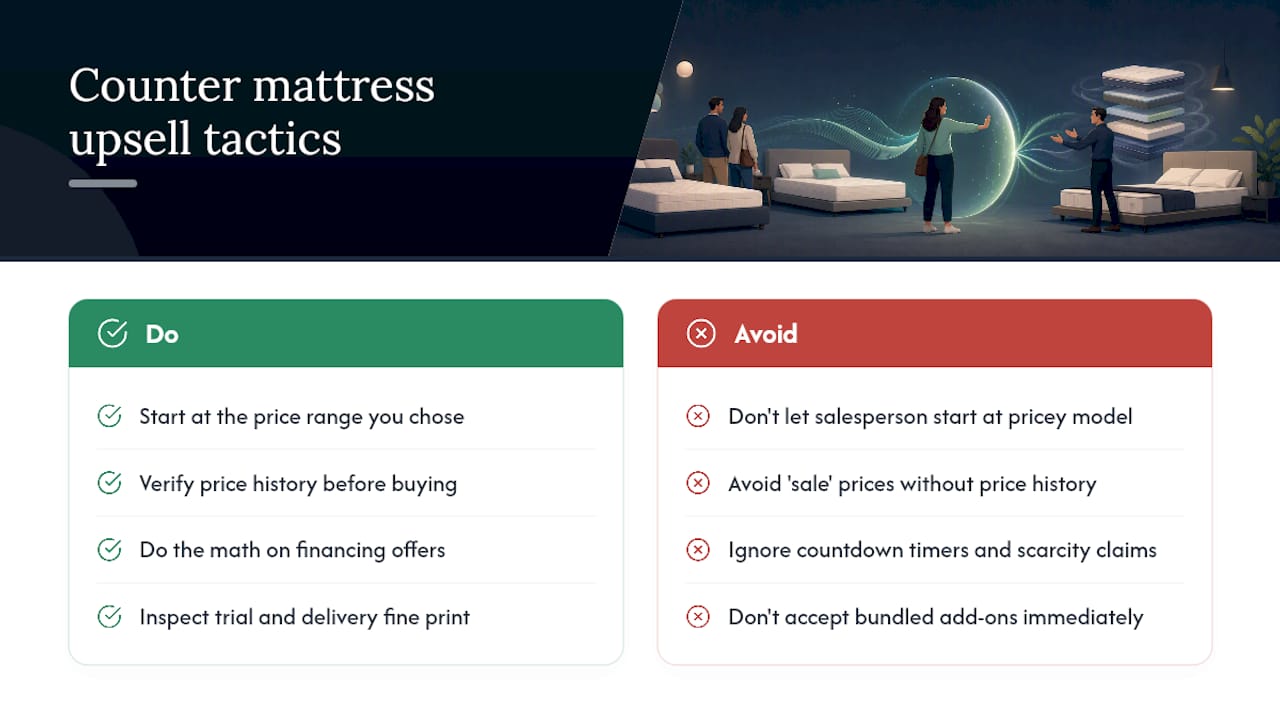
Fake discounts follow close behind. A mattress advertised as “on sale” at a significantly reduced price is often just priced at that amount year-round. Retailers routinely use inflated MSRPs and perpetual sales so the sale price simply is the market price. Pair that with countdown timers and “only 2 left in this style” signage, both classic manufactured-scarcity plays that Tom’s Guide flags as pressure tactics rather than real inventory constraints.
Then come the add-ons: a protector, a frame, “mandatory” delivery setup fees, all bundled in after you’ve mentally committed to the mattress itself. Financing pitches often show up at the same moment, timed to when you’re least likely to do the math. Bait-and-switch delivery, where the mattress that shows up isn’t quite the one you tested, and vague trial fine print round out the list.
“The sale price is frequently the real market price,” according to MattressNut’s analysis of retail discount patterns. Verifying price history before you buy is the fastest way to see through it.
Each tactic works because it exploits something specific: anchoring skews your sense of a fair price, countdowns trigger urgency, and commission structures push staff toward whatever earns the highest payout, not what actually fits your back.
How to Test a Mattress in the Store Before You Buy
A quick sit-and-press test tells you almost nothing. Consumer Reports recommends lying down for at least 10 minutes in every position you actually sleep in, using your own pillow if you brought one, and paying attention to spinal alignment rather than whether it feels generically “soft” or “firm.”
Work through it in this order:
- Take your shoes off and lie down as you would at home, not perched on the edge.
- On your back, check whether your spine stays neutral or your lower back arches or sinks.
- On your side, feel whether your shoulder and hip sink in enough to keep your spine straight, or if you feel pressure points.
- If you sleep on your stomach, check that your hips don’t dip lower than your chest.
- Sit and press near the edge to test edge support, then roll or shift your weight to gauge motion isolation.
- If you share a bed, have your partner lie down too. How a mattress handles two people matters more than how it feels solo.
Pro Tip: Photograph the model tag and spec sheet before you leave. It’s your proof of exactly what you tested if a different model shows up at delivery.
Keep in mind that even a careful in-store test is only a first impression. Bodies take weeks to adjust to a new sleep surface, which is exactly why a real trial period matters more than the showroom experience.
Pre-Shop Checklist and In-Store Playbook to Skip the Upsell
The order you do things in matters as much as what you do. Handle your homework before you ever talk to a salesperson, then follow a fixed script once you’re in the store.
Before you shop:
- Set a firm total budget for the mattress itself, not including delivery, removal, or accessories.
- Narrow your options to one or two firmness levels based on how you actually sleep, using a guide to firmness for back pain if that’s a concern.
- Check two or three review sites for trial length, warranty terms, and real customer complaints about that specific model.
- Calculate total delivered cost, meaning price plus delivery, plus old-mattress removal, plus any fees you can find listed.
In the store:
- State your budget out loud in the first minute, and ask to see only models in that range.
- Lie down for a full 10 minutes before discussing price at all.
- Ask your scripted questions (covered next) and request written answers, not verbal reassurances.
- Ask for a price breakdown that separates the mattress, delivery, removal, and any accessories.
- Request the mattress-only price in writing, and compare it against what you found online using comparison shopping best practices.
A few lines that work well in the moment: “I’m only looking in the [X] to [Y] range today.” “Can you write down the trial start date and restocking fee for me?” “I’d like to see the mattress-only total before we talk about anything else.” None of that is confrontational. It just keeps the conversation on your terms.
Miss one payment deadline and some plans retroactively charge interest on the full original balance.*
What to Ask Sales Staff and How to Read Their Answers
A few direct questions tend to expose more than an hour of browsing. Ask them plainly, and pay close attention to how confidently they’re answered.
- “When does my sleep trial actually start, delivery day or the day I first sleep on it?” A trustworthy answer names a specific date rule; a red flag is vague language like “whenever you’re ready.”
- “Is there a restocking fee if I return it?” Trustworthy: a clear percentage or flat fee stated upfront. Red flag: “we’ll figure that out if it happens.”
- “What exactly does the warranty cover, and for how long at full value?” Trustworthy: specifics on sagging depth and prorated timelines. Red flag: “it’s fully covered for 20 years” with no detail.
- “Does delivery include setup and old mattress removal?” Trustworthy: itemized in the quote. Red flag: bundled into a vague “delivery fee.”
- “What’s the APR after the promotional financing period ends?” Trustworthy: a specific number. Red flag: “you won’t need to worry about that.”
Get every answer in writing, ideally linked to the retailer’s own return policy page, before you hand over a card.
Red Flags That Signal a Bad Mattress Deal
Some signals are reliable enough that they should end the conversation, not just make you cautious.
- Permanent “sale” banners that never seem to change from visit to visit.
- Scarcity claims like “only one left at this price” with no way to verify inventory.
- Reluctance to hand you a written return or trial policy on request.
- Restocking fees or “donation requirements” that weren’t mentioned until you tried to leave.
- A delivered mattress that doesn’t match the model tag you photographed in-store.
- Setup framed as “mandatory” and priced separately, even though it should be part of delivery.
- Financing terms explained verbally but never shown to you in writing.
On the fine print, verify the trial start date, any mandatory break-in period before you’re allowed to return it, whether the warranty prorates after year 10, and what proof (receipt, photos) you’d need to file a claim.
Pro Tip: If a store won’t put trial terms in writing before you pay, that’s your answer. Walk out and buy from someone who will.
Should You Buy a Mattress Online or in a Store?
Buying in person lets you test the actual feel and sometimes negotiate face to face, but Forbes notes that showrooms tend to carry higher markups to cover retail overhead and commission. Buying online usually means longer trials, often 90 nights or more, and clearer return logistics, but you’re trusting reviews and specs instead of your own body in the moment.
The smartest approach borrows from both. Shortlist two or three models online, check their firmness by sleep position, then find similar-feel mattresses in a showroom just to confirm firmness and edge support. If the online retailer’s pricing and trial terms beat the store’s, buy there instead of feeling obligated because you tested in person.
Pro Tip: Before buying online, confirm exactly who picks up the mattress if you return it, and whether that pickup carries any fee. Some brands quietly charge for return logistics even when the trial itself is “free.”
What Low-Pressure Mattress Policies Actually Look Like
A retailer’s policy language tells you more than its showroom does. We recommend shoppers hold out for at least a 60-night trial with a clearly defined pickup process, a 10-year warranty that’s non-prorated (meaning full coverage, not a shrinking percentage as the mattress ages), a delivered price with no fees added at checkout, and staff who aren’t pushed to upsell protectors or frames as a condition of sale.
Run any store’s stated policy against this list before you commit:
- Is the trial length at least 60 nights, in writing, with a named start date?
- Does the warranty state “non-prorated” for a specific number of years, not just “lifetime coverage”?
- Is the total delivered price shown before you’re asked to pay, with no fees surfacing at checkout?
- Are accessories offered, not required, to complete the sale?
A mattress company that won’t put its trial and warranty terms in writing before you buy usually has something in that fine print it doesn’t want you reading closely.
Guestly Sleep builds its offer around exactly these standards, including a 60-night trial and fiberglass-free construction, without requiring accessory add-ons to close a sale.
Author note: what I tell friends before they buy
I tell friends to photograph the model tag, keep every receipt, and start the trial clock only after the mattress is actually set up in their bedroom, not on delivery day if setup happens later. Walking away from a pushy salesperson isn’t rude. It’s usually the clearest signal you can send, both to them and to yourself, that the deal wasn’t right.
A Lower-Pressure Way to Shop for a Mattress
Everything above works whether you buy from a showroom, a big-box retailer, or an online-only brand, but the pricing and policy transparency vary a lot by where you shop. Guestly Sleep sells fiberglass-free mattresses made in the United States with delivered pricing shown upfront, no accessory bundling required to check out, and no commissioned staff pushing add-ons.
Every mattress comes with a 60-night sleep trial and free shipping, so you get real time to test it at home instead of relying on a 10-minute showroom impression. Return logistics and trial terms are stated clearly on the product page itself, not buried in a call you have to make after the fact. If you want to compare materials and comfort levels before deciding, start with the mattress comparison chart or look at a specific option like the 15" TRU Luxury Plush mattress to see exactly what you’d be getting, no vague model names attached.
Sources
- Choose the Right Mattress for Better Sleep - Consumer Reports
- Mattress shopping — Sleep Foundation
- The 7 tricks mattress brands use to get you to buy — Tom’s Guide
- How to buy a mattress — Forbes