

Mattress Firmness for Back Pain: What to Choose
For most adults with non-specific low-back pain, a medium-firm mattress is the best general starting point. That conclusion comes from clinical trials, not marketing copy. A randomized controlled trial by Kovacs et al. comparing 313 adults found that medium-firm surfaces produced better pain and disability outcomes at 90 days than firm ones. A 2026 systematic review of 47 studies reached the same conclusion. Medium-firm is the evidence-based default. But it is not universal.
Who should start firmer:
- Stomach sleepers (need more resistance to prevent lumbar hyperextension)
- Adults over 230 lbs (more body mass compresses foam faster, so a firmer surface holds alignment longer)
Who should start softer:
- Side sleepers with narrow hips or low body weight (under 130 lbs) who need more contouring at the shoulder and hip
- Anyone whose current medium-firm mattress leaves them waking with hip or shoulder soreness
Pro Tip: Before spending anything, try placing a sheet of plywood between your mattress and box spring for a few nights. Harvard Health recommends this exact test as a low-cost way to gauge whether a firmer surface helps your back. If you wake up feeling worse, firmer is not your answer.
Key Takeaways
Medium-firm mattresses are the most consistently supported option in clinical trials for adults with non-specific low-back pain, but sleep position and body weight determine whether you should go softer or firmer from that baseline.
| Point | Details |
|---|---|
| Medium-firm is the default | Clinical trials and systematic reviews consistently favor medium-firm for pain, stiffness, and sleep quality. |
| Individualize by position and weight | Side sleepers under 130 lbs often need softer; stomach sleepers and heavier adults often need firmer. |
| Test before you buy | The plywood test and multi-week home trials give more reliable data than any showroom visit. |
| Red flags need a clinician | Leg weakness, bowel or bladder changes, or trauma-related pain require medical evaluation, not a new mattress. |
| Guestlysleep 60-night trial | Fiberglass-free, American-made mattresses with a 60-night trial let you test the right firmness at home. |
Table of Contents
- Does mattress firmness actually affect your spine?
- What does the clinical research actually show?
- How do you pick the right firmness level?
- How do materials change the way firmness feels?
- How to test a mattress at home before committing
- When your mattress probably is not the problem
- When should you replace your mattress?
- What a non-toxic mattress means for your back pain recovery
- The part most mattress guides get wrong
- Sources
Does mattress firmness actually affect your spine?
Firmness and support are not the same thing, though they get used interchangeably. Firmness describes how a surface feels under initial pressure. Support describes whether the mattress keeps your spine in a neutral position throughout the night. A mattress can feel firm but still fail to support the lumbar curve, and a softer mattress can provide excellent support if it contours correctly.
When you lie down, three outcomes are possible. A well-matched mattress lets your spine rest in a neutral curve, with hips and shoulders cushioned just enough. A too-firm surface bridges the low back, leaving a gap between the lumbar spine and the mattress that forces the back muscles to work all night. A too-soft surface lets the hips sink, creating a hammock shape that twists the lumbar joints and compresses the discs on one side.
Pressure redistribution matters beyond just comfort. When the hips or shoulders sink too far, the resulting joint torque creates micro-rotation in the lumbar vertebrae. Over eight hours, that adds up. Side sleepers are especially vulnerable because the shoulder and hip carry most of the load. Back sleepers need lumbar fill more than pressure relief. Stomach sleepers need a surface firm enough to prevent the pelvis from dropping, which would arch the lumbar spine into extension.
What does the clinical research actually show?
The strongest single piece of evidence is the Kovacs et al. randomized, double-blind, multicenter trial. It enrolled 313 adults with chronic non-specific low-back pain and assigned them to either a firm mattress (hardness score 2.3 on a validated scale) or a medium-firm mattress (hardness score 5.6). At 90 days, the medium-firm group reported significantly better outcomes for pain while lying in bed, pain on rising, and disability scores, with odds ratios consistently favoring the medium-firm surface.
Statistic: In the Kovacs trial, participants sleeping on medium-firm mattresses were more likely to report improvement in pain and disability at 90 days compared to those on firm mattresses.
A 2021 systematic literature review covering multiple smaller studies found that medium-firm mattresses consistently promoted comfort, sleep quality, and spinal alignment, though the authors noted the overall evidence base was not fully uniform. The more recent 2026 review of 47 studies confirmed medium-firm as the most consistently supported option across pressure distribution, morning stiffness, and pain intensity measures, while flagging heterogeneity and calling for larger trials on air-adjustable and zoned systems.
Important limitations to keep in mind:
- Most trials studied adults with non-specific low-back pain, meaning no identified structural cause. Results may not transfer to radiculopathy, fracture, or inflammatory conditions.
- “Firmness” is measured differently across studies, making direct comparisons difficult.
- Follow-up periods rarely exceed 90 days, so long-term durability of benefit is less clear.
- Individual variation is real. The research supports a population-level recommendation, not a guarantee for any one person.
How do you pick the right firmness level?
Body weight and hip width
Your weight and build shift the firmness sweet spot more than most people realize. Lighter adults (under 130 lbs) compress foam less, so a medium-firm mattress may feel too rigid and fail to cushion the shoulder and hip adequately. Heavier adults (over 230 lbs) compress foam more quickly, meaning a medium-firm surface may feel softer than its label suggests and lose support faster. The 130–230 lb range is where the medium-firm default holds most reliably. Research confirms that hip width and body habitus alter the required give and support for neutral spine alignment.
Sleep position starting points
Picking the right mattress by sleeping position involves more than just the table above, but these starting points cover the majority of cases.
Step-by-step process for choosing firmness
- Identify your primary sleep position and body weight range.
- Use the table above to set your starting firmness target.
- Run the plywood test on your current mattress before buying anything new.
- If you are shopping, use a 60-to-90-night home trial rather than a showroom test. Showroom testing is unreliable because a few minutes lying down rarely predicts how your back responds over weeks.
- Track morning stiffness, pain on rising, and how quickly you fall back asleep after waking. These are the three most useful signals.
- If the mattress feels too firm after 30 nights, add a 1–2 inch memory foam topper before concluding the mattress is wrong.
- If it feels too soft, try removing the topper or placing the mattress on a solid platform rather than a slatted base.
How do materials change the way firmness feels?
A mattress labeled “medium-firm” in memory foam feels different from one labeled the same in an innerspring or hybrid. The label is a starting point, not a precise specification.
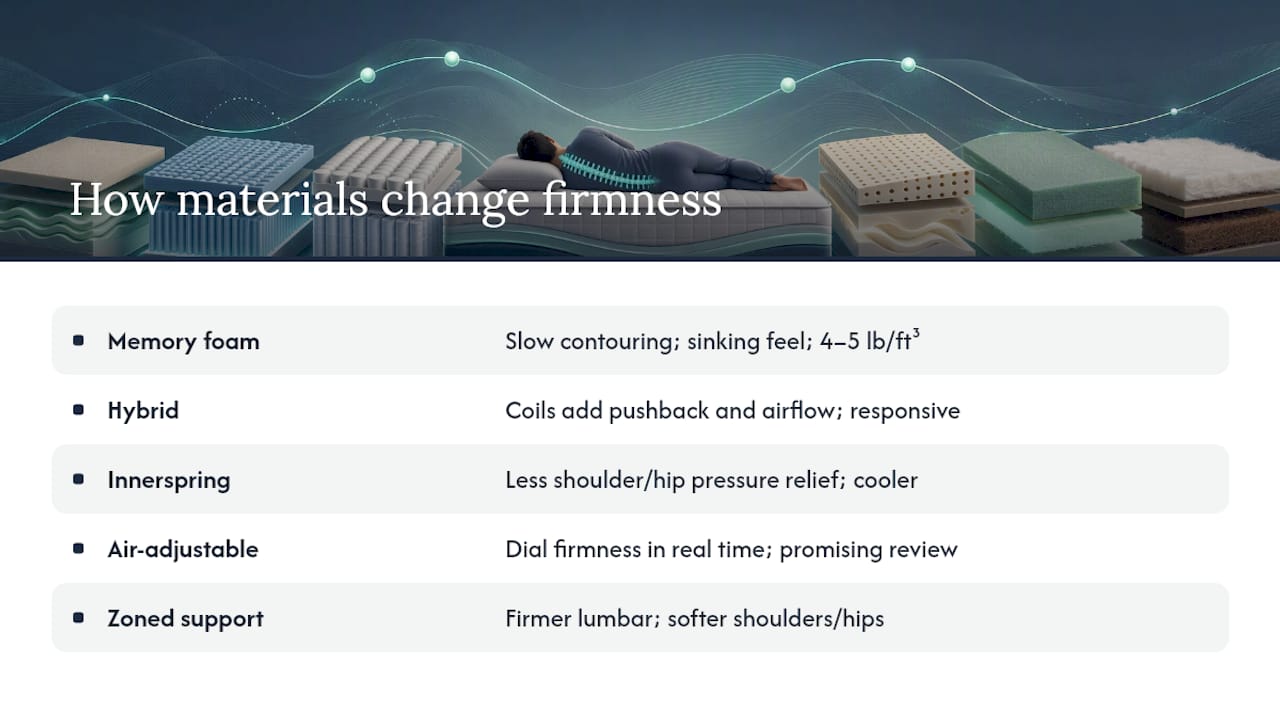
Memory foam contours slowly to body shape, which distributes pressure well but can create a “sinking” sensation that some people find supportive and others find restrictive. Foam density matters: higher-density foam (4–5 lbs per cubic foot) holds its shape longer and resists premature softening. Memory foam’s performance for back pain depends heavily on that density, not just the firmness label. One genuine downside is heat retention, which disrupts sleep for some people and indirectly worsens pain by reducing restorative sleep stages.
Hybrid mattresses combine a foam or latex comfort layer with a pocketed coil support core. The coils add pushback and airflow that foam alone cannot match. The result tends to feel more responsive, with less of the “stuck” sensation that some people dislike in all-foam beds. Hybrid mattresses balance pressure relief and support in a way that suits a wide range of body types, which is part of why they dominate the current market.
Innerspring mattresses have more surface bounce and less contouring. They tend to sleep cooler than foam but offer less pressure relief at the shoulder and hip. For back and stomach sleepers who run hot, they remain a practical option.
Air-adjustable systems let you dial firmness in real time, which is the most direct way to individualize support. The 2026 systematic review flagged these as promising but noted that larger trials are still needed.
Zoned support layers place firmer foam or coils under the lumbar region and softer material under the shoulders and hips. For back sleepers especially, this can provide lumbar fill without sacrificing shoulder pressure relief for side-sleeping partners.
Pro Tip: Motion transfer matters more than most buyers anticipate. If a partner’s movement wakes you repeatedly, sleep fragmentation alone can amplify pain sensitivity the next day. Pocketed coil hybrids and memory foam both reduce motion transfer significantly compared to traditional innerspring designs.
How to test a mattress at home before committing
Showroom tests tell you almost nothing useful. Your back needs several nights, not several minutes, to respond to a new surface.
- Run the plywood test first. Slide a sheet of plywood between your mattress and its foundation. Sleep on it for 3–5 nights. If your back improves, a firmer surface is worth trying. If it worsens, go softer.
- Use a hotel or travel stay as a data point. Pay attention to how your back feels after two or three nights on a different mattress. That is a more reliable signal than any showroom test.
- Commit to at least 30 nights on a new mattress. Your body adapts to a new surface over several weeks. Judging a mattress after three nights is like judging a new running shoe after one mile.
- Track three metrics daily: morning pain level (1–10), time to feel comfortable after rising, and number of times you woke during the night. Write them down. Memory is unreliable.
- Try a 1–2 inch topper before returning. If the mattress feels too firm at the 30-night mark, a medium-density memory foam topper often resolves it for a fraction of the cost of a replacement.
- Consider an adjustable base. Elevating the head or foot of the bed changes lumbar loading and can reduce pain for some people, particularly those with lumbar stenosis or hip flexor tightness. Adjustable bases for back pain work best when paired with a compatible mattress.
Pro Tip: If you are using a return window, document your pain metrics in writing. A clear record of morning stiffness scores over 60 nights is far more persuasive than “it just didn’t feel right” when requesting an exchange.
When your mattress probably is not the problem
A new mattress will not fix structural back pain, and chasing the perfect firmness level can delay care that actually helps.
Seek medical evaluation promptly if you experience any of the following:
- Progressive leg weakness or numbness
- Loss of bowel or bladder control
- Back pain that wakes you from sleep and does not ease with position changes
- Unexplained weight loss alongside back pain
- Pain following a fall or trauma
These are red flags for conditions including cauda equina syndrome, spinal fracture, or malignancy. No mattress adjustment addresses them.
Radiculopathy (nerve root compression from a disc or bone spur) causes pain that radiates down the leg, often with tingling or burning. Inflammatory conditions like ankylosing spondylitis tend to cause stiffness that is worst in the morning and improves with movement. Deconditioning, meaning weak core and hip muscles, is one of the most underdiagnosed contributors to chronic low-back pain and responds well to physical therapy.
When to get help: see your primary care physician if pain has lasted more than six weeks without improvement. Ask for a referral to orthopedics or a physical therapist if the pain is affecting your ability to work or sleep consistently. Bring your mattress trial notes. A clinician who knows you have already tested firmness systematically can skip that conversation and focus on what else might be driving the pain. Lumbar support as an adjunct has shown benefit in some trials when mattress changes alone are insufficient.
When should you replace your mattress?
Guestly Sleep recommends replacing a mattress every 2–5 years for optimal spinal support and sleep hygiene. That is a shorter window than most manufacturers suggest, and the rationale is straightforward: foam and coil systems lose their ability to maintain neutral spine alignment well before they look visibly worn.
Signs your mattress has failed, regardless of age:
- Visible sagging or indentations deeper than 1 inch in the sleep zone
- Waking with more pain or stiffness than you had when you went to bed
- Noticeably better sleep on a hotel mattress or guest bed
- Uneven surface that causes you to roll toward the center
- Increased morning stiffness that has developed gradually over months
Material type affects how quickly these signs appear. High-density memory foam holds up longer than low-density foam. Pocketed coil hybrids tend to maintain support better than bonded foam over time. Air-adjustable systems can compensate for some softening by increasing firmness, but the comfort layers still degrade.
For a full range of fiberglass-free, non-toxic options organized by firmness and sleep position, the Guestlysleep mattress comparison chart is a practical starting point.
What a non-toxic mattress means for your back pain recovery
Back pain recovery depends on sleep quality, and sleep quality depends partly on what you are sleeping on. Medium-firm is the evidence-based starting point. Individualize by sleep position and body weight. Test before you buy using the plywood method. Give any new mattress at least 30 nights before judging it. Use a topper or adjustable base to fine-tune before replacing. And if pain persists despite all of that, see a clinician.
Guestly Sleep offers fiberglass-free, American-made mattresses across a full firmness range, from plush to firm, organized by sleep position and comfort level. Every mattress ships free and comes with a 60-night sleep trial, which is long enough to get a real read on how your back responds. The RZ Cool Choice 14" mattress comes in both firm and plush options, making it a practical choice for anyone still working out which firmness level their back actually needs. No fiberglass, no harmful fillers, made in the United States. If the first choice is not right, the trial period gives you time to find out.
The part most mattress guides get wrong
The conventional advice on firmness for back pain has improved over the past two decades. The old “sleep on a firm mattress” rule has been replaced by a more nuanced medium-firm recommendation, and that shift is well-supported by the evidence. But there is still a gap between what the research says and what most guides actually tell people.
The gap is this: the research supports a starting point, not a destination. The Kovacs trial showed medium-firm outperformed firm at the population level. It did not show that medium-firm is right for every individual. The 2026 systematic review said the same thing more explicitly, calling for individualization based on anthropometry and sleep position. Most guides skip that part and just hand you the label.
The second thing most guides underweight is the testing timeline. Thirty nights is the minimum. Ninety nights is better. Your nervous system adapts to a new sleep surface, and your pain response lags behind the adaptation. Judging a mattress at two weeks is genuinely unreliable, yet most people do exactly that.
What I would tell anyone starting this process: run the plywood test tonight. It costs nothing and gives you real data within a week. If firmer helps, you know your direction. If it makes things worse, you have ruled out the most common assumption. Then, and only then, start shopping. A 60-night trial period from a brand that actually stands behind it is worth more than any firmness label.
This article is general information, not a substitute for advice from a qualified doctor. Consult a qualified healthcare professional about your own circumstances before acting on anything here.
Sources
The evidence behind this article comes from peer-reviewed trials and systematic reviews. Each is worth reading directly if you want to go deeper.
- Effect of firmness of mattress on chronic non-specific low-back pain: randomised, double-blind, controlled, multicentre trial
- What type of mattress is best for people with low back pain? - Harvard Health
- Mattress impact on lifestyle and back pain: a 25-year orthopedic literature review guideline | Journal of Orthopaedics and Traumatology | Springer Nature Link
A note on evidence limits: Every study in this list focused on adults with non-specific low-back pain. If your pain has a diagnosed structural or inflammatory cause, these findings may not apply directly. Use this research as a starting framework, then work with a clinician to individualize.