

Adjustable Beds for Back Pain: What Actually Works
An adjustable bed can meaningfully reduce back pain for many people, particularly those with mechanical low-back pain, degenerative disc disease, or sciatica that responds to positional changes. The short verdict: often yes for symptom relief and sleeping comfort, but not a cure for structural spinal disease. Two caveats matter before you go further. First, if your pain is chronic, progressive, or post-surgical, consult a spine specialist before relying on any positional tool. Second, adjustable bases address how you sleep, not what’s wrong with your spine. They’re a comfort and alignment tool, not a medical treatment.
That said, the right position at night can make a real difference in how you feel in the morning. Products like the Guestlysleep Tranquility II Adjustable Base are designed with exactly this in mind, and a 60-night sleep trial means you can test results without committing blind.
Key Takeaways
An adjustable bed relieves back pain most effectively when the pain has a clear positional component and is paired with a compatible, flexible mattress.
| Point | Details |
|---|---|
| Adjustable beds offer symptomatic relief | They improve spinal alignment and reduce lumbar pressure but don’t treat underlying structural disease. |
| Zero-gravity is the most effective preset | Head raised at a moderate angle with knees slightly elevated reduces lumbar disc load for many mechanical back pain patterns. |
| Consult a doctor for chronic or post-op pain | Unstable spine, recent surgery, severe osteoporosis, or new neurologic signs require clinical evaluation before use. |
| Mattress compatibility is non-negotiable | Memory foam and flexible hybrids work; rigid innersprings resist bending and can damage the base motor. |
| Guestlysleep Tranquility II | Zero-clearance, zero-gravity preset, 60-night trial, free shipping, and U.S.-made fiberglass-free mattress pairings available. |
Table of Contents
- How adjustable beds relieve back pain
- Best positions for back pain and how to find your angle
- Who benefits from an adjustable bed, and who should be cautious
- What to look for in an adjustable base for back-pain relief
- How to trial an adjustable bed and track whether it’s actually helping
- The Guestlysleep Tranquility II: a back-pain-focused option worth trying
- An honest take on what adjustable beds can and can’t do
- Sources
How adjustable beds relieve back pain
The mechanism isn’t complicated, but most people don’t think about it clearly. When you lie flat, your lumbar spine often has to bridge a gap between your mattress and the natural curve of your lower back. That gap creates sustained muscle tension and disc pressure through the night.
An adjustable base changes that equation in several ways:
- Spinal alignment and lumbar unloading. Raising the head section and slightly elevating the knees flattens the lumbar curve in a controlled way, reducing the load on lumbar discs and facet joints. Orthopedic guidance confirms that this head-and-knee elevation redistributes pressure and can reduce lower-back strain for positional pain patterns.
- Pressure redistribution. Changing the angle shifts focal pressure away from specific discs and joints, which is especially relevant for people whose pain spikes after hours in one position.
- Reduced muscle spasm. A slight knee bend takes tension off the psoas and paraspinal muscles, which often go into protective spasm when the lumbar spine is loaded overnight.
- Improved circulation. Elevating the legs modestly encourages venous return, which can reduce morning stiffness in the lower back and hips.
- Indirect sleep quality gains. Elevating the head reduces acid reflux and can help with snoring, both of which fragment sleep. Fragmented sleep amplifies pain perception, so an adjustable bed for snoring can indirectly help back pain by simply letting you sleep through the night.
The knee-bend effect deserves a closer look. When you bend your knees even slightly while lying down, the hip flexors relax. That relaxation reduces the anterior pull on the lumbar spine, which is the same reason physical therapists often place a pillow under patients’ knees post-procedure. An adjustable base does this automatically, at whatever angle you’ve found works for you.
Pro Tip: Before your first overnight test, sit in your chosen preset for 10 minutes while awake. If your lower back feels noticeably less tense, that’s a strong signal the position is worth trying overnight.
One clinical caveat: for people with spinal stenosis or certain disc herniations, a reclined position can actually increase symptoms. Spine-health that patients with complex or structural spinal disease should get clinical guidance before using positional tools.
Best positions for back pain and how to find your angle
The zero gravity bed position gets the most attention, and for good reason. Originally developed by NASA to distribute astronaut body weight during launch, the zero-gravity preset on most adjustable frames raises the head to roughly 30–45 degrees and elevates the knees slightly, putting the body in a mild recline that approximates weightlessness for the spine. WIRED’s reporting on zero-gravity sleep documents that users commonly report immediate comfort improvements in this position, and it’s now a standard preset on midrange and premium frames.
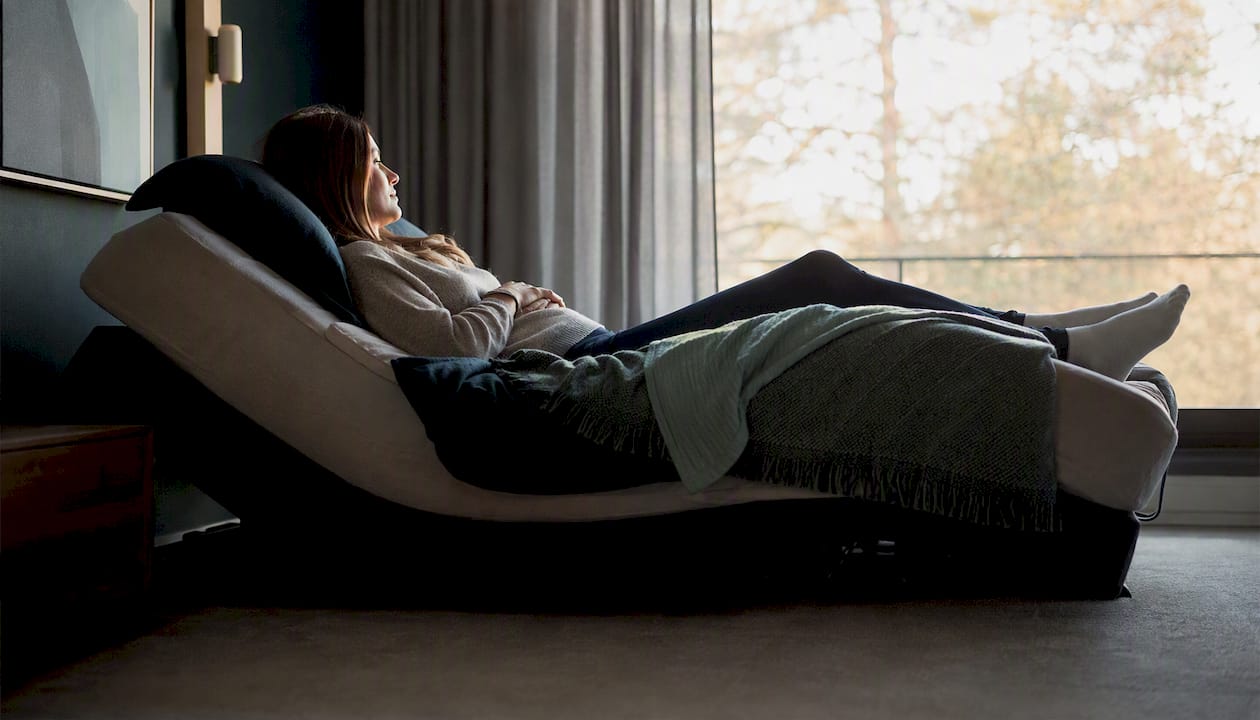
But zero gravity isn’t the only option worth testing. Here’s how the common presets compare:
| Preset | Typical purpose | What to watch for |
|---|---|---|
| Zero gravity (head moderately raised, knees slightly elevated) | Lower-back disc pressure, general lumbar relief | Neck strain if head angle is too steep |
| Gentle head incline (about 20°) | Acid reflux, snoring, mild upper-back tension | Sliding down the mattress overnight |
| Knee bend only (head flat, knees raised) | Hip flexor tension, sciatica, hip pain | Pressure behind the knees |
| Head + knee combo (moderate) | Mechanical low-back pain, morning stiffness | Numbness in legs if angle is too acute |
Finding your angle: a step-by-step approach
- Start with the head section raised to about 20 degrees and the foot section flat.
- Lie still for five minutes and notice whether lower-back tension increases, decreases, or stays the same.
- If tension decreases, add a few degrees of knee elevation and reassess.
- If tension increases, lower the head angle slightly before adding knee elevation.
- Once you find a position that feels noticeably better, lock it as a preset and use it for three consecutive nights before adjusting further.
- Make changes in small increments, never jumping more than 5 degrees at a time.
Safety note: if you notice pins and needles, increased leg pain, or new numbness during any position, return to flat immediately and consult a clinician before continuing.
Who benefits from an adjustable bed, and who should be cautious
Not everyone with back pain will get the same results. The people most likely to see real improvement share one thing: their pain responds to position changes during the day.
Conditions that commonly benefit:
- Mechanical low-back pain (pain that worsens with prolonged flat lying and improves with position change)
- Degenerative disc disease with positional relief patterns
- Sciatica that eases when the hip and knee are slightly flexed
- Sleep apnea or snoring that disrupts sleep and amplifies pain sensitivity
- Hip osteoarthritis where a flat position loads the joint overnight
Red flags and contraindications:
- Unstable spine or recent spinal fusion surgery (positional changes can stress hardware or healing tissue)
- Severe osteoporosis (certain angles may increase vertebral fracture risk)
- Positional worsening: if your pain reliably gets worse when you recline or elevate your legs, an adjustable base is likely to make things worse, not better
- New severe neurologic signs: sudden weakness, bowel or bladder changes, or rapidly progressing numbness require immediate medical evaluation, not a new mattress
C3 Spine’s clinical overview outlines which pain patterns tend to respond to adjustable bases and consistently advises pairing positioning with mattress choice and medical review for anything beyond mild positional discomfort.
When to consult a doctor: Chronic pain lasting more than six weeks, pain that wakes you from sleep with new neurologic symptoms, or any post-surgical back pain all warrant a spine specialist or primary care evaluation before you rely on positional tools. An adjustable base is for symptomatic relief, not diagnosis.
During a sleep trial, monitor for worsening pain, new numbness, or leg weakness. If any of these appear, stop using the elevated position and seek evaluation.
What to look for in an adjustable base for back-pain relief
The feature list on most adjustable bases is long. For back-pain buyers, a few things matter more than the rest.
Range of motion is the starting point. A base that only raises the head to 30 degrees gives you fewer options than one reaching 60 degrees. Look for independent head and foot adjustment so you can dial in the exact knee-bend and head-angle combination that works for your body.
Preset memory positions save you from re-finding your angle every night. Zero-gravity presets are now standard on most midrange frames, but confirm the base has at least two programmable memory positions so you can store your personal comfort angle.
Motor quality and quietness matter more than most buyers expect. A loud or jerky motor wakes a partner and makes micro-adjustments during the night impractical. Look for dual motors (one for head, one for foot) and a listed noise rating if available.
Weight capacity is a hard spec. Most quality bases handle 600–750 lbs combined (base plus sleeper), but verify the spec for your size.
Anti-entrapment safety features prevent limbs from being caught during movement. This is a regulated safety standard in the U.S., so confirm any base you consider meets current requirements.
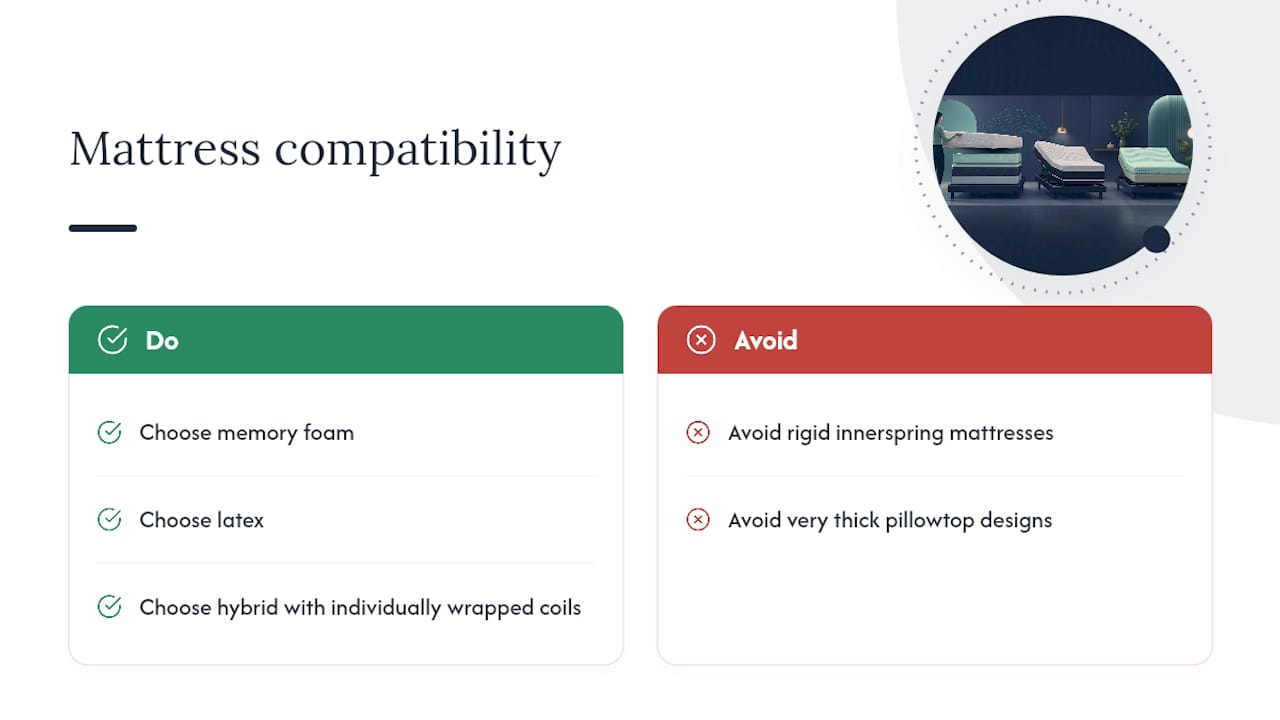
Mattress compatibility is where many buyers make a costly mistake. Adjustable bases require a flexible mattress. Memory foam and latex work well. Most hybrid mattresses with individually wrapped coils flex adequately. Rigid innerspring mattresses and very thick pillowtop designs resist bending and can damage both the mattress and the base motor over time. Pairing the right mattress with an adjustable base is as important as the base itself for back-pain relief.
Trial and warranty terms are a trust signal, not a formality. A 60-night sleep trial gives you enough time to assess real pain changes. Motor warranties of five years or more indicate the manufacturer stands behind the mechanism.
Pro Tip: If you can’t test a base in person, prioritize sellers who offer setup and disposal services. Getting the base installed correctly and removing your old setup on the same visit removes the two biggest friction points that cause buyers to abandon the trial early.
How to trial an adjustable bed and track whether it’s actually helping
The biggest mistake people make with a new adjustable base is using it casually for two weeks and then deciding it “didn’t work.” Systematic tracking over three to six weeks gives you real data.
Nightly sleep trial checklist:
- Rate your back pain on a 1–10 scale before bed and immediately upon waking.
- Note sleep quality: how many times you woke, and whether pain was the cause.
- Record morning stiffness: how long before you feel mobile and loose.
- Log the position used (preset name or approximate angles).
- Note any medication use for pain that night.
- Keep all other variables constant: same mattress, same bedtime routine, same pillow.
Three weeks of this data will tell you more than any product review. If your morning pain scores drop by two or more points on average, the position is helping. If they stay flat or worsen, the position isn’t the right one, and you should either adjust the angle or consult a clinician.
Setup checklist before your first night:
- Confirm your mattress is flexible enough to bend without cracking or bunching.
- Check that the base fits your bed frame or that you’re using it as a platform (zero clearance adjustable base setups work directly on the floor or a platform frame without a box spring).
- Route all cables away from moving parts.
- Test each motor preset slowly before lying on the base.
- Verify the weight limit includes both sleepers if sharing.
- Check headboard bracket compatibility if you’re keeping an existing frame.
Guestlysleep offers free shipping, professional setup, and disposal of your old base, which removes the logistical headaches that often derail a proper trial. Their fiberglass-free, U.S.-made mattresses are built to flex with an adjustable base from day one.
Pro Tip: Run your first few preset tests during the day, lying on the base for 10–20 minutes while awake. This screens for immediate adverse effects, like leg numbness or increased lumbar pressure, before you commit to a full night.
The Guestlysleep Tranquility II: a back-pain-focused option worth trying
If you’ve worked through the position testing and buying criteria above and you’re ready to try a specific base, the Tranquility II Adjustable Base from Guestlysleep is built for exactly this use case. It’s a zero-clearance, platform-bed-friendly design, which means it works directly on a platform frame or the floor without a box spring underneath, keeping the sleep surface low and stable.
The Tranquility II includes a zero-gravity preset, independent head and foot adjustment, and programmable memory positions so you can lock in the angle that works for your back without re-dialing every night. Its low-profile design suits most bedroom setups without requiring a new frame.
For mattress pairing, Guestlysleep’s foam and hybrid options are designed to flex with the base and are fiberglass-free, certified safe, and made in the U.S. Their cooling memory foam and hybrid mattresses offer the pressure relief and contouring that back-pain sleepers typically need, without the rigidity that fights an adjustable base.
The full package: free shipping, a 60-night sleep trial, professional setup and disposal services, and a warranty that covers the motor. If the base doesn’t improve your sleep in 60 nights, you’re not stuck with it. Browse the full Guestlysleep mattress and base collection to find the pairing that fits your comfort level and budget.
An honest take on what adjustable beds can and can’t do
There’s a tendency in sleep marketing to oversell positional tools as near-medical solutions, and an equal tendency among skeptics to dismiss them as expensive gadgets. Both miss the point.
The honest picture: if your back pain has a positional component, meaning it reliably changes when you shift how you’re lying, an adjustable base is one of the most practical tools available. It lets you fine-tune that position every night, consistently, without stacking pillows or waking a partner. The zero-gravity position in particular has enough user-reported evidence and orthopedic rationale behind it to be worth a serious trial.
What it won’t do is fix a herniated disc, resolve nerve compression, or substitute for physical therapy. The readers who get the most out of adjustable bases are the ones who treat them as one piece of a broader approach: right position, right mattress, and where needed, clinical support.
If daytime positional testing shows clear relief, try the Tranquility II with Guestlysleep’s 60-night trial. That’s a long enough window to know whether it’s working.
Sources
The following sources informed this article and are worth bookmarking if you want to go deeper on the clinical and consumer side:
- Spine-health
- Orthopedicandlaserspinesurgery
- Many Adjustable Bed Frames Have a “Zero Gravity” Feature. I Tried It for a Week | WIRED
- C3spine
For persistent, severe, or worsening back pain, consult a spine specialist or primary care physician. Positional tools are a complement to medical care, not a replacement for it.
This article is general information, not a substitute for advice from a qualified doctor. Consult a qualified healthcare professional about your own circumstances before acting on anything here.