

Mattress Fatigue Explained: Why You Wake Up Tired
What is mattress fatigue and why it causes morning tiredness
Mattress fatigue is the gradual breakdown of your mattress’s internal materials, specifically the foam layers, coils, and comfort padding that work together to support your body through the night. When those materials compress, deform, and lose their original structure, your mattress can no longer maintain even support or proper spinal alignment. The result is a body that spends eight hours fighting its sleep surface instead of recovering from the day.
The connection to morning tiredness is direct. A fatigued mattress creates pressure points at your hips, shoulders, and lower back, which trigger micro-arousals throughout the night. You may not fully wake up, but your brain registers the discomfort and pulls you out of the deeper, restorative stages of sleep. Research published on PubMed confirms that sleep fragmentation, even when subtle, significantly reduces next-day alertness and physical recovery.
Three things happen simultaneously when mattress fatigue sets in:
- Support failure: Foam cells collapse permanently, creating dips that tilt your spine out of neutral alignment.
- Pressure buildup: Without even weight distribution, joints bear concentrated load all night.
- Temperature dysregulation: Compressed foam loses its open-cell structure, trapping heat and disrupting sleep cycles.
One practical way to check for structural failure is the straightedge test. Lay a rigid ruler or level across the mattress surface. Significant dips indicate the support core has failed, even if the mattress looks fine from across the room. A mattress can also fail structurally before visible sagging appears, because sag measurement with tools reveals internal deformities that the eye misses entirely.
Pro Tip: Run the straightedge test with your body weight off the mattress first, then press down in your usual sleep position and check again. The loaded measurement tells you far more about real-world support than an unloaded surface.
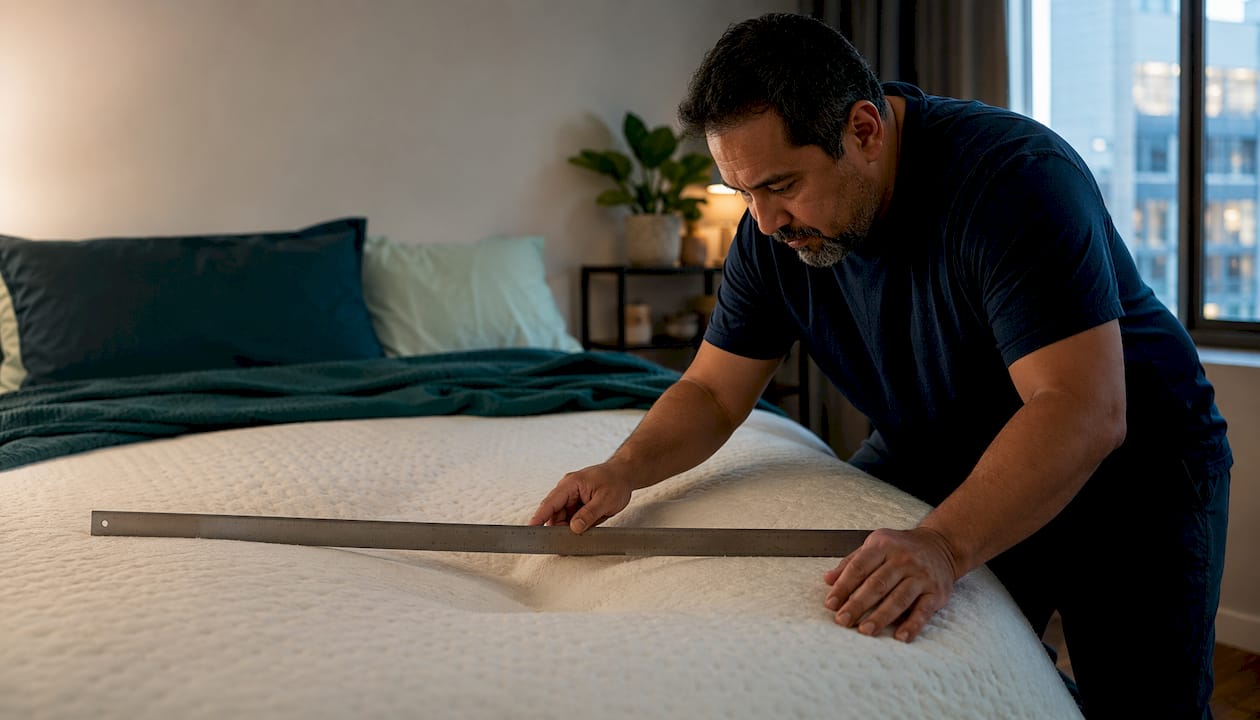
Table of Contents
- How to identify the signs your mattress is causing fatigue
- How mattress support affects spinal alignment and pressure points
- When and how to replace your mattress to improve sleep quality
- How allergens, hygiene, and heat make mattress fatigue worse
- Understanding mattress material durability and what drives fatigue
- Guestlysleep offers fiberglass-free mattresses built for real sleep recovery
- Key Takeaways
How to identify the signs your mattress is causing fatigue
Most people blame stress, screen time, or their schedule when they wake up exhausted. The mattress rarely gets the first look, even though it is the one variable present every single night. Knowing what to look for changes that.
Physical signs on the mattress itself
- Visible sagging or body impressions: Permanent indentations where you sleep are the clearest sign the comfort layers have compressed beyond recovery.
- Lumps or uneven surface: Foam layers shifting or coil springs losing tension create an uneven surface that disrupts body positioning.
- Squeaking or creaking: Noise from the support core when you move suggests coil fatigue or a broken foundation.
- Persistent odor: Old mattresses accumulate sweat, skin cells, and moisture over time, producing a stale smell that signals deep material degradation.
Symptoms you feel in your body
- Morning back or hip pain that fades within 30 minutes of getting up. Pain resolving shortly after waking points to mattress-related support failure rather than a chronic medical condition. If the pain disappears once you are upright and moving, your mattress is the likely cause.
- Waking up stiff and unrested despite a full night in bed. The Sleep Foundation notes that waking without feeling refreshed is a primary indicator that a mattress is no longer performing.
- Frequent tossing and turning. Constant repositioning is your body’s attempt to escape pressure points. You may not remember doing it, but your partner will.
- Sleeping better away from home. If a hotel bed or a guest room mattress leaves you feeling noticeably more rested, your own mattress is almost certainly the variable.
Quick diagnostic steps
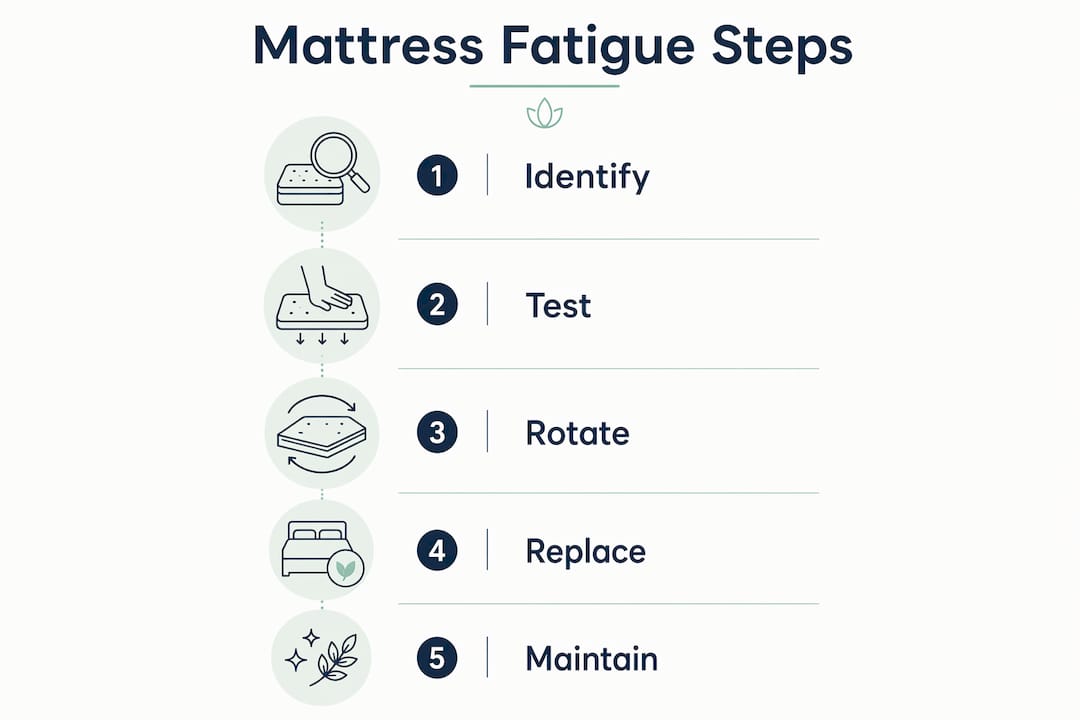
- Press your palm firmly into the center of the mattress and release. Slow recovery (more than two to three seconds) suggests foam compression fatigue.
- Sit on the edge. If it collapses significantly under your weight, edge support has failed.
- Rotate the mattress 180 degrees and sleep on it for a week. If your symptoms shift to a different part of your body, uneven wear is confirmed.
Rotating your mattress can temporarily redistribute wear and buy you a few more months of tolerable sleep, but it cannot reverse permanent compression damage. Think of it as a diagnostic tool as much as a maintenance step.
How mattress support affects spinal alignment and pressure points
Your spine has a natural S-curve that needs to be maintained during sleep, not flattened or exaggerated. A healthy mattress holds the heavier parts of your body, such as your hips and shoulders, while supporting the lighter curves at your waist and neck. When the mattress fatigues, that balance breaks down.
Sagging under the hips is the most common failure pattern. It causes the pelvis to sink lower than the shoulders, rotating the lumbar spine out of neutral and compressing the discs. Side sleepers feel this as hip and lower back pain. Back sleepers experience it as a hammock effect that strains the lumbar curve. Stomach sleepers, already in the most vulnerable position, face the worst of it because the sagging surface forces the lower back into hyperextension.
“The comfort layers should conform to encourage proper spinal alignment without excessive sinking. The support core should provide a stable base to support the heavier parts of the body and keep the spine on an even plane. If you are waking up stiff and sore, it may be due to an unsupportive mattress.” — Sleep Foundation
Pressure points develop wherever the mattress fails to distribute weight evenly. The shoulders, hips, and knees bear the most concentrated load in a fatigued mattress. That concentrated pressure restricts blood flow to soft tissue, which triggers the nervous system to signal a position change. Those signals are what pull you out of deep sleep, often without your awareness. Research from the NIH on sleep architecture shows that the body’s restorative processes, including tissue repair and memory consolidation, occur primarily in slow-wave and REM sleep stages. Repeated interruptions to those stages accumulate into the kind of fatigue that no amount of caffeine fully fixes.
Mattress features that actively support spinal alignment include:
- Zoned support systems: Firmer foam or coil tension under the hips and lumbar, softer under the shoulders.
- High-density base foam: Provides a stable foundation that resists compression under the heaviest body zones.
- Individually wrapped coils: Each coil responds independently, contouring to body shape without transferring motion.
- Appropriate firmness for sleep position: Side sleepers generally need a softer surface to allow shoulder and hip sinkage; back and stomach sleepers need firmer support to prevent spinal flexion.
If you wake with neck pain or morning headaches, a fatigued mattress is often the starting point, because the same support failure that misaligns the lumbar spine also affects cervical positioning throughout the night.
When and how to replace your mattress to improve sleep quality
Most mattresses carry a warranty of 10 years, and that number has become shorthand for “how long a mattress lasts.” It is a misleading benchmark. Warranties cover manufacturing defects and sagging greater than 1.5 inches, not the gradual comfort decline that makes sleep worse long before any visible defect appears. Your mattress can be well within warranty and still be the reason you wake up exhausted every morning.
Guestly Sleep recommends replacing mattresses every few years, a more aggressive timeline than the industry average, and one grounded in the reality that material fatigue begins well before a mattress looks worn out.
Factors that accelerate wear
- Body weight: Higher body weight increases local stress on foam cells, compressing them faster and creating deeper, more permanent impressions.
- Single-zone sleeping: Always sleeping in the same position on the same side of the bed concentrates wear in one area, creating asymmetric degradation.
- Improper foundation: Using a flexible box spring or a slatted base with gaps wider than three inches accelerates sagging by failing to provide uniform support. This can also void your warranty.
- Mattress type: All-foam mattresses, especially those using low-density foam, tend to fatigue faster than hybrid or latex options.
A practical replacement timeline
- At 2 years: Run the straightedge test and the palm-press recovery test. Note any morning pain patterns in a sleep journal for two weeks.
- At 3 years: If you are waking stiff more than three mornings per week, or if the straightedge reveals dips approaching one inch, begin evaluating replacements.
- At 4 years: Even without obvious symptoms, the foam’s ability to recover from compression has likely declined enough to affect sleep quality. Replacement at this point is preventive, not reactive.
Maintenance tips that extend comfort life
- Rotate the mattress 180 degrees every three to six months to distribute wear more evenly.
- Use a mattress protector from day one to prevent moisture from degrading foam cells.
- Ensure your foundation meets the manufacturer’s specifications. A solid platform or a slatted base with supports no more than three inches apart is standard.
- Avoid sitting on the same edge repeatedly, as edge foam compresses faster than the sleeping surface.
Understanding the difference between mattress age and sleep quality is the first step toward making a replacement decision based on how you actually feel, not on how old the receipt is.
How allergens, hygiene, and heat make mattress fatigue worse
Material fatigue is not the only way a mattress degrades your sleep. Even a mattress that still passes the straightedge test can be actively harming your sleep through accumulated allergens, poor hygiene, and heat retention.
Allergens and dust mites
Over time, mattresses accumulate dust mites, dead skin cells, mold spores, and pet dander. Accumulated allergens trigger nighttime allergy symptoms including nasal congestion, skin irritation, and respiratory disturbance, all of which fragment sleep without you realizing the cause. People who wake up with a stuffy nose, itchy eyes, or a scratchy throat that clears up an hour after rising are often reacting to what is living inside their mattress, not to seasonal allergies.
Practical steps to reduce allergen load:
- Wash bedding weekly in hot water (at least 130°F).
- Use an allergen-barrier mattress protector and wash it monthly.
- Vacuum the mattress surface every two to three months using an upholstery attachment.
- Consider replacing the mattress sooner if allergy symptoms are persistent and no other source is identified.
Temperature regulation and overheating
Heat is one of the most underappreciated causes of poor sleep. The body needs to drop its core temperature by roughly 1–2°F to initiate and maintain deep sleep. A mattress that traps heat works directly against that process. Mattresses that fail to dissipate heat disrupt sleep cycles and increase daytime tiredness, particularly by cutting short REM sleep, the stage most associated with cognitive recovery and emotional regulation.
Dense, closed-cell foams are the worst offenders. As foam fatigues and compresses, the open-cell structure that originally allowed airflow collapses, making heat retention worse over time. Mattress materials that tend to sleep cooler include:
- Latex: Naturally breathable with an open-cell structure that resists compression.
- Individually wrapped coils: The air channels between coils allow heat to escape throughout the night.
- Gel-infused or copper-infused foam: Designed to absorb and dissipate body heat, though effectiveness varies by foam density.
- Organic cotton or wool covers: Both materials wick moisture and regulate temperature passively.
A mattress that started as a cool sleeper can become a heat trap as its foam fatigues. If you have noticed yourself sleeping hotter over the past year on the same mattress, that is not just a seasonal issue. It is a sign of material breakdown.
Understanding mattress material durability and what drives fatigue
The technical term for what happens inside a foam mattress over time is compression set. Foam is made of millions of tiny open cells that act like miniature springs, compressing under load and recovering when the load is removed. With repeated compression, those cells sustain permanent cellular damage and lose their ability to rebound. That is compression set, and it cannot be undone. A topper or a rotation can mask the symptoms, but the underlying cellular structure stays damaged.
The rate at which compression set occurs depends heavily on foam density. Foams with density below 3 lb/ft³ fatigue faster than higher-density foams, regardless of how firm they feel when new. This is the single most common misconception buyers carry into a mattress purchase: a firm feel at the store does not mean the foam will hold up. Density, not firmness, predicts longevity.
The industry measures foam fatigue using the ASTM D3574 I3 standard, which runs 80,000 compression cycles on a foam sample and measures the resulting loss in height and hardness. Failure is defined as greater than 20% hardness loss or greater than 10% height loss. Those thresholds translate directly to the kind of support failure that causes the morning pain and fatigue described throughout this article.
Body weight and sleep patterns compound the problem. Higher body weight and single-zone loading increase material degradation rates, meaning two people sleeping on identical mattresses can experience very different lifespans depending on their weight and how consistently they sleep in the same spot.
Pro Tip: When shopping for a replacement, ask for the foam density specification, not just the firmness rating. A base foam density of 1.8 lb/ft³ or higher and a comfort foam density of 3 lb/ft³ or higher are reasonable minimums for durability. Anything below those numbers will fatigue faster, regardless of how it feels on day one.
Warranty terms are another area where buyers get misled. Warranties protect against sagging greater than 1.5 inches and manufacturing defects, not against the gradual comfort decline that makes sleep worse year over year. A mattress can be fully within warranty and still be causing the fatigue you feel every morning. Understanding that gap between warranty life and comfort life is what separates a well-timed replacement from one that comes two years too late.
For a deeper look at why price alone does not protect against this, the reasons expensive mattresses fail just as quickly as budget options often come down to the same foam density and compression set dynamics described here.
Guestly Sleep offers fiberglass-free mattresses built for real sleep recovery
Waking up tired every morning is a solvable problem, and for most people the solution starts with the surface they sleep on. Guestly Sleep makes fiberglass-free mattresses in the United States, using certified, non-toxic materials that skip the harmful fillers found in many mass-market options.

What sets Guestly Sleep apart for someone coming from this article is the replacement philosophy. While the industry pushes 10-year warranties as a reason to wait, Guestly Sleep is built around replacing mattresses every 2–4 years, keeping your sleep surface in the window where materials actually perform. The mattress collections are organized by sleep position and comfort level, so whether you are a side sleeper dealing with hip pressure or a back sleeper fighting lumbar pain from a sagging surface, there is a fit designed for your body. Free shipping, a 60-night sleep trial, and direct manufacturer pricing make that replacement cycle realistic, not a financial stretch. If your mattress has been on your bed for more than two years and mornings still feel like a battle, explore the full collection at Guestlysleep and find the option that matches how you sleep.
Key Takeaways
A mattress that has lost its structural integrity through compression set and material fatigue is one of the most common and most overlooked causes of persistent morning tiredness and disrupted sleep.
| Point | Details |
|---|---|
| Mattress fatigue defined | Permanent compression set in foam cells destroys support and pressure relief, directly causing fragmented sleep. |
| The 1.5-inch threshold | Dips greater than 1.5 inches measured with a straightedge indicate structural support failure requiring replacement. |
| Warranty vs. comfort life | Warranties cover defects, not gradual comfort decline; a mattress can harm sleep quality well within its warranty period. |
| Foam density predicts durability | Foams below 3 lb/ft³ fatigue faster regardless of initial firmness; density is the real durability indicator. |
| Guestlysleep replacement approach | Guestlysleep recommends replacing every 2–4 years with fiberglass-free, American-made mattresses built for real recovery. |