

How Foam Grade Shapes Mattress Price and Value
Foam grade, specifically density measured in pounds per cubic foot (lb/ft³), is the single most reliable predictor of what a mattress costs and how long it will last. Higher-density foam requires more raw material per cubic foot, takes longer to manufacture, and holds its shape years after low-density alternatives have softened into a body-shaped divot. That relationship between material weight and price is not marketing; it is physics and chemistry.
The short version:
- Check the lb/ft³ number on every foam layer listed in the spec sheet, not just the mattress’s overall firmness rating.
- Identify which layer is doing what job (comfort, transition, or support core) because density requirements differ by role.
- Divide the mattress price by its realistic lifespan to get a cost-per-year figure that makes comparisons honest.
Table of Contents
- What does foam grade actually mean on a spec sheet?
- Density bands: what the numbers mean for durability and price
- Why does higher foam grade cost more to make?
- How foam grade affects real-world performance
- How to choose the right foam grade for your situation
- How to read a mattress spec sheet without getting misled
- Materials, certifications, and what they add to the price
- Key Takeaways
- The part most shoppers get backwards
- Foam-grade–transparent mattresses from Guestlysleep
- Useful sources and standards to verify foam claims
What does foam grade actually mean on a spec sheet?
Shoppers run into two numbers that sound related but measure completely different things: density and firmness. Mixing them up is one of the most common and costly mistakes in mattress shopping.
Density is mass per unit volume, expressed in lb/ft³. A one-cubic-foot block of 4 lb/ft³ foam literally weighs four pounds. More mass means more polymer chains packed into the same space, which translates directly to more raw material cost and, in practice, better resistance to compression over time.
Firmness, expressed as ILD (Indentation Load Deflection) or IFD, measures how many pounds of force it takes to compress a foam sample by 25%. A 14 ILD foam feels soft; a 40 ILD foam feels firm. Critically, two mattresses can share the same ILD rating while having entirely different densities. A 3 lb/ft³ memory foam and a 5 lb/ft³ memory foam can both measure 14 ILD on day one. Five years later, only one of them will still feel that way.
Common foam types and what they cost
| Foam Type | Typical Density Range | Durability Expectation | Relative Cost |
|---|---|---|---|
| Standard polyfoam | 1.8 lb/ft³ | Low (3–5 years) | Lowest |
| High-Density (HD) polyfoam | 1.8–2.5 lb/ft³ | Moderate (5–8 years) | Low–moderate |
| High-Resilience (HR) polyfoam | 2.5+ lb/ft³ | Good (8–10 years) | Moderate |
| Standard memory foam | 2.0–3.5 lb/ft³ | Moderate (5–8 years) | Moderate |
| High-density memory foam | 4+ lb/ft³ | High (8–12+ years) | High |
| Plant-based memory foam | 3.0 lb/ft³ | High | High–premium |
| Natural latex | N/A (measured differently) | Very high (10+ years) | Premium |
Reputable brands publish full layer-by-layer densities and certifications rather than relying on marketing language like “premium foam.” If a listing does not include lb/ft³ numbers for each layer, that absence tells you something.
Density bands: what the numbers mean for durability and price
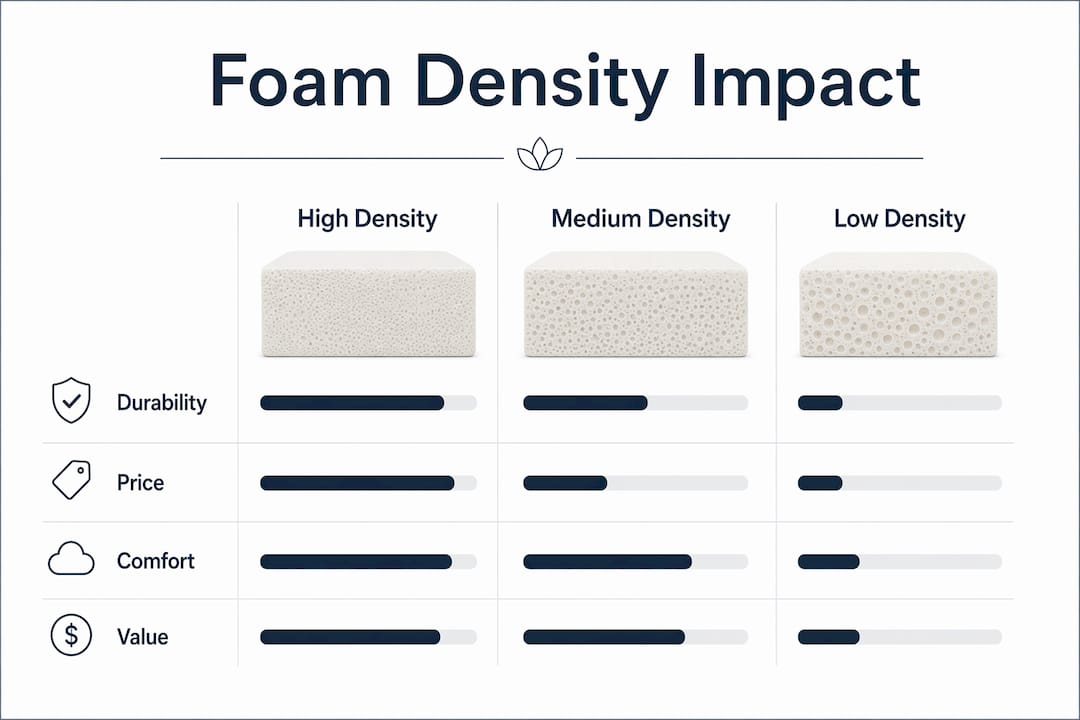
Density bands give you a practical map from spec sheet to real-world expectation. The ranges below reflect broadly accepted industry guidance for foam mattress layers.
| Density Band | lb/ft³ Range | Typical Lifespan | Common Use | Typical Queen Price Range |
|---|---|---|---|---|
| Low | Under 1.8 | 3–5 years | Guest beds, temporary use | $250–$1,200 |
| Mid | 1.8–3.0 | 5–8 years | Everyday use, lighter sleepers | $700–$1,100 |
| High | 3.0–4.0 | 8–12+ years | Primary beds, heavier sleepers | $1,100–$1,500 |
Industry guides recommend 4 lb/ft³ or higher for comfort layers intended for long-term daily use of eight or more years. Below 3 lb/ft³, notable impressions often appear within five years, particularly in comfort layers that absorb body weight night after night.
The Sleep Foundation’s mattress pricing data puts budget all-foam queens in the $250–$1,200 range and mid-range models at $700–$1,100, with luxury options starting around $1,200. Those price bands track closely with density tiers. Industry analysis shows that price tiers correlate to construction bundles where foam density acts as a predictable cost threshold.
A few exceptions are worth flagging. Hybrid mattresses use coil systems for support, so their foam layers can be thinner without the same durability penalty. Very thin comfort layers (under 1 inch) may carry a high density number that looks impressive but contributes little to overall feel or longevity. And specialty foams like gel-infused or copper-infused memory foam may carry a density premium that reflects the additive cost rather than purely the foam structure.
Note: Mid-range mattresses commonly include 1.8–2.5 lb/ft³ foams and represent where value concentration typically sits for most buyers, with the $700–$1,100 price band offering certified densities and hybrid constructions.
Why does higher foam grade cost more to make?
The price gap between a $400 queen and a $1,400 queen is not arbitrary. Three concrete cost drivers explain most of it.
Raw material volume. Density is mass per volume. A mattress built with 4 lb/ft³ memory foam uses roughly twice the raw polymer per cubic foot compared to a 2 lb/ft³ version. Scale that across a queen-size mattress with several inches of comfort foam, and the material cost difference per unit becomes significant before a single manufacturing step begins.
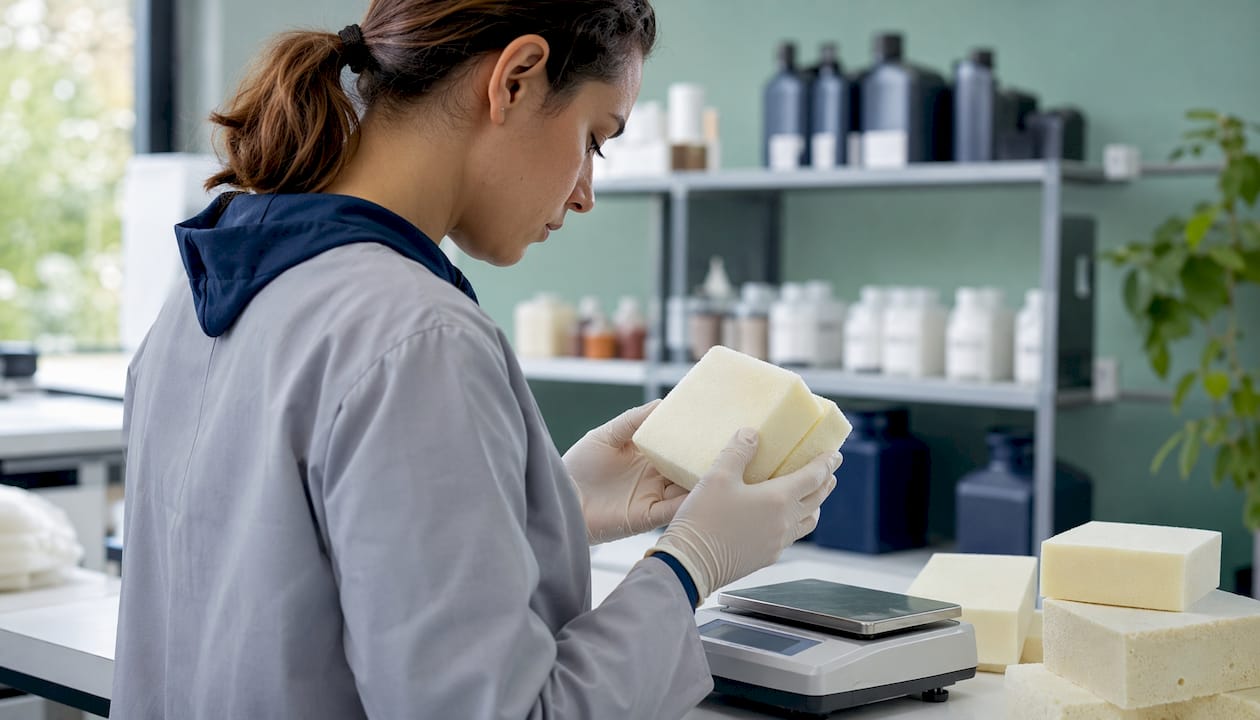
Formulation premiums. Not all foam chemicals are equal. Plant-based polyols used in eco-conscious foams typically add a 20–40% material premium compared with conventional petroleum-based polyols. Gel infusions, copper particles, and graphite additives each carry their own cost. Those formulation choices show up directly in retail price.
Manufacturing time. Higher-density formulations often require 12–18 hours of curing time, compared to 4–6 hours for low-density foams. Longer cure times mean lower throughput per facility per day, which spreads fixed overhead costs across fewer units. Add durability testing and tighter quality tolerances, and the per-unit cost climbs further.
- More raw material per cubic foot raises base material cost.
- Premium formulations (plant-based, gel-infused) add 20–40% to material cost.
- Longer cure times reduce manufacturing throughput, raising per-unit overhead.
- Stricter QA and certification testing add cost that reputable brands absorb.
Foam chemicals are also tied to crude oil prices. Rising crude oil and fuel costs increase the price of propylene oxide, polyols, and isocyanates, the core ingredients in polyurethane foam. When oil prices spike, foam prices follow, and mattress retail prices adjust accordingly. That is an industry-wide cost pressure, not a brand-specific markup.
How foam grade affects real-world performance
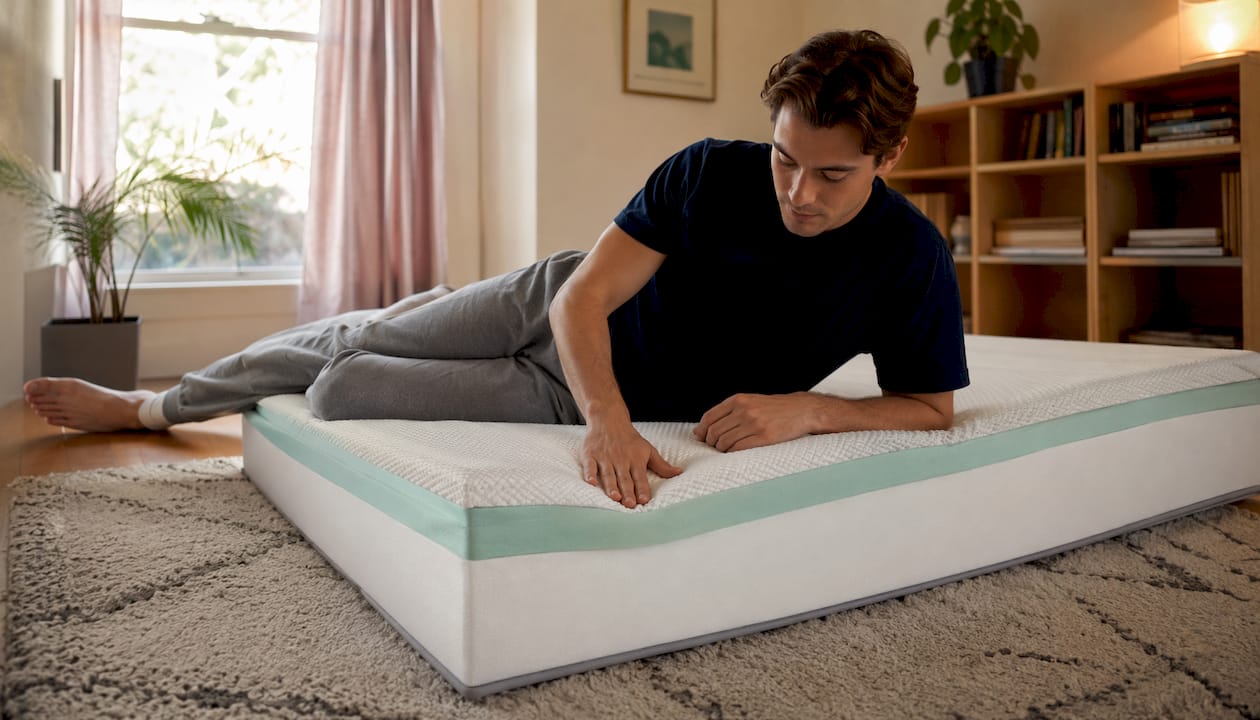
Density’s most direct effect is on sagging resistance. Foam compresses under body weight thousands of times per year. Higher-density foams recover more completely after each compression cycle because there is more material to push back. Lower-density foams lose that recovery gradually, which is why a mattress that felt supportive at purchase can develop a permanent body impression within a few years.
Beyond sagging, density influences several other performance factors:
- Heat retention: Denser foams trap more heat because there is less open-cell space for air to move through. This is the most common trade-off shoppers accept when choosing high-density memory foam. Gel infusions help, but they do not eliminate the effect entirely.
- Motion isolation: Higher-density memory foam absorbs movement more effectively, which matters for couples with different sleep schedules.
- Responsiveness: High-resilience (HR) polyfoam offers both good density and faster rebound than memory foam, making it a better choice for combination sleepers who change positions frequently.
- Edge support: The support core density matters here. A low-density core compresses at the perimeter under sitting weight, which shortens usable mattress life and makes getting in and out of bed harder.
Pro Tip: The transition layer, the foam between the comfort layer and the support core, is often where mattresses fail first. Premature mattress failure typically starts in mid layers, not the top comfort layer. Specify at least 1.8 lb/ft³ HD polyfoam in the transition layer, and ideally 2.0–2.5 lb/ft³, to prevent early sagging even when the comfort layer density is high.
Understanding why expensive mattresses sometimes fail just as quickly as cheaper ones often comes down to this: a high-density comfort layer sitting on a thin, low-density transition layer will still fail at the transition point. The top layer looks great on the spec sheet; the middle layer is the weak link.
How to choose the right foam grade for your situation
The right density depends on three variables: your body weight, your sleep position, and how long you expect the mattress to last before replacing it.
Decision checklist:
- Sleep position: Side sleepers need softer, higher-density comfort foam (3–4 lb/ft³) to cushion shoulders and hips without bottoming out. Back and stomach sleepers need firmer comfort layers but still benefit from higher-density support cores.
- Body weight: Sleepers over 230 lb compress foam more aggressively and should prioritize higher-density foams in both comfort and support layers.
- Desired lifespan: If you plan to replace every 2–4 years (a reasonable health-focused approach), mid-density foams in the 1.8–3.0 lb/ft³ range offer good value. If you want 8–10 years, invest in 4+ lb/ft³ comfort layers.
- Heat sensitivity: If you sleep hot, balance density with open-cell or gel-infused formulations, or consider a hybrid where the coil system handles airflow.
- Budget: Calculate cost-per-year, not just sticker price.
Density recommendation by sleeper type and layer role
| Sleeper Type | Comfort Layer | Transition Layer | Support Core |
|---|---|---|---|
| Side sleeper (under 130 lb) | 3.0 lb/ft³ | 1.8–2.0 lb/ft³ | 1.8–2.0 lb/ft³ |
| Side sleeper (130–230 lb) | 3.5 lb/ft³ | 2.0–2.5 lb/ft³ | 1.8–2.5 lb/ft³ |
| Back/stomach sleeper | 3.0 lb/ft³ | 2.0–2.5 lb/ft³ | 1.8–2.5 lb/ft³ |
| Heavy sleeper (230+ lb) | 4+ lb/ft³ | 2.5 lb/ft³+ | 2.0–2.5 lb/ft³ |
| Guest/occasional use | 1.5–2.5 lb/ft³ | 1.5–1.8 lb/ft³ | 1.5–1.8 lb/ft³ |
The cost-per-year rule is simple: divide the mattress price by the realistic lifespan based on its density. A $900 mattress with 3.5 lb/ft³ comfort foam that lasts eight years costs $112.50 per year. A $500 mattress with 1.8 lb/ft³ foam that needs replacing in four years costs $125 per year. The cheaper mattress costs more annually. For practical guidance on choosing an affordable foam mattress without sacrificing density where it counts, the layer-role framework above is the right starting point.
How to read a mattress spec sheet without getting misled
Most mattress listings bury the information that actually matters. Here is what to look for and what to skip.
What to check:
- Layer-by-layer density in lb/ft³. A single “high-density foam” claim with no number is a red flag. You need the density of each individual layer, not a blanket description.
- Layer thickness. A 1-inch comfort layer at 5 lb/ft³ contributes less to feel and durability than a 3-inch layer at the same density. Both numbers matter together.
- Certifications. CertiPUR-US covers emissions, off-gassing, and chemical content. OEKO-TEX Standard 100 covers textile safety. GOLS (Global Organic Latex Standard) applies to latex layers. These are not marketing badges; they are third-party verified claims.
- Warranty sagging threshold. A warranty that covers indentations of 1.5 inches or more is weaker than one covering 0.75 inches. The threshold tells you how much sagging the manufacturer expects before they consider it a defect.
Red flags:
- No density numbers listed anywhere in the product description.
- “Premium foam,” “luxury foam,” or “high-quality foam” with no lb/ft³ figure attached.
- A thick comfort layer (4+ inches) with no density disclosure. Manufacturers sometimes use thicker but low-density comfort layers to create a perception of luxury; check both thickness and lb/ft³, not thickness alone.
- Unusually short warranties (under 5 years) paired with heavy marketing language about durability.
- No CertiPUR-US or equivalent certification listed.
Pro Tip: Calculate cost-per-year before you buy. Take the mattress price, divide by the expected lifespan based on the comfort layer density (use the density bands table above), and compare that number across options. A $1,100 mattress with 4 lb/ft³ foam lasting 10 years costs $110/year. A $650 mattress with 2.0 lb/ft³ foam lasting 5 years costs $130/year. The math often flips the apparent bargain.
For additional savings tactics that work alongside density-based selection, Guestlysleep’s guide on ways to save on your mattress purchase covers timing, trial periods, and direct-to-consumer pricing.
Materials, certifications, and what they add to the price
The foam inside a mattress is not a commodity. Two mattresses with identical density numbers can differ substantially in chemical formulation, and that difference affects both price and what you are breathing in every night.
Plant-based polyols, derived from soy, castor oil, or other renewable sources, replace a portion of the petroleum-based polyols in conventional foam. This substitution adds roughly 20–40% to raw material cost, which flows through to retail price. The trade-off is a lower environmental footprint and, in some formulations, reduced off-gassing during the initial break-in period.
Certifications carry their own cost implications. CertiPUR-US testing requires manufacturers to submit foam samples to accredited labs, which adds per-batch testing costs. OEKO-TEX Standard 100 certification covers the full textile component, including covers and ticking. GOLS certification for latex involves farm-level auditing. None of these are free, and brands that invest in them pass some of that cost to the consumer. What you get in return is third-party verification, not a manufacturer’s self-assessment.
“Density is the single best predictor of how a foam mattress will age; two beds that feel similar today can diverge in performance within a few years based on density differences alone.” — Mattress Pricing Guide
Guestly Sleep’s mattresses are made in the United States, free from fiberglass and harmful fillers, and organized into collections by comfort level and sleep position. The brand’s mattress materials health comparison covers how specific material choices affect both safety and price, which is useful reading before comparing spec sheets across brands. For shoppers concerned about indoor air quality and off-gassing during the break-in period, pairing a new mattress with a quality sleep environment air purification system can reduce exposure to any residual VOCs.
The petroleum connection also matters for timing. Foam prices track crude oil and fuel costs because propylene oxide, polyols, and isocyanates are all petroleum derivatives. When energy markets spike, foam costs follow within weeks, and retail mattress prices adjust within months. Buying during stable or declining energy price periods can meaningfully affect what you pay for the same density specification.
Key Takeaways
Foam density (lb/ft³) is the primary driver of mattress price, durability, and long-term value, and checking it by layer is the single most useful thing you can do before buying.
| Point | Details |
|---|---|
| Density drives price and lifespan | Higher lb/ft³ means more raw material, longer cure times, and a mattress that holds its shape longer. |
| Density ≠ firmness | ILD measures feel; lb/ft³ measures durability. Two mattresses can share the same firmness but diverge in lifespan within years. |
| Transition layers fail first | Specify at least 1.8–2.5 lb/ft³ HD polyfoam in the transition layer to prevent premature sagging. |
| Cost-per-year beats sticker price | Divide mattress price by expected lifespan based on density; a $900 mattress at 3.5 lb/ft³ often costs less per year than a $500 alternative. |
| Guestlysleep | Offers fiberglass-free, American-made mattresses with transparent specs and a 60-night trial for shoppers who want verified materials. |
The part most shoppers get backwards
Most people shop for a mattress by feel and price, then rationalize the decision with whatever the salesperson or product page says about quality. The problem is that “feel” on day one is almost entirely determined by ILD firmness, which tells you nothing about how the mattress will perform in year three or five. Density is invisible to the hand but completely visible on a spec sheet, and it is the number that actually predicts your experience two, four, and eight years from now.
The conventional wisdom says to spend more for better quality, which is true but incomplete. Spending more on a thick comfort layer with no density disclosure is not better quality. Spending more on a certified, layer-by-layer disclosed mattress with 4 lb/ft³ comfort foam is. The difference is not price; it is information. A brand that publishes every layer’s density is telling you something about its confidence in the product. A brand that hides behind “premium foam” language is telling you something too.
There is also a health angle that most mattress guides underweight. Lower-density foams tend to off-gas more aggressively in the first weeks because they have more open-cell structure and often use simpler, less refined formulations. Certifications like CertiPUR-US set emissions limits, but the baseline formulation still matters. Plant-based polyols and higher-grade formulations tend to produce cleaner off-gassing profiles, which is one reason the price premium for those materials is worth considering beyond just durability.
The cost-per-year framework is the most honest way to compare options, and almost nobody uses it at the point of purchase. Run the math before you decide, not after.
Foam-grade–transparent mattresses from Guestly Sleep
Knowing what to look for in a spec sheet is only useful if the brand you are buying from actually publishes those specs. Guestly Sleep builds its mattresses in the United States, free from fiberglass and harmful fillers, and organizes its range into collections that match comfort level to sleep position, so you are not guessing which density profile fits your needs.
The 60-night sleep trial means you can verify real-world feel and support without committing upfront, and the direct manufacturer relationship keeps pricing honest relative to the density specifications you are getting. For shoppers who have done the density math and want a mattress that backs it up with transparent materials and American manufacturing, browse the full range of fiberglass-free mattresses at Guestly Sleep and check the spec details for each collection before you buy.
Useful sources and standards to verify foam claims
When you are reading a mattress listing and want to verify what a certification actually covers, these are the authoritative sources to check.
- CertiPUR-US: The primary U.S. certification for polyurethane foam. Covers emissions (VOCs), off-gassing limits, and prohibits specific harmful chemicals including formaldehyde, heavy metals, and certain flame retardants. Foam must be tested by accredited labs to carry the mark.
- OEKO-TEX Standard 100: Covers textile safety across the full mattress cover and fabric components. Verifies that every component, including threads and dyes, meets human-ecological requirements. Check oeko-tex.com for certified product lookup.
- GOLS (Global Organic Latex Standard): Applies specifically to latex layers. Requires that the latex content meets organic certification at the farm level, not just the processing stage.
- International Sleep Products Association (ISPA): The U.S. trade association for the sleep products industry. Publishes industry data and consumer guidance on mattress construction standards at sleepproducts.org.
- Sleep Foundation (sleepfoundation.org): Publishes independent mattress reviews, foam density explanations, and price range data that are useful benchmarks when comparing listings.