

Air Out a Mattress in 24–72 Hours With Compression Steps
Yes, air out a new or noticeably odorous mattress: unbox it, leave it uncovered, and ventilate the room for 24 to 72 hours. Dense memory foam and sensitive sleepers generally need a longer airing period, which can extend for several days. The single most useful action right now is opening a window and pointing a fan directly at the surface.
TL;DR:
- Ventilating a newly unboxed mattress with cross-ventilation and a fan during the first 24 to 72 hours significantly reduces perceived odors.
- Foam density and packaging tightness impact off-gassing duration, with denser or more compressed mattresses taking longer to fully air out.
- Mechanical compression by walking or pressing on the mattress accelerates VOC release faster than passive airing alone.
- Using a HEPA and activated-carbon filter purifier during ventilation can reduce odor by up to 80% over 24 hours, especially in rooms with poor airflow.
- Proper placement, such as using a bed frame and propping the mattress at an angle, improves airflow and shortens the airing process.
Table of Contents
- How to Air Out a Mattress Right Now
- Why Does a New Mattress Smell, and What Actually Fixes It?
- Step-by-Step: Airing Techniques That Actually Speed Things Up
- How Long Does It Take to Air Out a Mattress?
- Five Mistakes That Slow Down Airing (and Waste Your Time)
- Airing Guidance for Sensitive Sleepers, Infants, and Pregnancy
- What Guestly Sleep Recommends for Airing and Long-Term Mattress Care
- Primary Sources and Further Reading
- Why Most Airing Advice Gets the Timeline Wrong
- Sources
- FAQ
How to Air Out a Mattress Right Now
Skip the overthinking. These are the moves that actually move the needle in the first three days.
- Unbox it in the room where it will live. Dragging a rolled mattress through the house and unwrapping it in a garage just delays the process, since sealed spaces trap the same gases you’re trying to release.
- Strip the plastic completely, including any thin film left around the edges or handles. Manufacturers sometimes leave a layer behind that people miss.
- Set it on a bed frame or slatted foundation, not the floor. Airflow needs to reach the underside too.
- Open windows on opposite sides of the room if you can, and run a fan pointed straight at the mattress top. Cross ventilation moves stale air out instead of just stirring it around.
- Leave it bare for the first 24 to 72 hours. No sheets, no mattress protector, no comforter. Covering it traps exactly what you’re airing out.
- Sprinkle baking soda over lingering surface odor, let it sit a few hours, then vacuum it off. If you own a HEPA purifier with an activated carbon filter, run it in the room during this window.
None of this requires special equipment. A box fan and an open window handle most of the work for a typical bed-in-a-box mattress.
Why Does a New Mattress Smell, and What Actually Fixes It?
That smell is off-gassing, the release of volatile organic compounds (VOCs) that get trapped inside foam during manufacturing and packaging. Foam cores absorb these compounds as they cure, and when a mattress gets compressed, rolled, and vacuum-sealed for shipping, the gases have nowhere to go. The moment you cut the plastic, they start escaping into the air.
How strong that smell is and how long it lingers depends on two things: how the mattress was packaged and how dense the foam is. A tightly compressed mattress that spent weeks in a warehouse box holds a higher concentration of trapped VOCs than one shipped flat and loosely wrapped. Denser foam, the kind used in premium comfort layers, also holds onto compounds longer than lighter, more open-cell foam.
This is why airflow matters more than almost anything else you can do. Cross-ventilation and a fan pointed at the surface don’t just move air around the room, they physically pull VOCs out of the foam and disperse them before they build up to a noticeable concentration. Opening windows and running a fan for the first 24 to 48 hours cuts perceived off-gassing intensity roughly in half, making it the single most effective home step you can take. Warmer, drier air also speeds the process, while a closed, humid room slows it down considerably. Understanding what mattress off-gassing actually is helps explain why sprays and air fresheners never solve the problem. They mask a smell chemically instead of removing it.
Step-by-Step: Airing Techniques That Actually Speed Things Up
Unbox the mattress and give it a real look before you do anything else. A faint chemical smell for the first day is normal. A smell so strong it makes your eyes water or gives you a headache within minutes is not, and that mattress needs extra ventilation time, possibly several days, before anyone sleeps on it.
Placement matters more than people think. A frame or foundation lets air circulate underneath, which a floor or a wall corner blocks entirely. If you’re waiting on a frame, prop the mattress against a wall at an angle rather than laying it flat, so at least one side gets full exposure.
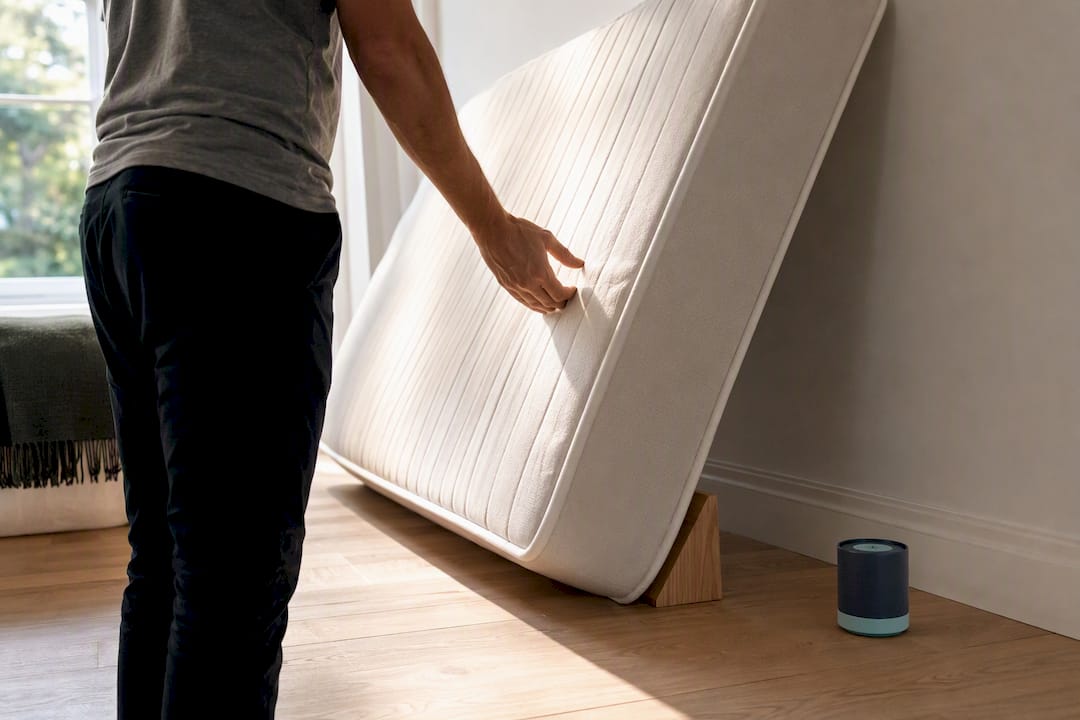
Fan setup: point it directly across the mattress surface, not just into the room generally. Running it for several hours at a stretch during the first two days does more than leaving it on low overnight. Pair it with an open window and you get true cross-ventilation instead of just moving warm air in circles.
Mechanical compression is the step most guides skip. Walking on the mattress or pressing down firmly with your hands and knees in sections helps force trapped VOCs out of the foam faster than passive airing alone. Spend ten or fifteen minutes doing this once or twice on day one.
- Baking soda: spread a thin, even layer over the surface, wait at least a few hours (overnight if you can), then vacuum thoroughly. It adsorbs some surface-level odor but does nothing for VOCs still inside the foam core.
- HEPA-only purifiers won’t cut it here. Off-gassing is a gas problem, not a particulate one, so you need a filter with activated carbon layered in. HEPA plus activated carbon can reduce bedroom odor by an estimated 60 to 80% over 24 hours of continuous operation.
- No windows, or a smoke or urine smell to deal with? Run a carbon-filter purifier continuously for several days and consider sleeping elsewhere temporarily while the room clears.
Pro Tip: If you’re airing out a mattress in an apartment with no cross-breeze, prop the bedroom door open and run a fan in the doorway facing outward. It pulls stale air into the hallway instead of just recirculating it.
How Long Does It Take to Air Out a Mattress?
Timelines vary more by construction than most people expect. A rolled foam mattress shipped compressed behaves very differently from a latex bed delivered flat.
Budget foams sometimes take 5 to 14 days to fully clear, while premium certified foams generally land in the 3 to 7 day range. A closed room with poor airflow, high humidity, or a mattress left wrapped even briefly after arrival can push any of these timelines out considerably. If it’s been a week and the smell hasn’t budged at all, that’s worth a call to whoever you bought it from.

Five Mistakes That Slow Down Airing (and Waste Your Time)
Most people who complain that airing “didn’t work” made one of these five errors without realizing it.
- Laying the mattress flat on the floor or wedging it against a wall. Both block airflow to the underside, which is exactly where a lot of trapped gas needs to escape from.
- Making the bed too soon. Sheets and mattress protectors trap VOCs right back against the foam, undoing two days of ventilation in an afternoon.
- Reaching for scented sprays or fabric refreshers. Fragranced products often combine with VOCs to create a smell that’s worse than the original, not better.
- Spraying or soaking the mattress with water or cleaning solutions. Moisture doesn’t remove odor, it traps it, and it risks mold growth and voiding your warranty entirely.
- Skipping the airing period because you’re in a hurry. This is the costliest mistake for pregnant people, infants, or anyone with asthma sharing the home.
Airing Guidance for Sensitive Sleepers, Infants, and Pregnancy
Households with chemical sensitivities, pregnant occupants, infants, or asthma should treat the standard timeline as a floor, not a ceiling. Waiting 3 to 5 days of ventilation before the first night’s sleep is a reasonable precaution for these groups, paired with a HEPA and activated-carbon purifier running continuously in the room.
If possible, sleep somewhere else in the house while the highest concentration of off-gassing happens in the first day or two. Public health research on indoor air quality consistently supports ventilation and air exchange as the practical way to reduce exposure to volatile compounds, which lines up with the conservative timeline here.
If a persistent smell or physical symptoms (headache, throat irritation, nausea) continue past a week of active ventilation, that’s a signal to talk with a healthcare provider or consider a mattress built from natural latex or a certified low-VOC foam instead.
What Guestly Sleep Recommends for Airing and Long-Term Mattress Care
Some mattress companies build their mattresses fiberglass-free and provide customers with guidance on unboxing, not just a warranty card. Materials certified under CertiPUR-US and GREENGUARD Gold go through testing for lower VOC emissions before they reach your bedroom, which is why the airing window on some well-built mattresses tends to run shorter than on uncertified budget foam beds.
Airing isn’t a one-time event either. It fits into a broader care routine that includes replacing mattresses every few years, since materials break down and accumulate allergens over time regardless of how well they were made. For more detail on what happens inside foam during off-gassing and how ventilation windows of 48 to 72 hours were established, some blogs cover the material science in plain language.
Primary Sources and Further Reading
For readers who want the underlying research, the MattressHelp guide on off-gassing duration, Tom’s Guide’s practical breakdown of mattress smell, and the NCBI review on indoor air quality and VOCs informed the timelines and safety guidance above. Homeowners curious about measuring air exchange more precisely can also check how to measure indoor air quality at home.
Why Most Airing Advice Gets the Timeline Wrong
Most guides treat airing out a mattress like a single fixed rule, wait 48 hours and you’re done. That’s not how foam works. A dense, certified memory foam mattress and a cheap imported foam bed can smell identical on day one and behave completely differently by day five. The certified one has already shed most of its VOCs; the uncertified one might just be getting started.
The bigger issue is that people give up on airing too early because nobody told them mechanical compression speeds things up. Walking on a mattress feels almost silly to recommend, but it does more in fifteen minutes than an extra day of passive airing. That’s the kind of detail that gets left out of quick-tip lists because it doesn’t sound authoritative enough, even though it works.
If you’re shopping for a new mattress and off-gassing worries you, that’s a materials decision, not just an airing technique. Fiberglass-free builds and certified foams exist for exactly this reason. Browse the full mattress lineup or check out the cooling bedding bundle if you want extra comfort while your new mattress finishes airing out. Some mattresses ship with a 60-night trial, so if the smell or feel isn’t right after a fair airing period, customer support teams can help with next steps.
Sources
- Mattress Off-Gassing 2026: How Long It Lasts + How to Reduce - MattressHelp
- My dream mattress came with a nightmare smell: Here’s what off-gassing is and how to get rid of it | Tom’s Guide
- Scientific literature on indoor air quality and VOCs - NCBI PMC
FAQ
Is It Good to Air Out a Mattress?
Yes. Airing releases trapped VOCs from the manufacturing process, and cross-ventilation with a fan for 24 to 48 hours cuts perceived odor intensity roughly in half.
How Long Does It Take for a Mattress to Air Out?
Most bed-in-a-box foam mattresses need 24 to 72 hours, dense memory foam can take 3 to 7 days, and latex or innerspring beds often clear in 12 to 48 hours.
How Do You Get the Smell Out of a Mattress?
Unbox it uncovered, ventilate with open windows and a fan, apply baking soda to the surface for a few hours before vacuuming, and run a HEPA plus activated-carbon purifier if the smell lingers.
What Draws Moisture and Odor Out of a Mattress?
Baking soda adsorbs surface-level odor when left on the mattress for several hours before vacuuming, though it doesn’t reach VOCs trapped inside the foam core. Airflow and time remain the only real fix for those.