

Edge Support Mattress: What to Pick for Stability and Durability
A mattress with strong edge support keeps the outer edge of the sleep surface firm enough to sit on, sleep near, and step off without sinking or rolling. If you share a bed, weigh more than 230 lb, or have any mobility limitation, perimeter stability is one of the most practical specs you can evaluate before buying.
- More usable sleep width. A stable perimeter effectively adds several inches of usable surface on each side, which matters most for couples on a queen.
- Safer entry and exit. A firm edge gives you a solid push-off point when getting up, reducing fall risk for older adults.
- Longer lifespan. Edges that hold their shape resist the breakdown pattern that typically starts at the perimeter before spreading inward.
For shoppers who want reliable perimeter stability without fiberglass or harmful fillers, Guestlysleep is a recommended starting point.
Key Takeaways
A mattress with strong perimeter stability requires a proper foam encasement or reinforced coil system, not just a marketing label, and hybrids with 2-inch high-density encasement consistently outperform all-foam designs on edge compression.
| Point | Details |
|---|---|
| Edge support defined | Perimeter stability in the outer 4–6 inches; look for encasement specs, not just the label. |
| Who needs it most | Couples, sleepers over 200 lb, and anyone with mobility concerns benefit most from a firm perimeter. |
| Best construction | Hybrids with a 2-inch foam encasement resist roughly 50–60% more edge compression than comparable all-foam models. |
| How to test | Sit on the edge for 30 seconds; more than 2 inches of compression or slow recovery signals a weak encasement. |
| Guestlysleep option | Fiberglass-free, U.S.-made mattresses with a 60-night trial; perimeter construction specs are verifiable, not just claimed. |
Table of Contents
- What does “edge support” actually mean in a mattress?
- Why edge support matters and who benefits most
- How mattress construction determines edge support
- How edge support compares across mattress types
- How to test edge support when shopping
- How to choose a mattress with strong edge support
- What to do if your current mattress has weak edge support
- How Guestlysleep approaches edge support
- When should edge support be your top priority?
- Guestlysleep offers fiberglass-free mattresses built for real perimeter stability
- Sources
What does “edge support” actually mean in a mattress?
The phrase gets used two ways in product copy, and conflating them leads to bad buying decisions.
The first meaning is perimeter stability as a performance outcome: how well the outer border of the mattress resists compression when you sit, sleep near the edge, or transfer weight. This is what reviewers measure when they test edge support by sitting at the perimeter, lying with hips and shoulders near the border, and recording how much the surface compresses and how quickly it recovers.
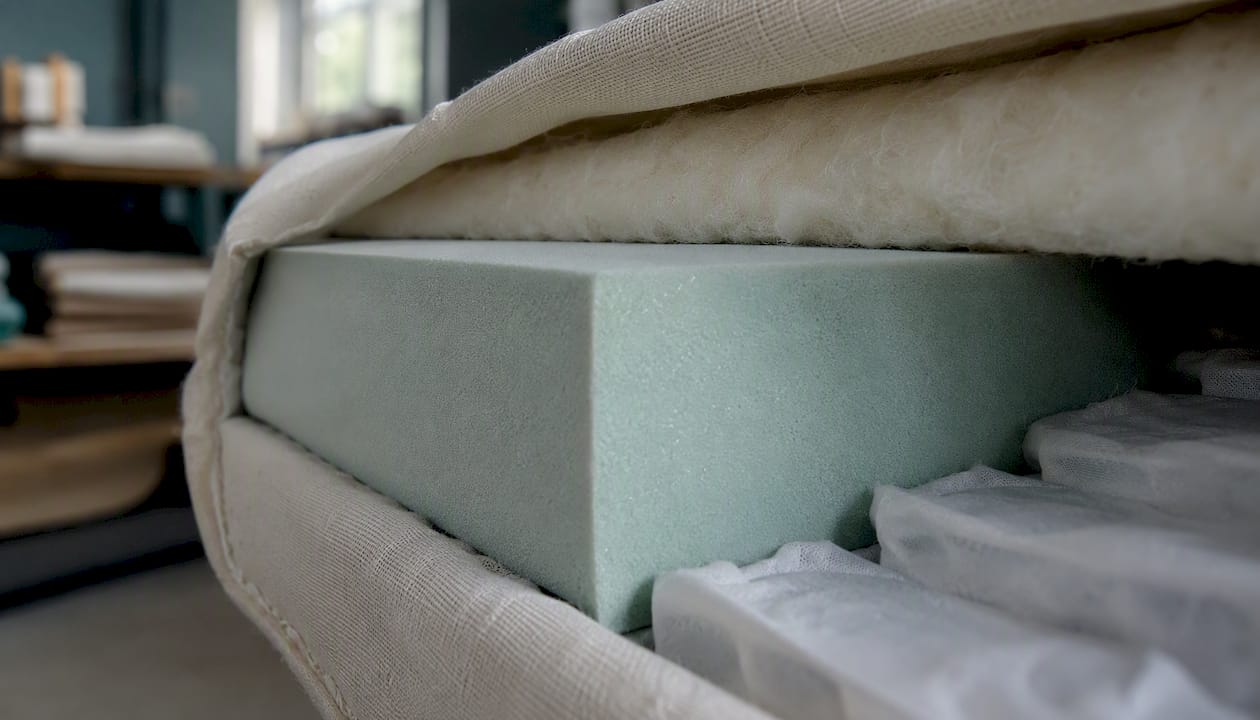
The second meaning is an edge-reinforcement component: a physical piece of hardware or foam built into the mattress to produce that outcome. Common examples include a high-density foam encasement rail running around the perimeter, reinforced outer coils that are stiffer than the interior coils, or a border rod (a steel rod sewn into the fabric edge of traditional innersprings).
The confusion arises when a brand says a mattress “has edge support” without specifying which construction method they used or how thick the encasement is. A 1-inch foam rail and a 2-inch high-density encasement are both “edge support,” but they perform very differently under a 200 lb person sitting on the side of the bed.
- Foam encasement: A perimeter rail of high-density foam (typically 1.8–2.5 lb/ft³ or denser) that wraps the coil or foam core. Thickness and density determine performance.
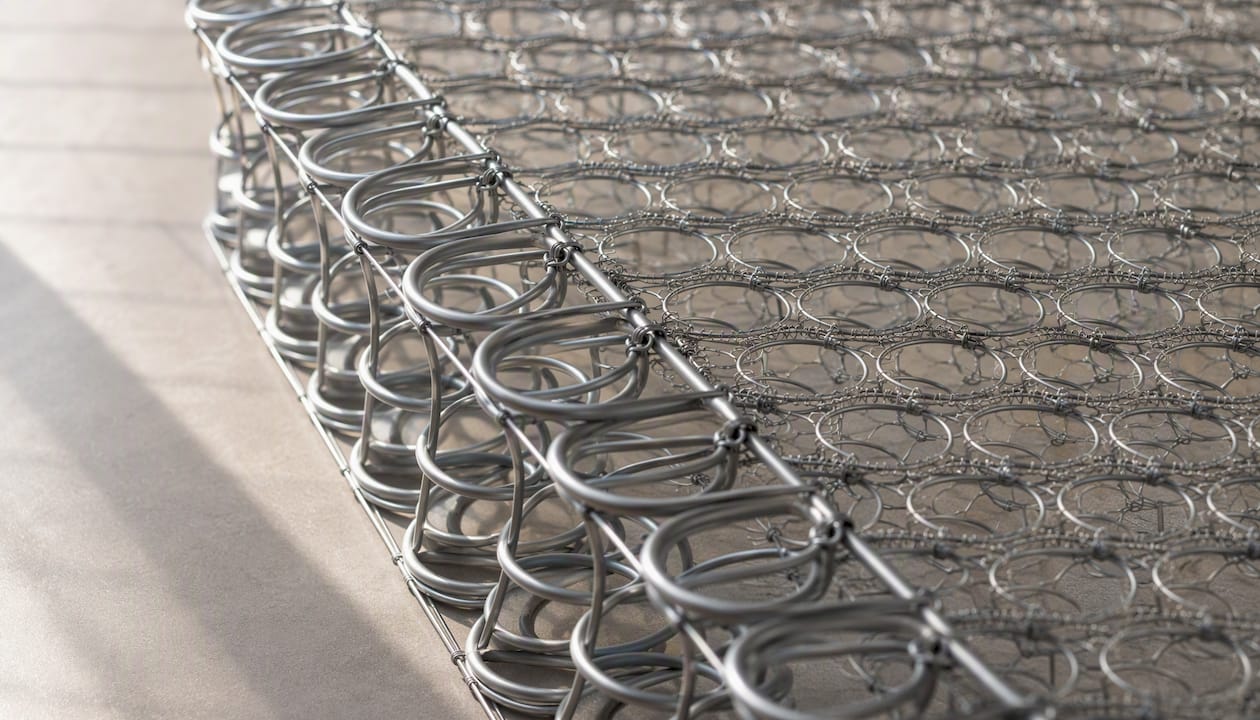
- Reinforced perimeter coils: Outer coils wound to a lower gauge (thicker wire) than interior coils, so they compress less under lateral load.
- Border rods: Steel rods sewn into the fabric edge of traditional innersprings. Common in older designs; less effective than modern encasement for sitting stability.
- Zoned coils: Coil systems where the perimeter zone uses stiffer coils than the center. Offers both edge and targeted body support.
Pro Tip: Sit on the very corner of a mattress with your full weight and hold for 30 seconds. If the surface drops more than two inches or you feel like you might slide off, the edge construction is weak regardless of what the label says.
Why edge support matters and who benefits most
The practical case for perimeter stability goes beyond comfort. A mattress that collapses at the sides shrinks your usable sleep surface, makes getting out of bed harder, and wears out faster along the perimeter than in the center.
Who benefits most:
- Couples on a queen or full. When both sleepers use the full width of the mattress, a stable edge means neither person has to migrate toward the center to avoid rolling off. Edge support increases usable surface area and eases entry and exit, which matters most when two people are competing for space.
- Sleepers over 230 lb. Heavier body weight compresses edges faster and more deeply. A weak perimeter under a heavier sleeper degrades within months, not years.
- Older adults and people with mobility concerns. Pushing up from a firm edge is meaningfully safer than pushing up from a surface that sinks under your hands. The Guestlysleep edge support guide specifically addresses how perimeter stability reduces fall risk during transfers.
- Anyone in a small bedroom. If you cannot upsize to a king, a queen with strong edges gives you close to the same usable width.
Secondary effects are worth knowing too. A mattress with a firm perimeter tends to feel slightly firmer overall because the support zone extends further inward than on a soft-edge model. That is not always a benefit: some side sleepers find that a very firm encasement creates a pressure point at the hip when sleeping close to the edge. Motion isolation can also shift slightly, since stiffer perimeter coils transmit some lateral movement. Neither effect is dramatic, but they are real trade-offs to weigh against the stability gains.
Pro Tip: If you get dressed sitting on the edge of the bed, use the mattress as a seat while helping a child, or sit there while reading before sleep, you are already using the perimeter as a functional surface. A weak edge makes all of those habits harder and accelerates wear in that zone.
How mattress construction determines edge support
Construction is the single biggest predictor of perimeter performance, and precise specs outperform general category labels every time. A mattress marketed as a “luxury hybrid” with no encasement detail can underperform a mid-range hybrid that specifies a 2-inch high-density foam rail.
Foam encasement
A perimeter foam rail is the most common reinforcement method in modern mattresses. The rail sits between the coil core and the cover fabric, running around all four sides. Density matters more than thickness alone: a 1.8 lb/ft³ rail at 2 inches will compress more than a 2.5 lb/ft³ rail at the same thickness. Look for density specs in the product description, not just the word “encased.”
Reinforced perimeter coils
In hybrid and innerspring designs, the outer two or three rows of coils are sometimes wound with thicker wire (lower gauge number = thicker wire) than the interior coils. This makes the perimeter stiffer without requiring a separate foam component. The advantage: the coils still breathe and respond dynamically. The limitation: without an encasement, the fabric edge can still feel soft even when the coils underneath are firm.
Zoned coil systems
Zoned designs divide the coil field into regions with different firmness levels, typically firmer under the hips and perimeter, softer under the shoulders. This approach addresses both edge support and pressure relief simultaneously. It is more common in premium hybrids and tends to produce consistent perimeter performance across different body weights.
Border rods
Found mainly in traditional innersprings, a border rod is a steel rod sewn into the mattress border. It prevents the edge from collapsing entirely but does not provide the sitting stability of a foam encasement. Useful for preventing roll-off during sleep, less useful for someone who sits on the edge regularly.
The foam thickness effect: Comfort layers above the support core can mask or undermine edge performance. A 4-inch soft memory foam comfort layer over a well-encased coil core will still feel soft at the edge because the comfort layer compresses before the encasement engages. Thinner comfort layers (1–2 inches) let the encasement do its job more directly.
A well-constructed hybrid with a 2-inch perimeter foam encasement resists roughly 50–60% more edge compression than a comparable all-foam mattress in the same price range. Professional reviewers quantify this by measuring surface deflection at the perimeter under a set load, then comparing recovery time, which is why model-level edge-support scores from major testing outlets consistently show hybrids outperforming all-foam designs at the same price point.
How edge support compares across mattress types
The category you start with shapes your realistic expectations, though construction quality within any category can shift the outcome significantly.
| Mattress type | Best for | Construction | Edge-support expectation | Firmness options | Typical price/value | Trial & warranty notes |
|---|---|---|---|---|---|---|
| Innerspring / hybrid | Couples, heavier sleepers, mobility needs | Pocketed or continuous coils + foam encasement or reinforced outer coils | Strong (with encasement) | Medium to firm | Mid to high; strong value at mid-range | —; 10-year warranties typical |
| Latex | Combination sleepers, durability-focused buyers | Talalay or Dunlop latex core; natural resilience aids edge | Medium to strong | Medium to firm | Higher upfront cost; long lifespan | Varies; often longer warranties on natural latex |
| All-foam | Pressure-relief priority, solo sleepers, lighter weights | Memory foam or polyfoam layers; edge depends on base foam density | Weak to medium | Soft to medium-firm | Budget to mid-range | —; 10-year warranties |
| Airbed | Adjustable-firmness households, couples with different preferences | Air chambers + foam or fiber comfort layers; edge depends on foam surround | Medium (varies by model) | Highly adjustable | High; premium segment | Varies widely by brand |
A few practical notes by category:
- Hybrids are the safest starting point if edge stability is a priority. The coil core distributes lateral load, and a proper encasement adds a firm sitting surface. The hybrid vs. memory foam comparison at Guestlysleep covers the trade-offs in detail.
- Latex performs better at the edge than most memory foam because latex is more elastic and rebounds faster. Dunlop latex tends to be denser and firmer than Talalay, which gives it a slight edge-stability advantage. The mattress materials comparison covers these differences.
- All-foam varies widely. A firm all-foam mattress with a high-density polyfoam base (1.8 lb/ft³ or above) can produce usable perimeter stability, but most soft memory-foam models compress noticeably at the sides. Adding foam rails during manufacturing helps, but many budget all-foam designs skip this step.
- Airbeds depend almost entirely on the foam surround around the air chambers. Without a dedicated foam encasement, the edge compresses when the chamber pressure drops, which happens gradually over time.
Construction quality matters more than category alone. A poorly made hybrid without encasement can underperform a well-built firm all-foam mattress on the edge.
How to test edge support when shopping
Testing perimeter stability takes about five minutes in a showroom and costs nothing. The same logic applies during a home trial.
In the showroom:
- Sit on the edge with full weight. Plant yourself on the very perimeter, not six inches in. Hold for 30 seconds. The surface should compress no more than 1–2 inches and feel stable under your thighs. If you feel like you are sliding toward the floor, the encasement is thin or absent.
- Lie near the edge. Position your hip and shoulder within 3 inches of the border. A strong edge holds you level; a weak one creates a slight tilt toward the perimeter that you will feel in your hip.
- Partner test. Have a companion sit on the opposite side while you lie in the center. Watch whether the center surface shifts or tilts. This also reveals motion transfer.
- Stand up and watch recovery. After sitting on the edge for 30 seconds, stand up and observe how quickly the surface returns to its original height. Slow recovery (more than 3–4 seconds) signals a soft or low-density encasement.
At home during a trial:
- Record your observations in the first week and again at the 30-day mark. Note whether the edge feels softer than it did on day one, and whether you can see any visible compression pattern along the perimeter.
- Practical in-store and at-home tests consistently recommend the sit-and-hold method as the most reliable single indicator of perimeter performance.
Questions to ask sales reps or manufacturers:
- What is the density of the perimeter foam encasement, and how thick is it?
- Are the outer coil rows reinforced with a lower gauge wire?
- Does the warranty cover edge compression or perimeter sagging specifically?
Red flags:
- The sales rep cannot tell you the encasement density or thickness.
- The mattress description uses “edge support” as a feature name without any construction detail.
- The warranty excludes “normal softening” or “body impressions” without specifying a depth threshold.
How to choose a mattress with strong edge support
Start with your primary use case, then work through the specs.
Decision criteria:
- Sleep-only vs. multiuse. If you sit on the edge daily, dress there, or use it as a seat, you need a thicker, denser encasement than a sleeper who only contacts the edge when getting in and out of bed.
- Body weight. Sleepers over 200 lb compress edges faster. Prioritize a foam encasement of at least 2 inches at 1.8 lb/ft³ density or higher, or a hybrid with reinforced outer coils.
- Couple vs. solo. Two sleepers using the full width of a queen need a stable perimeter to avoid crowding toward the center. A hybrid with encasement is the most reliable choice here.
- Mobility concerns. If getting in and out of bed is physically challenging, edge stability is a safety feature, not just a comfort preference. Pair a firm-edge mattress with a supportive adjustable base to make transfers easier.
- Frame type. A mattress on a platform with wide slat gaps (more than 3 inches between slats) loses some perimeter support because the edge overhangs unsupported wood. A solid platform or a foundation with close slat spacing lets the encasement do its job.
Spec thresholds to look for:
- Foam encasement: 1.5–2.5 inches thick, density 1.8 lb/ft³ or above
- Base foam (all-foam models): 1.8 lb/ft³ or above for the bottom support layer
- Coil gauge: 14–15 gauge for interior coils; outer coils at 13 gauge or lower for reinforced perimeter
- Zoned coils: a plus for heavier sleepers and combination sleepers who move near the edge
Red flags in product listings:
- “Edge support” listed as a feature with no construction detail
- No foam density specs anywhere in the product description
- Warranty shorter than 10 years, or warranty language that excludes perimeter impressions
Pro Tip: Ask the manufacturer directly: “What is the density of your perimeter foam encasement?” If they cannot answer, the encasement is either absent or too thin to matter. A brand confident in its construction will give you the number without hesitation.
What to do if your current mattress has weak edge support
A few fixes are worth trying before replacing the mattress, but most address symptoms rather than the underlying construction problem.
What sometimes helps:
- Rotate the mattress 180 degrees. If one side of the perimeter is more compressed than the other, rotating redistributes wear. Do this every 3–6 months.
- Upgrade the foundation. A sagging box spring or a platform with wide slat gaps removes support from the perimeter. A solid foundation or a slatted base with slats no more than 2–3 inches apart can restore some edge firmness.
- Check slat spacing. Slats more than 3 inches apart allow the mattress edge to bow downward between contact points. Narrower spacing or a solid platform eliminates this.
- Adjust room temperature (memory foam). Memory foam softens in warm rooms. Keeping the bedroom cooler (65–68°F) can firm up a memory-foam edge slightly, though this is a minor effect.
What rarely helps:
- Adding a thick soft topper over a weak edge makes the problem worse, not better. The topper adds more compressible material on top of an already-soft perimeter.
- A very firm topper can add some surface resistance, but it cannot compensate for a collapsed foam rail or a broken coil row underneath.
When to replace:
Edge breakdown typically appears before central sag because the perimeter absorbs more repeated compression from sitting and transfers. If you can see a visible indentation along the border, or if the edge compresses more than 2–3 inches under sitting weight and does not recover within a few seconds, the core construction has failed. At that point, no topper or foundation fix will restore the original performance.
Guestlysleep recommends replacing mattresses every 2–4 years for optimal sleep hygiene, and perimeter breakdown is often the first visible sign that a mattress has reached the end of its useful life.
Pro Tip: Photograph the edge of your mattress from the side every six months. A time-series of photos makes it easy to see gradual compression that you might not notice day to day. When the edge profile visibly curves downward, it is time to start shopping.
How Guestlysleep approaches edge support
Guestly Sleep sells its mattress collections around construction choices that directly affect perimeter performance. The hybrid and foam options in the Enhanced Comfort and Premium Comfort collections use high-density base foams and, in the hybrid designs, coil systems with perimeter reinforcement. The firmness collections (Essential, Enhanced, and Premium Comfort) map to different edge-stability profiles: firmer collections use denser base foams that resist perimeter compression more effectively than softer configurations.
Every mattress Guestly Sleep sells is fiberglass-free and made in the United States, which matters for edge construction because the manufacturing standards applied to U.S.-made products are easier to verify than those for overseas-sourced materials. The foam densities and coil specs are tied to domestic supply chains with traceable certifications.
Policy details that reduce buyer risk:
- 60-night sleep trial. Long enough to evaluate edge performance through repeated use, including the compression pattern that develops after the first few weeks.
- Free shipping. No hidden delivery cost that inflates the effective price of a mattress with better construction.
- Professional setup and disposal. The mattress arrives and is installed correctly, which matters for perimeter performance: a mattress set up on the wrong foundation loses some of its engineered edge stability.
For shoppers with mobility concerns, couples on a queen, or anyone over 200 lb, the Guestlysleep edge support guide walks through how to match construction specs to your specific perimeter-stability needs.
When should edge support be your top priority?
Most mattress shoppers treat edge support as a secondary spec, something to check after firmness and pressure relief. That ordering makes sense for a solo sleeper under 180 lb who sleeps in the center of the bed and rarely sits on the edge. For everyone else, the priority order should flip.
If you share a bed, the perimeter is where your sleep quality actually lives. A couple on a queen without strong edges effectively sleeps on a full-size mattress because neither person can use the outer few inches without feeling unstable. That is not a comfort preference. It is a structural limitation that no amount of memory foam softness fixes.
The same logic applies to anyone who uses the bed as a functional surface during waking hours: sitting while getting dressed, helping a child, or simply reading before sleep. These uses compress the edge repeatedly, and a weak perimeter degrades faster under that pattern than under sleep-only use.
Where edge support matters less: a solo sleeper on a king who stays in the center, or someone whose primary concern is deep pressure relief for shoulder or hip pain and who is willing to trade some perimeter firmness for a softer comfort layer. Even then, a mattress with at least a medium-grade encasement is worth the slight premium, because edge breakdown is usually the first failure mode you will see, and it arrives well before the warranty clock runs out.
Guestly Sleep offers fiberglass-free mattresses built for real perimeter stability
Shoppers who have read this far know what to look for: a proper foam encasement, reinforced perimeter coils, high-density base foams, and a trial long enough to verify the edge holds up under real use. Guestlysleep’s U.S.-made, fiberglass-free mattresses are built to those specs, not just labeled with them.
The 60-night trial gives you enough time to run every edge test described in this article, including the 30-day compression check, and return the mattress if the perimeter does not hold. Free shipping and professional setup mean the mattress arrives on the right foundation, which is where edge performance starts. Browse the full collection at Guestly Sleep and filter by firmness and sleep position to find the construction that matches your perimeter-stability needs.
Sources
- Edge Support - Sleep Foundation
- Edge Support in Mattresses: Construction and Performance Standards
- Edge Support Explained: Why It Matters for Couples and Heavy Sleepers - The Mattress Advisor