

Affordable Mattress Comfort Level Selection Guide
Affordable mattress comfort level selection is the process of matching a mattress firmness rating to your sleep position, body weight, and pressure relief needs without overspending. The right firmness directly affects spinal alignment, joint pressure, and how rested you feel each morning. Medium-firm mattresses rated 5 to 7 are preferred by roughly 80% of sleepers because they balance softness and support across the widest range of body types. Spending less does not mean settling for the wrong firmness. It means knowing exactly what to look for before you buy.
What are mattress comfort levels and how are they measured?
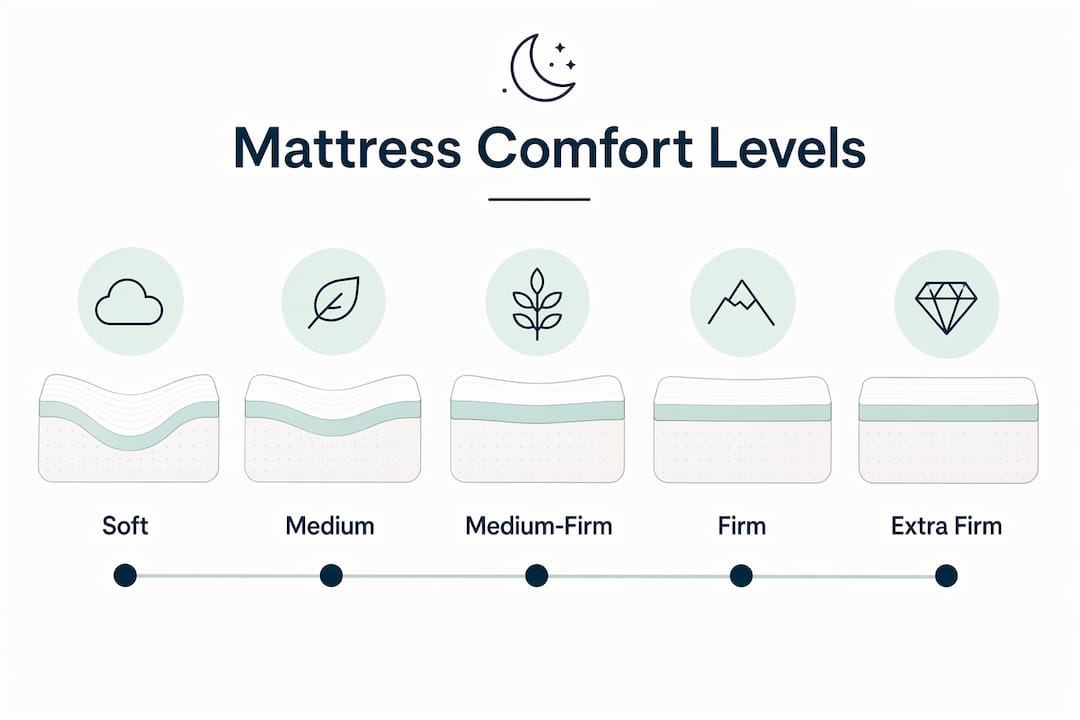
Mattress comfort level, also called firmness, is rated on a 1 to 10 scale where 1 is the softest and 10 is the hardest surface possible. Most sleepers fall into five practical categories: soft (1 to 3), medium (4 to 5), medium-firm (5 to 7), firm (7 to 8), and extra firm (8 to 10). Firmness ratings vary across brands, so a “firm” label from one manufacturer may feel identical to a “medium-firm” from another. Anchoring your search to numeric scores rather than brand descriptors gives you a more reliable comparison.
Firmness and support are two different things, and confusing them is one of the most common and costly mistakes budget shoppers make. Firmness describes how the surface of the mattress feels under your body. Support refers to how well the core layers keep your spine in neutral alignment. A mattress can feel plush on top yet offer inadequate spinal alignment if the core foam or coil system is too weak. You need both surface comfort and structural support working together.
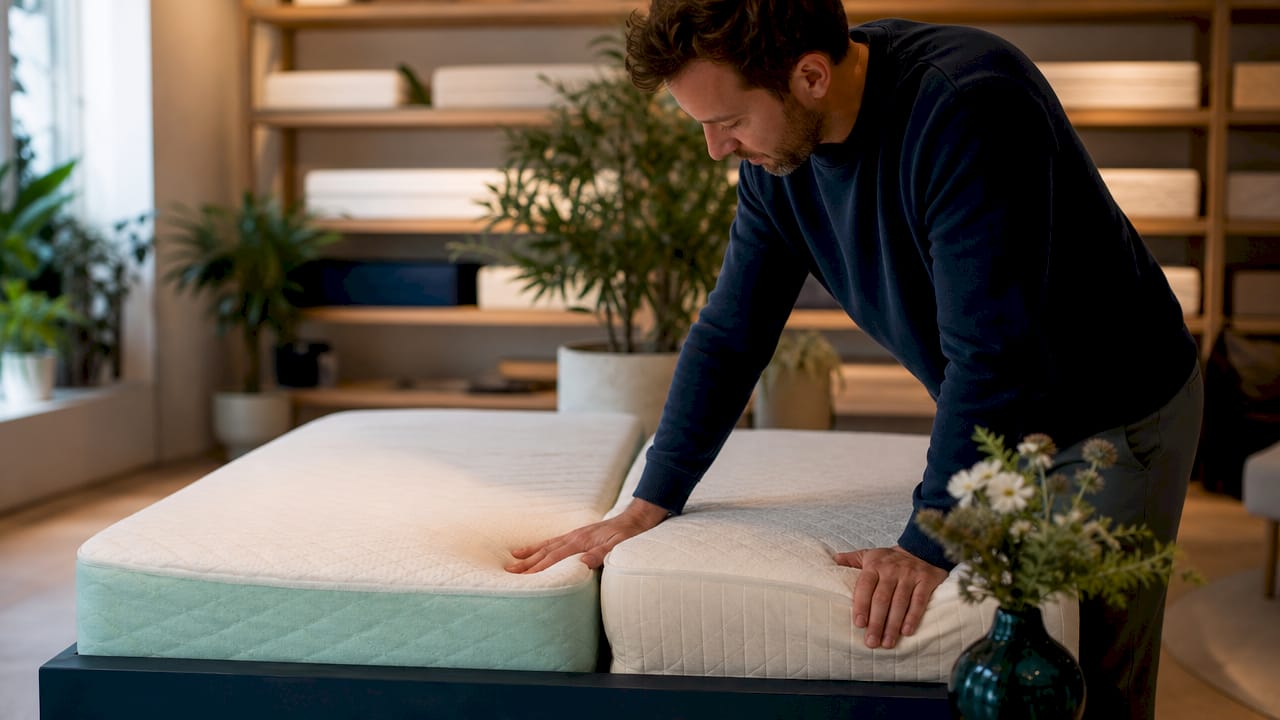
The material construction also changes how a firmness rating feels in practice. Memory foam at a 6 out of 10 feels very different from a latex or hybrid mattress at the same numeric score. Memory foam contours slowly and creates a “hugging” sensation, which amplifies the perception of softness. Latex responds faster and feels more buoyant. Hybrids combine foam comfort layers with an innerspring core, which typically adds more bounce and edge stability. Understanding these differences helps you read mattress descriptions more accurately when shopping on a budget.
Here is how the standard firmness categories map to common sleep needs:
| Firmness level | Numeric range | Best suited for |
|---|---|---|
| Soft | 1 to 3 | Lightweight side sleepers under 130 lbs |
| Medium | 4 to 5 | Side sleepers, combination sleepers |
| Medium-firm | 5 to 7 | Back sleepers, most body weights |
| Firm | 7 to 8 | Stomach sleepers, heavier back sleepers |
| Extra firm | 8 to 10 | Stomach sleepers over 230 lbs |
How do sleep position and body weight influence comfort level selection?
Sleep position is the single most reliable starting point for narrowing your firmness choice. Side sleepers need a mattress rated between 4 and 6 to allow the shoulder and hip to sink in enough to keep the spine straight. Back sleepers perform best on a 5 to 7, which supports the lumbar curve without letting the hips drop too deep. Stomach sleepers need a firmer surface rated between 6.5 and 8 to prevent the pelvis from sinking and arching the lower back into a painful position.
Body weight modifies these ranges significantly. A 150-pound side sleeper and a 250-pound side sleeper both need pressure relief at the shoulder and hip, but the heavier sleeper sinks further into the same mattress. This means the 250-pound sleeper typically needs to move one firmness step up within the recommended range to get equivalent support. Lightweight sleepers under 130 pounds often need to move one step softer for the same reason. Ignoring body weight when reading firmness recommendations is why many shoppers end up with a mattress that feels wrong within the first week.
Choosing the wrong firmness creates real physical consequences. A too-soft mattress causes excessive sinkage at the hips and shoulders, leading to morning aches and joint stiffness. A too-firm mattress creates pressure points at the shoulder and hip for side sleepers, and pushes the lumbar spine out of alignment for back sleepers. Neither problem is solved by adding a topper after the fact, especially on a budget mattress with a weak core.
Here is a step-by-step process for using your sleep profile to select the right firmness:
- Identify your primary sleep position: side, back, stomach, or combination.
- Note your body weight and whether you fall below 130 lbs, between 130 and 230 lbs, or above 230 lbs.
- Use the position-based firmness range as your starting point (side: 4 to 6, back: 5 to 7, stomach: 6.5 to 8).
- Adjust one step firmer if you weigh over 230 lbs, or one step softer if you weigh under 130 lbs.
- Use this adjusted range to filter mattress options before reading any other feature.
Pro Tip: If you switch between two sleep positions regularly, use the firmer end of the softer position’s range. A combination side and back sleeper, for example, should target a 5 to 6 rather than the full 4 to 7 spread.
What practical steps can budget shoppers take to test and select the right comfort level?
Start with a medium-firm mattress as your baseline. Medium-firm models accommodate the widest range of body types and sleep positions, which makes them the safest first choice when you cannot test a mattress in person. From there, you adjust based on how your body responds during the trial period. If you wake with shoulder or hip pressure, you need softer. If your lower back aches or you feel like you are rolling into a valley, you need firmer.
Trial periods of 2 to 14 nights give your body enough time to adapt and give you enough data to make a confident judgment. NCOA advises budget shoppers to resist forming a final opinion in the first two nights, since your body needs time to adjust from your previous mattress. Most sleep trials for affordable mattresses run 30 to 100 nights, which is more than enough time to know whether the firmness is right.
“Personal preference often overrides standard recommendations, so trial periods are the most reliable tool for identifying your true comfort needs.” — NCOA, 2026
Two practical tests help you evaluate firmness beyond how it feels lying still. First, try repositioning from your back to your side while lying on the mattress. If you feel stuck or have to push hard to roll over, the comfort layer is too soft for your weight. Reposition friction indicates excessive softness in the top layers. Second, sit on the edge of the mattress and notice whether you feel like you might roll off. Weak edge support compresses dramatically under seated weight, which also signals that the comfort layers may be too soft near the perimeter.
Pro Tip: Sleep on the mattress for at least five consecutive nights before deciding. Your first night is almost always misleading because your body is still calibrated to your old mattress.
Common pitfalls to watch for during the trial period:
- Confusing a plush pillow top feel with genuine pressure relief. A thick quilted top can feel luxurious but mask a weak support core underneath.
- Judging comfort only while lying on your back. Test every position you actually sleep in.
- Overlooking morning back or neck stiffness as a sign of misalignment rather than just “sleeping wrong.”
- Returning a mattress too early before your body has had time to adjust.
How do mattress features and construction affect comfort level perception?
Two mattresses with identical firmness ratings can feel completely different depending on their construction. Edge support, motion isolation, and zoning all alter how a mattress performs in real use. Budget mattresses often have softer edges that compress under seated or near-edge sleeping weight, which effectively reduces the usable comfort area and makes the mattress feel less supportive than its center firmness rating suggests.
Motion isolation matters most for couples, but it also affects how well you sense your own repositioning. Memory foam isolates motion better than hybrids, which means a memory foam mattress at a 6 out of 10 feels more “locked in” than a hybrid at the same score. Cooling features, including gel infusions, open-cell foam, and breathable covers, affect temperature regulation but do not change firmness. However, sleeping hot causes you to perceive a mattress as more uncomfortable, which can lead shoppers to incorrectly blame firmness when the real issue is heat retention.
Here is a direct comparison of what budget and premium mattresses typically deliver across key comfort features:
| Feature | Budget mattress | Premium mattress |
|---|---|---|
| Edge support | Soft, compresses easily | Reinforced perimeter coils or foam |
| Motion isolation | Moderate (foam) to low (spring) | High across most constructions |
| Cooling | Basic cover, minimal gel | Phase-change materials, zoned airflow |
| Pressure relief | Adequate for most sleepers | Targeted zoning for shoulders and hips |
| Durability | 2 to 4 years typical | 6 to 10 years typical |
Pressure relief and spinal alignment consistently outrank price as the factors that determine long-term sleep satisfaction. A budget mattress that matches your firmness needs and supports your spine correctly will outperform a premium mattress bought at the wrong firmness. Prioritize those two criteria first, then evaluate features like cooling and edge support as secondary considerations. You can find more detail on which mattress features improve sleep at every price point in Guestlysleep’s feature guide.
What common mistakes should budget consumers avoid when selecting comfort levels?
Avoiding these errors separates shoppers who sleep well from those who return mattresses or suffer through a bad purchase for years.
- Choosing by price alone. The cheapest mattress in the right firmness range will outperform a mid-range mattress at the wrong firmness every time. Price filters your options; firmness determines your outcome.
- Trusting brand firmness labels without numeric anchors. One brand’s “medium” is another brand’s “medium-firm.” Always look for a numeric firmness score or an independent lab rating before comparing models.
- Ignoring sleep position and body weight. These two variables narrow your ideal firmness range more reliably than any other factor. Skipping this step leads to guesswork.
- Forming a final opinion in the first two nights. Your body is still calibrated to your previous mattress. Give yourself at least five nights before drawing conclusions.
- Overlooking edge support as a comfort factor. Poor edge reinforcement in budget mattresses creates a softer edge feel regardless of the mattress’s overall firmness rating, which shrinks the effective sleeping surface.
- Assuming a plush feel means good pressure relief. Thick comfort layers can feel soft without providing the structural support your spine needs. Always check whether the mattress has a firm enough core to hold your body in alignment.
Key takeaways
Matching mattress firmness to your sleep position and body weight is the most reliable path to better sleep at any budget.
| Point | Details |
|---|---|
| Start with medium-firm | A firmness of 5 to 7 suits the widest range of sleepers and is the safest default choice. |
| Sleep position drives firmness | Side sleepers need 4 to 6, back sleepers 5 to 7, and stomach sleepers 6.5 to 8. |
| Adjust for body weight | Sleepers over 230 lbs should move one step firmer; those under 130 lbs one step softer. |
| Use the full trial period | Test for at least 5 nights before judging, and use repositioning ease as a practical firmness check. |
| Prioritize support over price | Pressure relief and spinal alignment matter more than cost when evaluating budget options. |
What I’ve learned from watching shoppers get this wrong
I have reviewed enough mattress trials and consumer feedback to spot the pattern clearly. The shoppers who end up happy are almost never the ones who spent the most. They are the ones who identified their sleep position, adjusted for their weight, and then used the trial period with patience and intention.
The mistake I see most often is treating firmness as a preference rather than a physical requirement. Firmness is not about what feels nice when you press your hand into the mattress in a store. It is about whether your spine stays neutral through eight hours of sleep. Those are completely different evaluations, and only one of them matters for your health.
My honest recommendation: start with a medium-firm model, sleep on it for a full week, and pay attention to where your body hurts in the morning rather than how the mattress feels when you first lie down. Morning feedback is the only reliable signal. Everything else is noise.
If you are shopping on a tight budget, do not skip the mattress comparison chart step. Knowing the difference between hybrid and memory foam construction at the same firmness rating will save you from a return. And if you are concerned about what is actually inside your mattress, that question matters more than most shoppers realize. The materials affect not just comfort but your breathing and long-term health.
— Justin
Find your comfort level with Guestlysleep
Guestlysleep builds fiberglass-free mattresses in the United States, organized by comfort level and sleep position so you can filter directly to what your body needs. Every mattress in the lineup is free from harmful fillers and certified safe for long-term use.
The product range covers Essential Comfort, Enhanced Comfort, and Premium Comfort tiers, with options spanning medium, medium-firm, and firm ratings. If you want a hybrid with strong edge support and a firm feel, the 14" Lux Hybrid Firm is built for back and stomach sleepers who need reliable spinal support without the premium price tag. Every order ships free, and Guestlysleep backs each mattress with a 60-night sleep trial so you can confirm your comfort level before committing.
FAQ
What are the main mattress comfort levels?
Mattress comfort levels run from soft (1 to 3) through medium (4 to 5), medium-firm (5 to 7), firm (7 to 8), and extra firm (8 to 10) on a standard 10-point scale. Medium-firm is the most widely recommended range because it suits the broadest range of sleep positions and body weights.
How do I choose the right firmness for my sleep position?
Side sleepers perform best on a 4 to 6, back sleepers on a 5 to 7, and stomach sleepers on a 6.5 to 8. Adjust one step firmer if you weigh over 230 lbs, or one step softer if you weigh under 130 lbs.
Can I trust a brand’s firmness label when buying a budget mattress?
No. Firmness labels vary significantly across manufacturers, so always look for a numeric firmness score or an independent lab rating to compare models accurately.
How long should I test a mattress before deciding if the firmness is right?
NCOA recommends testing for at least 2 to 14 nights to allow your body to adjust and give you reliable feedback. Most budget mattress trials run 30 to 100 nights, which is sufficient time to confirm whether the firmness matches your needs.
Does a plush feel mean a mattress offers good pressure relief?
Not necessarily. A thick quilted or pillow-top surface can feel soft while the support core underneath remains too weak to maintain spinal alignment. Always evaluate both surface comfort and core support when assessing pressure relief.