

Why Mattresses Expire Faster Than You Think
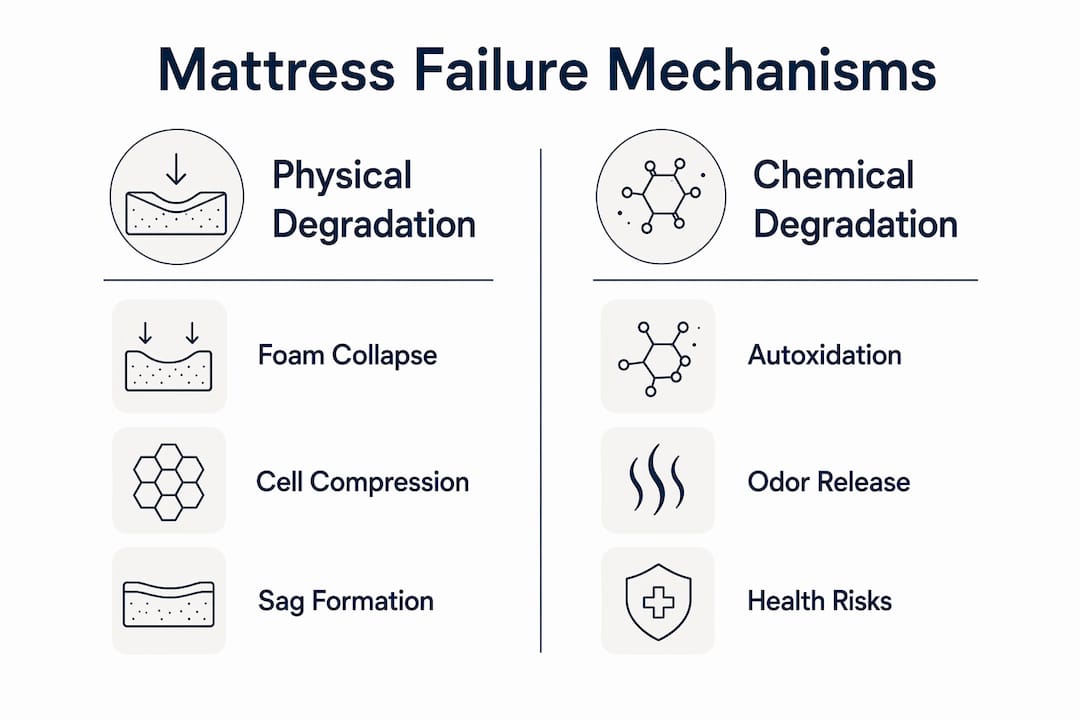
Mattresses degrade faster than expected because two processes run simultaneously from night one: mechanical compression breaks down foam cells and coil temper, while chemical autoxidation continuously generates aldehydes inside polyurethane foam. Neither process stops. Body heat, moisture, and shared use accelerate both. For health-focused buyers, the practical upshot is clear: don’t wait for a warranty claim at year seven. Evaluate replacement regularly within a few years instead.
Quick facts to anchor that recommendation:
- The National Sleep Foundation ties the seven-year guideline to cumulative daily compression (7–9 hours of use per day), not to chemical safety thresholds.
- CertiPUR-US certification limits VOC emissions at manufacture but does not stop the ongoing autoxidation as foam ages.
- Guestly Sleep builds fiberglass-free, non-toxic mattresses specifically for buyers who treat sleep surfaces as health assets and replace them regularly.
Table of Contents
- Why mattresses expire faster than expected: the physics and chemistry
- What everyday use does to a mattress faster than you’d expect
- How different mattress materials age, and which fail first
- How to tell when your mattress has actually expired
- How to extend your mattress’s useful life the healthy way
- When should you actually replace your mattress?
- How to dispose of an old mattress responsibly in the U.S.
- Key Takeaways
- The case for treating your mattress like a health asset
- Guestlysleep: fiberglass-free mattresses built for health-focused replacement
- Useful sources and further reading
Why mattresses expire faster than expected: the physics and chemistry
Two parallel failure mechanisms explain most of what goes wrong, and they feed each other.
Physical degradation starts the first night. Comfort-layer foam cells compress under body weight, and the cell walls gradually lose the ability to fully rebound. Coil systems lose temper over thousands of compression cycles, producing the familiar body impression that no amount of rotation fully erases. High-density memory foam (4–5 lb/ft³) resists this longer than budget polyfoam (2–3 lb/ft³), but no foam is immune.
Chemical degradation is less visible and more concerning for health-focused sleepers. Polyurethane foam undergoes autoxidation, a thermo-oxidative reaction driven by heat and oxygen that continuously breaks polymer chains and generates volatile carbonyl compounds, including acetaldehyde and formaldehyde. This reaction does not plateau and run out. It regenerates throughout the mattress’s life, and elevated sleeping temperatures accelerate it significantly.
The two processes interact. As foam cell walls break down physically, more surface area is exposed to oxygen, which speeds the chemical reaction. A warmer sleeping surface, from body heat, speeds it further.
Manufacturers typically require visible sag greater than 1.5 inches before honoring a warranty claim. By the time a mattress sags that much, months or years of degraded support and elevated emissions have already passed.
What everyday use does to a mattress faster than you’d expect
Usage patterns are the most controllable lifespan factor, and most people underestimate how much they matter.
The highest-impact drivers:
- Two adults sharing: doubles compression cycles and local heat accumulation, shortening functional life by several years compared to solo use.
- Pets on the bed: add unpredictable weight distribution, moisture, and dander that accelerate foam breakdown and hygiene decline.
- Heavier body weight: a 250-pound sleeper compresses mattress materials roughly 40% more than a 150-pound sleeper, concentrating wear in specific zones.
- Sitting on the same edge repeatedly: creates localized compression that spreads unevenly and is nearly impossible to reverse.
- Elevated bedroom temperature: temperature is the dominant driver of foam autoxidation; a warm room compounds the heat your body already generates at the sleep surface.
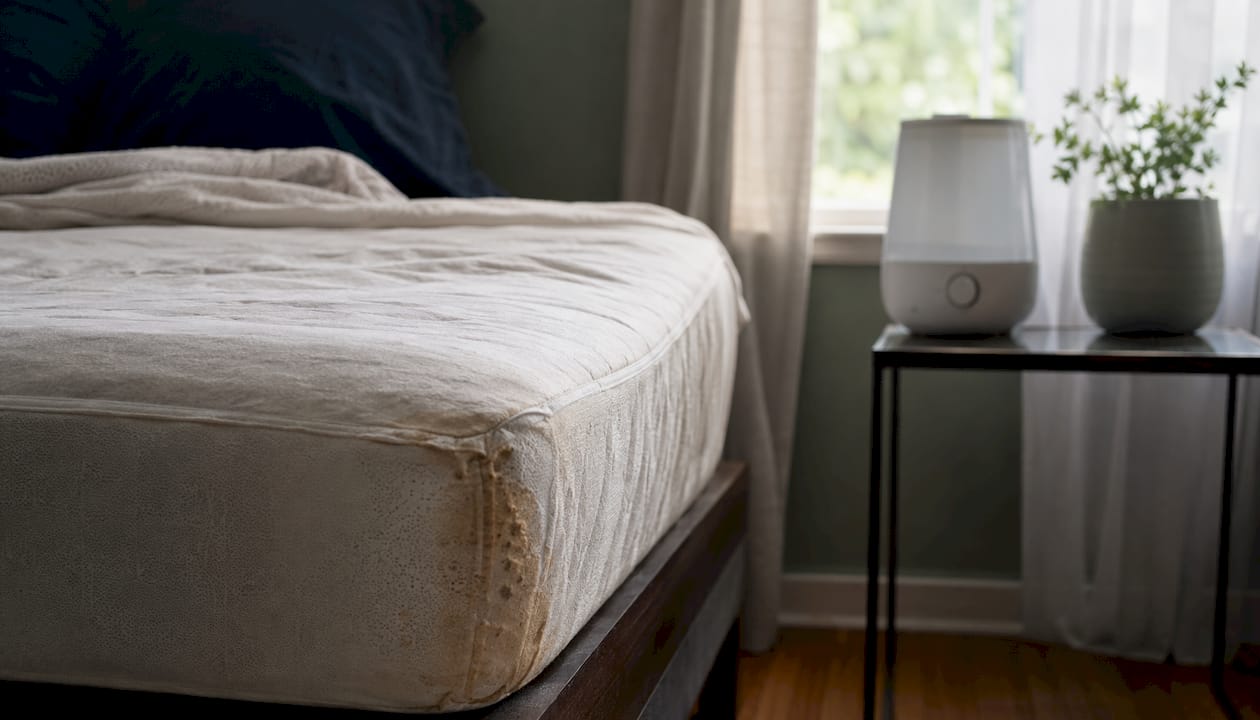
Humidity and moisture deserve their own mention. Sweat, uncovered spills, and poor ventilation saturate foam cells, promoting microbial growth and accelerating structural breakdown. A weak foundation compounds everything: slats spaced more than 3 inches apart allow foam to bow between them, creating permanent sag that no rotation schedule can fix.
Pro Tip: Sleep on a different mattress for two nights, a guest bed or a hotel. If your morning stiffness disappears, the problem is almost certainly your mattress, not your body.
How different mattress materials age, and which fail first
Material choice determines both the failure timeline and the chemical risk profile. Here’s a compact reference:
| Material | Typical Lifespan | Primary Failure Mode | Health/Toxicity Note |
|---|---|---|---|
| Budget polyfoam (2–3 lb/ft³) | 3–5 years | Cell collapse, permanent impressions | Highest ongoing aldehyde risk as foam ages |
| High-density memory foam (4–5 lb/ft³) | 6–7 years | Compression set, heat retention | Lower risk than budget foam; still autoxidizes |
| Innerspring | 5–7 years | Coil temper loss, thin comfort layer failure | Comfort layer (polyfoam) fails before coils |
| Hybrid | 6–7 years | Comfort-layer foam breakdown | Risk depends on foam density and cover materials |
| Natural latex (Dunlop/Talalay) | — | Edge cracking, gradual softening | Lowest chemical risk; no polyurethane autoxidation |
The comfort layer is almost always the lifespan limiter, not the support core. Coils outlast the foam on top of them. That’s why a hybrid with cheap polyfoam comfort layers fails just as fast as an all-foam budget mattress.
For health-conscious buyers, certifications matter at purchase but don’t eliminate long-term risk:
- CertiPUR-US certifies foam meets emission limits at manufacture. It does not prevent autoxidation over time.
- OEKO-TEX Standard 100 and GOTS (Global Organic Textile Standard) apply to textile covers and batting, limiting harmful substances in the fabric layers.
- Fiberglass-free construction is a separate and critical concern. Some mattresses use fiberglass as a fire barrier inside the cover. If that cover is ever removed or damaged, microscopic glass fibers can contaminate an entire bedroom and are extremely difficult to remediate.
How to tell when your mattress has actually expired
Don’t rely on the calendar alone. These checks give you real data.
Structural checks:
- Lay a straightedge (a broomstick works) across the mattress surface. Measure the gap at the deepest point. A gap greater than 1.5 inches indicates structural failure by both warranty and clinical standards.
- Press your palm firmly into the center and release. Budget polyfoam that takes more than 5 seconds to rebound has lost meaningful pressure recovery.
- Inspect the perimeter for edge collapse, which signals that the support core is compromised beyond the sleep surface.
Symptom tracking:
- Morning stiffness or lower back pain that clears within 30 minutes of getting up, and disappears entirely when sleeping elsewhere.
- Increased nighttime heat, even when room temperature hasn’t changed, suggesting foam has lost its breathability.
- New squeaks or creaks from coil systems under normal movement.
- Worsening allergy or asthma symptoms at home but not when traveling, pointing to dust mite accumulation or off-gassing.
Replace when three or more symptoms are present, or immediately when the 1.5-inch sag threshold is confirmed after the two-night sleep-elsewhere test.
How to extend your mattress’s useful life the healthy way
Maintenance buys time. It does not stop the underlying chemistry, but it slows the physical side meaningfully.
- Use a certified mattress protector from day one. A breathable, waterproof protector blocks moisture and sweat from reaching foam layers. Choose one free of vinyl/PVC for a non-toxic option.
- Check your foundation. Slat spacing should be 3 inches or less. A missing center support beam on a queen or king allows the mattress to bow and accelerates sag.
- Rotate (don’t flip, unless the manufacturer says otherwise) every 3–6 months for the first 3–5 years. After that, materials age more uniformly and rotation yields diminishing returns.
- Vacuum the surface occasionally and spot-clean with mild soap and water. Let it dry fully before replacing bedding.
- Keep bedroom temperature lower. Cooler rooms slow autoxidation at the foam surface, where your body heat is already pushing the reaction.
Pro Tip: A mattress topper can relieve a comfort-layer problem short-term, but it cannot fix a failing support core. If you’re sinking through the topper into the mattress, the topper is masking a spinal alignment risk, not solving it.
Airing a new mattress reduces initial manufacturing residuals, but autoxidation products continue to be generated throughout the mattress’s life. Airing is a good first step, not a long-term solution.
When should you actually replace your mattress?
The seven-year rule comes from cumulative daily use: 7–9 hours of compression per day, multiplied across years, produces measurable material fatigue that experts link to sleep and musculoskeletal decline. It’s a reasonable baseline for the general population.
For health-focused buyers, it’s too conservative. Here’s a practical two-track framework:
| Buyer Profile | Suggested Replacement Cadence | Key Trigger |
|---|---|---|
| General consumer | 7 years | Visible sag, pain on waking, 7+ years of use |
| Health-conscious / non-toxic priority | 2–4 years | Any 3+ symptoms, or after a significant life change (new baby, illness, allergy onset) |
| Latex mattress owner | — | Edge cracking, measurable softening |
| Budget polyfoam owner | 3–5 years | Compression set visible within 2–3 years |
| Hybrid mattress owner | 6–7 years | Comfort-layer foam breakdown |
Warranties protect against manufacturing defects, specifically sag beyond the stated threshold. They are not a signal of ergonomic or chemical safety. A mattress can be well within warranty and still be generating elevated aldehyde emissions and providing inadequate spinal support. The Better Sleep Council’s research shows most consumers wait until clear deterioration before replacing, which means prolonged exposure to both poor support and aging foam chemistry.
If you want to understand the full cost-per-night math that makes frequent replacement financially sensible, the numbers often favor a lower-cost mattress replaced every 2–3 years over a premium mattress kept for a decade.
How to dispose of an old mattress responsibly in the U.S.
Replacing a mattress creates a disposal problem. Here’s how to handle it without harming yourself or the environment.
Disposal options:
- Mattress recycling programs: Several states, including California, Connecticut, and Rhode Island, have mattress stewardship programs through the Mattress Recycling Council (bye.bye.mattress.org). Check availability by zip code.
- Retailer haul-away: Many mattress retailers offer haul-away with delivery of a new mattress. Confirm in advance whether they accept mattresses with fiberglass liners, as some services refuse them.
- Charity donation: Mattresses in good condition (no stains, no structural damage, less than 5 years old) may be accepted by local shelters or Habitat for Humanity ReStores. Call ahead.
- Municipal bulk-waste pickup: Most U.S. municipalities offer scheduled bulk-item pickup. Check your city’s public works website for scheduling and any preparation requirements.
Fiberglass safety:
- Before moving an old mattress, check whether the cover is intact. Never unzip or remove a mattress cover if you suspect fiberglass inside.
- Wrap the mattress in plastic sheeting before moving it through your home.
- Ask haul-away services directly whether they are equipped to handle fiberglass-containing mattresses. Some are not, and improper handling can spread fibers.
For a step-by-step replacement checklist, Guestlysleep’s practical replacement guide covers logistics from removal to setup.
Key Takeaways
Mattresses expire faster than expected because physical compression and chemical autoxidation run simultaneously, and heat, moisture, and shared use accelerate both processes well before year seven.
| Point | Details |
|---|---|
| Dual failure mechanism | Foam cell collapse and polyurethane autoxidation both begin night one and compound each other over time. |
| Health-focused cadence | Replace every 2–4 years if you prioritize low-toxicity sleep; the 7-year rule fits general consumers, not health-first buyers. |
| Warranty vs. comfort life | Warranties cover defects above a 1.5-inch sag threshold, not ergonomic decline or rising aldehyde emissions. |
| Certifications to prefer | Look for CertiPUR-US foam, OEKO-TEX or GOTS textiles, and fiberglass-free construction to reduce long-term exposure risk. |
| Guestlysleep option | Guestlysleep offers fiberglass-free, American-made mattresses with a 60-night trial, built for buyers who replace on a health-focused schedule. |
The case for treating your mattress like a health asset
The conventional wisdom on mattress replacement is built around durability, not biology. Seven years sounds reasonable until you consider what’s happening chemically inside a polyurethane foam mattress every night you sleep on it. Autoxidation doesn’t care about your warranty. It runs on heat and oxygen, and your body supplies both in abundance for eight hours a night.
What most replacement guides miss is the asymmetry of the risk. Replacing a mattress a year or two early costs money. Sleeping on an aging foam mattress for years past its ergonomic and chemical peak costs you sleep quality, spinal alignment, and ongoing exposure to aldehyde compounds that accumulate rather than dissipate. That’s not a symmetric tradeoff.
The fiberglass issue compounds this. A mattress that looks fine from the outside can contain a shredded glass fire barrier that contaminates your bedroom the moment the cover is compromised. Asking specifically about fiberglass-free construction isn’t overcautious. It’s the right question for anyone who takes their sleep environment seriously.
The 2–4 year replacement cadence Guestly Sleep recommends isn’t arbitrary. It reflects the reality that comfort-layer foam, the part you actually sleep on, degrades meaningfully within that window under normal use. Pairing that cadence with certified, non-toxic materials and a mattress built without fiberglass is the most practical way to keep your sleep surface working for you rather than against you.
Guestly Sleep: fiberglass-free mattresses built for health-focused replacement
Replacing your mattress every 2–4 years only makes sense if the replacement itself is non-toxic, affordable, and worth the swap.
Guestly Sleep’s fiberglass-free mattress collection is made in the United States using materials free from fiberglass and harmful fillers, with options organized by comfort level and sleep position. Every mattress ships free and comes with a 60-night sleep trial, so you’re not committing blind. The direct-manufacturer model keeps prices low enough that frequent replacement stays realistic, not aspirational. For buyers who want a specific product, the 15" TRU Luxury Plush is a strong starting point for side and combination sleepers prioritizing pressure relief and clean materials. Browse the full collection at Guestlysleep and compare health features before you buy.
Useful sources and further reading
The sources below back the specific claims in this article. Each entry notes what it supports.
- MattressNut: How Long Does a Mattress Last? — Comfort-layer density data (2–3 lb vs. 4–5 lb/ft³), lifespan by material type, and maintenance practices that extend useful life.
- Embr Sleep: How Your Mattress Ages Chemically — Primary source for autoxidation mechanics, aldehyde generation, and the role of temperature in accelerating foam degradation.
- MattressHelp: When to Replace Your Mattress — Warranty threshold data (1.5-inch sag rule), usage factors, and the distinction between warranty and comfort life.
- Mattress Bible: When to Replace Your Mattress — Straightedge sag measurement methodology and the two-night sleep-elsewhere diagnostic protocol.
- Yahoo Health: How Often Should You Replace Your Mattress? — Dr. Joseph Dzierzewski (National Sleep Foundation) on the seven-year guideline; Terry Cralle on warranty vs. comfort life; Better Sleep Council consumer behavior data.
- Sleep Foundation: How Long Should a Mattress Last? — Lifespan ranges by mattress type and the role of body weight, sleep position, and care routine.
- Cozy Sleep System: Warranty Registration — Partner resource for understanding warranty registration terms and coverage scope.