

Mattress Buyers: Use Your 21–30 Night Trial, Then File Warranty
A sleep trial is a short-term comfort return window; a warranty is a long-term promise against manufacturing defects. Use the trial in your first weeks with a new mattress to judge comfort and fit. Once that window closes, the warranty is your only protection, and only for structural defects. Some mattress brands offer a trial of a couple of months as one example of how that comfort window works in practice.
TL;DR:
- Most sleep trials last between 30 and 365 nights, but you typically can’t return the mattress before 21 to 30 nights due to break-in requirements.
- Warranty coverage usually lasts 10 to 25 years and only applies to manufacturing defects such as broken coils, deep indentations, or foam splitting.
- Returning or exchanging the mattress during the trial window is your best option for comfort issues, while warranty claims are reserved for structural defects after the trial ends.
- Common warranty denials include stains, unsupported foundations, removal of the law tag, or purchases from unauthorized resellers; documenting your setup can help prevent claims from being voided.
- Acting quickly by reporting issues during the trial or within the warranty period ensures your rights are protected, with recommended documentation and timely communication being essential.
Table of Contents
- How Does a Mattress Sleep Trial Work?
- What Does a Mattress Warranty Actually Cover?
- When Does Each Protection Actually Apply?
- What Voids a Mattress Warranty?
- Return, Exchange, or Warranty Claim: How Do You Decide?
- What Should You Keep From Day One?
- How Guestly Sleep Approaches Trials and Warranties
- Prioritize the Trial First, the Warranty Second
- Ready to Shop With a Clear Trial and Warranty Policy?
- Sources
- FAQ
How Does a Mattress Sleep Trial Work?
A sleep trial is a return period meant to test comfort at home, not a defect guarantee. Trial lengths typically run30 to 365 nights, and most brands require a break-in minimum of 21 to 30 nights before you’re even allowed to return the mattress. Your body needs that adjustment time to judge a new foam or hybrid fairly.
Return logistics vary more than shoppers expect:
- Some companies send free pickup trucks; others charge $100 to $200 in return or shipping fees
- Donation pickup has become common instead of a straight return to the warehouse
- Extras like white-glove delivery or old-mattress removal are often nonrefundable
- Refunds arrive as a full refund, store credit, or a one-time exchange, depending on the seller’s policy
Keeping the mattress in reasonable, stain-free condition matters for getting money back at all.
What Does a Mattress Warranty Actually Cover?
A warranty protects against manufacturing defects, not comfort preferences, and it runs far longer than any trial. Coverage commonly spans 10 to 25 years, though almost all of them are “limited” warranties with specific conditions attached rather than blanket protection.
Manufacturers generally define a defect as one of these:
- Seam separation or broken zippers along the cover
- Broken or exposed coils in a hybrid or innerspring build
- A permanent indentation deeper than a stated threshold, often around three quarters of an inch
- Physical splitting or cracking of the foam
Claim outcomes typically fall into repair, replacement, or a prorated credit. Many policies use a non-prorated early period followed by prorated years later, meaning your payout shrinks the longer you’ve owned the mattress. To file anything, you’ll need proof of purchase, the sewn-in law tag, and dated photos of the issue.
When Does Each Protection Actually Apply?
The trial and the warranty don’t overlap the way most buyers assume. A 100-night trial with a 30-night break-in requirement doesn’t give you 100 days to decide. It gives you 70.
- During break-in (first 21 to 30 nights): you generally can’t return the mattress yet, even if it feels wrong immediately.
- After break-in, before trial ends: this is your real decision window. Comfort complaints, firmness issues, or a mattress that just doesn’t suit your sleep position all belong here.
- If a defect shows up mid-trial: you can usually choose between a straight return/exchange or a warranty claim, whichever resolves it faster.
- After the trial closes: comfort is no longer covered by anyone. From this point, the warranty is your only recourse, and it only responds to defects, not preference.
Pro Tip: Set a calendar reminder five days before your trial deadline. Sellers rarely extend the window, and missing it by a day can forfeit the return entirely.
What Voids a Mattress Warranty?
Warranty denials aren’t random. They follow patterns manufacturers repeat across the industry, and most of them are avoidable.
- Stains are the number one cause of denied claims. A single spill can void coverage even when the underlying defect is unrelated, so a protector from night one is the cheapest insurance you’ll buy.
- An improper or unsupported foundation, think a sagging box spring or missing center support on a queen or king, can void the warranty outright since flex from a bad base mimics a manufacturing defect.
- A removed law tag, unauthorized repair, or DIY modification gives the manufacturer legal grounds to deny the claim.
- Buying through an unauthorized third-party reseller can shorten or void the warranty entirely, since many brands tie coverage to the original purchase channel.
Pro Tip: Photograph your foundation and mattress together on delivery day. If a claim ever gets questioned, that single photo proves you used an approved base from the start.
Return, Exchange, or Warranty Claim: How Do You Decide?
Most disputes come down to answering one question honestly: is this about comfort, or is this about damage?
- If the problem is softness, firmness, or general fit, and you’re still inside your trial window past break-in, use the return or exchange process.
- If you see a visible structural issue, a broken coil, a split seam, or sag beyond the manufacturer’s stated depth, file a warranty claim right away instead of waiting.
- Document everything before you call anyone: dated photos, a tape-measure reading of any indentation, and your proof of purchase.
- Contact customer service the moment you notice a problem. Waiting even a few weeks can push you past a trial deadline or complicate a warranty review.
Sleep trials and warranties get routinely confused precisely because shoppers wait too long to act on either one. Acting inside your trial window is the single clearest advantage you have as a buyer, according to consumer guidance from the Sleep Foundation.
What Should You Keep From Day One?
A short list of habits, kept from the day your mattress arrives, protects both your trial rights and your warranty rights later.
- Save your order confirmation and any emailed receipt as proof of purchase
- Keep the sewn-in law tag attached; cutting it off can void coverage
- Put a mattress protector on immediately, before the first night of sleep
- Photograph the mattress and the foundation underneath it at setup
- Write down your break-in end date and final trial deadline somewhere you’ll actually see it
- Register your warranty if the manufacturer requires it
- Hold onto receipts for setup or haul-away services since these often carry separate, nonrefundable terms
Pro Tip: Store a digital folder with your receipt, law tag photo, and setup photos the same day your mattress arrives. You won’t remember to do it later, and you’ll need all three if a claim ever comes up.
How Guestly Sleep Approaches Trials and Warranties
Some mattress brands offer a 60-night sleep trial with free shipping, giving you two months to judge comfort before the return window narrows your options. That timeline matters more than the headline number: two months is enough to get past initial adjustment without dragging the decision out indefinitely.
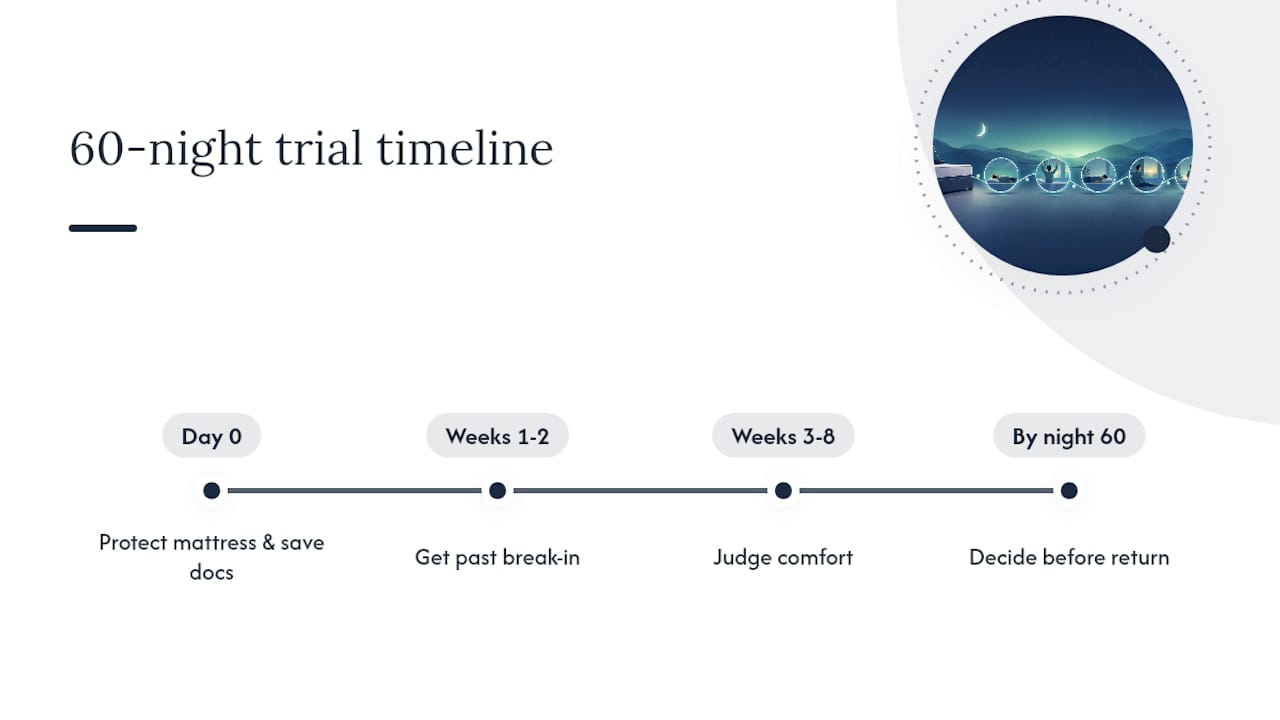
Mattresses that are fiberglass-free and built from certified, safe materials tend to have more straightforward warranty evaluation. There are fewer questionable fillers or off-spec materials that complicate a defect inspection. Our practical advice mirrors what protects any buyer: put a protector on the mattress the day it arrives, and keep your purchase documentation somewhere you can find it in year eight, not just year one.
Prioritize the Trial First, the Warranty Second
If you take one thing from this guide, it’s this: spend your trial window testing comfort like it’s disappearing, because it is, and treat the warranty as a separate, much longer conversation about defects, not preference. Read the fine print before you order, not after something goes wrong.
Ready to Shop With a Clear Trial and Warranty Policy?
Some mattress companies offer a straightforward setup: a 60-night sleep trial, free shipping, and mattresses built without fiberglass or harmful fillers, all manufactured in the United States. Compared to brands that bury break-in rules and return fees in fine print, the terms here are meant to be readable in one sitting.

If you’re still narrowing down firmness or construction, the mattress comparison chart breaks down hybrid versus memory foam builds side by side. Ready to browse models by comfort level and sleep position? Head to the full mattress collection and run through your checklist, protector, photos, and proof of purchase, before you place the order.
Sources
- Mattress trial periods — Sleep Foundation
- Mattress warranties and sleep trials, explained — Pillow & Post
- Understanding your mattress warranty — Mattress Clarity
FAQ
Is a warranty void if you don’t buy a matching base?
Yes, in many cases. Using an unsupported or incompatible foundation is a common reason manufacturers deny warranty claims, since improper support can cause sagging that mimics a defect.
How long should a $500 mattress last?
Most mattresses often show sagging or comfort loss within a couple of years, which is part of why some sleep experts recommend replacing mattresses every few years for cleaner sleep.
What are two reasons not to buy an extended warranty?
Extended warranties often duplicate coverage the manufacturer already provides for defects, and their payouts are frequently prorated, meaning you get less back the longer you’ve owned the mattress.
What mattress should you stay away from?
Avoid any mattress that hides its break-in period, charges steep return fees not disclosed upfront, or won’t specify defect thresholds like sag depth in writing. Vague warranty language, not a specific brand, is the real warning sign.
How long is a typical sleep trial?
Most sleep trials run 30 to 365 nights, with a common break-in minimum of 21 to 30 nights before returns are accepted. Guestly Sleep’s trial runs 60 nights.