

3–5 CFM Open Cell Memory Foam: Why It Cools and What to Check
Open-cell memory foam is memory foam manufactured with intentionally ruptured internal cell walls, letting air move through the material instead of getting trapped inside it. That structural change is what makes it sleep noticeably cooler than the dense, closed-cell memory foam that gave the material its “sleeps hot” reputation. The trade-off: unless the manufacturer builds it at a higher density, it can soften or sag faster than older, denser formulations. Keep reading for how it’s made, where it excels, and what to check before you buy.
TL;DR:
- Open-cell memory foam offers significantly improved airflow, with CFM ratings typically between 3 and 5, which helps reduce heat buildup during sleep.
- Lower-density open-cell foam tends to soften or sag faster and may absorb more moisture, making it less durable over time unless compensated with higher density formulations.
- Variables such as foam density (usually 4 to 5 PCF), CFM airflow, and cooling infusions like gel or PCM are critical factors to evaluate before purchasing.
- Durability of open-cell foam can be compromised in low-density versions, with replacement recommended every 2 to 4 years for optimal health and hygiene.
- Reputable manufacturers disclose specific density and airflow ratings, and choosing higher density foam ensures better longevity and sustained cooling performance.
Table of Contents
- What Is Open-Cell Memory Foam, and How Does It Differ From Closed-Cell?
- How Manufacturers Make Open-Cell Memory Foam
- Does Open-Cell Memory Foam Actually Sleep Cooler?
- What Are the Trade-Offs of Open-Cell Memory Foam?
- How to Evaluate Open-Cell Memory Foam Before You Buy
- How Long Does Open-Cell Memory Foam Last, and How Do You Care for It?
- How Guestlysleep Balances Breathability and Durability
- Try an Open-Cell Cooling Mattress Risk-Free
- Sources
What Is Open-Cell Memory Foam, and How Does It Differ From Closed-Cell?
Every block of memory foam starts as a liquid polymer that expands and cures into a matrix of tiny cells. In closed-cell foam, those cells stay sealed, trapping air (and body heat) inside each pocket. In open-cell foam, manufacturers rupture or reticulate those cell walls during production so the pockets connect into an interconnected network that air can actually pass through.
That structural shift changes three things at once:
- Airflow: heat and moisture escape through the foam instead of building up under your body.
- Feel: open-cell foam often feels slightly less dense and marginally more responsive underhand.
- Off-gassing: because air moves through the material more freely, the “new mattress smell” from volatile organic compounds tends to dissipate faster.
The underlying chemistry is the same viscoelastic polyurethane that NASA researchers helped develop decades ago for cushioning and impact absorption. Most memory foam sold today, closed or open cell, descends from that original formula. What’s changed is how manufacturers engineer the cell structure inside it.
How Manufacturers Make Open-Cell Memory Foam
Getting foam to breathe isn’t a matter of just whipping air into it. Manufacturers control the cell structure through two main levers: the blowing agent used during the chemical reaction, and mechanical or chemical reticulation that ruptures cell walls after the foam cures.
Formulation choices here carry real consequences. The Department of Energy’s spray polyurethane foam guide documents this dynamic in a related industry: open-cell spray foams use different blowing agents than closed-cell versions and end up with lower density and different vapor permeability as a direct result. Mattress foam works on the same principle, even though the end use is completely different.
- Higher water content in the blowing agent tends to produce lighter, more open cell structures.
- Mechanical reticulation (crushing the foam under rollers) ruptures cells more uniformly than chemical methods alone.
- Density, typically measured in pounds per cubic foot (PCF), is the byproduct that determines how the foam ages.
- Foam that recovers quickly from compression does so because air rushes back into open cells fast, which is part of why open-cell layers can feel more responsive than old-school memory foam.
Lower-density open-cell foam bounces back quickly but wears faster. Manufacturers who want both breathability and longevity compensate by adjusting the polymer backbone and crosslinking density rather than relying on cell structure alone.
Does Open-Cell Memory Foam Actually Sleep Cooler?
Yes, and there’s a real number behind that claim. Airflow through foam is measured in cubic feet per minute (CFM), and it’s the clearest technical signal of how much a given foam will trap or release heat.
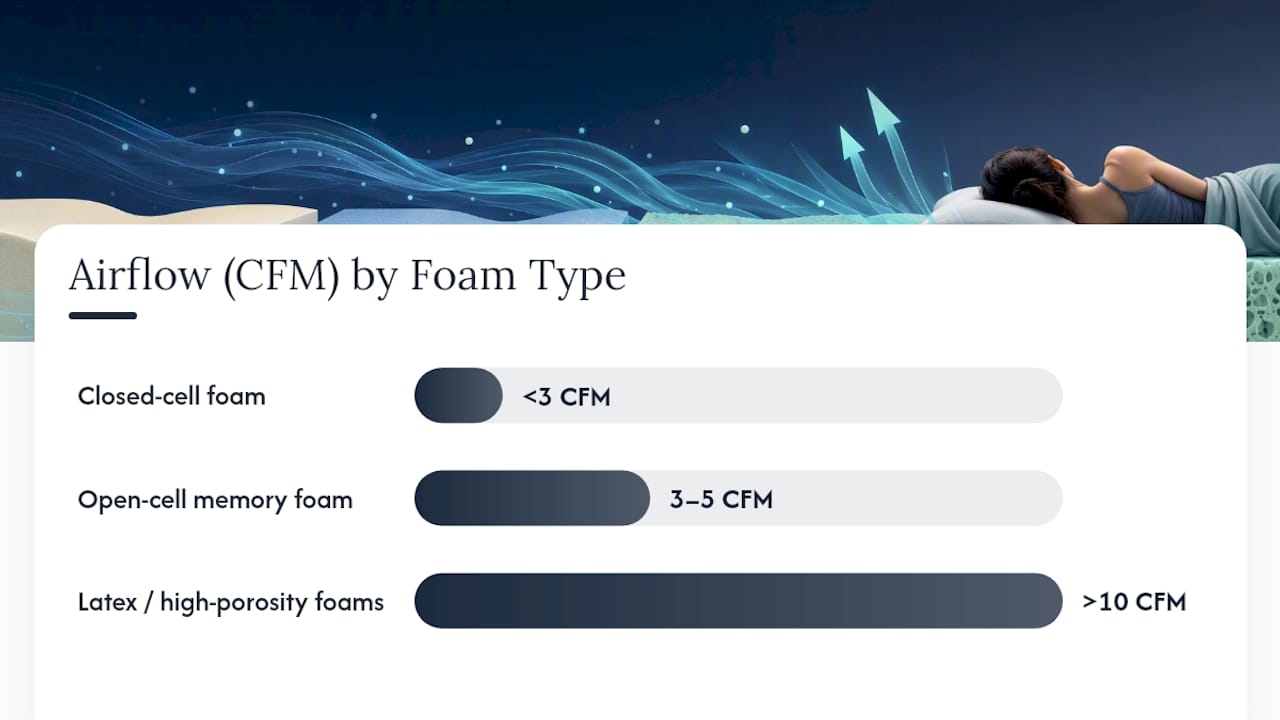
By the numbers: traditional closed-cell memory foam typically rates below a low CFM airflow range, while open-cell memory foam commonly falls in the 3 to 5 CFM range, with latex and specialty high-porosity foams sometimes exceeding 10 CFM.
That gap matters in practice, not just on a spec sheet. Higher CFM means convective airflow, air actually circulating through the material, carries heat and moisture away from your body instead of letting it pool against the mattress surface. It’s the same reason a mesh running shoe feels cooler than a solid rubber one.
Open-cell foam doesn’t sacrifice the pressure relief that made memory foam popular in the first place. The material still contours to your shoulders, hips, and lower back, distributing weight across a wider surface area and easing the joint pressure that leads to tossing and turning. If pressure relief is your main concern, how memory foam distributes weight is worth understanding before you shop by cooling specs alone.
Where open-cell foam alone falls short is dramatic cooling. It offers incremental improvement, not a night-and-day difference. That’s why most cooling mattresses on the market pair open-cell foam with something else:
- Gel infusions that absorb heat on initial contact.
- Graphite layers that conduct heat laterally away from your body.
- Phase change materials (PCM), which absorb heat as they change state and release it slowly, smoothing out temperature swings through the night.
- Hybrid coil cores, which add airflow channels between coils that foam alone can’t replicate.
A phase change material mattress cover can meaningfully change how your body regulates temperature at sleep onset, when your core temperature naturally drops. Combining that kind of cover with an open-cell foam comfort layer addresses both the fast initial heat spike and the slower buildup over hours.
What Are the Trade-Offs of Open-Cell Memory Foam?
Breathability comes with real costs, and any honest buying guide has to say so plainly.
The biggest one is density-linked durability. Open-cell structures, especially at low PCF, tend to compress and lose their original shape faster than higher-density closed-cell foam or latex. A Sleepline breakdown of memory foam composition frames it as a straightforward trade: better airflow, but unless manufacturers compensate with a denser formulation, you sacrifice some long-term support.
- Sag risk rises in lower-density open-cell foam, particularly in the areas where you carry the most weight.
- Moisture absorption is higher than closed-cell foam or latex, since the same open channels that let air through also let liquid in, a real consideration for spill-prone households.
- Firmness ceiling is lower. Open-cell foam rarely delivers the same firm, edge-supportive feel that heavier sleepers or hybrid mattress fans need.
If you run hot and sleep heavy, or if you want strong edge support for getting in and out of bed, a hybrid construction with a coil core or a latex comfort layer will usually outperform open-cell foam on durability, even with lower airflow numbers.
Pro Tip: Ask for the published density in PCF before buying. Manufacturers who skip that number on the spec sheet are often using a lower-cost, lower-durability formulation and would rather you not compare it.
How to Evaluate Open-Cell Memory Foam Before You Buy
Comparing mattress listings gets a lot easier once you know exactly which specs to check and in what order.
- Check the density (PCF). A published number, ideally in the 4 to 5 PCF range for a comfort layer, signals a manufacturer confident in the foam’s longevity. Missing density specs are a red flag.
- Match density to your body weight and sleep position. Heavier sleepers and those who sleep primarily on their back or stomach need firmer, denser support; side sleepers generally do better with a softer, more contouring open-cell layer.
- Look for CFM or airflow claims. Third-party testing or a stated CFM range gives you an objective cooling comparison instead of marketing copy alone.
- Note any cooling infusions. Gel, graphite, and PCM covers each address heat differently. PCM tends to help most with initial sleep onset; graphite helps more with sustained heat dispersion.
- Verify materials and certifications. Look specifically for fiberglass-free construction and non-toxic certifications, especially if anyone in the household has allergies or chemical sensitivities.
- Confirm the trial period and warranty. A trial of 60 nights or longer gives your body enough time to adjust before you’re locked into a decision.
A few other things worth a quick scan before checkout:
- Published care instructions (spot-clean only vs. machine washable cover)
- Return shipping and disposal policy if the mattress doesn’t work out
- Whether the listing separates comfort layer density from base layer density
How Long Does Open-Cell Memory Foam Last, and How Do You Care for It?
A few habits go a long way toward protecting an open-cell comfort layer’s lifespan. Since the open structure absorbs moisture more readily than closed-cell foam, a breathable mattress protector is close to essential, not optional. Spot-clean spills immediately rather than letting liquid sit and soak into the cells.
Watch for three warning signs that replacement time is approaching:
- Visible body impressions that don’t spring back within a few minutes of getting up.
- A noticeable drop in pressure relief, waking up with new aches in the shoulders or hips.
- Cooler-feeling mattress giving way to renewed heat retention, a sign the open-cell structure has compressed and lost its airflow channels.
Lifespan varies with density and use, but Guestlysleep recommends replacing any mattress, open-cell foam included, every 2 to 4 years for the cleanest, healthiest sleep surface. That’s a tighter window than the 7 to 10 years some manufacturers advertise, and it’s intentional: foam compresses gradually long before it visibly fails, and a mattress harboring years of sweat, skin cells, and dust mites isn’t doing your sleep hygiene any favors even if it still looks fine.
How Guestly Sleep Balances Breathability and Durability
Every open-cell comfort layer Guestly Sleepspecifies gets built around one question: how do we keep the cooling benefit without inheriting the durability problem that gives open-cell foam its bad reputation. That means checking density thresholds before a formulation makes it into a collection, not after customer complaints roll in.
Guestly Sleep organizes its lineup by comfort level and sleep position specifically because density needs shift with body weight and sleep style. Every mattress ships fiberglass-free and made in the USA, backed by a 60-night trial that gives your body real time to judge whether the foam holds up.
Try an Open-Cell Cooling Mattress
Guestly Sleep skips the guesswork on the checklist above because every listed mattress publishes its materials and construction upfront, no digging through fine print required. That’s the direct advantage over shopping generic online listings where PCF and CFM numbers are often missing entirely: you can compare specs before you commit instead of hoping the marketing copy is accurate.
Collections are grouped by comfort level and sleep position, so a side sleeper looking for a softer open-cell contour and a back sleeper needing firmer support aren’t stuck browsing the same one-size-fits-all lineup. Every mattress ships fiberglass-free, is assembled in the USA, and comes with free shipping. If you’re ready to see the difference open-cell cooling makes for yourself, start your 60-night trial and test it in your own bedroom before deciding if it’s a keeper.
Sources
For deeper technical detail, the DOE’s spray foam guide covers blowing agents and density; Mattress Miracle breaks down CFM airflow ratings by foam type.
- Open-Cell Foam in Mattresses — Does It Actually Help?
- NASA — memory foam history
- Spray polyurethane foam guide (Building America / DOE)