

Stop Wakeups: Motion Isolation Mattresses for Couples & Light Sleepers
Memory foam and pocketed-coil hybrids consistently isolate motion best, while traditional innerspring beds with connected coils rank worst. Foam gives you the flattest, quietest sleep surface but can trap heat and skimp on edge support, while hybrids trade a fraction of that isolation for better airflow and a bed that holds its shape at the perimeter. If you can’t replace your mattress right now, a dense memory-foam topper or a split foundation buys you real relief while you plan the bigger purchase.
TL;DR:
- Memory foam and hybrid mattresses provide the best motion isolation, with dense foam layers absorbing movement and pocketed coils localizing vibrations.
- Tests like drop, ripple, and couples’ subjective assessments are used to measure how well a mattress prevents motion transfer, but no single method is perfect.
- Denser foam (at least 5 lb/ft³) and individually pocketed coils significantly improve motion damping compared to interconnected coil systems.
- A medium firmness mattress (6 to 6.5) balances motion isolation with support, while wider beds or split configurations reduce perceived movement transfer.
- For consistent sleep quality, prioritize motion isolation if sharing with a light sleeper, a partner with different sleep habits, or a restless pet, especially over other features like temperature control.
Table of Contents
- What Does Motion Isolation Actually Mean?
- How Do Mattress Materials Compare on Motion Isolation?
- Motion Isolation vs. Everything Else You’ll Notice at Night
- How Do You Choose the Right Motion-Isolating Mattress?
- Can Toppers or Split Beds Fix a Bad Mattress?
- How Does Guestlysleep Approach Motion Isolation?
- Author Perspective: When Should Motion Isolation Be Your Top Priority?
- Try a Fiberglass-Free Mattress Built for Two
- Where This Guide’s Facts Come From
- Sources
What Does Motion Isolation Actually Mean?
Motion isolation measures how well a mattress absorbs the kinetic energy from movement so it doesn’t ripple across the surface and wake up whoever’s on the other side. When your partner rolls over at 2 a.m., or the dog jumps up at dawn, that energy has to go somewhere. On a bad mattress, it travels. On a good one, it dies within a few inches of where it started.
The concept sounds abstract until you’ve slept next to someone who tosses. Then it’s the difference between six uninterrupted hours and a night chopped into fragments. Research on sleep continuity backs up what light sleepers already know by instinct: reducing a bed partner’s motion transfer measurably improves how well the other person stays asleep.
Labs test this in a few concrete ways. A drop test involves releasing a weighted ball onto one side of the mattress and measuring the vibration recorded on the other side with a seismometer or accelerometer. A ripple test is more visual: fill a glass with water, set it a foot or two from where someone drops onto the bed, and watch how much the surface disturbs it. Reviewers also run informal “couples’ tests,” where two people lie on opposite sides and one moves while the other rates what they felt.
- Drop/ripple tests quantify vibration transfer using sensors or visible water disturbance.
- Couples’ tests capture the subjective, real-world feel that lab numbers sometimes miss.
- Edge and center comparisons reveal whether motion isolation holds up across the whole surface, not just the middle.
None of these methods is perfect on its own. A drop test can’t tell you how a mattress feels after five years of use, and a couples’ test depends on two people’s very different sensitivity to movement. Lab-tested reviews that combine both approaches tend to give the most reliable picture.
Who actually needs to care about this number? Couples with different sleep or wake schedules, light sleepers who wake at the slightest jostle, anyone sharing a bed with a restless pet, and people recovering from injury who can’t afford a jarring wake-up. If none of that describes your situation, motion isolation might rank below firmness or cooling on your priority list. If it does describe you, it should probably be the first spec you check, not the last.
How Do Mattress Materials Compare on Motion Isolation?
Not all mattresses fight motion transfer the same way, and the differences come down to how each material responds to pressure and how fast it releases that pressure back.
Memory foam wins this category more often than not. Its slow, viscous rebound means the foam absorbs movement rather than bouncing it back or passing it along. Sleep Foundation’s testing methodology confirms memory foam consistently scores at or near the top for motion isolation, largely because denser foam layers act like a shock absorber, soaking up energy instead of transmitting it. The catch is that this same slow-moving quality is what makes memory foam feel like it “hugs” you, and hugging takes time. If you need to reposition quickly, that same density works against you.
Pocketed-coil hybrids come in a close second, and for a lot of buyers, they’re the better real-world choice. Instead of one continuous coil system, individually encased coils compress independently, so movement on one side doesn’t automatically rock the coils under your partner. Sleep Foundation’s research explains that interconnected coils act as a single unit and spread vibration across the whole bed, while pocketed coils isolate that compression to a localized area. Layer a few inches of foam over those pocketed coils and you get isolation that rivals all-foam beds, plus the airflow and edge support foam alone can’t match.
Latex sits in the middle of the pack. It’s naturally more responsive and bouncier than memory foam, which means it transfers more motion overall, but its point elasticity, meaning it deforms only where pressure is applied instead of sagging across a wide area, helps contain that transfer to a smaller zone. Talalay latex, which is processed with a vacuum and flash-freeze method, tends to feel softer and more consistent throughout, while Dunlop latex is denser and firmer at the base. Neither isolates motion as well as memory foam, but both beat a standard innerspring.
Traditional innersprings with interconnected coils perform worst, full stop. Because the coils are wired together, pressure on one section pulls on the coils around it, and that chain reaction is exactly what wakes up the person on the other side. This is the mattress type most likely to leave a couple feeling every toss and turn from across the bed.
A few construction details matter more than the material label on the box:
- Comfort layer thickness determines how much cushioning stands between you and the support core; thin comfort layers let more motion reach the surface.
- Foam density (measured in pounds per cubic foot, though brands rarely advertise the number clearly) correlates with how well a layer damps movement, with denser foams generally isolating better.
- Coil encasement is the single biggest factor separating a motion-isolating hybrid from a noisy one; look for language like “individually wrapped” or “pocketed” coils, not just “coil” on its own.
Pro Tip: Ask for the foam density spec, not just the firmness rating. A 5 lb/ft³ memory foam layer isolates motion noticeably better than a 3 lb/ft³ layer of the same thickness, even if both are marketed as “medium firm.”
Motion Isolation vs. Everything Else You’ll Notice at Night
The mattress that isolates motion best on paper isn’t automatically the best mattress for your bed. Motion isolation trades against a handful of other everyday comforts, and ignoring those trade-offs is how people end up regretting a purchase within the first month.
Edge support is where all-foam beds tend to disappoint. Foam compresses evenly, which is great in the center but means the perimeter offers little resistance when you sit down to put on socks or when a partner sleeps close to the edge. Hybrids solve this more naturally, since many use a reinforced steel coil around the border, or a firmer foam encasement, specifically to keep the edge from collapsing.
Temperature regulation is the other classic foam weakness. Dense memory foam that’s great at absorbing motion is often just as good at trapping body heat, since the same closed-cell structure that stops vibration also blocks airflow. Look for gel infusion, open-cell or copper-infused foams, or a phase-change cover material if you run warm. Hybrids again have a structural edge here, since the coil layer creates natural air channels that foam alone doesn’t.
Responsiveness matters more than people expect until they’re mid-repositioning. Memory foam’s slow recovery is fantastic for isolating a partner’s movement, but it makes it harder to shift positions quickly or move during sex, since the foam needs a beat to release and reshape. Latex and pocketed-coil hybrids recover faster, giving you more bounce and easier movement, at the cost of a little isolation. Hybrid mattresses tend to split this difference better than either pure foam or pure innerspring designs.
- Foam maximizes isolation but sacrifices edge support and heat release.
- Hybrids balance isolation, airflow, and edge performance, at a slight cost to raw motion-dampening.
- Latex offers the fastest recovery and coolest feel, but transfers more motion than foam or coil hybrids.
Durability claims are harder to verify from a spec sheet, but a few signals help. A longer warranty (10 years is standard; anything shorter is a flag) usually correlates with denser, longer-lasting foam. Higher coil gauge numbers mean thinner, more flexible steel, which isn’t necessarily worse, but combined with a low coil count, it can mean a support core that sags faster. None of these numbers guarantee performance five years out, but a mattress that’s vague about foam density or coil specs is usually hiding a cheaper build.
How Do You Choose the Right Motion-Isolating Mattress?
Start with firmness, because it does more heavy lifting for motion isolation than most buyers realize. A medium to medium-firm feel, generally in the 6 to 6.5 range on the standard 1 to 10 firmness scale, tends to be the safest compromise when isolation and support both matter. Very soft mattresses isolate motion exceptionally well because they let a body sink in and absorb movement locally, but that same softness can undercut spinal support for back and stomach sleepers, so it’s not a free win.
Size is the second lever, and it’s the one people underestimate most. A wider mattress physically increases the distance between two sleepers, which reduces how much perceived motion reaches the other side even before you factor in materials. Moving from a queen to a king can feel like solving half your motion problem overnight, and whether a queen is really enough space for two people is worth settling before you shop for materials at all. If your preferences diverge sharply (one person wants firm, the other wants soft, or one runs hot and the other cold), a split king or two twin XL mattresses pushed together lets each side be tailored independently, with zero motion crossover between them.
Body weight and sleep position change what “isolation” should even mean for you. A heavier sleeper compresses foam and coils more deeply, which can either help isolation (deeper compression localizes pressure) or hurt it (if the base layer bottoms out and transfers motion to the frame). Side sleepers generally want more pressure relief at the shoulders and hips, which points toward foam or a plush hybrid, while back and stomach sleepers need firmer support that can come from either foam or coils. If you and your partner are a combination sleeper pair with different positions, a mattress built for combination sleeping that balances contouring with responsiveness is usually a safer bet than a single-position specialist.
Before you buy, run through this checklist:
- Ask what the comfort layer is made of and how thick it is, not just the overall mattress height.
- Ask whether the coils (if any) are individually pocketed or interconnected.
- Confirm the trial period length and the return policy in writing, since most mattress trials run 90 to 120 nights and you need real time to test motion isolation with your actual partner or pet.
- Sit on the edge and press down firmly; if it collapses more than an inch or two, expect that same softness across the whole bed.
- If shopping in person, ask to lie down together and have one person shift positions while the other stays still.
Pro Tip: Don’t test a mattress alone in the showroom. Motion isolation is a two-person problem, so bring whoever you actually sleep next to, even if that means an awkward ten minutes in a mattress store.
For a broader walk-through of how these factors interact, Guestlysleep’s guide to choosing a mattress for couples covers the decision points in more depth than a single checklist can.
Can Toppers or Split Beds Fix a Bad Mattress?
A memory-foam topper helps, but it’s a patch, not a cure. Depth and density both matter here: a thin 2 inch topper made from low-density foam does almost nothing for motion transfer, while a 3 to 4 inch topper in a denser foam can noticeably calm down surface ripple on a mattress that’s otherwise too bouncy or too old to isolate well. Reviewers who test motion isolation directly generally agree toppers help at the margins but never fully replicate what a mattress built for isolation from the ground up delivers, since the underlying support core is still doing most of the work transmitting motion.
Split beds and split foundations solve a different problem entirely, and honestly, they solve it better than any topper can. Two mattresses (or one mattress split down the middle on an adjustable base) means your side and your partner’s side are mechanically separate. There’s no shared coil system, no shared foam layer, nothing for motion to travel through. This is the closest thing to a guaranteed fix for shared-surface transfer, and it’s why so many hotel suites and higher-end bedroom setups quietly use split configurations.
- A topper works best as a stopgap on a mattress that’s still structurally sound but has lost some of its original isolation over time.
- A split foundation or split mattress works best when preferences (firmness, temperature, motion sensitivity) are permanently different between two sleepers.
- Neither fixes a mattress that’s sagging, broken down, or past its usable life. At that point, replacement is the only real answer.
If you’re waking up more from your own mattress’s fatigue than from your partner’s movement, a topper will mask the symptom for a while. If your partner’s motion is the actual problem and your mattress itself is fine, splitting the surface solves it permanently.
How Does Guestlysleep Approach Motion Isolation?
Some mattress brands build fiberglass-free mattresses and manufacture in the United States, which can matter for motion isolation in a practical way: safer, certified materials let you focus on comfort and construction quality instead of worrying about what’s inside the layers you’re sleeping on every night.
Some companies organize their product lineup by comfort level and sleep position rather than by marketing tier, which can make it easier to match a mattress to the way you and your partner actually sleep instead of guessing from a firmness number alone. Memory-foam and hybrid options may be offered across collections that cater to side, back, and stomach sleepers as a starting point instead of one generic “for couples” model.
- Some mattress lines offer fiberglass-free construction, with materials selected for health-conscious buyers.
- Collections may be organized by comfort level and sleep position, not just price point.
- Sleep trials can range around 60 nights, intended to allow testing how a mattress handles a partner’s movement over several weeks, not just a few nights.
- Free shipping can be available on some orders, reducing barriers to trying a mattress built with motion isolation in mind.
A sleep trial window around 60 nights is typically longer than the handful of nights most people spend deciding whether a new mattress is working, and testing conducted by AARP on couples’ mattresses points to exactly why that matters: motion isolation issues often only show up once real sleep patterns settle in, not on night one.
Author Perspective: When Should Motion Isolation Be Your Top Priority?
Not every couple needs to obsess over motion isolation, and I think a lot of buying guides oversell it as a universal must-have. If you and your partner have similar body weights, similar schedules, and neither of you wakes easily, you can probably rank other features (temperature, pressure relief, price) above it without regret.
But if one of you is a genuinely light sleeper, if there’s a significant weight difference between you, or if someone gets up multiple times a night for work, kids, or a restless pet, isolation should move to the top of your list before you even look at firmness or price. That’s the group where a bad match doesn’t just feel uncomfortable, it actively costs you sleep, night after night.
The other case where I’d deprioritize it is medical support needs or serious overheating. No amount of motion isolation is worth sleeping on a mattress that leaves your back sore or has you kicking off blankets at 3 a.m. In those situations, solve the bigger problem first and treat isolation as a secondary filter among the options that already work for you.
Whatever you land on, don’t trust the spec sheet alone. Sleep on it, with your actual partner, for as many nights as the trial allows. That’s the only test that matches your real bed.
— Justin
Try a Fiberglass-Free Mattress Built for Two
Some mattress companies skip the fiberglass liners most mass-market mattresses still use and build their models in the United States, so customers may choose comfort without weighing it against what’s hidden inside the layers.
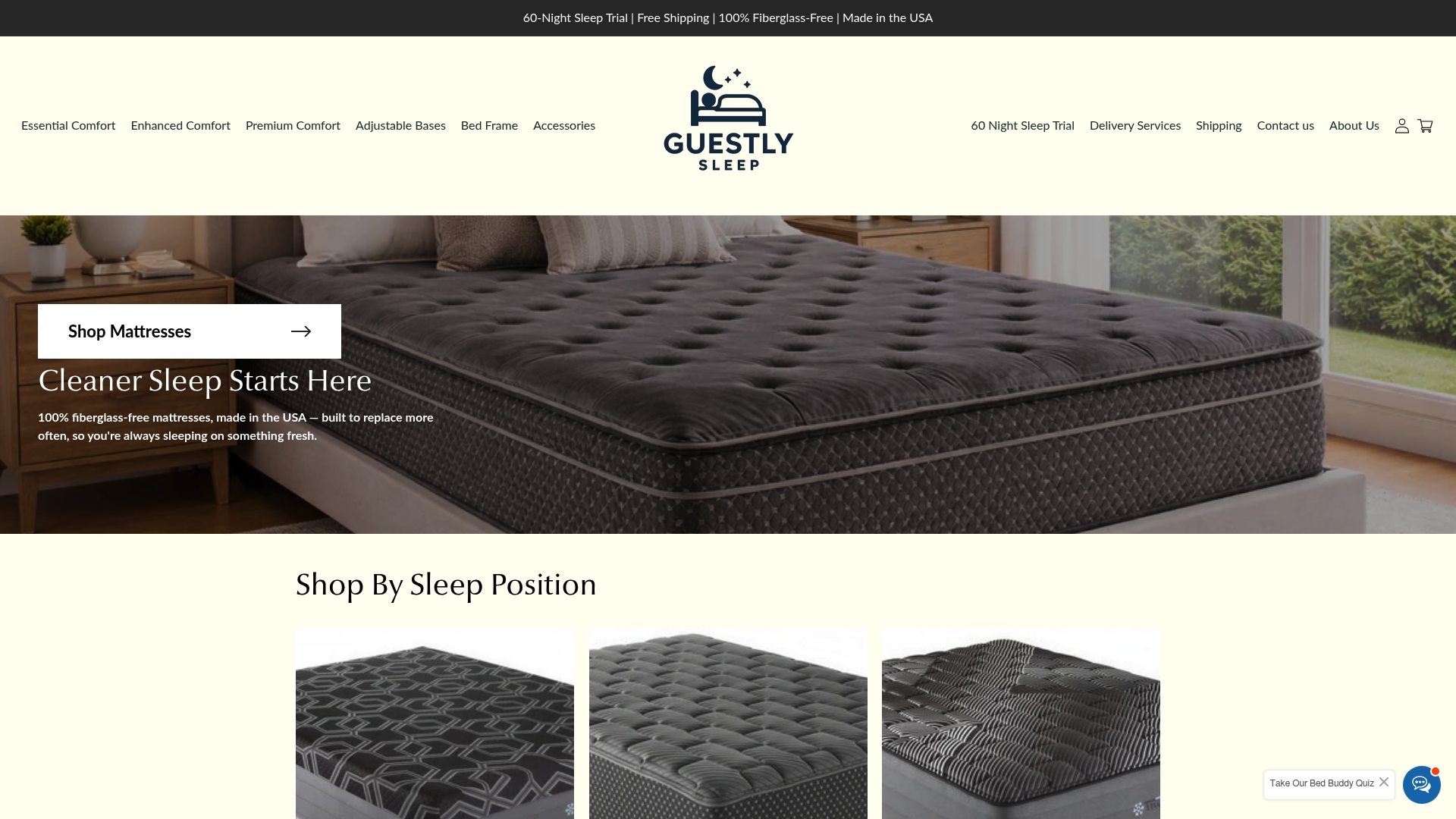
Some mattress collections are grouped by comfort level and sleep position, which can help couples find a clearer starting point than scrolling through an undifferentiated catalog. Many mattresses ship free and come with a 60-night sleep trial, enough time to actually test how the mattress handles a partner’s movement or a pet jumping onto the bed at 6 a.m., not just how it feels on night one. For those weighing firmness against isolation, some guides provide breakdowns on medium versus firm mattresses to review before deciding.
Guestlysleep is one option among several worth considering, but if fiberglass-free materials and a long trial period matter to you, browse the current mattress collections and pick the comfort level that matches how you actually sleep.
Where This Guide’s Facts Come From
- Sleep Foundation’s motion isolation methodology explains how labs test coil types and foam layers, and why pocketed coils outperform interconnected ones.
- Tom’s Guide’s breakdown of motion isolation defines the concept in plain terms and covers realistic topper expectations.
- Sleep Report’s lab-tested mattress rankings show how memory foam and hybrid models score in practical ripple and drop tests.
- AARP’s mattress testing for couples documents real-world couples’ tests and near-perfect isolation scores on top-performing models.
If a mattress you’re considering claims strong motion isolation, ask to see the actual test method behind that claim rather than taking a marketing bullet point at face value. For sleep habits that complement a better mattress, a resource like this sleep meditation checklist covers non-mattress strategies for staying asleep through a partner’s movement.
Sources
- How we determine motion isolation | Sleep Foundation
- What is motion isolation in a mattress? | Tom’s Guide
- Best Mattress for Motion Isolation 2025 Lab-Tested | Sleep Report
- Best mattresses for couples | AARP
- PMC article related to sleep disturbance and sleep continuity (example)