

Build to 2 Inches: Bed Slat Spacing Rules, Math, and Low Cost Fixes
Keep slat gaps at 2.75 inches or less for memory foam and latex, since anything past 3 inches risks sagging and voided warranties. Hybrids handle up to 4 inches, and innerspring mattresses can tolerate 4 to 5 inches. If you’re unsure which category your mattress falls into, build to 2 inches and add center support on queen or larger frames. That single rule covers almost every warranty on the market.
TL;DR:
- Memory foam and latex mattresses require slat gaps no wider than 2.75 to 3 inches to prevent sagging, with the safest standard being 2 inches plus center support for larger frames.
- Hybrids and innerspring beds can tolerate wider gaps, up to 4 inches for hybrids and 4 to 5 inches for innerspring mattresses, due to coil support.
- Measuring the widest gap at the center and ends of the frame is essential, since slats tend to bow over time and could increase unsupported span.
- Thicker, hardwood slats of at least 1 inch are recommended for spans over 30 inches, with center support mandatory for queen and larger beds to avoid premature support failure.
- Building to the recommended spacing and support standards reduces warranty issues, prevents sagging, and prolongs mattress lifespan, with professional setup advised if standards aren’t met.
Table of Contents
- Recommended Maximum Slat Gap by Mattress Type
- How to Measure Your Bed Slat Spacing
- Slat Thickness, Span, and When You Need Center Support
- Typical Slat Counts by Bed Size (With Worked Examples)
- Practical Fixes for Out-of-Spec Slat Spacing
- Warranty Checklist: What to Document Before You File a Claim
- Guestly Sleep Guidance on Setup and Support
- Slat Spacing for Kids’ Beds and Specialty Mattresses
- Common Problems Caused by Incorrect Slat Spacing
- How Frame Style Changes Slat Spacing Requirements
- Why Manufacturer Warranty Language Often Undersells the Real Risk
- Setup Help When Your Frame Falls Short
- Sources
- FAQ
Recommended Maximum Slat Gap by Mattress Type
Foam and latex mattresses have no coils to bridge a gap, so they sag directly into open spaces. A 3 inch gap might sound small, but repeated pressure from a sleeper’s hips and shoulders pushes foam downward over months, creating permanent ridges that no amount of fluffing fixes. Latex behaves similarly but tends to ripple rather than dent, which shows up as visible waves across the mattress surface.
Innerspring mattresses distribute weight across a steel coil grid, so they tolerate wider gaps without the same sagging risk. Hybrids split the difference. Their foam comfort layer sits above a coil base, so the coils absorb some of the gap stress but the foam still needs reasonably tight support underneath.
Pro Tip: If your mattress tag doesn’t list a slat requirement, treat it as memory foam for spacing purposes. That’s the safer assumption and it costs you nothing extra in materials.
- Memory foam and latex: 2.75 to 3 inches maximum
- Hybrid: up to 4 inches
- Innerspring: 4 to 5 inches, sometimes tolerated at the upper end
Most mattress manufacturers cap gaps around 3 inches for foam and latex, while hybrids and innersprings get more room because of that coil support. Tighter spacing also traps more heat against the mattress bottom, so there’s a real trade off between airflow and firmness. A frame built for ventilation and cooling usually spaces slats just wide enough to move air without sacrificing support.
How to Measure Your Bed Slat Spacing
Grab a tape measure and check the gap at three points: both ends of the frame and the center. Slats bow slightly over time, so the center measurement often reveals the widest gap even when the ends look fine. Use the largest number you find, not an average.
- Measure the gap between slats at the left end of the frame.
- Measure again at the right end.
- Measure the center gap, where sagging or warping shows up first.
- Record the widest measurement as your true gap.
- Compare that number against your mattress type’s maximum.
If you want to calculate spacing yourself, the math is straightforward. The spacing formula is: Gap = (Frame inside span − N × Slat width) / (N + 1), where N is your slat count.
| Tool | Purpose |
|---|---|
| Tape measure | Confirms actual gap width at each point |
| Spacer block | Cut to your target gap for even placement during installation |
| Calculator or app | Solves for slat count when you know your target gap |
A flush layout pushes slats tight against the frame rails on both ends; an even layout distributes slats so the first and last gaps match the interior gaps exactly.
Slat Thickness, Span, and When You Need Center Support
Thin slats bend, and bending is what actually breaks mattress support, not the number of slats you have. A minimum thickness of ¾ inch (19 mm) works for lighter sleepers on shorter spans, but 1 inch thick slats hold up far better for heavier sleepers or wider beds. Hardwood or 5/4 surfaced lumber resists warping over years of use better than soft pine.
The physics behind this comes down to what engineers call the deflection cube law: bending increases roughly with the cube of the unsupported span, so doubling the span multiplies deflection by about eight times. A 1x4 pine slat spanning a full queen width without center support can deflect close to an inch under normal weight. Cut that span in half with a center rail, and deflection drops dramatically, often to a fraction of an inch.
Pro Tip: When shopping for a bed frame, ask specifically whether center support is included, not just implied. Some budget frames sell you the rail as a $15 add on you’ll need before the mattress ever goes on top.
- Minimum ¾ inch thickness for slats; 1 inch preferred for heavier sleepers
- Hardwood or 5/4 lumber for spans over 30 inches
- Center rail mandatory for queen, king, and California king frames
- Position center support directly under the middle slats or along a center beam running the bed’s length
Queen and larger mattresses need center support underneath, either as a center rail with legs or a beam running the length of the frame. Skipping it is the single most common reason platform beds fail early, regardless of how tight the slat gaps are everywhere else.
Typical Slat Counts by Bed Size (With Worked Examples)
More slats mean tighter, more uniform gaps, but you don’t need to max out the count to hit warranty specs. Twin frames typically run 12 to 15 slats, full frames 12 to 16, queen frames 18 to 24, and king frames 24 or more, depending on slat width and the manufacturer’s spacing target.
Here’s a worked example using a queen frame with a 58-inch inside span and 3.5-inch wide slats, targeting a 2.75-inch maximum gap.
- Rearrange the slat count formula: N = ceil((S − G) / (W + G)).
- Plug in the numbers: N = ceil((58 − 2.75) / (3.5 + 2.75)) = ceil(8.84), rounded up to 9 slats.
- Recalculate the actual gap with 9 slats: Gap = (58 − 9×3.5) / (9 + 1) = 2.65 inches.
- Confirm 2.65 inches falls under your 2.75 inch target. It does.
| Bed size | Typical slat count | Notes |
|---|---|---|
| Twin | 12 to 15 | Fewer slats needed due to narrower span |
| Full | 12 to 16 | Center support recommended but not always required |
| Queen | 18 to 24 | Center rail required |
| King | 24 or more | Center rail and often a third leg row required |
A flush layout tightens the end gaps slightly compared to an even layout, so always double check your actual gap after installation rather than trusting the formula alone. Place any center slat directly over your center rail, never straddling it.
Practical Fixes for Out-of-Spec Slat Spacing
Fixing wide gaps rarely requires a new bed. Start with the cheapest option and work up only if it doesn’t solve the problem.
- Add more 1x4 slats into existing slat holders. Costs $20 to $40 for a set and takes under an hour.
- Install a bunkie board on top of your existing slats to create a nearly solid surface. Runs $40 to $80 depending on size.
- Cut ventilated plywood to fit your frame’s inside dimensions, drilling airflow holes every few inches. Costs $25 to $50 in materials plus your own labor.
- Buy a slat conversion kit designed for your specific frame brand, usually $50 to $100.
- Replace the frame or foundation entirely when the existing base is structurally unsound, not just under spaced.
Pro Tip: A ventilated plywood deck is often the best value fix for foam and latex mattresses because it keeps airflow moving while giving you near total support, unlike a solid unventilated board.
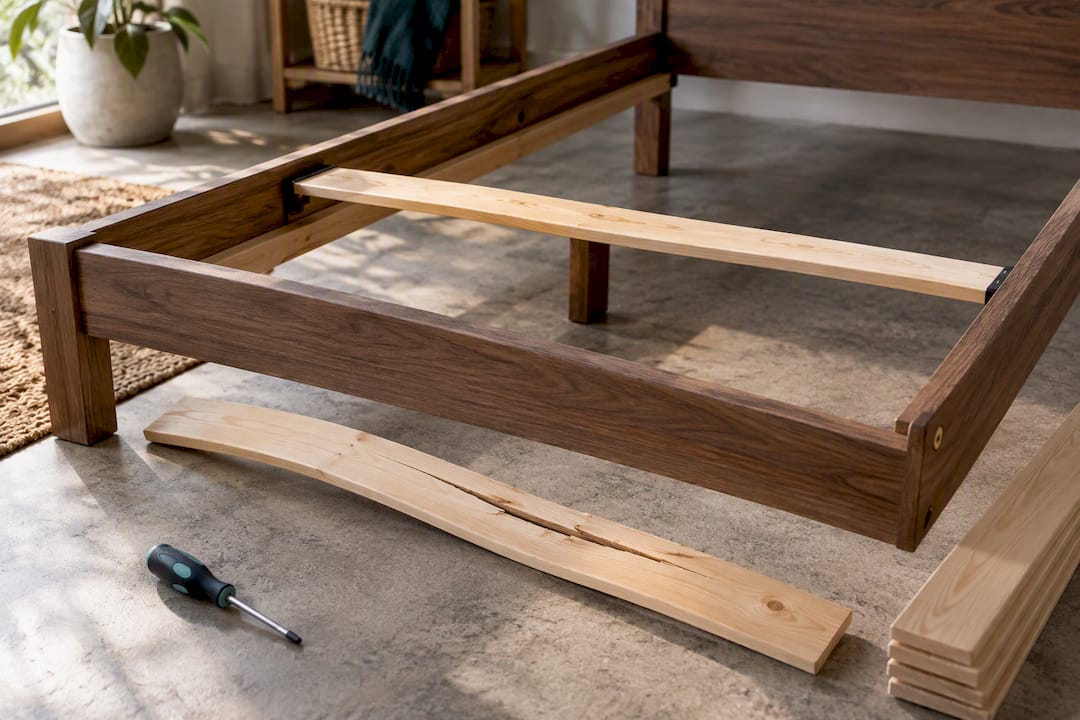
When slats are cracked, warped, or the frame itself is flexing under weight, a new foundation or professional frame installation beats patching a structurally compromised base.
Warranty Checklist: What to Document Before You File a Claim
Mattress brands don’t agree on a single spacing standard. Published limits range from about 2 inches to 5.5 inches depending on the manufacturer, which is exactly why building to 2 inches satisfies nearly every published rule at once.
Before you ever need to file a claim, document your setup:
- Photograph slat gaps measured at both ends and the center.
- Note slat material and thickness (pine versus hardwood, ¾ inch versus 1 inch).
- Photograph center support, showing the rail or beam and its legs.
- Save your purchase receipt and installation date for both mattress and frame.
- Contact the mattress manufacturer’s support line before filing anything. They can confirm whether your setup meets their specific written requirement.
Guestly Sleep Guidance on Setup and Support
Guestly Sleep builds fiberglass-free mattresses in the United States and recommends replacing a mattress every 2 to 4 years to keep sleep environments cleaner. That replacement cadence makes correct slat spacing worth checking every time you set up a new mattress, not just once.
For readers dealing with a frame that doesn’t meet spec, a bed frame installation service handles slat and rail setup directly, while mattress and adjustable base installation covers full setup when pairing a new mattress with a powered base. Haul away options exist too, when the old foundation needs to go. Before ordering, check Guestly Sleep’s foam-on-slats compatibility guide or the adjustable base compatibility guide for model-specific instructions.
Slat Spacing for Kids’ Beds and Specialty Mattresses
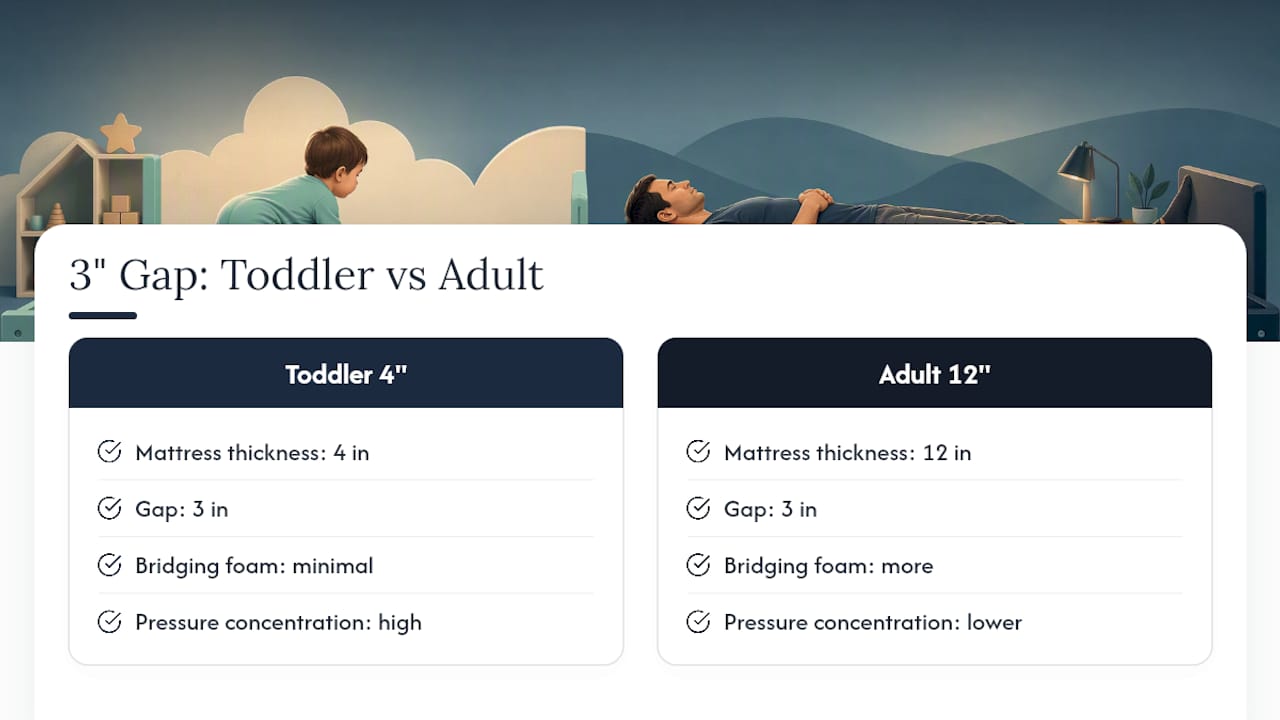
Children’s mattresses are usually thinner and lighter than adult mattresses, which sounds like it should mean looser spacing rules. It’s the opposite. Thinner foam or lower-density innerspring construction in kids’ mattresses has less material to bridge a gap, so the same 2.75 to 3 inch foam rule applies, sometimes even tighter for toddler mattresses under 4 inches thick. A 3 inch gap under a 4 inch toddler mattress creates far more localized pressure than the same gap under a 12-inch adult mattress.
Airbeds and waterbeds don’t follow slat rules at all in the traditional sense, because most are designed for solid, flat platform support rather than slatted frames. Putting an airbed or waterbed on a slatted frame risks the material stretching into gaps over time, which can shorten the life of the bladder or chamber significantly. If you’re using either on a slatted platform anyway, a plywood deck or bunkie board underneath is close to mandatory, not optional.
Daybeds and trundle mattresses, which are often thinner foam units squeezed into narrow frames, need the same tight foam spacing as any full-size foam mattress. Don’t assume a smaller mattress means looser tolerances just because the bed itself looks less substantial. If sensory comfort and a stable, predictable sleep surface matter for your household, a sensory-friendly sleep setup starts with a frame that doesn’t shift or sag underneath the mattress.
Common Problems Caused by Incorrect Slat Spacing
Sagging is the most obvious symptom, but it’s rarely the first one you’ll notice. Before visible dips appear, most sleepers report increased motion transfer, a mattress that feels softer than it did at purchase, or unexplained back and hip discomfort after switching frames.
Foam mattresses subjected to gaps beyond 3 inches develop what’s often called “slat memory,” permanent indentations that trace the exact gap pattern underneath. Once that happens, no amount of rotating or flipping restores the surface, because the foam cells themselves have collapsed in those specific zones. Latex mattresses show a different failure mode: rippling and soft spots that create an uneven sleep surface, sometimes within just a few months of use on overly wide slats.
Innerspring and hybrid mattresses fail more slowly but not painlessly. Coils that lack support underneath can shift position over time, eventually poking through the fabric or creating squeaking and popping sounds during normal movement. A center rail’s absence compounds every one of these problems on queen and larger frames, since the unsupported center section takes the brunt of a sleeper’s weight regardless of mattress type.
The financial cost adds up fast. A mattress that shows premature sagging due to slat spacing, rather than a manufacturing defect, typically won’t qualify for a warranty replacement, leaving the full cost of a new mattress on the buyer.
How Frame Style Changes Slat Spacing Requirements
Platform beds put the entire support burden on the slats themselves, since there’s no box spring or additional layer underneath. That makes slat spacing on a platform bed the single biggest factor in mattress longevity, more so than almost any other frame type.
Adjustable bases complicate things further because the base flexes at hinge points when you raise the head or foot section. Slats or a solid panel across an adjustable base need to accommodate that movement without gapping wider at the joints, which is why most adjustable base manufacturers specify their own panel or slat systems rather than letting you retrofit standard wood slats. Mixing a standard wood-slat frame with an adjustable base mechanism is one of the more common compatibility mistakes buyers make.
Box springs behave differently altogether. The internal spring structure of a traditional box spring already provides even support across the entire surface, so the wood slats on top of a box spring frame exist mainly to hold the box spring in place, not to bear weight directly. That means box spring setups tolerate wider slat gaps than platform beds, since the box spring itself is doing the real support work underneath the mattress.
Why Manufacturer Warranty Language Often Undersells the Real Risk
Most warranty documents bury slat spacing requirements in a single sentence, and that sentence rarely explains why the number matters. The research backs up something worth saying plainly: a 2 inch gap isn’t an arbitrary manufacturer preference, it’s the number that satisfies the tightest published limits across the industry, which means building to it protects you regardless of which brand you eventually buy.
Where conventional advice falls short is treating slat count as the main variable. Slat count matters less than most buyers assume, once you understand that thickness and span control deflection far more than raw quantity. A frame with 16 thick hardwood slats and proper center support will outperform a frame with 24 thin pine slats and no center rail, every time.
If you’re setting up a mattress today, prioritize center support first, gap measurement second, and slat count last. That order reflects what actually causes failures, not what’s easiest to count at a glance. A thoughtfully chosen bed frame with the right support structure will outlast a dozen frames chosen purely on slat count or price.
— Justin
Setup Help When Your Frame Falls Short
If your current frame can’t meet these spacing rules without a rebuild, a bed frame installation service can handle the fix directly, and mattress and adjustable base installation services cover the job when pairing a new mattress with a powered base at the same time.

Mattresses are built fiberglass-free and assembled in the United States, backed by a 60-night sleep trial so you can confirm your support setup actually works before committing. That trial period matters more than most buyers realize, since slat-related sagging often takes weeks to show up, not days. Browse the full mattress and accessory lineup to find a model built for your frame type, or check the Install Bed Frame page directly if you already know you need professional setup. For model-specific questions, Guestly Sleep’s support team can confirm compatibility before you order anything.
Sources
- Bed Slat Spacing by Brand: Warranty Gap Limits, Center Rail Rules and Span Tables | Sawdust Journey
- Mattress Slat Spacing Guide — Safe Gaps by Mattress Type
- Bed Slat Spacing Calculator | Gap & Slat Count - Calculator Academy
FAQ
What Is the Recommended Maximum Gap Between Bed Slats?
For memory foam and latex mattresses, keep gaps at 2.75 to 3 inches maximum, since most manufacturers cap spacing around 3 inches for these mattress types. Hybrids tolerate up to about 4 inches, and innerspring mattresses can handle 4 to 5 inches, though building to 2 inches satisfies the strictest published warranty limits across brands.
How Many 1x4 Slats Do I Need for a Queen Bed?
A queen frame typically needs 18 to 24 slats, depending on the exact inside span and your target gap. Using the formula N = ceil((S − G) / (W + G)) with a 58 inch span, 3.5 inch wide slats, and a 2.75 inch target gap works out to 9 slats if they’re spaced evenly across the full frame width, though narrower slat spacing or additional slats per section can raise the total count.
My Bed Slats Are Too Short for My Frame. What Should I Do?
Short slats usually mean they’re not reaching the frame rails on both sides, which creates an unstable, uneven surface. The most reliable fix is replacing them with correctly sized 1x4 slats cut to your frame’s exact inside span, or switching to a bunkie board that spans the full width regardless of individual slat length.
Is 3 Slats Enough for a Bed?
No single bed size works with only 3 slats. Even a twin frame needs 12 to 15 slats minimum to keep gaps within a safe range for any mattress type, and 3 slats would leave gaps of a foot or more, guaranteeing sagging and likely voiding your mattress warranty.
Does Guestly Sleep Offer Bed Frame Installation?
Yes, Guestly Sleep offers an Install Bed Frame service priced at $150, along with combined options like Install Mattress and Adjustable Base at $175. Both services ensure your frame meets proper slat spacing and center support requirements before your new mattress goes on top.