

Wiki Mattress Sizes: US Dimensions and Room-Fit Guide
There are six standard U.S. mattress sizes, and knowing their exact dimensions saves you from buying the wrong frame, sheets, or mattress altogether. In ascending order: Twin (38×75 in), Twin XL (38×80 in), Full/Double (54×75 in), Queen (60×80 in), King (76×80 in), and California King (72×84 in). For most couples, a Queen is the right call — it fits a suitably sized bedroom with room to spare and generally costs less to accessorize than a King. Before you go further, do three things:
- Measure your bedroom floor space (width and length)
- Measure your doorframe, stairwell, and any tight hallway turns
- Note your mattress depth plus any topper you plan to use (this determines fitted-sheet pocket depth)
Table of Contents
- U.S. mattress size dimensions: the complete reference table
- What the size names actually mean (and where they get confusing)
- How U.S. sizes compare with UK, European, Australian, and Asian sizes
- How to pick the right mattress size for your bedroom
- Which sheets, protectors, and frames pair with each size
- How to measure your mattress, doorway, and frame before ordering
- Why mattress depth matters more than most shoppers realize
- Size recommendations for couples, families, tall sleepers, and small rooms
- Key Takeaways
- The size decision most buyers get backward
- Guestlysleep makes sizing straightforward from the start
- Useful sources
U.S. mattress size dimensions: the complete reference table
The table below covers every standard size with dimensions in both inches and centimeters, plus the typical thickness ranges you will encounter on product pages.
| Size | Common Label | Width × Length (in) | Width × Length (cm) | Typical Depth Range |
|---|---|---|---|---|
| Twin | Single | 38 × 75 | — | 6–12 in |
| Twin XL | Twin Extra Long | 38 × 80 | — | 6–14 in |
| Full | Double | 54 × 75 | — | 6–12 in |
| Queen | Standard Queen | 60 × 80 | — | 8–14 in |
| King | Eastern King | 76 × 80 | — | 8–16 in |
| California King | Western King, Cal King | 72 × 84 | — | 8–16 in |
Mattress depth is not standardized — it varies by construction and brand, so always check the product page for the exact profile measurement before buying fitted sheets.
Queen is the most popular mattress size in the U.S., fitting most standard bedrooms while giving couples enough sleeping surface. Leave at least 24 inches of clearance on all sides for comfortable movement and furniture access.
What the size names actually mean (and where they get confusing)
Retail labels are not always consistent, and the same mattress can carry two or three different names depending on the seller or the region.
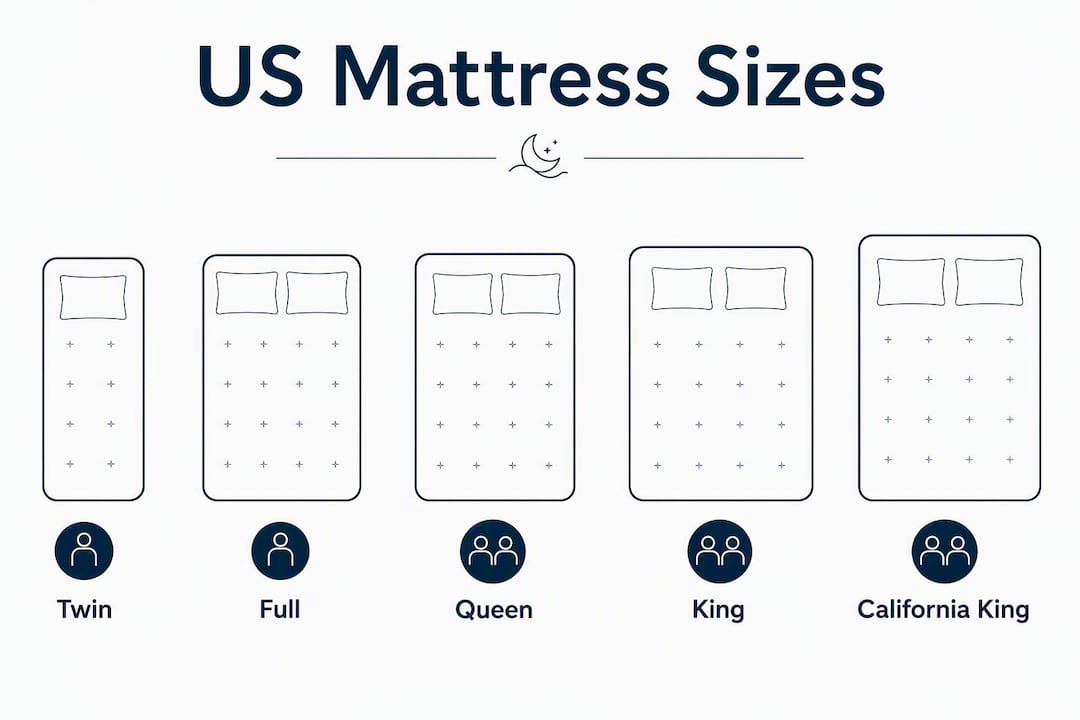
Twin = Single. These are identical: 38×75 in. “Single” is the older term, still common in Canada and parts of Europe. In U.S. retail, “Twin” dominates.

Full = Double. Again, the same mattress: 54×75 in. “Double” implies two people can sleep comfortably, which is technically true but tight — each person gets about 27 inches of width, roughly the space of a crib.
Queen variants are where things get genuinely tricky:
- Standard Queen: 60×80 in (the default when no modifier is listed)
- Short Queen: 60×75 in — common in RVs and campers
- Olympic Queen: 66×80 in — six inches wider than standard, requires specialty bedding
- RV Queen: 60×75 in (same as Short Queen, different marketing name)
King variants split into two distinct sizes that shoppers regularly confuse:
- King (Eastern King): 76×80 in — wider, shorter
- California King: 72×84 in — narrower, four inches longer; better for tall sleepers
Split sizes (Split King, Split Cal King) divide the mattress into two separate halves, each on its own adjustable base. This matters for couples with different firmness preferences — the footprint stays the same, but you need two sets of fitted sheets and a split-compatible frame.
Pro Tip: When shopping specialty sizes like Olympic Queen or Short Queen, always confirm the exact inches with the retailer. Bedding for these sizes is not interchangeable with standard Queen sheets.
How U.S. sizes compare with UK, European, Australian, and Asian sizes
The biggest trap in international mattress sizing: the name means almost nothing. A UK King is not a US King. Always compare the numbers.
| US Size | US Dimensions (in) | Closest International Equivalent | International Dimensions (in) | Gap |
|---|---|---|---|---|
| Twin | 38 × 75 | UK Single | 36 × 75 | 2 in narrower |
| Full/Double | 54 × 75 | EU Double | — | Slightly wider and longer |
| Queen | 60 × 80 | EU Queen / AU Queen | 60 × 80 | Near match, verify cm |
| King | 76 × 80 | UK King | 60 × 79 | 16 in narrower — closer to US Queen |
| Cal King | 72 × 84 | No direct equivalent | — | Specialty US size |
The UK King at 150×200 cm (roughly 59×79 in) is almost exactly the width of a US Queen. Buying UK King sheets for a US King bed leaves you short by about 16 inches of width — a significant mismatch. European sizing uses metric standards, and the centimeter measurements rarely land on clean US-inch equivalents, so rounding errors compound.
The rule: when importing bedding or moving between markets, compare the numeric width × length values in centimeters. Ignore the name entirely.
Australia uses similar labels to the US but with slightly different dimensions. An Australian King runs 183×203 cm (72×80 in), which is closer to a US Cal King in width but shorter in length. Asian markets, particularly Japan, use their own sizing system (Single, Semi-Double, Double, Queen, King) with dimensions that differ from both US and European standards.
How to pick the right mattress size for your bedroom
Start with the room, not the mattress. A King in a 10×10 ft bedroom leaves almost no usable floor space once you account for nightstands and a dresser.
Step-by-step decision checklist:
- Measure your bedroom: length and width in feet and inches
- Measure your doorframe width and height, plus any stairwell or hallway turns
- Decide who shares the bed: one adult, two adults, kids, or pets
- Factor in height: anyone over 6 ft should consider Twin XL, King, or Cal King
- Set a budget that includes bedding, protector, and frame — not just the mattress
Minimum recommended room dimensions by size:
| Mattress Size | Minimum Room Size | Clearance Remaining |
|---|---|---|
| Twin | — | Tight but workable |
| Full | 9 × 10 ft | Comfortable for one |
| Queen | 10 × 10 ft | 24 in clearance on sides |
| King | 12 × 12 ft | Adequate for two nightstands |
| Cal King | 12 × 12 ft | Slightly more length, same width need |
Bigger is not always better when it crowds out furniture access or blocks a door swing. A Queen in a well-arranged 10×12 ft room often feels more comfortable than a King crammed into the same space.
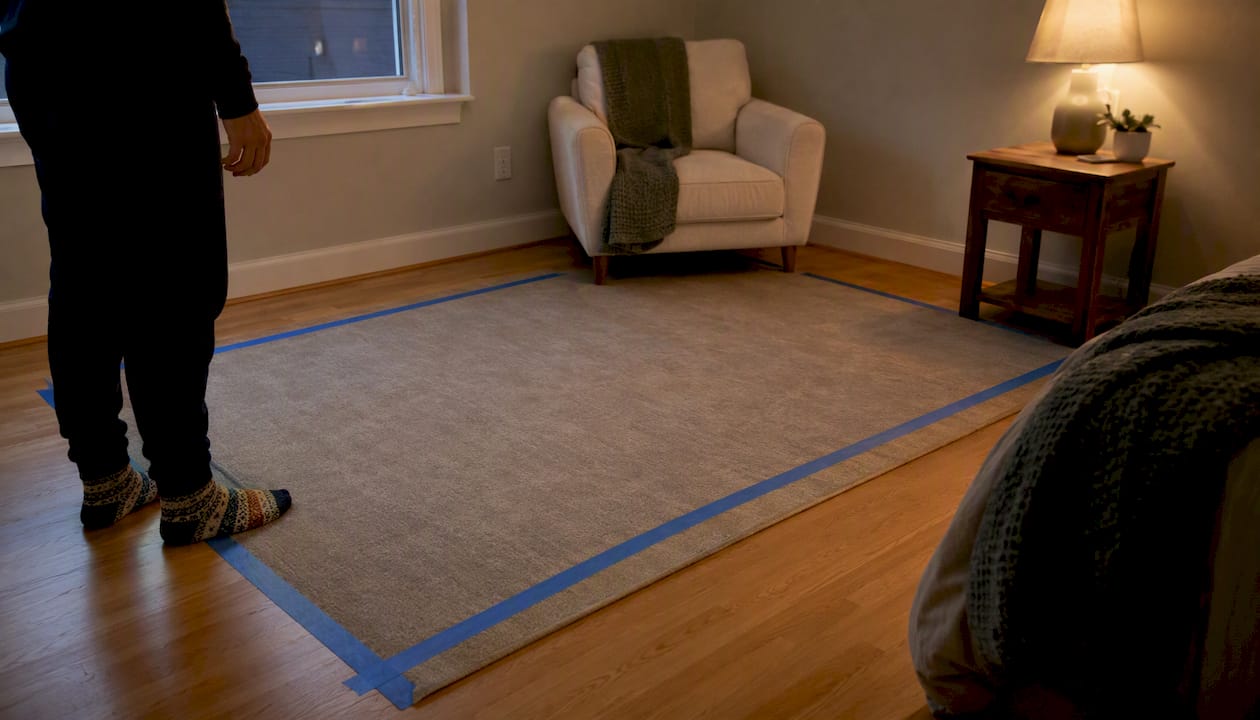
Pro Tip: Tape out the mattress footprint on your bedroom floor with painter’s tape before ordering. Walk around it, open the closet, and check the door swing. This five-minute test prevents a lot of expensive returns.
Common scenarios:
- Small bedroom (under 10×10 ft): Full or Twin XL; skip the Queen unless the room is at least 10 ft wide
- Tall sleeper (over 6 ft 2 in): Twin XL, King, or Cal King — all offer 80+ inches of length
- Co-sleeping with a child or pet: Queen minimum; King if budget allows
Which sheets, protectors, and frames pair with each size
Bedding sizing follows mattress sizing directly, but depth is the variable most shoppers get wrong. Accessory costs scale with mattress size — a King comforter runs noticeably more than a Queen, and deep-pocket sheets add to the total.
| Mattress Size | Fitted Sheet Size | Recommended Pocket Depth | Protector Size | Comforter/Duvet |
|---|---|---|---|---|
| Twin | Twin | 8–12 in | Twin | Twin/Twin XL |
| Twin XL | Twin XL | 10–14 in | Twin XL | Twin XL |
| Full | Full/Double | 8–12 in | Full | Full/Queen |
| Queen | Queen | 10–14 in | Queen | Queen |
| King | King | 12–16 in | King | King |
| Cal King | Cal King | 12–16 in | Cal King | Cal King |
Frame compatibility matters too. Platform beds, adjustable bases, and traditional box-spring setups all have different internal dimensions and slat configurations. An adjustable base requires a flexible mattress (memory foam or hybrid) — a coil-only innerspring will not bend without damage. Always confirm the frame’s internal width and length against the mattress dimensions before purchasing.
Deep-pocket sheets (14–16 in pocket depth) are worth the extra cost for any hybrid or luxury mattress over 12 inches thick, especially when adding a topper. Standard sheets will pop off the corners by morning.
When upsizing from a Queen to a King, budget for a new fitted sheet, flat sheet, duvet cover, protector, and potentially a new frame. That accessory swap can add several hundred dollars to the total cost of the upgrade — worth knowing before you commit. For context on how furniture-related costs compound when you change bedroom setups, the 2026 couch repair cost guide illustrates how quickly room-refresh expenses stack up beyond the primary purchase.
How to measure your mattress, doorway, and frame before ordering
Measuring takes ten minutes and prevents delivery-day problems that take weeks to resolve.
Measuring your existing mattress:
- Lay a tape measure flat across the widest point (side to side) — this is the width
- Measure top to bottom (head to foot) — this is the length
- Measure from the floor surface of the mattress to the top — this is the depth/profile
- If you use a topper, add its thickness to the depth measurement for fitted-sheet purposes
- Note that manufacturing tolerances run +/- 0.5 to 1 inch — two mattresses labeled “Queen” can differ slightly
Measuring your doorframe and stairwell:
- Measure the doorframe width at the narrowest point (often the trim, not the opening)
- Measure the doorframe height
- Walk the delivery path: hallway width, any 90-degree turns, stairwell width and ceiling height
- For a King or Cal King, the mattress ships compressed in a box (for bed-in-a-box products) or flat — confirm with the retailer which delivery format applies
- Standard interior doorframes are 32–36 in wide; a King mattress at 76 in wide will need to be tilted or compressed for entry
Checking your bed frame:
- Measure the internal frame width and length (rail to rail, not the outer frame edge)
- Check slat spacing — most mattress manufacturers recommend slats no more than 3 inches apart
- Confirm the frame’s weight capacity covers the mattress plus sleepers
Why mattress depth matters more than most shoppers realize
Thickness affects three things: how the bed looks, how you get in and out of it, and whether your fitted sheets stay on. None of those are trivial.
Common depth categories run roughly as follows: low-profile mattresses sit at 5–8 inches, standard profiles at 9–11 inches, and high-profile or luxury builds at 12 inches and above. Hybrid mattresses with coil systems and foam comfort layers frequently land at 12–14 inches before you add a topper.
A mattress topper adds 2–4 inches to the total sleeping surface height. That combined measurement is what determines your fitted-sheet pocket depth requirement, not the mattress depth alone. Buy sheets rated for the mattress-plus-topper total.
Pro Tip: Before completing any mattress purchase, check two numbers on the product page: the measured depth (not an estimate) and the manufacturer’s recommended sheet pocket depth. If the page only lists one, ask customer service for both.
Luxury and hybrid mattresses commonly exceed 12 inches in profile, making standard 8–10 in pocket-depth sheets a poor fit. Deep-pocket sheets (14–16 in) are the practical default for any mattress in this category.
When a mattress sits on an adjustable base, total bed height can increase further depending on the base’s platform height. Factor that into your fitted-sheet decision and your own comfort getting in and out of bed.
Size recommendations for couples, families, tall sleepers, and small rooms
The right size depends on who is sleeping in the bed and what the room can actually hold.
- Most couples: Queen (60×80 in) gives each person 30 inches of width — enough for comfortable sleep without dominating a standard bedroom. Read more about choosing a mattress for couples before deciding between Queen and King.
- Couples with a child or pet in the bed: King adds significantly more width over a Queen. That extra space matters when a toddler or a large dog joins the equation.
- One tall partner (over 6 ft 2 in): California King offers extra length over a standard King, though it is narrower. Worth it if foot overhang is the main complaint.
- Single sleeper in a small room: Twin XL (38×80 in) gives full adult length in a narrow footprint — the standard college dorm choice for good reason.
- Couples with different firmness needs: A Split King (two Twin XL mattresses side by side on a dual adjustable base) lets each partner dial in their own comfort level without changing the overall bed footprint. You will need two Twin XL fitted sheets and a King flat sheet or duvet, which affect bedding costs.
Selecting the right firmness by sleep position matters as much as size — a mattress that is the right dimensions but the wrong feel still disrupts sleep.
The trade-off between space and room function is real. A King in a 10×10 ft room leaves roughly 17 inches on each side after accounting for the frame — below the 24-inch clearance that makes a bedroom feel functional. Prioritize room usability over maximum mattress surface when the two conflict.
Key Takeaways
Choosing the right mattress size comes down to measuring your room and doorways first, then matching size to who shares the bed and what your bedding budget can cover.
| Point | Details |
|---|---|
| Standard US sizes | Twin, Twin XL, Full, Queen, King, and Cal King — dimensions vary; always verify inches and cm. |
| Queen fits most couples | At 60×80 in, Queen balances sleeping space with room function and lower accessory costs. |
| Measure before buying | Account for +/- 0.5–1 in manufacturing tolerance when buying frames or fitted sheets. |
| Depth drives sheet choice | Add topper thickness to mattress depth; buy deep-pocket sheets (14–16 in) for profiles over 12 in. |
| Guestlysleep sizing | Guestlysleep offers fiberglass-free, US-made mattresses across standard sizes with a 60-night trial. |
The size decision most buyers get backward
Most shoppers pick a mattress size based on what sounds right — “we’re a couple, so King” — without measuring the room first. Then the mattress arrives, the nightstands get pushed to the wall, the closet door barely clears the footboard, and the bedroom stops functioning as a bedroom.
The better sequence is: measure the room, tape out the footprint, walk around it, then choose the largest size that still leaves 24 inches of clearance on the sides you actually use. For most couples in a standard American bedroom, that answer is Queen. King works well in rooms 12 feet wide or larger. Cal King is a specific solution for tall sleepers, not a general upgrade.
One thing that gets overlooked even more than room dimensions: depth. Shoppers spend time comparing size names and almost no time checking mattress profile. A 14-inch hybrid with a 2-inch topper needs 16-inch deep-pocket sheets. Standard sheets will not stay on, and replacing them after the fact adds cost and frustration that a two-minute product-page check would have prevented.
Size and depth together determine whether the mattress you buy actually works in your bedroom with the bedding you own. Get both right before you order.
Guestlysleep makes sizing straightforward from the start
Picking the right size is only half the decision. The mattress itself needs to be safe, durable, and built to last through regular replacement cycles.
Guestlysleep sells fiberglass-free mattresses made in the USA, available across standard sizes from Twin through California King. Every mattress is built without harmful fillers, which matters especially for health-conscious shoppers who replace their mattress every 2–4 years as recommended. Free shipping, a 60-night sleep trial, and direct-manufacturer pricing make the size upgrade easier to commit to without the usual financial risk. If you are considering an adjustable setup for a Split King or Split Cal King configuration, the Tranquility II adjustable base pairs with Guestlysleep’s flexible mattress options and ships with professional setup support. Measure your room, confirm your doorway clearance, and then browse the full mattress selection at Guestlysleep to find the right size and comfort level for your bedroom.
Useful sources
The following references back the dimensional data, naming conventions, and international comparisons in this guide. Manufacturing tolerances and exact dimensions can vary by brand, so always verify the specific product page before purchasing.
- Bed size — Wikipedia: Primary reference for US standard dimensions, manufacturing tolerances (+/- 0.5–1 in), and international naming conventions.
- Mattress — Wikipedia: Background on mattress construction standards, topper thickness ranges (2–4 in), and how sizing standards vary by market.
- Standard Mattress Sizes — Sizemarker: US, UK, and EU dimension comparisons in both inches and centimeters; accessory cost scaling notes.
- Best Mattress Size for Couples — Eachnight: Clearance guidance (24 in recommended on all sides) and room-function trade-off analysis for Queen vs King.
Dimensions listed here reflect widely published retail standards. Always check the manufacturer’s product page for the exact measured depth and recommended sheet pocket depth before completing a purchase.