

Couples: Split King vs King, When Adjustable Bases Fix Snoring
Both options measure 76 inches by 80 inches, so floor space is never the deciding factor. Choose a split king when you and your partner need different firmness levels, independent adjustable bases, or separate sleep schedules. Choose a standard king when a seamless surface, easy cuddling, and lower upfront cost matter more than customization.
TL;DR:
- A split king allows independent firmness and adjustable head and foot controls on each side, making it ideal for couples with different sleep needs or health issues.
- The cost of a split king roughly doubles that of a standard king, due to purchasing two mattresses and possibly two adjustable bases, with added bedding accessories needed.
- To reduce the seam visibility and improve comfort, couples often use split-king sheets or a king-size topper, along with foam bridge pads or fitted-sheet grippers.
- A split king with independent adjustable bases effectively manages issues like snoring, acid reflux, and circulation problems without disturbing a partner.
- Lighter and easier to carry, a split king is advantageous for moving and replacing one mattress independently, especially when wear or damage occurs unevenly.
Table of Contents
- Split King vs King: A Quick Comparison
- What Is a Split King Mattress, Exactly?
- Split King Pros and Cons You Should Actually Weigh
- How Much More Does a Split King Cost?
- Split King Bedding: Sheets, Toppers, and Closing the Gap
- Why Adjustable Bases Make a Split King Worth Considering
- Moving Day: Where a Split King Genuinely Wins
- The Guestly Sleep Take on Split King vs King
- Ready to Choose Your Setup? Here’s Where to Start
- Sources
Split King vs King: A Quick Comparison
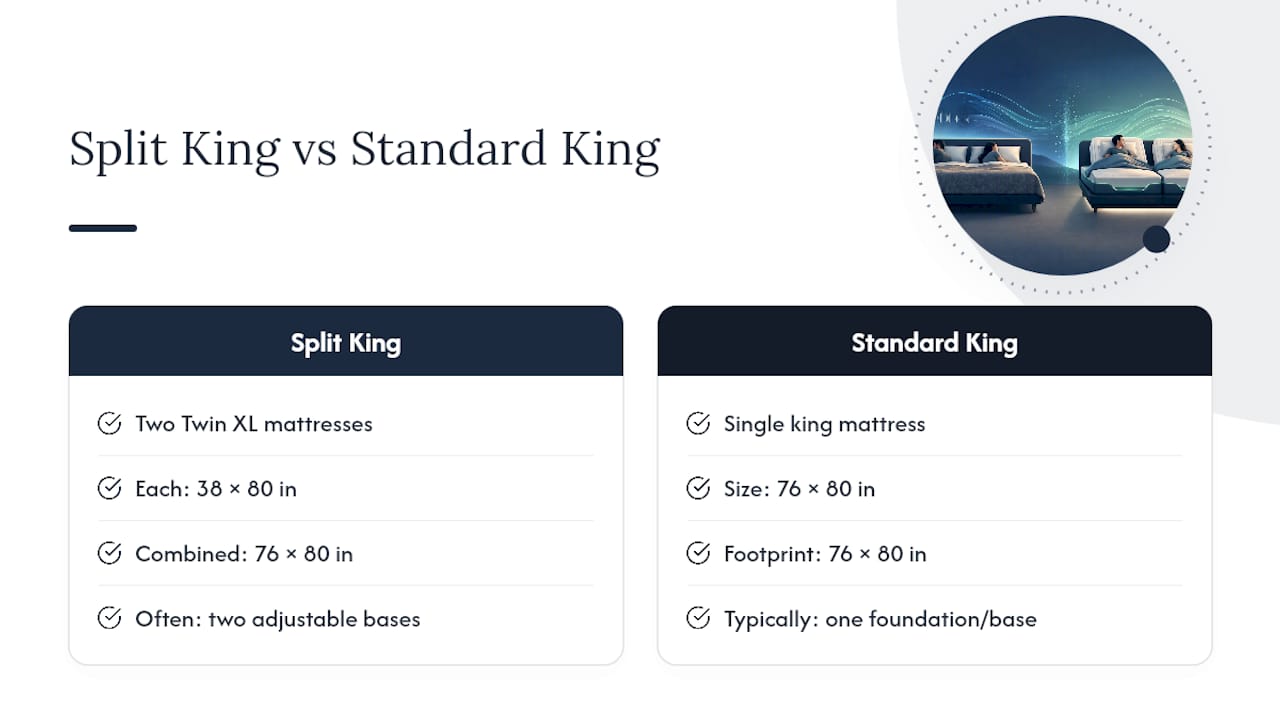
The two setups take up the exact same footprint, but everything about how they function underneath you is different. A standard king is one continuous mattress. A split king is two independent Twin XL mattresses, each 38 inches wide, pushed together to form that same 76 by 80 inch footprint.
Here’s how the two stack up in practice:
- Dimensions: Identical at 76" x 80" — no space savings either way
- Surface feel: King is one continuous slab; split king is two separate units with a seam between them
- Motion isolation: Split king wins decisively since each side moves independently
- Adjustability: Split king allows dual bases with independent head and foot elevation
- Bedding: King uses standard sheets; split king needs split fitted sheets or two Twin XL sets
- Cost: Split king typically runs higher since you’re buying two mattresses instead of one
Most of that gap between the two options closes once you add a topper or bridge pad, which we’ll get into below.
What Is a Split King Mattress, Exactly?
A split king is two Twin XL mattresses, each measuring 38 inches by 80 inches, placed side by side to create a combined surface of 76 inches by 80 inches, the same footprint as a standard king. That’s the whole trick. There’s no special “split king” mattress model being manufactured somewhere. It’s just a sizing convention that lets two twin XLs do the job of one king.
Setups vary. Some people place both Twin XLs on a single flat platform frame. Others put each mattress on its own adjustable base, which is where a split king earns its reputation. A less common third option uses a single foundation with a divider underneath two separate mattresses. Done right, with matched mattress models, a split king looks like one bed from across the room. The split only becomes obvious up close or when someone points it out.
Split King Pros and Cons You Should Actually Weigh
The split king’s biggest strength is control. Each side can have its own firmness level, and because the mattresses are physically separate, movement on one side barely registers on the other. If you’re a light sleeper paired with someone who tosses and turns, that alone can be worth the switch. Add adjustable bases and you get independent elevation on each side too, letting one partner sit up to read while the other lies flat.
There are real trade-offs, though:
- Cost: You’re buying two mattresses, which usually pushes the total price higher than a comparable single king, and dual adjustable bases add even more.
- The seam: Even well-matched pairs leave a gap, typically half an inch to two inches wide, which some couples notice while cuddling near the center.
- Bedding logistics: Standard king sheets won’t fit properly; you need split-king fitted sheets or two Twin XL sets plus a king top sheet.
- More parts to maintain: Two mattresses mean two rotation schedules and, in some cases, two separate warranties to track.
Pro Tip: If the center gap bothers you, buy two mattresses from the same model line rather than mixing brands, as this can reduce the seam’s visibility.
A foam bridge pad laid across the seam or a king-size topper stretched over both mattresses can help minimize the gap between mattresses.
How Much More Does a Split King Cost?
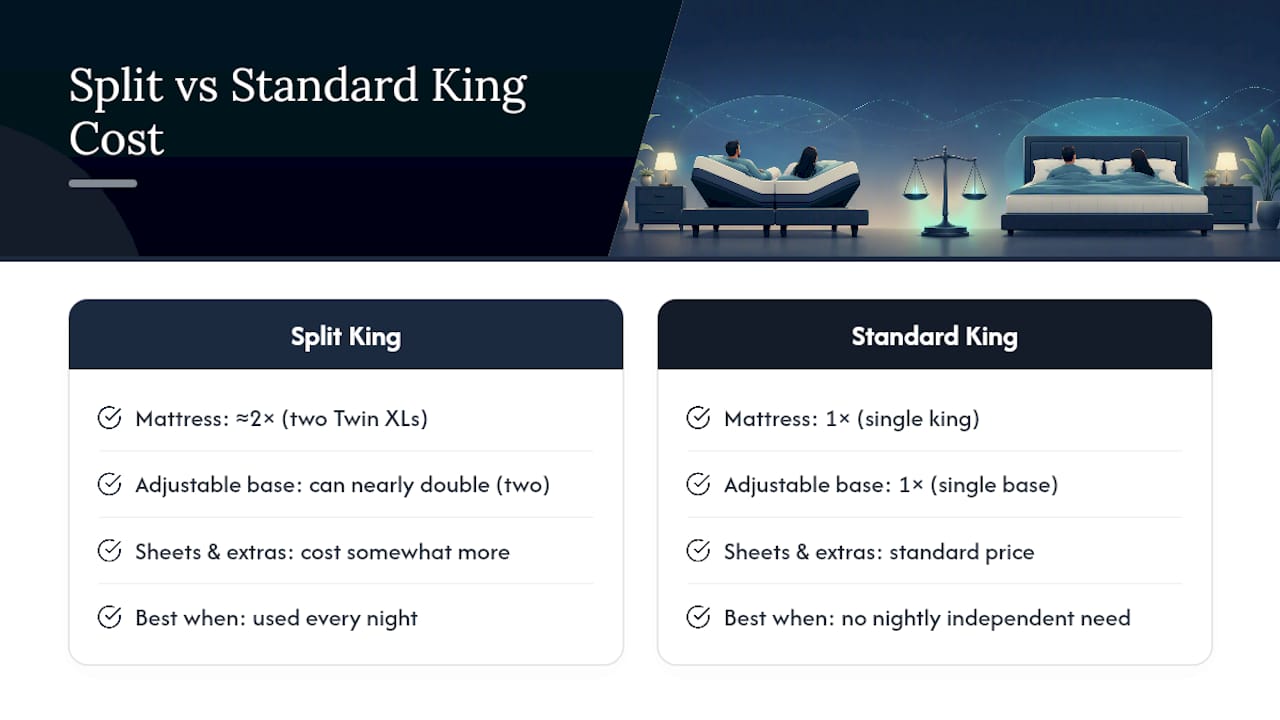
Doubling the mattress count roughly doubles that portion of your budget, since you’re paying for two Twin XL units instead of one king. Add dual adjustable bases and the base cost can nearly double too, since you’re powering two independent motorized units instead of one.
Smaller costs stack up beyond the mattresses themselves. Split-king fitted sheet sets usually cost somewhat more than standard king sheets; additional items like bridge pads and installation for two setups may add to the overall expense.
Here’s the decision rule that actually matters: a split king pays for itself when the benefit gets used every single night. If one partner needs to sleep elevated for reflux, or you’re managing chronic snoring, or your body weights differ enough that a single firmness never satisfies both people, the extra cost is buying something you’ll use constantly. If you’re on the fence and neither of you has a strong nightly need for independent settings, the standard king’s lower price and simpler setup wins on value.
Split King Bedding: Sheets, Toppers, and Closing the Gap
Regular king sheets won’t stretch properly across two separate mattresses. Most split-king households use one of two approaches: two Twin XL fitted sheets paired with a single king top sheet, or purpose-made split-king sheet sets built for the exact configuration.
To make the two mattresses feel like one surface, a king-size topper laid across both units is the most common fix, smoothing over the seam and giving your body one continuous surface to sleep on. A foam bridge wedge tucked into the gap works too, and fitted-sheet grippers help keep everything anchored so the sheets don’t shift apart in the middle of the night. On the maintenance side, plan on washing and rotating two mattress protectors instead of one. It’s a minor extra chore, not a dealbreaker.
Why Adjustable Bases Make a Split King Worth Considering
This is where a split king stops being a nice-to-have and starts solving real problems. A single king-size adjustable base moves both sides together. If your partner raises their head to watch TV, you’re getting tilted too, whether you want to or not.
Two independent Twin XL bases fix that entirely. Each side elevates, declines, or adjusts on its own schedule. That independence helps with a specific list of nightly issues:
- Snoring reduction through elevated head positioning on one side only
- Acid reflux management without disturbing a partner who sleeps flat
- Better circulation for people who need legs elevated
- Reading or watching TV in bed without waking the other person
If snoring or reflux is a nightly issue in your house, improving airflow through head elevation is one of the more direct fixes available, and a split base is what makes that fix possible without a fight over the remote. Our split king adjustable base guide breaks down compatible frames and what to check before buying, and our adjustable base selection guide covers the broader decision if you’re still deciding whether an adjustable base makes sense at all.
Moving Day: Where a Split King Genuinely Wins
Anyone who has tried to wrestle a king mattress up a narrow stairwell knows the pain. A split king sidesteps that entirely because each Twin XL piece is lighter and narrower, making it far easier to carry through doorways, around tight corners, and up stairs that a single king would never clear.
There’s a practical bonus most people don’t consider until later: if one side wears out faster than the other, which happens more often than you’d expect with uneven weight distribution, you replace just that one mattress instead of the whole set. Before buying, confirm your frame or foundation actually supports a split configuration; not every platform bed is built to hold two separate units securely side by side.
The Guestly Sleep Take on Split King vs King
A split king earns its cost when the benefit gets used nightly, not occasionally. Couples with chronic firmness disagreements, significant weight differences, or a real need for independent elevation get their money’s worth fast. If you and your partner sleep the same way, want to cuddle without noticing a seam, and don’t need dual bases, a standard king remains the simpler, cheaper answer.
Whichever way you lean, the mattress itself still matters more than the configuration around it. Every Guestly Sleep mattress is made in the USA without fiberglass, backed by a 60-night trial, and a suggested 2 to 4 year replacement cycle that keeps a sleep surface actually clean. For deeper reading, our motion isolation guide and firmness and back pain guide cover the two factors that decide this choice for most couples.
Ready to Choose Your Setup? Here’s Where to Start
Guestly Sleep builds fiberglass-free mattresses across comfort tiers, so whether you’re outfitting two Twin XL units for a split king or a single mattress for a standard king, the same non-toxic, American-made construction applies either way.
If you’re leaning split king for the adjustable-base benefits, start with our mattress lineup to find matched pairs that minimize seam feel, and pair either setup with our cooling bedding bundle to smooth over the transition between two mattresses or simply upgrade a standard king’s comfort layer. Every order ships free and comes with a 60-night trial, so you can test the setup in your actual bedroom before committing. Reach out if you need help with delivery or setup logistics for a two-mattress configuration; that’s exactly the kind of detail worth getting right before moving day, not after.
Sources
- What Is a Split King Bed? — Sleep Foundation
- Split King Guide 2026 — Benefits, Costs, Who Needs One — Mattressnut
- King vs Split King — Which Is Right for Your Bedroom? — Mattressnut