

Mattress Buyers: Avoid Voiding Warranty With Platform vs Box Spring
A platform bed with solid or closely spaced slats is the right foundation for nearly every mattress sold today, including memory foam, latex, and hybrid models. Traditional coil box springs are built for old-style innerspring mattresses and can actually damage or void the warranty on anything newer. The only real exceptions are older innerspring mattresses that specifically call for a box spring, or a household set on the extra height a box spring adds. Check your mattress warranty and slat spacing before you decide anything else.
TL;DR:
- Using a platform bed with closely spaced slats (no more than 3 inches apart) ensures proper support for all modern foam and hybrid mattresses.
- Coil box springs are unsuitable under foam or hybrid mattresses, as they can cause premature sagging and void the warranty due to uneven support.
- Support requirements vary by mattress type: all-foam needs a firm, solid or tightly slatted surface; hybrids tolerate platforms but not coil box springs; older innerspring mattresses may still require box springs.
- For adjustable bases, coil box springs are incompatible because they cannot flex with the frame, making low-profile foundations or platforms essential.
- Checking mattress warranty clauses and verifying slat spacing and center support are crucial before purchasing or converting bed foundations to avoid support and warranty problems.
Table of Contents
- Platform vs Box Spring: What a Platform Bed Actually Is
- What a Box Spring or Foundation Really Does
- Platform vs Box Spring at a Glance
- Platform vs Box Spring: Matching the Foundation to Your Mattress
- How to Convert an Old Frame Without Buying a New One
- Buying Checklist: What to Confirm Before You Commit
- Guestly Sleep’s Take on Foundations and Mattress Care
- Justin’s Take: The Simple Answer Most People Overthink
- Ready to Match Your Mattress to the Right Foundation?
- Sources
- FAQ
Platform vs Box Spring: What a Platform Bed Actually Is
A platform bed is any frame that supports a mattress without requiring a separate box spring underneath. There are three common builds. A solid deck uses one continuous flat surface, usually plywood. A slatted platform uses evenly spaced wood or metal slats across the frame. A metal slat system, common in adjustable and budget frames, does the same job with thinner, often adjustable rails.
Slat spacing is where most mattress problems start. The maximum gap should sit around 3 inches, and for all-foam mattresses, you want closer to 2 to 2.5 inches. Wider gaps let foam sag into the openings over time, which shows up as premature body impressions and, in some cases, a denied warranty claim. Slats themselves should run at least 0.75 inch thick. Thinner slats flex and crack under regular use, especially with a heavier hybrid mattress.
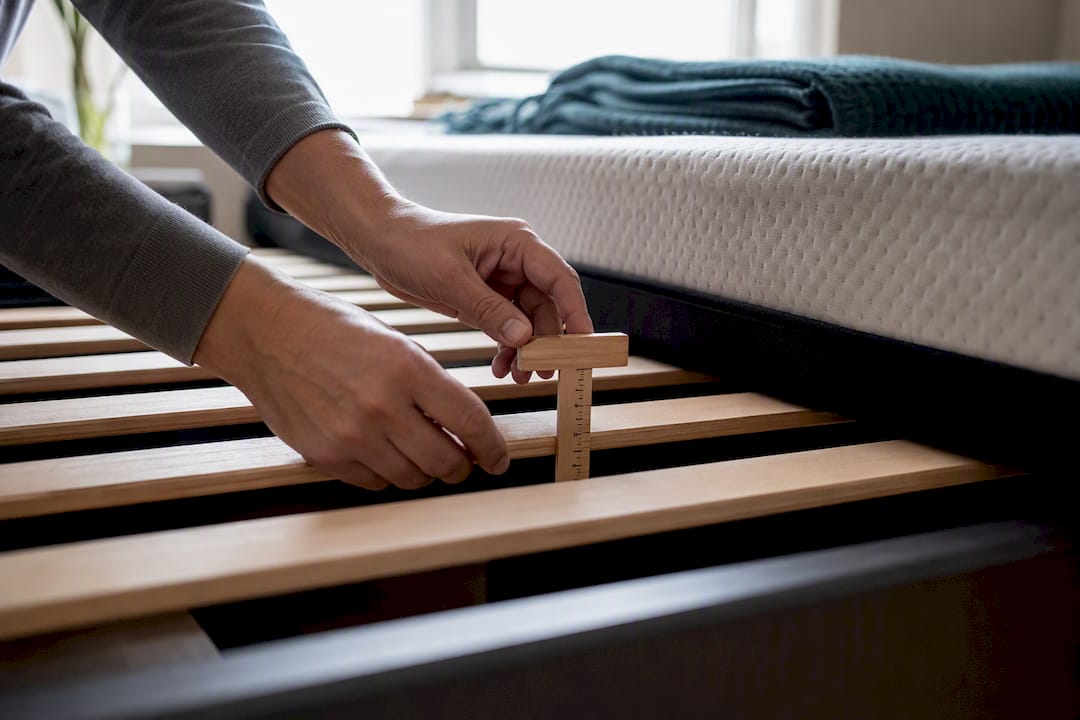
Queen and king frames also need a center support beam with its own set of legs, not just slats resting on the side rails. Without it, the middle of the mattress dips first, which is the single most common cause of early sagging complaints.
Platform beds bring a real set of tradeoffs:
- Support: firm, consistent surface that matches how modern foam and hybrid mattresses are engineered to perform.
- Airflow: slatted designs let air circulate underneath, which helps with heat and moisture; solid decks trade that ventilation for a firmer feel.
- Height: platforms typically sit lower to the ground than a bed built on a box spring, which some sleepers prefer and others don’t.
- Storage: many platform frames include drawers or open space underneath that a box spring setup can’t offer.
- Cost over time: fewer moving parts means less to replace, though the upfront frame cost can run higher than a basic metal bed frame plus box spring.
What a Box Spring or Foundation Really Does
A traditional box spring is a wood frame packed with metal coils, wrapped in fabric. It was designed decades ago to work alongside coil innerspring mattresses, and it did three specific jobs: added height to the bed, absorbed shock so the coils in the mattress above didn’t take all the impact, and distributed the sleeper’s weight across a wider surface.
Here’s where it gets confusing for shoppers: many products sold as “box springs” today aren’t actually coil box springs at all. They’re low-profile rigid foundations, usually built from wood slats or a solid panel inside a fabric-covered frame. No coils, no give, just a flat rigid base that happens to look like the box springs your parents had.
That distinction matters because stacking an actual coil box spring under a modern foam or hybrid mattress is usually not recommended. The coils create uneven give exactly where foam needs firm, consistent contact. Over months, that mismatch shows up as premature sagging, and most manufacturers write flat, rigid support into the warranty terms. A coil box spring under foam voids that protection.
A few cases where a foundation, not a bed frame overhaul, still makes sense:
- You own an older coil innerspring mattress whose warranty explicitly calls for a box spring.
- You want extra height without buying a taller platform frame, and you’re using a low-profile rigid foundation rather than an old coil unit.
- Your existing frame already accepts a foundation and you want to avoid replacing the whole bed.
Platform vs Box Spring at a Glance
The differences boil down to six practical factors, and they matter more once you know which one applies to your mattress.
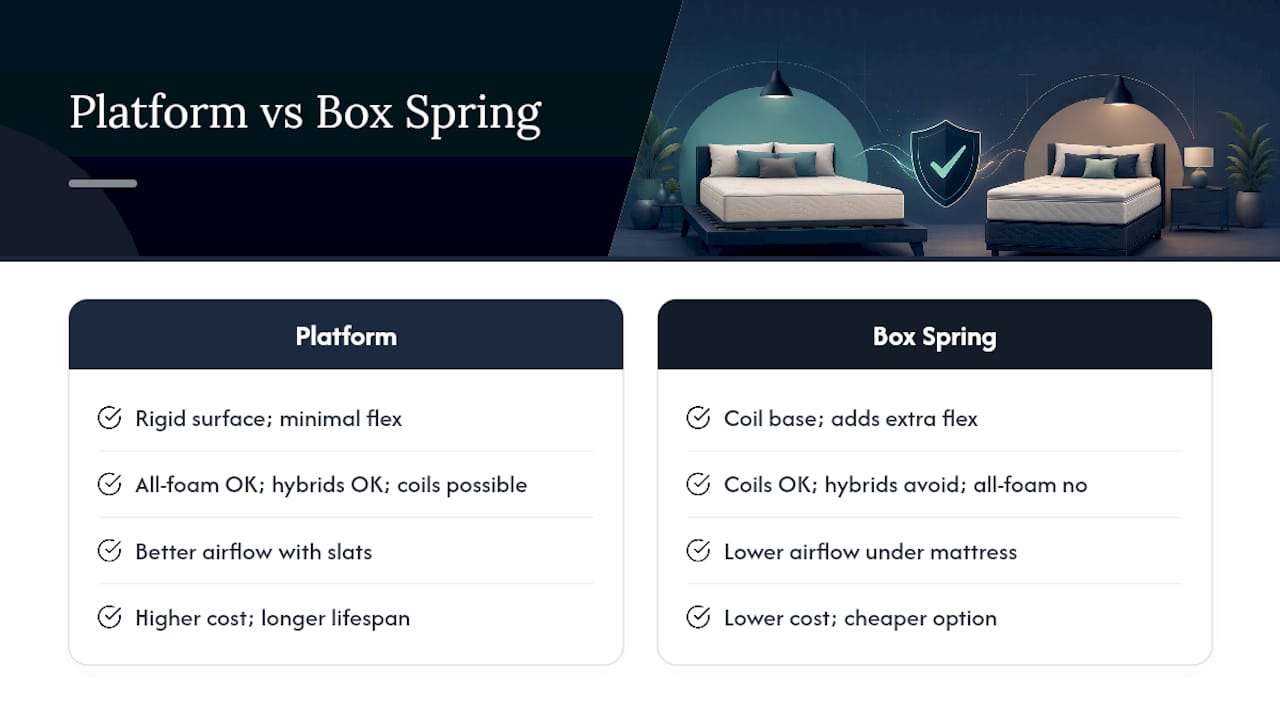
Support style is the biggest factor in mattress feel and long-term wear. A rigid surface, whether that’s a platform or a low-profile foundation, lets memory foam and hybrid layers compress and rebound the way they’re engineered to. A coil box spring adds its own flex on top of the mattress’s flex, and that double give is what causes the uneven wear pattern manufacturers flag when they deny warranty claims.
Compatibility splits cleanly by mattress type. All-foam mattresses need a solid or tightly slatted surface, full stop. Hybrids tolerate platforms well but shouldn’t sit on coil box springs, since that’s a coil-on-coil setup that fights itself. Older coil innersprings are the one category actually designed to pair with a box spring, and in that specific case, the pairing works as intended.
Ventilation is a genuine tradeoff, not a marketing point. Slatted platforms let more air move under the mattress than a solid deck does, which helps with heat retention on hot nights. Solid decks sacrifice that airflow in exchange for a firmer, more uniform support surface. Neither choice is wrong, it depends on whether you run warm at night or prioritize a very firm base.
Price tends to surprise people. A basic metal frame with a low-profile foundation often costs less than a well-built platform bed with a real center support system. The platform’s higher upfront cost usually buys you a longer lifespan, since there are no coils to fatigue.
Platform vs Box Spring: Matching the Foundation to Your Mattress
Your mattress type should drive this decision more than personal preference about how a bed frame looks.
-
All-foam or memory foam mattresses need a solid deck or slats spaced no wider than 3 inches, ideally 2 inches or tighter. Anything wider and the foam settles into the gaps, creating permanent ridges. Check the recommended slat spacing for foam mattresses before you assume your current frame will work.
-
Hybrid mattresses generally do fine on a standard platform, since the coil layer inside the mattress already provides bounce and support. What you want to avoid is placing a hybrid on a coil box spring, because that stacks two spring systems on top of each other and neither performs the way it’s designed to. If you’re shopping specifically for a foundation built for hybrid support, look for a platform with a firm, even slat pattern rather than anything with give built in.
-
Older innerspring mattresses are the one category where a box spring might actually be required. If the mattress came with a warranty that names a box spring specifically, follow it. Newer innerspring models have mostly moved to rigid foundation requirements too, so don’t assume the old pairing still applies just because the mattress has coils.
-
Adjustable base users need flexible mattress construction and a base that bends with them. Coil box springs are incompatible with adjustable frames entirely, since they can’t flex at the joints. Most adjustable bases skip a foundation altogether or use a minimal low-profile layer.
-
Height-focused buyers should reach for a taller platform frame or a low-profile foundation stacked on a taller frame, not a reused coil box spring. A low-profile foundation adds height without the coil mismatch that comes with traditional box springs.
How to Convert an Old Frame Without Buying a New One
If you already own a metal frame or an old box spring setup, you don’t necessarily need to replace the whole bed. A few conversion options solve the compatibility problem directly.
Bunkie boards are the simplest fix. These are thin, rigid panels, usually 1 to 3 inches thick, that sit on top of an existing frame or box spring to create one flat, warranty-safe surface. They’re a good option if your current frame has wide slats or you’re still using an old box spring you’re not ready to throw out. Ultra low-profile foundations work the same way and often come in solid wood construction for extra durability.
If your frame’s slats are the problem, not the frame itself, a slat kit can solve it. Buying replacement slats spaced at 2 to 2.5 inches, along with a center support beam and legs, turns an inadequate frame into a compliant one for a fraction of the cost of a new platform bed.
A few signs it’s time to retire the old box spring instead of converting it:
- It’s more than 8 to 10 years old. Coils fatigue and lose their resistance over that span, even if the unit looks fine from the outside.
- You can see or feel visible sag when you press down near the center.
- Any coils have broken loose or you hear creaking that wasn’t there when it was new.
When in doubt, a bunkie board over a questionable box spring costs less than a full mattress replacement caused by uneven support.
Buying Checklist: What to Confirm Before You Commit
Get these five things confirmed before you buy a new mattress, frame, or foundation, and you’ll avoid the two most common mistakes shoppers make.
-
Read the mattress warranty’s foundation clause. Most modern mattress warranties specify a maximum slat gap and require a flat, rigid surface. Skipping this step is how people accidentally void coverage on a mattress they just paid for.
-
Confirm slat thickness and center support. For queen and larger sizes, that means a dedicated center rail with its own legs, not just slats spanning the side rails unsupported.
-
Walk away from wide gaps and missing center support. A frame with slats spaced more than 3 inches apart, or no center leg on a queen-plus frame, is a sagging mattress waiting to happen.
-
Skip any coil box spring that shows sag or age, even if the price looks like a bargain. An old, tired box spring under a new mattress undoes the investment you just made.
-
Prioritize documented specs over guesswork. A frame listing exact slat spacing and weight capacity beats one with vague marketing language every time.
Pro Tip: If bed height matters to you, measure your current mattress-to-floor height before shopping. Most people want somewhere between 20 and 25 inches from floor to top of mattress, and it’s easier to hit that number with a taller platform or added foundation than to guess and return a frame later.
Guestly Sleep’s Take on Foundations and Mattress Care
Fiberglass-free mattresses still follow the same physics as any other foam or hybrid build, which is why Guestlysleep recommends a platform bed or low-profile foundation for every mattress it sells. Solid decks or slats spaced at 3 inches or tighter, with center support on queen and larger sizes, keep the support surface flat and consistent, which is exactly what these constructions need to perform the way they’re built to.
Foundation choice is only half the equation, though. Mattresses lose support over time no matter how good the base underneath them is, which is part of why Guestlysleep recommends replacing a mattress every 2 to 4 years rather than riding it out for a decade. A well-matched foundation slows that decline; it doesn’t stop it.
For anyone ready to shop, the company offers free shipping, a 60-night trial on mattresses, and setup and disposal services as add-ons for convenience.
The Simple Answer Most People Overthink
If you’re buying a new foam or hybrid mattress, put it on a platform with slats no wider than 2 inches and a real center support beam, and stop overanalyzing it. The only time I’d reach for an actual box spring is with an older coil innerspring mattress whose warranty specifically demands one, and even then I’d check whether a low-profile foundation qualifies instead.
Ready to Match Your Mattress to the Right Foundation?
Every mattress Guestly Sleep sells is designed to perform on a platform bed or closely slatted frame, which means you skip the coil box spring guesswork entirely. Each product page lists the specific foundation requirements and warranty terms for that mattress, so you know exactly what setup keeps your coverage intact before you buy.
Backed by a 60-night trial and free shipping, there’s room to test the mattress on your current setup and confirm it feels right before committing long-term. If you’re not sure whether your existing frame meets the slat spacing this guide covers, check the foundation specs listed on the Guestlysleep mattress collection before you check out, and add setup or disposal service if you’d rather skip the heavy lifting.
Sources
- Do You Need a Box Spring? | Sleep Foundation
- Do You Need a Box Spring in 2026? Foundation Options Explained - Mattress Bible
FAQ
What are the disadvantages of a platform bed?
Platform beds sit lower to the ground than a box-spring setup, which some sleepers find harder to get in and out of, and solid-deck versions offer less underbed airflow than a slatted design that relieves nerve pressure or a traditional box spring.
Can I still use a box spring with a platform bed?
Stacking a box spring on top of a platform bed isn’t necessary and usually isn’t recommended, since a platform already provides the flat, rigid support most modern mattresses need on its own.
Can you put a mattress directly on a platform bed frame?
Yes, as long as the slats are spaced no more than 3 inches apart, ideally 2 to 2.5 inches for all-foam mattresses, and the frame includes center support for queen and larger sizes.
Can a platform bed be used without a box spring?
Yes, that’s the entire point of a platform bed. It’s built to support a mattress on its own, which is why most modern mattresses list a platform or foundation, not a box spring, as the recommended base.