

Non Toxic Bedroom: Certifications First, 3 Moves for Busy Sleepers
A non-toxic bedroom combines three things: removing obvious chemical sources like synthetic fragrances, choosing certified materials for anything you sleep on or breathe near, and keeping the air moving. Tonight, you can pull plug-in air fresheners, crack a window for 15 minutes before bed, and check whether your mattress or its cover contains fiberglass. Those three moves cost little and change the air you breathe for hours every night. Some brands publish fiberglass-free, USA-made mattress specs you can verify, which makes them a useful reference point for what to look for.
TL;DR:
- Removing synthetic fragrances, scented laundry products, and ventilating your room nightly significantly lowers chemical exposure without new purchases.
- Prioritize replacing mattresses, pillows, and bedding with certified organic or fiberglass-free options for high-impact, low-cost improvements.
- Choose solid wood furniture and low or zero VOC paints to reduce formaldehyde emissions from long-lasting room materials.
- Effective air quality management combines source control, regular ventilation, and HEPA or carbon filters, with opening windows being the most impactful habit.
- Verify product claims with third-party certifications and request testing reports to ensure true non-toxic quality of mattresses and furnishings.
Table of Contents
- Three fast, low-cost steps you can take tonight
- How to prioritize larger changes: replacement vs. short-term fixes
- Sleep surfaces: choosing non-toxic mattresses, pillows, protectors, and sheets
- Furniture, finishes, and flooring: what to choose and what to avoid
- Air quality: source control, ventilation, and filtration: what works best in a bedroom
- Cleaning, maintenance, and daily habits that keep a bedroom non-toxic over time
- How to evaluate product claims and certifications: a practical checklist
- Publisher perspective: Guestly Sleep’s position and practical reasoning
- Impact of electronic devices and recommendations for reducing electromagnetic exposure
- Guidance on curtain and carpet choices that minimize toxic chemicals
- Information on non-toxic wall treatments and wallpaper alternatives
- Author Justin’s practical guidance and pacing advice
- A direct, verifiable mattress option worth checking
- FAQ
- Sources
Three fast, low-cost steps you can take tonight
You do not need a renovation budget to lower your bedroom’s chemical load. The fastest wins come from removing sources, not adding gadgets.
- Pull plug-in air fresheners and scented candles. These release volatile organic compounds continuously, and a bedroom is usually the room with the least airflow in the house.
- Switch laundry products to unscented versions. Scented detergents and fabric softeners coat sheets and pajamas in synthetic fragrance compounds that sit against your skin for eight hours a night.
- Open a window or run a window fan for 15 to 20 minutes before bed. Fresh air dilutes whatever has built up during the day, including dust, off-gassing from furniture, and residual cleaning product fumes.
None of this requires new purchases. It requires removing things you already own and building a five-minute habit around airflow. Once these are in place, you have bought yourself time to think through the bigger, costlier decisions like mattresses and furniture without feeling rushed into them.
How to prioritize larger changes: replacement vs. short-term fixes
Bigger non-toxic upgrades compete for the same budget, so it helps to weigh them by impact, cost, and disruption rather than tackling whatever feels most urgent. A simple way to sort priorities:
- High impact, lower cost: mattress protectors, pillow swaps, and bedding made from certified organic cotton or wool.
- High impact, higher cost: the mattress itself, especially for anyone with chemical sensitivities or allergies who spends seven to nine hours a night in direct contact with it.
- Moderate impact, timing-dependent: pressed wood or laminate furniture, which the EPA’s formaldehyde exposure assessment found emits most heavily in the first two to four months after installation, so timing a purchase around a period when you can ventilate heavily matters more than rushing it.
- Lower impact, lower urgency: decorative items like throw pillows or art, which rarely contribute meaningful exposure.
For sleepers with known sensitivities, the mattress and bedding move to the front of the line. Guestly Sleep recommends replacing a mattress every two to four years as part of a broader non-toxic maintenance approach, which gives you a natural checkpoint to reassess materials rather than waiting for a mattress to visibly degrade. Pressed wood furniture, by contrast, is worth delaying only if you can air out a newly installed piece in a well-ventilated space before moving it into the bedroom.
Sleep surfaces: choosing non-toxic mattresses, pillows, protectors, and sheets
The mattress is the single item in a bedroom with the most sustained skin and respiratory contact, which makes its materials worth scrutinizing more than almost anything else in the room.
Materials to look for:
- GOLS-certified organic latex, which verifies the latex was grown and processed under organic agricultural standards.
- Fiberglass-free constructions, since many foam mattresses use a fiberglass layer as a cheap fire barrier inside the cover rather than in the foam itself.
- Encasements and covers free of chemical flame retardants, often achieved through natural fiber barriers like wool instead of brominated or chlorinated chemical treatments.
Hazards to watch for include polyurethane foam that has not been allowed to off-gas, chemical flame retardants embedded in foam or fabric layers, and fiberglass woven into zip covers, which becomes a serious irritant if the cover is ever removed or damaged.
Certifications worth checking:
- GOTS (Global Organic Textile Standard) verifies organic fiber content and restricts hazardous chemical inputs through the full textile supply chain.
- OEKO-TEX tests the finished textile for a wide list of restricted substances, independent of how the fiber was grown.
- GREENGUARD Gold certifies low chemical emissions for indoor air quality, a particularly relevant standard for mattresses and foam products.
Pro Tip: Unwrap a new mattress in a garage or spare room for 24 to 48 hours before bringing it into the bedroom, and keep a window cracked during that window to let any initial off-gassing dissipate outside your sleeping space.
For pillows and protectors, the same certification logic applies: GOTS or OEKO-TEX labeling on cotton or wool fill tells you more than a package that simply says “natural.” A protector matters almost as much as the mattress itself, since it is the layer in direct, nightly contact with skin.
Furniture, finishes, and flooring: what to choose and what to avoid
Furniture and flooring are where formaldehyde most commonly enters a bedroom, and the EPA’s formaldehyde assessment identifies laminate flooring and pressed wood furniture as common high-emission sources, especially shortly after installation.
- Choose solid wood over pressed wood. Look for FSC certification, which verifies the wood came from responsibly managed forests, or consider reclaimed wood, which has typically off-gassed years ago.
- Avoid high-surface-area laminates and particleboard where you can. These products use formaldehyde-based resins as binders, and more exposed surface area means more emission.
- Use low or zero-VOC paint, and let painted surfaces cure for the manufacturer’s recommended time, ideally with windows open, before moving furniture back in. A practical guide to low-VOC paint selection breaks down what those VOC ratings actually mean on a label.
- Favor hard-surface flooring over old carpeting in moisture-prone bedrooms. EPA renovation protocols for single-family indoor air quality recommend removing aging carpet in damp conditions and choosing hard surfaces or low-emission finishes instead.
- Choose natural-fiber rugs with non-toxic dyes, and prefer washable options so dust and allergens do not accumulate in fibers you can never fully clean.
None of this means replacing every piece of furniture at once. A newly built bedroom or a recent renovation is the moment to be most careful, since that is when formaldehyde emissions from fresh materials peak.
Air quality: source control, ventilation, and filtration: what works best in a bedroom
The EPA outlines three basic strategies for improving indoor air quality, in order of usual effectiveness: source control, ventilation, and air cleaners. Source control, meaning removing or reducing the thing that pollutes in the first place, is typically the most effective and least expensive option, which is why the quick swaps covered earlier matter more than any gadget.
Ventilation comes next. Indoor formaldehyde and VOC concentrations are strongly tied to a room’s air exchange rate, and research on formaldehyde exposure suggests median air exchange rates in typical housing fall within a range generally reported as moderate and sufficient to reduce indoor pollutant concentrations, with higher exchange rates correlating to lower concentrations.
Opening windows for short periods meaningfully increases a bedroom’s air exchange rate, which dilutes accumulated VOCs and formaldehyde faster than any filtration device alone. That single habit, repeated nightly, does more for air quality than most purchased solutions.
Filtration is the third layer, and it matters to know what it can and cannot do:
- HEPA filters remove particles like dust, pet dander, and pollen effectively.
- Carbon adsorption filters are needed for gaseous pollutants like VOCs, since standard HEPA media does not capture gases.
- Source control or ventilation is still required for strong nearby sources, since the EPA notes that a powerful source can overwhelm even a well-placed air cleaner.
A workable routine: ventilate nightly for 15 to 20 minutes, run a HEPA or combination HEPA-carbon purifier during the day if you have allergies, and vacuum weekly with a sealed HEPA vacuum to keep particle levels down between deeper cleanings.
Cleaning, maintenance, and daily habits that keep a bedroom non-toxic over time
Non-toxic choices only hold up if daily habits reinforce them.
- Use a HEPA-sealed vacuum rather than a standard model, which can redistribute fine dust back into the air instead of capturing it.
- Avoid dry dusting with a cloth, since it re-suspends settled particles rather than removing them; a damp microfiber cloth traps dust instead.
- Control bedroom humidity, ideally between 30% and 50%, to prevent mold growth and reduce the secondary chemical reactions that can form when humidity interacts with certain finishes.
- Wash new sheets, pillowcases, and other textiles before first use, with an unscented detergent, to remove manufacturing residues and sizing chemicals.
- Store off-season textiles in breathable cotton bags rather than sealed plastic bins, which can trap moisture and off-gassing compounds.
- Hold off on redecorating with pressed wood furniture or fresh paint right after moving in, giving new materials time to vent before you are sleeping next to them nightly.
These habits take minutes a week but compound over months, which is where most of the long-term benefit actually shows up.
How to evaluate product claims and certifications: a practical checklist
Labels that say “non-toxic” or “eco-friendly” are not regulated claims by default, and the FTC’s Green Guides specifically warn that such claims must be substantiated, not just printed on packaging.
- Check for named, third-party certifications, not vague language: GOTS and GOLS for organic textiles and latex, GREENGUARD Gold for low chemical emissions, FSC for responsibly sourced wood, and CertiPUR-US for foam that meets specific chemical and emissions limits.
- Know each certification’s limits. CertiPUR-US covers certain flame retardants and heavy metals but is not an organic certification, and FSC covers sourcing, not finish chemicals.
- Treat unqualified “natural” or “eco” claims as a red flag per FTC guidance, especially when no certifying body or test standard is named anywhere on the product page.
- Ask sellers for documentation, including test reports, certificate numbers, and chemical inventories, rather than accepting marketing copy at face value.
- Request emissions test data when it matters, specifically results from standards like ASTM D5116 or the ISO 16000 series, which measure actual chemical emission rates in controlled chambers rather than relying on a label alone.
A seller confident in their materials will usually have this documentation ready. One that cannot produce it is telling you something, even if the word “non-toxic” is printed in bold on the box.
Publisher perspective: Guestly Sleep’s position and practical reasoning
Some companies build mattresses fiberglass-free and manufacture them domestically, positioning that fits directly into the prioritization framework above: the mattress is the highest-contact item in the room, so starting there with verifiable materials makes sense before spending on lower-impact items. The brand also recommends replacing mattresses regularly every few years, treating replacement as routine maintenance rather than a last resort once a mattress visibly wears out.
That said, a brand’s own description of its materials is a starting point, not a substitute for checking certifications yourself. Before buying from any mattress maker, verify GOTS, GOLS, or GREENGUARD Gold claims against the certifying body’s own database, and request test reports if none are published. Balancing cost against impact matters here too: a certified mattress protector is a smaller investment that still meaningfully reduces nightly contact with lower-certified materials underneath.

Impact of electronic devices and recommendations for reducing electromagnetic exposure
Phones, tablets, laptops, and smart speakers are common bedroom fixtures, and reducing their presence overnight is less about proven health risk and more about limiting unnecessary stimulation and clutter around your sleeping area. No consumer-grade exposure from household electronics has been shown to reach the thresholds flagged in formal indoor air or chemical exposure guidance, so this is a comfort and sleep-hygiene matter rather than a toxicity one in the same sense as VOCs or formaldehyde.
Practical steps that most health-conscious households find reasonable:
- Charge your phone outside the bedroom, or at least across the room rather than on the nightstand.
- Switch your WiFi router off at night if it is located in or near the bedroom, which also removes a light and noise source.
- Replace a digital alarm clock radio next to your pillow with a standard clock if you are trying to minimize nearby electronics generally.
- Keep laptops and tablets off the bed during the day, which also reduces dust and crumbs working into bedding.
None of these steps require special equipment or testing, and the strongest justification for them is behavioral: fewer screens in the bedroom generally supports better sleep timing, independent of any chemical or electromagnetic question.
Guidance on curtain and carpet choices that minimize toxic chemicals
Curtains and carpet sit in the room for years and accumulate dust, so their fiber content and finish chemicals matter more than their appearance alone.
For curtains, natural fibers like organic cotton, linen, or wool avoid the synthetic coatings and flame-retardant treatments sometimes applied to polyester blends. Unlined, lightweight natural-fiber curtains also wash easily, which matters since curtains trap as much dust as any textile in the room. Look for OEKO-TEX certification on curtain fabric when available, the same standard that applies to bedding, since it screens for a broad list of restricted chemical finishes.

For carpet, the EPA’s renovation protocols for single-family indoor air quality recommend removing old carpet in moisture-prone rooms in favor of hard-surface flooring, partly because aging carpet holds moisture, dust, and off-gassed chemicals in ways hard flooring does not. If carpet is already in place and replacement is not immediate, vacuuming weekly with a sealed HEPA vacuum and controlling humidity reduces the buildup of allergens and mold spores that carpet fibers tend to trap. When replacing carpet, wool or natural-fiber options with low-VOC backing are preferable to synthetic carpet with adhesive-heavy installation, which can off-gas for weeks after laying.
Information on non-toxic wall treatments and wallpaper alternatives
Walls cover more surface area than any other element in a bedroom, which makes paint and wallcovering choices worth getting right the first time rather than redoing later.
Low or zero-VOC paint has become widely available and performs comparably to standard paint in most residential applications. A guide to selecting low-VOC paint walks through what the VOC content numbers on a paint can actually mean and how to compare brands beyond the marketing label. After painting, ventilate the room and allow the recommended cure time before moving furniture back in or sleeping there, since even low-VOC formulas continue releasing small amounts of compounds during the initial cure.

For wallpaper, vinyl-based products are generally the highest-emission option due to the plastic backing and adhesives involved. Paper-based or fabric wallcoverings with water-based, non-toxic adhesives are a lower-emission alternative, and some manufacturers now offer PVC-free wallpaper lines specifically marketed around that distinction. As with any “non-toxic” claim, check for a named certification or test standard rather than taking the label at face value, consistent with FTC guidance on substantiating environmental claims.
If you are undecided between paint and wallpaper, paint generally offers more control: you choose the exact product, you can verify its VOC content directly, and you are not relying on an adhesive layer you cannot inspect.
Author Justin’s practical guidance and pacing advice
Start with one certified swap this season, not ten. A fiberglass-free mattress or a GOTS-certified protector is a reasonable first move if you are working with a limited budget, paired with one daily habit, like nightly ventilation, that costs nothing and compounds over time. Trying to overhaul every material in the room at once usually stalls out. If you have mattress-specific questions, Guestly Sleep’s posts on mattress off-gassing and what actually makes a mattress non-toxic are useful starting points for the material-specific details this article does not have room to cover in full.
— Justin
A direct, verifiable mattress option worth checking
If the mattress is first on your prioritization list, Some companies sell fiberglass-free mattresses made domestically, organized into various comfort lines along with adjustable bases, bed frames, and bedding.
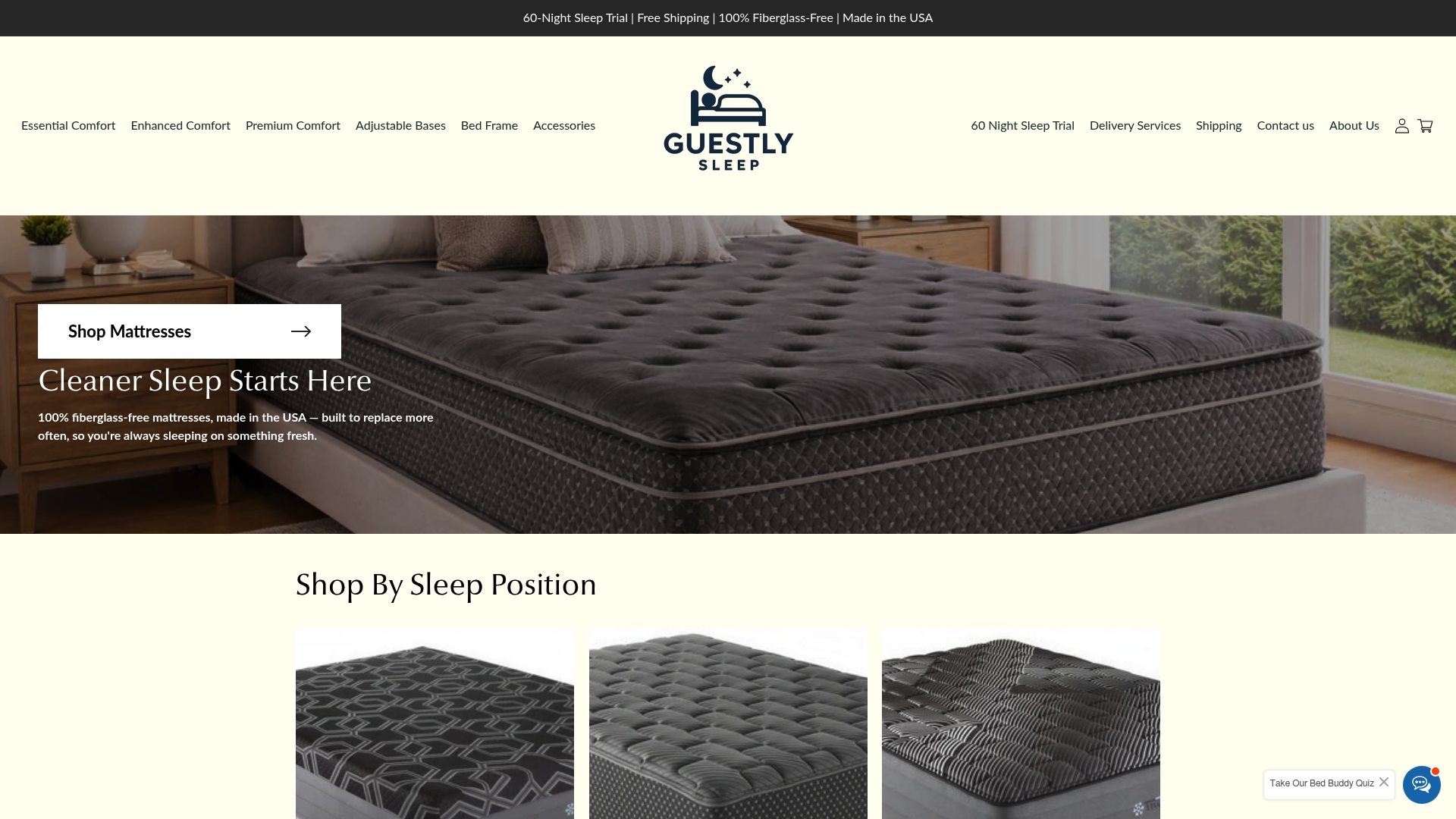
Purchases are often backed with a 60-night sleep trial and free shipping, which gives time to confirm fit and material comfort before committing. For anyone replacing an aging mattress as part of a broader non-toxic bedroom plan, browsing the full collection is a reasonable next step, and installation or haul-away service is available if you would rather not handle setup and disposal yourself.
FAQ
What is the best non-toxic bed?
There is no single “best” bed for every household, but a non-toxic choice should be fiberglass-free, free of chemical flame retardants, and backed by a named certification like GOLS for latex or CertiPUR-US for foam. Checking for a published test report rather than relying on marketing language is the more reliable way to compare options.
What is the healthiest bed to sleep on?
A healthy bed combines certified, low-emission materials with proper ventilation after setup and a protector made from GOTS-certified organic cotton or wool. Letting any new mattress air out for a day or two before regular use, as the EPA’s formaldehyde research suggests for new materials generally, further reduces initial exposure.
What furniture is formaldehyde free?
Solid wood furniture, particularly FSC-certified or reclaimed pieces, avoids the formaldehyde-based resins used as binders in pressed wood and particleboard. The EPA’s formaldehyde assessment identifies pressed wood and laminate products as common high-emission sources, especially in the first few months after installation.
Are there any non-toxic platform beds available?
Yes, platform beds made from solid wood with low or zero-VOC finishes and no pressed wood components are widely available and fit a non-toxic bedroom plan. Some companies offer bed frames alongside mattress lines for shoppers looking to pair a certified mattress with matching non-toxic furniture.
Sources
- Indoor Air Exposure Assessment for Formaldehyde | US EPA (Dec 2024)
- Environmental claims: summary of the FTC ‘green guides’ | FTC