

New Mattress Sore Back: What to Try First
A new mattress causing back soreness is common and usually temporary, but it can also signal a firmness mismatch worth addressing now. Most people adapt within 30–90 days. If your pain is worsening rather than gradually easing, that’s a different story.
Three things to try right now, in order:
- Check your foundation first. A slatted base with gaps wider than 3 inches, or a box spring that doesn’t match your mattress type, can undermine even a well-made mattress before you’ve slept a single night on it.
- Add a thin topper or adjust your pillow tonight. A 1–2 inch foam topper can take the edge off while your body adapts. If you’re a side sleeper, a thicker pillow to fill the shoulder gap helps too.
- Try 10 minutes of gentle stretching and heat or ice before bed. Cat-cow stretches and a heating pad on the lower back reduce muscle tension that builds up when your spine is adjusting to a new support pattern.
If pain is severe, radiating down your leg, or accompanied by numbness or weakness, skip the troubleshooting and see a doctor.
Key Takeaways
Most new mattress back soreness resolves within 30–90 days, but a firmness mismatch requires action, not just patience. Some people fully adapt within 30–60 nights, but up to 90 days is normal.
| Point | Details |
|---|---|
| Check the foundation first | Slat gaps over 3 inches or a mismatched base cause soreness regardless of mattress quality. |
| Adjustment window is 30–90 days | Gradual improvement in morning stiffness is normal; worsening pain after week two is not. |
| Medium-firm has the strongest evidence | A Lancet randomized trial found medium-firm outperformed firm mattresses for back pain at 90 days. |
| Document symptoms from night one | A nightly soreness log gives you concrete evidence to support an exchange if adaptation fails. |
| Guestlysleep 60-night trial | Fiberglass-free, US-made mattresses with a 60-night sleep trial to evaluate fit with no guesswork. |
Table of Contents
- Why does a new mattress make your back sore?
- What’s a realistic adjustment timeline?
- How to relieve soreness from a new mattress
- When should you use the sleep trial or return the mattress?
- Five mistakes that make new mattress soreness worse
- What clinical studies say about mattresses and back pain
- Your 30–90 day checklist
- What most people get wrong about new mattress soreness
- Sleep better on a mattress that fits from night one
- Sources
Why does a new mattress make your back sore?
The short answer: your body is used to sleeping on something specific, and switching that out forces your muscles, ligaments, and spinal joints to recalibrate. That process takes time and occasionally hurts.
Firmness and spinal alignment. When you move from a soft, worn-out mattress to a firmer new one, your spine shifts into a different position overnight. Muscles that were compensating for a sagging surface now have to work differently. The reverse is also true: going from a firm mattress to a plush one can let your hips sink too far, pulling the lumbar spine out of neutral. Either way, you wake up stiff. Understanding how firmness affects your back helps you figure out whether you’re dealing with an adjustment or a genuine mismatch.
The “muscle memory” effect. Your muscles and connective tissue have adapted to your old mattress over months or years. A new surface asks them to hold a slightly different position for 6–8 hours. That’s a real physiological load, not just a perception issue. Clinical and practical guidance notes that muscles, ligaments, and spinal joints often need 30–90 days to fully adapt to a different support pattern.
Foundation problems. A new mattress on a bad base is one of the most overlooked causes of early soreness. Slats spaced more than 3 inches apart allow memory foam to sag between them. An old box spring designed for an innerspring mattress won’t support a foam or hybrid model properly. Before blaming the mattress, get under the bed and look.
Off-gassing. Less common, but worth knowing: new foam mattresses release volatile organic compounds (VOCs) for the first few days. Most people don’t notice anything beyond a mild smell, but some report headaches or generalized discomfort. Ventilating the bedroom for 24–72 hours after unboxing usually resolves it. Memory foam’s properties and off-gassing timeline are worth understanding if you’re sensitive to chemicals.
“Mattress firmness and construction can be associated with complaints of back and neck discomfort — and mattress selection can affect symptoms.” NCBI Bookshelf review on mattresses and chronic back pain
Quick self-check for firmness mismatch. Lie on your back and slide a flat hand under your lower back. On a well-fitted mattress, there should be a small natural gap your hand fills snugly. If your hand slides through easily, the mattress is too firm for your body weight and position. If you can’t get your hand under at all, it’s likely too soft and your spine is flexing out of neutral.
Pro Tip: Take a photo of your spine from the side (ask someone to help) while you’re lying in your usual sleep position. If your lower back is visibly arched or rounded rather than gently curved, that’s a firmness mismatch, not just a break-in issue.
What’s a realistic adjustment timeline?
Soreness in the first week is normal. Soreness that’s still getting worse at week six is not.
- Night 1–3: Stiffness and mild soreness in the lower back, hips, or shoulders are typical. Your body is reacting to a new pressure map. This is the phase most people panic in — don’t.
- Week 1–2: Morning stiffness should start to ease slightly, even if overall soreness lingers. You may notice you’re sleeping more lightly as your body adjusts. Some people feel worse before they feel better during this window.
- Weeks 2–4: Gradual improvement in morning stiffness is the target. If you’re tracking symptoms (more on that below), you should see a downward trend in soreness scores, even if it’s not linear.
- Days 30–90: Full adaptation for most people. Break-in guidance from sleep resources consistently points to this window as the range where both the mattress materials and your body settle into a stable pattern.
| Stage | What’s normal | Warning sign |
|---|---|---|
| Night 1–3 | Mild stiffness, unfamiliar feel | Severe pain, can’t get comfortable at all |
| Week 1–2 | Soreness, light sleep, some improvement | Pain worsening each day |
| Weeks 2–4 | Gradual reduction in morning stiffness | No improvement, new radiating symptoms |
| Days 30–90 | Near-full adaptation, occasional residual soreness | Persistent pain, numbness, leg weakness |
Use your sleep trial window strategically. Most trials run 30–100 nights. Don’t return a mattress at day 10 — you haven’t given your body or the materials enough time. But do start documenting symptoms from night one so you have a clear record if you do need to exchange.
How to relieve soreness from a new mattress
Tonight:
- Check your foundation before anything else. Fix slat gaps, swap out a mismatched box spring, or add a bunkie board.
- Add a 1–2 inch foam topper if the mattress feels too firm. Thicker than 3 inches tends to undermine support rather than add it.
- Adjust your pillow height to match your sleep position. Side sleepers need more loft; back sleepers need less.
- Apply heat (heating pad, 15–20 minutes) to the lower back before sleep to relax muscles. Ice works better for acute inflammation in the first 48 hours.
- Do 5–10 minutes of cat-cow stretches, knee-to-chest pulls, and gentle spinal twists before bed.
This week:
Rotate your mattress 180 degrees. Most new mattresses benefit from rotation every two weeks in the first few months to promote even break-in and prevent body impressions from forming in one spot. Don’t flip unless the manufacturer specifically says it’s double-sided.
If you’re a back sleeper, placing a pillow under your knees reduces lumbar strain significantly. Stomach sleepers should try a thin pillow under the pelvis to reduce lower back hyperextension. The right mattress for your sleep position matters as much as firmness.

Topper vs. replacement. A topper is the right call when the mattress has good structural support but feels too firm on the surface. It’s the wrong call when the mattress is sagging, when you sink through the topper into the same problem, or when you wake up in pain regardless of what’s on top. At that point, the mattress itself is the issue.
Adjustable bases are worth considering if you have chronic lower back pain. Elevating the head and foot slightly takes pressure off the lumbar spine and can make a significant difference during the adaptation period. The Tranquility II adjustable base pairs with most foam and hybrid mattresses and allows you to dial in position without replacing the mattress.
Pro Tip: Keep a simple nightly log: date, soreness score out of 10, sleep position, and any changes you made (topper, pillow, base). After two weeks, you’ll have clear data to bring to a retailer or doctor instead of a vague “it still hurts.”
When should you use the sleep trial or return the mattress?
Not every mattress soreness problem resolves with patience. Here’s how to decide whether to wait or act.
Questions to ask your retailer before you do anything:
- How many nights is the trial period, and when does it start (delivery date or first night slept)?
- Is there a required break-in period before a return is accepted?
- Does the trial cover exchanges, or only full returns?
- Are there fees for pickup or restocking?
- Does the warranty require a specific foundation type?
What to document during the trial:
- Nightly symptom log (soreness score, location, sleep position)
- Photos of your mattress setup (foundation type, slat spacing, any visible sagging)
- Notes on any changes you tried (topper, pillow, base adjustment) and their effect
- Dates of any nights you slept elsewhere, since inconsistent use can slow break-in
WebMD’s guidance on replacement signals recommends using symptom frequency as the primary trigger: if you’re waking sore more nights than not after 30 days of consistent use, that’s a meaningful signal. Sleeping well at a hotel or on a friend’s mattress while your own keeps hurting is another clear sign the fit is wrong.
The WMTW consumer report on sleep quality signals adds visible sagging and waking with stiffness that resolves within 30 minutes as key replacement indicators.
Five mistakes that make new mattress soreness worse
1. Skipping the foundation check. This is the single most common mistake. A mattress on a bad base performs like a bad mattress. Fix the base first, always.
2. Using the mattress inconsistently. Sleeping on it three nights a week and the couch the other four means the mattress breaks in unevenly and your body never fully adapts. Commit to it nightly during the trial window.
3. Adding a topper that’s too thick or too soft. A 4-inch plush topper on an already-soft mattress doesn’t fix alignment — it makes it worse. If you’re sinking into the topper and still hitting the same pressure points, the topper is masking the problem rather than solving it. The medium-firm vs. plush comparison is worth reading before you buy a topper.
4. Returning before the break-in window closes. Mattress materials, particularly memory foam and latex, take weeks to soften and conform. Returning at day 14 because it still feels firm is almost always premature.
5. Ignoring neurological symptoms. Soreness and stiffness are expected. Numbness, tingling, leg weakness, or any change in bladder or bowel function are not mattress problems. Clinical guidance on red-flag back symptoms is clear: these signs require prompt medical evaluation, not more pillow adjustments.
Pro Tip: If your pain is worse when you first lie down but improves after a few minutes, that’s usually a pressure point issue a topper can fix. If it’s worse when you wake up and improves once you’re moving, that points to a support or alignment problem that needs a different solution.
What clinical studies say about mattresses and back pain
The evidence on mattresses and back pain is more specific than most people realize, and it challenges a common assumption.
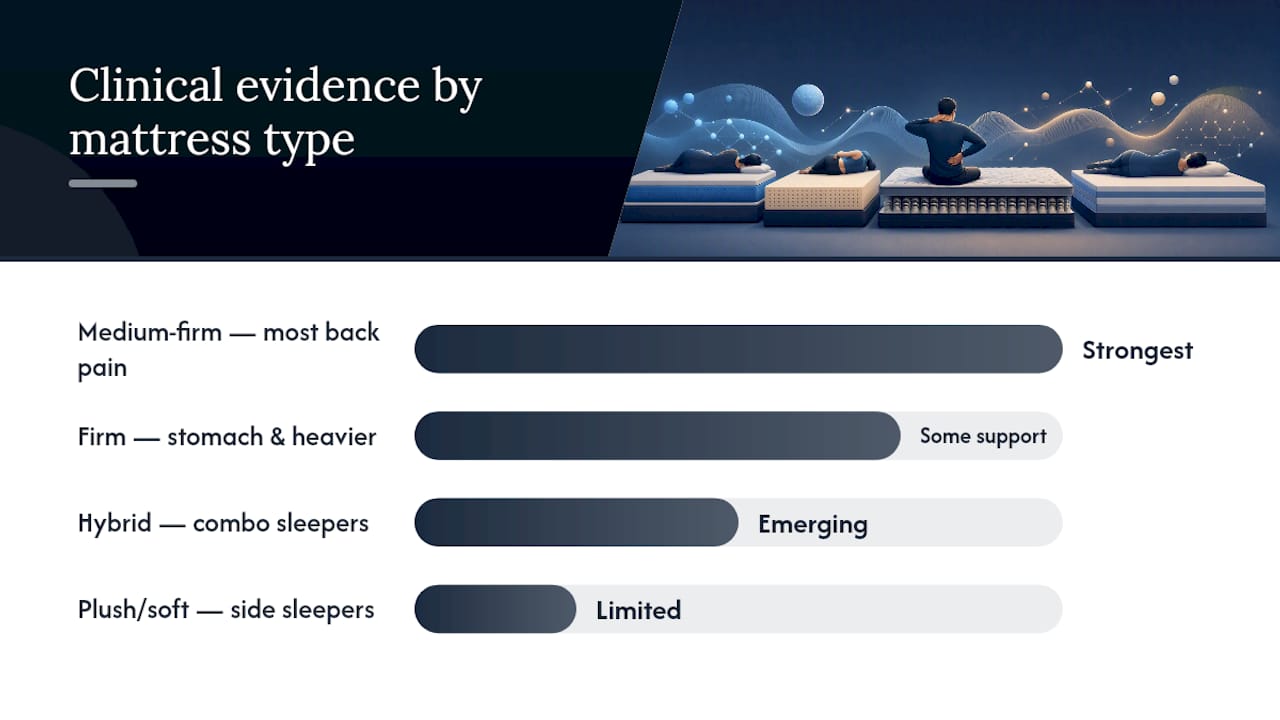
A randomized, double-blind, multicenter trial published in The Lancet found that medium-firm mattresses produced better outcomes at 90 days than firm mattresses for adults with chronic non-specific low-back pain. The medium-firm group reported less pain in bed, less pain on rising, and lower disability scores. This directly contradicts the widespread belief that the firmest mattress is always best for a bad back.
A review of clinical effectiveness and guidelines from NCBI Bookshelf confirms that mattress firmness and construction can be associated with back and neck discomfort, and that mattress selection can affect symptoms. The review also notes that conservative care, including physical therapy and activity, remains the core treatment for back pain — a mattress is one variable, not a cure.
Peer-reviewed work on mattress characteristics and pain outcomes supports the practical suggestion that medium-firm surfaces often balance spinal support and pressure relief better than either extreme.
| Mattress type | Evidence for back pain | Best suited for |
|---|---|---|
| Medium-firm | Strongest clinical support (Lancet RCT, 90-day outcomes) | Most back pain types, especially chronic non-specific LBP |
| Firm | Some support, but outperformed by medium-firm in trials | Stomach sleepers, heavier body weights |
| Plush/soft | Limited clinical support; risk of poor lumbar alignment | Side sleepers with hip/shoulder pressure issues |
| Hybrid | Emerging positive evidence for pressure relief + support | Combination sleepers, those who sleep hot |
When to seek medical attention. Soreness that gradually improves is a mattress issue. Any of the following requires a doctor, not a new mattress: pain that radiates below the knee, progressive weakness in the legs, numbness or tingling in the groin or inner thighs, or any change in bladder or bowel control. These are neurological red flags that need clinical assessment.
Your 30–90 day checklist
Night 1:
- Check foundation and slat spacing
- Set up in your normal sleep position with correct pillow height
- Note your starting soreness score
Week 1:
- Rotate mattress 180 degrees at the end of week one
- Try heat or ice before bed if stiffness is significant
- Start your nightly symptom log
Weeks 2–4:
- Assess whether morning stiffness is trending down
- Add a thin topper (1–2 inches) if the surface still feels too firm
- Adjust sleep position if needed (pillow under knees for back sleepers)
- If no improvement at all by day 21, contact the retailer to understand your exchange options
Month 2–3:
- Full adaptation expected for most people by day 60–90
- If pain is still present and consistent, use your documented symptom log to support an exchange request
- If neurological symptoms appear at any point, stop troubleshooting and see a clinician
Urgent: Numbness, leg weakness, or bladder/bowel changes at any stage mean you should call your doctor today, not wait out the break-in window.
What most people get wrong about new mattress soreness
The conventional advice is to “give it time.” That’s not wrong, but it’s incomplete in a way that costs people weeks of unnecessary pain.
The real issue is that most people don’t distinguish between two very different problems: adaptation soreness and firmness mismatch. Adaptation soreness improves. Firmness mismatch doesn’t, no matter how long you wait. The self-check described earlier (hand under the lower back) takes 30 seconds and tells you which problem you’re dealing with. Most people never do it.
The other thing worth saying plainly: the firmest mattress is not the safest choice for a bad back. The Lancet trial data on this is over 20 years old and still gets ignored in mattress marketing. Medium-firm is where the clinical evidence points for most people with chronic low-back pain. If you bought a very firm mattress because you thought it was the medically correct choice, the evidence suggests you may want to reconsider.
Patience is warranted. But it should be informed patience, with a symptom log, a foundation check, and a clear plan for what you’ll do if things don’t improve by day 30.
Sleep better on a mattress that fits from night one
Back soreness during break-in is one thing. Starting on a mattress that’s already wrong for your body is another. Guestlysleep offers fiberglass-free, non-toxic mattresses made in the United States, available in comfort levels matched to your sleep position: side, back, and stomach sleeper options, plus hybrid and cooling memory foam builds for those who run warm.
Every mattress ships free and comes with a 60-night sleep trial, so you have the full adaptation window to evaluate fit without pressure. If you’re considering a softer option, the 15" TRU Luxury Plush is a good starting point. For readers dealing with chronic lower back pain, pairing any mattress with an adjustable base can reduce lumbar strain during the adjustment period. Browse the full range at Guestlysleep and use the 60-night trial the way it’s meant to be used: with a symptom log and a clear decision point at day 30.
Sources
- Mattresses for Chronic Back or Neck Pain: A Review of the Clinical Effectiveness and Guidelines - NCBI Bookshelf
- Effect of firmness of mattress on chronic non-specific low-back pain: randomised, double-blind, controlled, multicentre trial
- New Mattress Back Pain? Why You Must Act Now: Doctor’s Note | Ubie Doctor’s Note
- How to Break in a New Mattress - eachnight
- Signs your mattress might be due for replacement - WebMD
- Ncbi
- Is your bed ruining your sleep? Here’s how to tell - WMTW
This article is general information, not a substitute for advice from a qualified doctor. Consult a qualified healthcare professional about your own circumstances before acting on anything here.