

Medium vs. Medium Firm: Which Mattress Is Right for You?
For most adults, especially back sleepers and anyone who wakes up stiff, medium-firm is the safer starting choice. The Sleep Foundation places medium at roughly 5/10 and medium-firm at roughly 6/10 on a standard 1–10 firmness scale, and a randomized controlled trial published on PubMed found medium-firm produced meaningfully better outcomes for chronic low-back pain than firm mattresses at 90 days. That said, medium is the right call for some sleepers. Here is how to tell which one fits you:
- Side sleepers under 130 lb tend to do better on medium for shoulder and hip pressure relief.
- Back sleepers and combination sleepers between 130–230 lb usually get better spinal support from medium-firm.
- Heavier sleepers over 230 lb often need medium-firm or firmer to prevent sinking through the comfort layers.
- Morning low-back pain on rising is a specific signal the trial evidence links to medium-firm improvement.
- Couples with different preferences may want a split option or an adjustable base.
Key Takeaways
Medium-firm is the most evidence-supported starting firmness for adults with low-back pain or back-sleeping habits, but medium remains the better fit for side sleepers and lighter body weights.
| Point | Details |
|---|---|
| Firmness scale anchors | Medium sits at ≈5/10 and medium-firm at ≈6/10 on a standard 1–10 scale. |
| Clinical evidence | A randomized trial found medium-firm produced odds ratios of 2.36 and 2.10 for pain and disability improvement vs. firm at 90 days. |
| Position-based guidance | Side sleepers typically do better on medium; back and stomach sleepers usually need medium-firm. |
| Label variability | No U.S. industry standard exists, so the same label can feel different across brands — always test and use a trial window. |
| Guestlysleep option | Guestlysleep offers fiberglass-free medium and medium-firm mattresses with a 60-night trial and free shipping. |
Table of Contents
- How medium firmness feels and who it actually suits
- What medium-firm means in practice and when it helps
- At-a-glance comparison: medium vs. medium-firm
- Which sleepers should choose medium and which should choose medium-firm
- What the research actually says about mattress firmness
- How to decide and what to do when you shop
- Why two mattresses with the same label can feel completely different
- A note on how Guestlysleep approaches firmness
- Guestlysleep’s medium and medium-firm options are worth trying
- Sources
How medium firmness feels and who it actually suits
On a 1–10 scale, medium lands at about 5/10. Lie down on one and you will notice your shoulders and hips sink noticeably into the comfort layers while the mattress contours around your body. There is real cushioning, but the surface still pushes back enough to keep you from feeling “stuck.”
Typical medium builds use a thicker memory foam or soft latex comfort layer, usually 2–4 inches, sitting over a supportive polyfoam or pocketed coil core. The comfort layer does most of the work, absorbing pressure at the joints. The core keeps the spine from collapsing into a hammock shape.
Medium tends to work well in these situations:
- Side sleepers who need the mattress to give way at the shoulder and hip without creating pressure points.
- Lighter sleepers under 130 lb, who may not compress a medium-firm surface enough to feel its contouring benefits.
- Couples with different sleep positions, since medium offers a middle ground that neither partner finds punishing.
- Anyone prioritizing motion isolation, because thicker foam comfort layers absorb movement more effectively.
One thing worth knowing: the label “medium” is not standardized. Fortune notes that the U.S. mattress market has no single objective firmness standard, so a medium from one brand may feel closer to a medium-firm from another. The number on the spec sheet is a starting point, not a guarantee. Always check the comfort-layer thickness and materials, and use a trial window to confirm the feel in your own sleep environment. A mattress firmness guide can help you map those specs to what you will actually feel.
What medium-firm means in practice and when it helps
Medium-firm sits at about 6/10 on the same scale. The difference from medium sounds small, but it is noticeable the moment you lie down. Your hips and shoulders still get some contouring, but the surface resists more quickly. You feel supported rather than cradled.
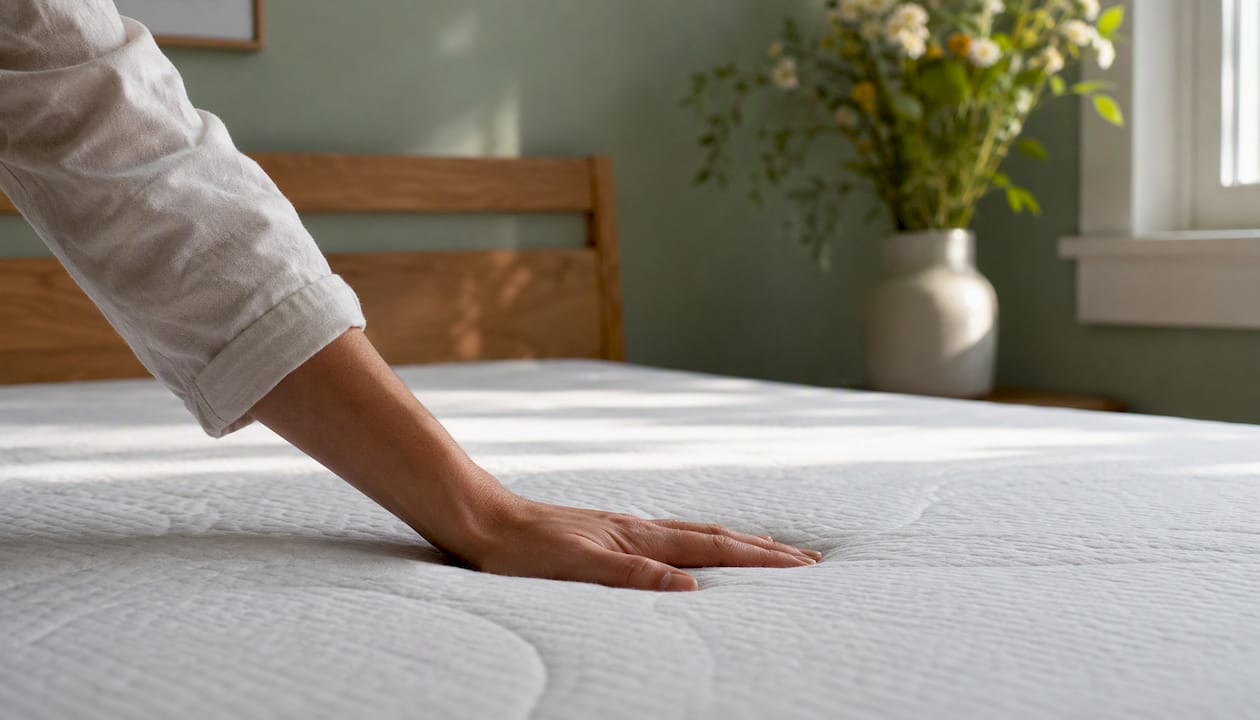
Construction-wise, medium-firm mattresses typically use a thinner or denser comfort layer, often 1–2 inches of firmer foam or latex, over a more robust coil or high-density foam core. Some medium-firm models use zoned support, where the coil tension or foam density is higher under the lumbar region and softer under the shoulders. That zoning is what lets a medium-firm mattress offer pressure relief and spinal support at the same time.
Where medium-firm tends to help:
- Back sleepers, who need the lumbar region supported without the hips sinking below the shoulders.
- Stomach sleepers (with caveats), since a firmer surface helps prevent the pelvis from dropping and straining the lower back.
- Heavier sleepers over 230 lb, who compress comfort layers more deeply and need a firmer base to maintain alignment.
- People with chronic low-back pain, based on the clinical evidence covered below.
At-a-glance comparison: medium vs. medium-firm
| Feature | Medium (≈5/10) | Medium-Firm (≈6/10) |
|---|---|---|
| Firmness rating | 5/10 | 6/10 |
| How it feels | Noticeable sink, deep contouring | Light sink, quicker pushback |
| Pressure relief | High, especially at shoulders/hips | Moderate, better at lumbar |
| Spinal support | Good for side sleepers | Better for back/stomach sleepers |
| Motion transfer | Lower (thicker foam absorbs movement) | Slightly higher |
| Heat retention | Can run warmer (denser foam layers) | Often cooler (firmer, less enveloping) |
| When to choose | Side sleeper, lighter body weight, pressure points | Back pain, back/stomach sleeper, heavier build |
| Red flags | Waking with low-back stiffness, feeling “stuck” | Shoulder or hip pressure, numbness in side-sleeping |
A few practical notes beyond the table:
- If you wake with pressure points on your shoulder or hip, the surface is too firm for your sleep position.
- If you wake with low-back stiffness or a sore lumbar region, the surface may be too soft and letting your spine sag.
- Motion transfer matters most for couples. Medium’s thicker foam layers absorb more movement, which can mean less disruption when a partner shifts.
Which sleepers should choose medium and which should choose medium-firm
Sleep position is the single biggest predictor of which firmness will work. Body weight is the second. Pain patterns are the third.
By sleep position:
- Side sleepers almost always do better on medium. The shoulder and hip need to sink in enough to keep the spine level. Tom’s Guide confirms that side sleepers typically benefit from medium for pressure relief, and a dedicated side-sleeper firmness guide walks through why joint loading matters here.
- Back sleepers generally prefer medium-firm. The lumbar curve needs active support, and a surface that sinks too much lets the lower back flatten or sag.
- Stomach sleepers usually need medium-firm or firmer. A soft surface lets the pelvis drop, which hyperextends the lumbar spine. See stomach sleeper firmness guidance for more detail.
- Combination sleepers who shift between side and back often land on medium-firm as a workable compromise, since it supports the back position without being punishing on the side.
By body weight:
- Under 130 lb: Medium or even slightly softer. Lighter sleepers do not compress comfort layers as deeply, so a medium-firm surface may feel harder than its label suggests.
- 130–230 lb: Medium-firm is the most reliable starting point for back and combination sleepers. Side sleepers in this range can go either way.
- Over 230 lb: Medium-firm is usually the floor. Heavier sleepers compress foam layers faster, and a medium surface may bottom out within months, losing its support.
Pain signals:
Morning pain on rising specifically is a meaningful clinical signal. The randomized trial found medium-firm improved pain on rising more than firm mattresses did. If your back hurts most in those first minutes after you get up, medium-firm is worth testing before anything else. For a broader look at how firmness affects back pain, this back-pain firmness overview covers the key considerations.
Pro Tip: Check your current mattress for visible sagging or body impressions deeper than about an inch. If you see that, your pain may be a mattress-wear problem rather than a firmness problem. A worn medium-firm can feel softer than a new medium.
What the research actually says about mattress firmness
The strongest single piece of evidence is a randomized, double-blind, multicentre trial that compared medium-firm and firm mattresses in adults with chronic non-specific low-back pain. At 90 days, medium-firm produced better outcomes across multiple endpoints, with odds ratios of 2.36 for pain while lying in bed and 2.10 for disability. Those are meaningful differences in a well-controlled study.
A 25-year orthopedic literature review of 47 studies reached a similar conclusion: medium-firm was the most consistently favored surface for pressure distribution, sleep quality, and reduced morning stiffness. The review’s authors were careful to note that heterogeneity across studies prevented a formal meta-analysis, and that individual factors, including body type, sleep position, and thermal comfort, still matter. Medium-firm is a defensible starting band, not a universal prescription.
A separate systematic review covering 2000–2019 found multiple controlled studies showing progressive improvement in back pain after switching to medium-firm surfaces, with benefits building over several weeks rather than appearing overnight.
Key caveats worth keeping in mind:
- Firmness labels are not standardized, so “medium-firm” in one trial may not match the label on a mattress you buy.
- Most trials focus on adults with existing back pain. Evidence for healthy sleepers without pain is thinner.
- Individual response varies. Some people genuinely need softer for pressure relief; others need firmer to prevent bottoming out.
How to decide and what to do when you shop
Start with your sleep position and body weight from the section above, then use the following steps to confirm your choice.
In-store testing protocol:
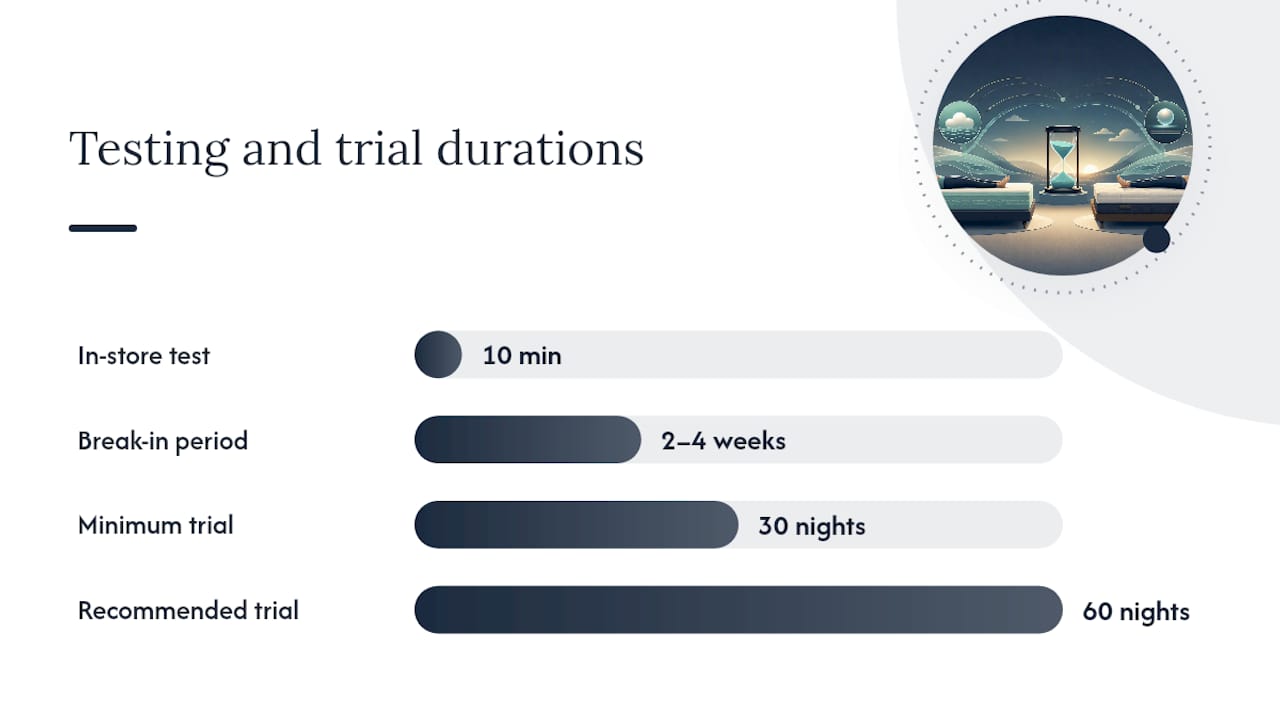
- Lie on your side for at least 10 minutes. Notice whether your shoulder sinks enough to keep your spine level, or whether it feels like the mattress is pushing your shoulder upward.
- Roll to your back. Check whether your lower back feels supported or whether it sinks into a slight arch.
- Press your palm into the surface and feel the pushback. Medium returns slowly; medium-firm pushes back more quickly.
- If shoulders or hips feel numb or tingly after 10 minutes, the surface is too firm for your position.
What to check in online specs:
- Firmness rating (look for the brand’s own 1–10 number, not just the label).
- Comfort-layer thickness and material (memory foam, latex, polyfoam, and their densities).
- Coil count and zoning if it is a hybrid.
- Weight limit, which tells you whether the core is built for your body weight.
Trial and return checklist:
- Look for a minimum 30-night trial, though 60 nights gives you time to get past the break-in period.
- Most mattresses take 2–4 weeks to fully break in. Do not judge the feel in the first week.
- Track your symptoms at weeks 2, 4, and 6. Improvement should be measurable by week 6.
- Return triggers: persistent pressure points, waking with new or worsening back pain, or visible sagging within the trial window.
Pro Tip: If you and your partner disagree on firmness, a split king with two twin XL mattresses at different firmness levels solves the problem cleanly. An adjustable base like the Tranquility II can also let each side adjust independently without a gap in the middle.
For a step-by-step firmness selection process, how to choose mattress firmness walks through each decision point in detail.
Why two mattresses with the same label can feel completely different
Firmness and support are not the same thing, and confusing them is one of the most common shopping mistakes. Firmness is what you feel at the surface: how much the mattress resists your initial weight. Support is what happens over time: whether the core keeps your spine in alignment through the night. A mattress can feel soft on the surface and still support your spine well, or feel firm and still let your lumbar region sag.
What actually drives the difference between two “medium-firm” mattresses:
- Comfort layer material: Memory foam contours slowly and retains heat. Latex responds faster and sleeps cooler. Polyfoam is cheaper and compresses more quickly over time.
- Core construction: Pocketed coils move independently and reduce motion transfer. Continuous coils are more responsive but transfer movement. High-density polyfoam cores are durable but can feel stiffer.
- Zoned support: Some mattresses use firmer coils or foam under the lumbar and softer zones under the shoulders. Two mattresses with the same firmness number can feel very different if one is zoned and one is not.
- Cover and topper: A quilted pillow-top cover adds softness that can push a medium-firm toward medium in feel. A tight, thin cover keeps the firmness truer to the spec.
- Foundation: A slatted bed frame with wide gaps can make any mattress feel softer by allowing the core to flex downward. A solid platform or a close-slat frame keeps the feel consistent.
The practical takeaway: read the spec sheet for comfort-layer thickness and density, not just the firmness label. Fortune’s reporting on firmness standards makes clear that without an industry-wide standard, the label alone tells you less than the construction details do.
A note on how Guestly Sleep approaches firmness
Guestly Sleep organizes its mattress lineup by comfort level and sleep position, which means you are not just picking a number off a chart. Every mattress in the range is fiberglass-free and made in the United States, using certified materials without harmful fillers. The 60-night sleep trial exists specifically because firmness is personal: the research points toward medium-firm as a strong starting band, but the only way to know for certain is to sleep on it in your own environment, in your own sleep position, for several weeks.
Guestly Sleep’s medium and medium-firm options are worth trying
Choosing between medium and medium-firm does not have to be a guess. Guestly Sleep’s fiberglass-free mattress collections are organized by comfort level and sleep position, so you can filter directly to the firmness band the evidence supports for your situation. Every mattress ships free, arrives without fiberglass or toxic fillers, and comes with a 60-night sleep trial long enough to get past the break-in period and actually measure whether your back pain or pressure points improve.
If you are a back sleeper with morning stiffness, start with the medium-firm collection. Side sleepers under 130 lb should look at the medium options. Couples who cannot agree can explore the adjustable base pairing. Browse the full range at Guestlysleep and use the trial window the way the research recommends: track your symptoms at weeks 2, 4, and 6, and return if the improvement is not there.
Sources
- Mattress Firmness: Finding the Best Firmness for You! | Sleep Foundation
- Effect of firmness of mattress on chronic non-specific low-back pain: randomised, double-blind, controlled, multicentre trial | PubMed
- Mattress impact on lifestyle and back pain: a 25-year orthopedic literature review guideline | Journal of Orthopaedics and Traumatology | Springer Nature Link
- How Firm Should Your Bed Be? | Fortune
- Medium vs firm mattress: Which is the right comfort level for you? | Tom’s Guide
This article is general information, not a substitute for advice from a qualified doctor. Consult a qualified healthcare professional about your own circumstances before acting on anything here.