

Pocketed Coils and 3 in Comfort Layers Prove Hybrid Mattress Benefits
Yes, a well-built hybrid mattress delivers real, measurable benefits: balanced pressure relief, better spinal support, noticeably cooler sleep than all-foam beds, and solid motion isolation when it uses pocketed coils. The tradeoffs are real too: hybrids cost more, weigh more, and can develop coil noise or delamination over time. The Sleep Foundation backs the cooling claim, and a 60-night trial (the kind Guestlysleep offers) is how you confirm the fit before committing.
TL;DR:
- Hybrid mattresses typically feature pocketed coils for better motion isolation and support, with comfort layers of at least 2 to 3 inches for effective pressure relief.
- They are generally more expensive, heavier, and can develop coil noise or delamination over time, with durability depending on material quality and bonding.
- For hot sleepers, ventilated foam and breathable covers are crucial, especially if the comfort layer uses dense memory foam that can trap heat.
- Back and side sleepers should look for medium-firm hybrids with zoned or reinforced coils to support proper spinal alignment, particularly for heavier individuals.
- A 60-night trial and verified warranty are essential to evaluate fit and long-term durability before committing to a hybrid mattress.
Table of Contents
- What a Hybrid Mattress Is: Construction and Materials
- Comfort and Pressure Relief: How Hybrids Feel
- Support and Spinal Alignment by Sleep Position and Weight
- Temperature Regulation and Cooling Features
- Motion Isolation and Partner-Friendly Features
- Durability, Edge Support, and Long-Term Maintenance
- Drawbacks and Trade-Offs Worth Knowing
- How to Choose a Hybrid Mattress: A Buying Checklist
- Guestlysleep’s Approach to Hybrid Construction
- The Gap Between Hybrid Marketing and Hybrid Reality
- Try a Fiberglass-Free Hybrid Risk-Free
- Where This Information Comes From
- Sources
- FAQ
What a Hybrid Mattress Is: Construction and Materials
A hybrid mattress is built in two distinct layers: a comfort system on top and a coil support core underneath. The Sleep Foundation defines it as a design that pairs foam comfort layers with a coil core, typically pocketed coils, to deliver contouring plus responsiveness in one bed. That pairing is the entire reason hybrids exist. All-foam beds sink and cradle. Innerspring beds bounce and support. A hybrid tries to give you both without the extremes of either.
The comfort layer is what your body actually touches, and its thickness matters more than most shoppers realize. A comfort layer under 2 inches feels more like a padded innerspring. Get up to 2 to 3 inches or more, and you start feeling genuine cushioning, especially around the shoulders and hips. Materials vary here: memory foam for slow, deep contouring, latex for a springier and cooler feel, and sometimes a thin microcoil layer for extra responsiveness right under the surface.
The support core does the structural work. Pocketed coils, meaning individually wrapped steel springs, are the standard in quality hybrids because they flex independently instead of moving as one connected unit. That independence is what separates a modern hybrid from an old-school innerspring, where a coil moving under your hip could tug on the coil under your partner’s shoulder.
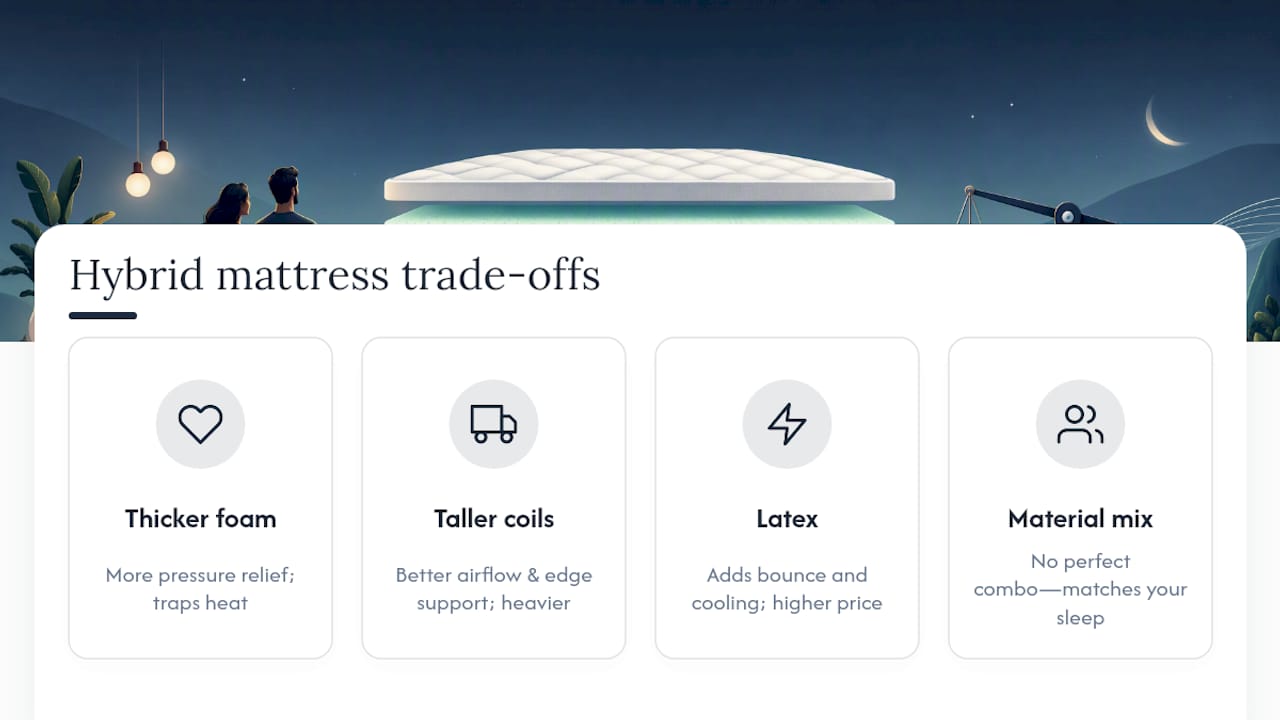
Every material choice here trades off against another. A thicker foam layer improves pressure relief but can trap heat. Taller coils improve airflow and edge support but add weight and cost. Latex adds bounce and cooling but raises the price. There is no perfect combination, only a combination that fits how you actually sleep.
Comfort and Pressure Relief: How Hybrids Feel
Hybrids relieve pressure by letting the comfort layer flex around your body’s heaviest points, your shoulders and hips, while the coil layer underneath keeps your spine from sagging out of alignment. Foam or latex in the top layer compresses locally instead of pushing back uniformly, so the bed absorbs pressure right where you need it instead of spreading it evenly across a flat surface.
Where hybrids differ from all-foam mattresses is in how far that contouring goes. A hybrid gives you a balanced feel: enough give to cushion pressure points, but enough underlying push back that you don’t feel like you’re sinking into the bed. A dense memory foam mattress with no coils goes further in one direction. It hugs the body more completely, which can be the better call for a strict side sleeper dealing with severe shoulder or hip pain who wants maximum contouring and doesn’t mind a slower, more enveloping feel.
Here’s how that plays out by sleep position and body type:
- Side sleepers with shoulder or hip pain benefit from a hybrid with a comfort layer of at least 3 inches, since thinner layers let the coils show through at pressure points.
- Back sleepers usually do well with a medium comfort layer, enough cushioning under the lower back without losing the lift the coils provide.
- Stomach sleepers need less give up top and more push back from the coil layer, or the midsection sinks and the spine bows.
- Lightweight sleepers (under 130 lbs) may feel a hybrid as firmer than expected, since there isn’t enough body weight to compress the top layer fully.
If severe pressure pain is the primary issue and cooling or bounce is a secondary concern, a dedicated pressure-relieving hybrid with a generous comfort layer is usually the better starting point than a thin-comfort, coil-forward build.
Support and Spinal Alignment by Sleep Position and Weight
The coil core is what keeps a hybrid mattress from turning into a hammock under your hips. Coils create lift, pushing back against body weight instead of just compressing and staying compressed the way memory foam alone tends to do. That lift is what keeps your spine roughly level whether you’re on your back, your side, or somewhere in between during the night.
Combination sleepers, people who shift positions repeatedly, benefit the most from this responsiveness. A pure memory foam bed can feel slow to respond when you roll over, briefly leaving you unsupported in the new position. A hybrid’s coils react almost instantly, which is one reason combination sleepers tend to prefer them over slow-response foam.
Zoned coil systems take this a step further. Rather than using uniform coil firmness across the entire bed, manufacturers use firmer coils under the lumbar region and softer coils near the shoulders and hips. This zoning targets the exact spot where most people need extra lift: the lower back. Product pages usually list this under a “zoned support” or “targeted lumbar support” spec, so check the construction details before assuming a hybrid has it.
Here’s how to match support to your situation:
- Back and combination sleepers should look for medium-firm hybrids with at least a 6-inch coil core for reliable lift.
- Heavier sleepers (200+ lbs) should prioritize taller coils and higher coil gauge, since hybrids are frequently recommended for heavier sleepers precisely because the coil structure prevents the excessive sinkage that undermines alignment on softer all-foam beds.
- Stomach sleepers need a firmer overall build, since a soft comfort layer combined with a soft coil zone lets the midsection dip too far.
- Petite or lightweight sleepers can often go softer without losing support, since less body weight means less coil compression to begin with.
Temperature Regulation and Cooling Features
Airflow is the biggest structural advantage a hybrid holds over an all-foam mattress. A coil core is mostly open space, and air moves through that space instead of getting trapped the way it does inside a dense block of foam. Hybrid mattresses tend to sleep cooler than all-foam models specifically because of this coil ventilation, according to the Sleep Foundation.
That cooling advantage isn’t automatic, though. It depends heavily on what sits above the coils.
- Ventilated or open-cell foams in the comfort layer allow heat to pass through rather than get absorbed and held.
- Gel infusions in memory foam pull heat away from the body faster than standard foam, though the effect is modest compared to airflow-based cooling.
- Breathable covers, often knit with cooling fibers, reduce the insulating effect of the fabric itself.
- Thin microcoil layers near the top add a bit more airflow right where body heat concentrates.
Pro Tip: If you sleep hot, don’t just check for “cooling” in the product name. Look specifically for a comfort layer described as ventilated or open-cell, paired with a breathable knit cover, and confirm the coil layer is at least 6 inches tall. That combination does more for heat than a gel swirl on top of a dense foam slab.
A dense memory foam comfort layer can undercut the coil core’s natural airflow advantage, so hot sleepers should prioritize the top layer’s breathability as much as the coil design underneath it.
Motion Isolation and Partner-Friendly Features
Pocketed coils are the reason a modern hybrid can sleep two people without one person’s late-night rollover waking the other. Because each coil is individually wrapped and moves on its own, pocketed coils isolate motion far better than the old interconnected spring systems where movement traveled across the entire bed, a distinction the Sleep Foundation points to directly. A memory foam comfort layer on top adds a second layer of dampening, absorbing small movements before they even reach the coils.
There’s a real trade-off buried in this, though. Bounce and motion isolation pull in opposite directions. A bed with more coil bounce, which makes it easier to move and reposition, will transmit slightly more motion than a bed built purely from slow-recovery foam. Couples with very different sleep schedules or one restless sleeper usually feel this trade-off more than a couple who moves in sync.
- Individually pocketed coils outperform interconnected coils for isolating movement.
- A memory foam comfort layer adds meaningful extra dampening on top of the coil design.
- Pure foam mattresses still isolate motion slightly better overall, at the cost of the bounce and responsiveness hybrids provide.
Pro Tip: For the best all-around balance for couples, look for individually pocketed coils paired with a memory foam (not latex) top layer. Latex adds bounce, which is great solo but works against motion isolation when someone else is in the bed. Guestlysleep’s couples-focused guidance breaks this pairing down in more detail.
Durability, Edge Support, and Long-Term Maintenance
A well-constructed hybrid can last 7 to 10 years, according to Tom’s Guide, but that range depends heavily on coil steel quality, comfort-layer density, and how the layers are bonded together. Thin, low-density foam breaks down faster than denser foam, and lower-gauge coil steel loses its spring tension sooner. Warranty length is a decent proxy for how confident a manufacturer is in its own materials.
Hybrids also introduce failure points that all-foam beds simply don’t have. The coil unit and foam layers are bonded with adhesive, and that bond can weaken over years of use, causing delamination, essentially the layers separating or shifting out of place. Watch for localized lumps, an uneven surface, or a spot that suddenly feels different from the rest of the bed. Coil noise, a faint metallic creak when you move, is another early sign that a coil unit is wearing.
A few habits extend a hybrid’s usable life:
- Use a supportive, flat foundation rather than an old sagging box spring or slats spaced too far apart.
- Rotate the mattress occasionally, but only if the manufacturer’s care instructions allow it, since some hybrids are built with zoned layers that shouldn’t be flipped end to end.
- Add a mattress protector to guard against moisture and debris that accelerate foam breakdown.
- Read the warranty terms closely, especially the language around sagging depth, since many warranties only cover indentations beyond a specific threshold.
Edge support tends to outperform all-foam beds too, since coil cores with reinforced perimeter coils resist the collapse you get when sitting or sleeping near the edge of a foam-only mattress.
Drawbacks and Trade-Offs Worth Knowing
Hybrids aren’t the right call for every budget or every sleeper, and pretending otherwise does readers a disservice. Cost is the most immediate hurdle. Hybrid mattresses usually cost more than basic foam mattresses, and Healthline frames that premium as buying improved support, cooling, and edge performance rather than paying more for the same thing.
Weight is the second practical issue. Combining steel coils with multiple foam layers makes hybrids notably heavier than all-foam beds, which matters the moment you try to rotate one, move it up a staircase, or set it up without help.
- Higher upfront cost compared with basic foam or innerspring models.
- Significant weight, making solo setup or moving difficult.
- Potential for retained heat if the comfort layer uses a dense, non-ventilated memory foam.
- Long-term risk of coil noise or delamination as adhesive bonds age.
- Slightly less motion isolation than a pure foam bed, an issue mainly for very light sleepers sharing a bed.
If your main priority is silent, maximum motion isolation and budget is tight, a quality all-foam mattress may still serve you better. If you want traditional bounce at the lowest possible price and don’t mind more motion transfer, a classic innerspring remains a valid option too. For most everyone else balancing comfort, support, and cooling, a hybrid is the more versatile pick.
How to Choose a Hybrid Mattress: A Buying Checklist
Work through this in order, since the earlier items matter more than the later ones for most shoppers.
- Coil type (must-have): Confirm the coils are individually pocketed, not interconnected. This affects motion isolation, support responsiveness, and long-term durability all at once.
- Comfort-layer thickness (must-have): Look for at least 2 to 3 inches for genuine pressure relief; thinner layers will let the coils show through.
- Firmness by sleep position (must-have): Match firmness to how you actually sleep, medium-soft for side sleeping, medium-firm for back and combination, firmer for stomach.
- Edge support (nice-to-have): Reinforced perimeter coils matter more if you sit on the edge often or share the bed.
- Cooling features (nice-to-have unless you sleep hot): Ventilated foam and breathable covers matter far more for hot sleepers than casual buyers.
- Sleep trial and warranty (must-have): A real trial period, and reasonable warranty terms, is your safety net if the firmness or feel is wrong.
- Weight capacity (must-have for heavier sleepers): Confirm the coil gauge and comfort-layer density are rated for your body weight.
- Return policy (must-have): Know exactly how returns work before you buy, not after.
At the product page, ask directly: “Are the coils individually wrapped?” and “What is the exact comfort-layer thickness in inches?” Vague answers to either question are a red flag. Couples should weigh motion isolation and edge support more heavily; solo hot sleepers should weigh cooling features and comfort-layer breathability first.
Guestlysleep’s Approach to Hybrid Construction
Some hybrid mattresses are built fiberglass-free using certified, non-toxic materials, sometimes manufactured in the United States. Comfort-layer chemistry directly affects the pressure relief and cooling performance covered above, and material safety shouldn’t be an afterthought to firmness.
Many mattress companies back purchases with a 60-night sleep trial and free shipping, letting you test coil responsiveness and cooling performance in your own bedroom before committing. Comfort collections are often organized by sleep position and budget, so you’re matching construction to your actual sleep habits rather than guessing from a generic firmness scale.
The Gap Between Hybrid Marketing and Hybrid Reality
The phrase “best of both worlds” gets thrown around so often in mattress marketing that it’s lost meaning, and that’s the biggest disservice done to shoppers here. Hybrids don’t give you the full pressure relief of top-tier memory foam and the full bounce of a classic innerspring simultaneously. They give you a compromise, a genuinely good one, but a compromise. Anyone with severe, localized pressure pain who reads “hybrid” as a universal upgrade over dense memory foam is often disappointed.
Where I think the conventional advice actually falls short is in how it treats coil type as a footnote. Pocketed coils versus interconnected coils isn’t a minor spec, it’s the difference between a mattress that isolates motion well and one that doesn’t. I’d tell anyone shopping to interrogate that detail before firmness, before price, before brand reputation.
What actually matters, in order: coil type, comfort-layer thickness, then firmness suited to your sleep position. Cooling features and edge support are real benefits, but they’re refinements on a good foundation, not substitutes for one. A trial period exists precisely because no amount of reading replaces sleeping on the thing.
— Justin
Try a Fiberglass-Free Hybrid Risk-Free
Guestlysleep builds every hybrid around the exact benefits this article covers: pocketed coils for support and motion isolation, breathable comfort layers for cooling, and construction that’s fiberglass-free and made with certified, non-toxic materials in the United States.
Comfort collections are organized by how you actually sleep and what you want to spend, Essential Comfort, Enhanced Comfort, and Premium Comfort, so you can compare builds without wading through specs that don’t apply to your situation. Every mattress ships free and comes with a 60-night trial, which means you get to test coil support and temperature regulation in your own bed instead of trusting a showroom feel. Browse the full lineup on the Guestlysleep collection page and start narrowing down which comfort level and coil setup fits your sleep position, body weight, and whether you’re sleeping solo or sharing the bed.
Where This Information Comes From
This guide draws on the Sleep Foundation’s research on hybrid construction and cooling, the National Council on Aging’s guidance for heavier sleepers, Tom’s Guide’s reporting on hybrid durability, and Healthline’s comparison of memory foam and hybrid mattresses. Each source specializes in sleep health or product durability research.
Sources
- Memory Foam vs. Hybrid Mattresses | Sleep Foundation
- Best mattress for heavy people | NCOA
- Why a hybrid mattress | Tom’s Guide
- Memory foam vs hybrid mattresses | Healthline
FAQ
Are Hybrid Mattresses Good for Back Pain?
Hybrids can help with back pain because the coil core keeps the spine lifted and aligned instead of letting the hips sink too deep. Look for medium-firm options with zoned lumbar support and a comfort layer thick enough to cushion pressure points without losing that underlying lift.
Is a Hybrid Mattress Better Than Memory Foam?
Neither is universally better; hybrids sleep cooler and offer more responsiveness, while memory foam delivers deeper contouring for severe pressure pain. Choose a hybrid if you want balanced comfort and better airflow, and dense memory foam if pressure relief is your single top priority.
Are Hybrid Mattresses Worth the Extra Cost?
For most sleepers, yes. Hybrids usually cost more than basic foam mattresses but deliver better support, cooling, and edge stability in exchange, benefits that matter daily rather than occasionally.
What Mattress Type Is Best for Heavy People?
Hybrids are frequently recommended for heavier sleepers because the coil support system provides structural lift that prevents excessive sinkage, which is a common problem with all-foam beds under higher body weight. Prioritize taller coils and denser comfort layers when shopping in this category.
Does Guestlysleep Offer a Sleep Trial on Hybrid Mattresses?
Yes, Guestlysleep includes a 60-night sleep trial along with free shipping on its mattresses, giving you time to test comfort and cooling performance at home. Current pricing for each comfort collection is available on the Guestlysleep site.