

Firm vs Plush Mattresses: 3 Factor Sleep Position Checklist
Neither firm nor plush wins outright. The right pick depends on your sleep position, your body weight, and whether you wake up sore or stiff. If you’re unsure and just want the safest general answer, medium-firm splits the difference best: firm gives you support and cooler sleep, plush gives you pressure relief and contouring, and medium-firm gets you most of both without the tradeoffs of either extreme.
TL;DR:
- The ideal mattress firmness depends on sleep position and body weight, with medium-firm offering a balance suitable for most sleepers.
- Support comes from the core, not the comfort layer, so a mattress can feel plush yet still provide adequate spinal support.
- Firm mattresses suit back and stomach sleepers well but may cause shoulder and hip soreness for side sleepers, especially if they are lightweight.
- Plush mattresses offer pressure relief and motion isolation but can trap heat and support fewer body types long-term.
- Adjusting firmness with toppers or waiting two to six weeks for materials to soften can improve comfort and satisfaction.
Table of Contents
- What Does Mattress Firmness Actually Mean?
- What Does a Firm Mattress Feel Like to Sleep On?
- What Does a Plush Mattress Feel Like to Sleep On?
- Which One Fits Your Body and Sleep Position?
- How Do You Actually Choose Between Firm and Plush?
- What Guestly Sleep Recommends for Different Sleepers
- Why Position-First Thinking Beats Firmness Labels
- Ready to Match Your Sleep Position to the Right Mattress?
- Sources
What Does Mattress Firmness Actually Mean?
Firmness gets measured on an industry-standard 1 to 10 scale, where 1 feels like sinking into a cloud and 10 feels like a park bench. Most plush mattresses land in the lower range on the firmness scale, medium options sit around the middle, and firm mattresses typically rate higher on the scale. Nobody sells a true 10, and almost nobody wants one.
Here’s the part shoppers miss: firmness and support aren’t the same thing. Firmness describes how the top comfort layer feels against your skin. Support comes from the core underneath, whether that’s coils, dense foam, or a latex base. A mattress can feel plush on top and still hold your spine in a straight line underneath, because the support core is doing that job, not the comfort layer.
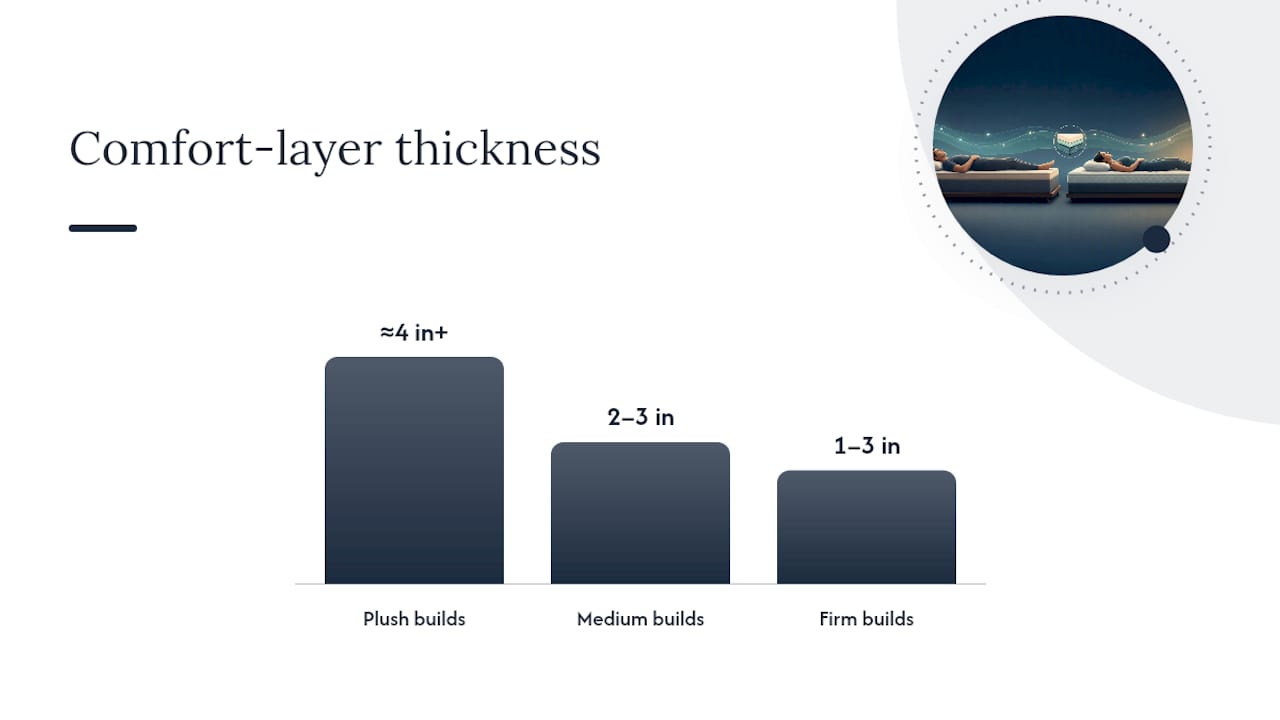
You can estimate firmness before you ever lie down by checking comfort-layer thickness:
- Plush builds: comfort layers of roughly 4 inches or more, often memory foam or a pillow top
- Medium builds: comfort layers around 2 to 3 inches, usually foam over a hybrid core
- Firm builds: comfort layers of about 1 to 3 inches, sitting over innerspring coils, dense polyfoam, or latex
A brand claiming “plush support” isn’t contradicting itself. It’s describing two different layers of the same mattress.
What Does a Firm Mattress Feel Like to Sleep On?
A firm mattress keeps you on top of the surface rather than sinking into it. You’ll feel the structure underneath almost immediately, whether that’s coils flexing back or a slab of dense foam holding its shape. Most firm builds are hybrids or innersprings paired with latex or high-density polyfoam, which is why they tend to last longer and sleep cooler than softer alternatives.
The advantages show up fast for the right sleeper:
- Better spinal alignment for people who sleep on their back or stomach
- Cooler sleep, since less sinkage means more airflow around your body
- Longer lifespan, especially with reinforced coils or higher-density foam that resists sagging
- Easier movement, which matters if you get up at night or shift positions often
- Stronger edge support, useful for couples who sit on the mattress edge to dress
The downside lands hardest on side sleepers. Without enough give at the shoulders and hips, a firm surface creates pressure points that can leave you sore by morning. Light-framed sleepers often describe firm mattresses as feeling like sleeping on a countertop. New firm mattresses can also feel harder than advertised for the first few weeks before the foams and fabrics relax.
Pro Tip: If a firm mattress feels brutal on night one, give it two to three weeks before judging it. Foam softens slightly as it breaks in, and your body adjusts faster than you’d expect.
What Does a Plush Mattress Feel Like to Sleep On?
Plush means sink-in. You lie down and the mattress wraps around your shoulders, hips, and lower back instead of pushing back against them. That contouring usually comes from thick memory foam layers or a Euro top and pillow top construction stacked over the support core, and it’s the reason plush mattresses show up so often in side sleeper recommendations.
The benefits are specific, not vague comfort talk:
- Real pressure relief at the shoulders and hips, the two spots side sleepers complain about most
- Strong motion isolation, so a restless partner is less likely to wake you
- A better match for lighter-framed sleepers, generally under about 130 pounds, who don’t compress foam enough to reach the support layer underneath
The tradeoffs matter just as much. Deep sinkage cuts down airflow, so plush mattresses trap more body heat overnight than firmer builds. Heavier back and stomach sleepers can feel their midsection sink lower than their hips and shoulders, which arches the lower spine instead of supporting it. Edge support and long-term durability also tend to be weaker on plush models, since softer foams compress faster under repeated weight than denser coils or latex.
Which One Fits Your Body and Sleep Position?
Match the mattress to how you actually sleep, not how you think you should sleep. Three factors decide this: position, weight, and whether you share the bed.
- Side sleepers generally do best on plush to medium mattresses. Softer comfort layers cushion the shoulder and hip, keeping the spine level instead of forcing the top shoulder to rotate forward.
- Back sleepers usually land in the medium to firm range. You need enough give to support the lower back’s curve, but enough push-back to stop your hips from sagging out of alignment.
- Stomach sleepers typically need firm. Anything softer lets the hips sink lower than the shoulders, which arches the lower spine in exactly the wrong direction.
Body weight shifts these rules. Lighter sleepers, under roughly 130 pounds, don’t compress foam enough to reach the firmer support core, so they often need to size down in firmness compared to what their position alone suggests. Heavier sleepers compress materials faster and deeper, so they usually need to size up: a side sleeper at 220 pounds might do better on medium instead of plush, because plush foam under real weight can sink past the point of support.
Couples with mismatched preferences have options beyond compromise. Medium-firm often works as a shared middle ground, but split mattresses with different firmness on each side, or hybrid builds with strong motion isolation, solve the problem without either partner losing sleep quality.
How Do You Actually Choose Between Firm and Plush?
Run through this checklist before you commit, whether you’re shopping online or lying on a showroom floor.
- Confirm your primary sleep position and rough weight bracket first. Everything else builds on this.
- Check the firmness rating and comfort-layer thickness listed on the product page, then confirm what the support core is made of, coil, foam, or latex.
- Think about your partner, motion transfer, edge support, and heat. A mattress that sleeps great solo can disappoint once someone else is sharing it.
- Read the trial length, return policy, and warranty terms, especially the sagging threshold that voids coverage. Firmness labeling isn’t standardized across brands, so a “medium” from one company can feel like another company’s “firm.”
- Use a topper as a reversible fix. A plush topper softens a mattress that arrived too firm; a firmer topper adds structure to one that feels too soft.
Pro Tip: Give any new mattress two to six weeks before deciding it’s wrong for you. Materials settle, your body adjusts, and a mattress that feels off on day three often feels right by week four.
What Guestly Sleep Recommends for Different Sleepers
Guestly Sleep builds its mattresses without fiberglass, using materials manufactured and assembled in the United States. Every mattress ships free with a 60-night trial, so you’re not guessing based on a showroom nap. Product collections are organized by comfort level and sleep position, including options intended for side sleepers, combination sleepers, back sleepers, and stomach sleepers. Guestly Sleep also recommends replacing a mattress every two to four years to keep materials from breaking down and sleep quality from quietly declining.
Why Position-First Thinking Beats Firmness Labels
The mattress industry loves to sell firmness as a personality trait, like you’re either a “firm person” or a “plush person” for life. That framing is backwards. Your sleep position and your weight do almost all the work in deciding what surface actually supports you, and both of those can change over the years. A back injury, weight gain or loss, or a shift from side to back sleeping can flip the right answer entirely.
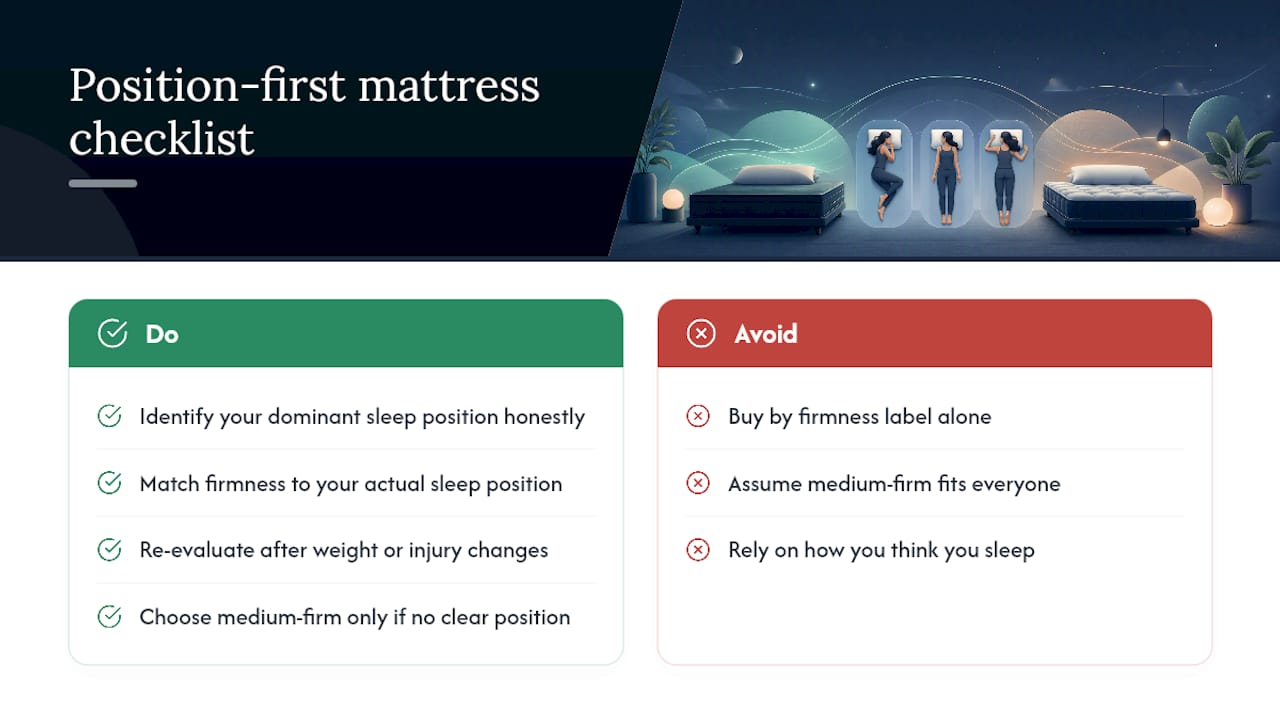
The research backing medium-firm for general back pain is genuinely strong, but it gets misapplied constantly. People read “medium-firm is best” and assume it’s best for everyone, when it’s really the safest bet for someone who doesn’t fit a clear position-based pattern or who sleeps in multiple positions through the night. If you’re a dedicated stomach sleeper, medium-firm might actually undersupport you. If you’re a 115 pound side sleeper, it might feel unexpectedly hard.
What I’d prioritize first: figure out your dominant sleep position honestly, not aspirationally. Most people think they’re back sleepers because that’s how they fall asleep, then wake up on their side. Sleep the way you actually sleep, then match firmness to that.
Ready to Match Your Sleep Position to the Right Mattress?
Guestly Sleep organizes its lineup so you don’t have to translate vague firmness labels into a real decision. Every model ships fiberglass-free and made in the United States, with free shipping and a 60-night trial that lets you sleep on it through a full adjustment period, not just a 15-minute showroom test.
If you sleep on your side or run lighter-framed, the TRU Luxury Plush mattress is built around exactly the contouring this article describes. Not sure where you land on the spectrum? The mattress comparison chart lets you check construction, firmness, and price side by side before you buy. Start there, pick the build that matches your position and weight, and let the 60-night trial confirm you got it right.
Sources
- Understanding the mattress firmness scale | NCOA
- What Is a Plush Mattress? | Sleep Foundation
- Mattress impact on lifestyle and back pain: a 25‑year orthopedic literature review guideline | Journal of Orthopaedics and Traumatology