

Shoppers: Match Mattress and People to Bed Frame Capacity 500–1,500 lb
Most standard bed frames safely hold between 500 and 1,000 pounds total, covering the mattress and everyone sleeping on it. Reinforced platform frames push that to 1,000 to 1,500 pounds, and heavy-duty steel frames go higher still. Before buying anything, add up mattress weight plus occupant weight, then jump to the calculation steps below to find your real number.
TL;DR:
- Most standard bed frames support 500 to 1,000 pounds total, but reinforced and heavy-duty steel frames can handle over 1,500 pounds and more.
- Confirm whether the capacity includes mattress weight, occupants, pets, and additional sitting or sleeping loads before selecting a frame.
- Weight ratings are based on static load tests and often function more as warranty guidelines; exceeding limits can cause frame damage and void warranties.
- Construction materials, such as welded steel and hardwood, along with design features like center support and proper slat spacing, strongly influence a frame’s actual load capacity.
- Calculating real capacity involves adding mattress weight, occupant weight, and a safety margin, then choosing a frame rated at least 25-30% higher than that total.
Table of Contents
- Bed Frame Weight Capacity By Type And Size
- What A Weight Limit Actually Covers
- How Manufacturers Test Capacity And Why It Affects Your Warranty
- Construction And Materials That Determine Load Capacity
- Calculating The Bed Frame Capacity You Actually Need
- Simple Ways To Boost An Existing Frame’s Support
- Guestly Sleep’s Approach To Pairing Mattresses And Frames
- How Frame Design Shapes Weight Distribution And Stability
- Safety Standards And Regulations For Bed Frames
- A Quick Checklist Before You Buy
- Find A Mattress And Frame Pairing That Actually Fits
- Sources
Bed Frame Weight Capacity By Type And Size
The number on a product listing depends almost entirely on how the frame is built, not how big the bed looks in a showroom photo.
Standard wood or basic metal frames, the kind sold in big-box stores for a few hundred dollars, typically list total capacities in the 500 to 1,000 pound range. That number has to cover the mattress, both sleepers, and anything else resting on the frame. Reinforced platform frames with thicker rails and a center support beam commonly reach 1,000 to 1,500 pounds. Heavy-duty or industrial-grade frames, usually welded steel with multiple center legs, can hit 1,500 to 2,500 pounds or more.
Bed size changes how that total gets divided. A queen frame rated at 1,000 pounds gives two average-weight adults plenty of margin. A king frame with the same rating spreads the load across a wider surface but doesn’t necessarily add strength, since the extra width often means longer, less-supported slats.
- Standard frames: 500 to 1,000 lb, fine for lighter individual sleepers or couples under a combined 400 lb.
- Reinforced/platform frames: 1,000 to 1,500 lb, the practical sweet spot for most couples.
- Heavy-duty frames: 1,500 to 2,500+ lb, built for heavier sleepers or anyone wanting a wide safety cushion.
Some steel frame listings get specific about this. One popular deluxe steel frame tests to 1,500 pounds in a distributed load configuration, with the rating tied directly to how the weight spreads across the rail system rather than a single guess-and-check number.
What A Weight Limit Actually Covers
A “1,000 pound capacity” claim on a product page rarely means what shoppers assume it means, and that gap causes most of the returns and warranty disputes in this category.
The first distinction that matters is distributed load versus point load. Distributed load is what you get lying flat across the mattress, weight spread evenly over the whole frame. Point load is what happens when someone sits on the edge, jumps to get into bed, or a large dog leaps onto one corner. A frame rated for 1,000 pounds distributed might struggle with 200 pounds concentrated on one rail edge, which is why edge creaking often shows up long before the frame is anywhere near its “limit.”
Run through this before trusting a number:
- Confirm the mattress weight is included. Some manufacturers explicitly exclude mattress weight from the stated capacity, which quietly eats into your real margin.
- Add both occupants’ combined weight, not an average or an estimate.
- Factor in pets, decorative pillows stacked at night, and anyone who sits on the edge daily.
- Check whether the number is per-slat, per-rail, or whole-frame total, since specs sometimes bury this distinction in a footnote.
If the listing doesn’t clarify any of this, that’s a sign to contact the seller directly before checkout, not after delivery.
How Manufacturers Test Capacity And Why It Affects Your Warranty
Most weight ratings come from static load testing, where engineers apply weight gradually across the frame and measure deflection, creaking, and joint stress until they hit a failure threshold or a safety cutoff. The published number is usually well below that failure point, built in as a cushion, not a ceiling you can push right up against.
That cushion matters more than most buyers realize. Weight limits function as warranty language as much as they function as engineering specs, and brands enforce that language differently. Exceed the stated limit and, structurally, here’s what tends to happen over time:
- Slats bow or crack under sustained pressure
- Center rails warp, especially on frames without a dedicated support leg
- Joinery loosens, producing the telltale creak when anyone shifts position
- Metal frames develop stress fractures at weld points
Reviewers who test these frames for a living routinely call manufacturers directly to verify the real tested capacity rather than trust the marketing copy alone.
Pro Tip: Call or email customer support before buying and ask specifically whether the listed capacity is a tested figure or an estimate. Save that response. If a joint ever fails and you need a warranty claim, having written confirmation of the stated capacity works in your favor.
Construction And Materials That Determine Load Capacity
The material a frame is built from predicts its weight capacity better than almost any other spec on the listing.
Solid hardwood rails and welded steel frames consistently outperform particleboard or glued composite construction, which tends to flex and eventually separate under repeated stress. Construction quality, more than any other single factor, determines how much weight a frame can safely carry, which is why two frames that look nearly identical in photos can have wildly different real-world ratings.
Three design details separate a frame that lasts from one that doesn’t:
- Slat spacing and thickness. Slats spaced more than 3 inches apart, or thinner than 0.75 inches, bow faster under sustained weight.
- Center support rails. A frame with a center beam and at least one additional leg redistributes load away from the outer rails, often adding hundreds of pounds of practical capacity.
- Rail-to-post connections. Welded steel joints hold up better long-term than bolted or friction-fit wood joints, which loosen with repeated motion.
The tradeoff is straightforward: heavier-duty construction costs more and weighs more to ship and move. For anyone who needs the higher end of that 1,500 to 2,500 pound heavy-duty range, that tradeoff is worth it, but a couple well under 800 combined pounds doesn’t need to pay for capacity they’ll never use.
Calculating The Bed Frame Capacity You Actually Need
Skip the guesswork. This is the same math a careful shopper runs before adding anything to a cart, and it takes about two minutes.
- Find your mattress weight. Check the manufacturer spec sheet first. If it’s not listed, estimate by size and type: a queen memory foam mattress typically runs 90 to 120 pounds, while a queen hybrid can run heavier.
- Add combined occupant weight. Use actual weights, not rounded-down estimates, and include a pet if it regularly sleeps on the bed.
- Apply a safety margin. A 25 to 30 percent buffer over your calculated total is the standard reviewers and manufacturers recommend, since it accounts for movement, jumping, and gradual wear.
- Round up to the next capacity tier, not down.
Here’s a worked example: a queen mattress at 100 pounds, plus two occupants combined at 350 pounds, equals 450 pounds. That number fits comfortably within a standard frame’s 500 to 1,000 pound range, but if either occupant weighs considerably more, the math pushes you toward a reinforced platform frame instead.
Run this calculation before you shop, not after the frame arrives and starts creaking.
Simple Ways To Boost An Existing Frame’s Support
Not every capacity problem requires buying a new frame. A center support rail with its own leg, retrofitted under an existing frame, redistributes load from the side rails and slats onto a central beam, effectively pushing a standard frame’s behavior closer to a reinforced platform frame.
A few practical fixes, roughly in order of effort:
- Add a center support rail with an extra leg if your frame doesn’t already have one; this is the single highest-impact upgrade.
- Lay a bunkie board or 3/4 inch plywood sheet across the slats to spread weight evenly and reduce individual slat stress.
- Check and tighten every bolt and joint every few months, since loose hardware accelerates wear long before the frame reaches its actual limit.
Pro Tip: If a frame is already creaking, sagging visibly, or has a cracked slat, reinforcement is a stopgap, not a fix. Structural damage that’s already started tends to spread, and at that point replacement is the safer and often cheaper long-term option.
Guestly Sleep’s Approach To Pairing Mattresses And Frames
Guestly Sleep recommends replacing mattresses every 2 to 4 years, and that cycle only works if the frame underneath stays structurally sound the whole time. A worn frame paired with a brand-new mattress undermines the investment before it has a chance to pay off.
Guestly Sleep’s installation service can assemble the frame for you, saving you the headache. That matters most for solid wood and welded steel frames, where correct assembly directly affects rated capacity. Choosing a bed frame built for your mattress type up front avoids the retrofit scramble later.
How Frame Design Shapes Weight Distribution And Stability
A frame’s geometry determines whether weight spreads evenly or concentrates at weak points, and that shows up most under real-world, uneven loads.
Platform frames with continuous slat support distribute weight across the entire mattress footprint, which is why they tend to feel more stable under a single heavier sleeper than a frame with widely spaced slats and no center beam. Frames without a center rail rely entirely on the perimeter rails to bear the load, and those rails flex more as span increases, particularly on queen and king sizes.
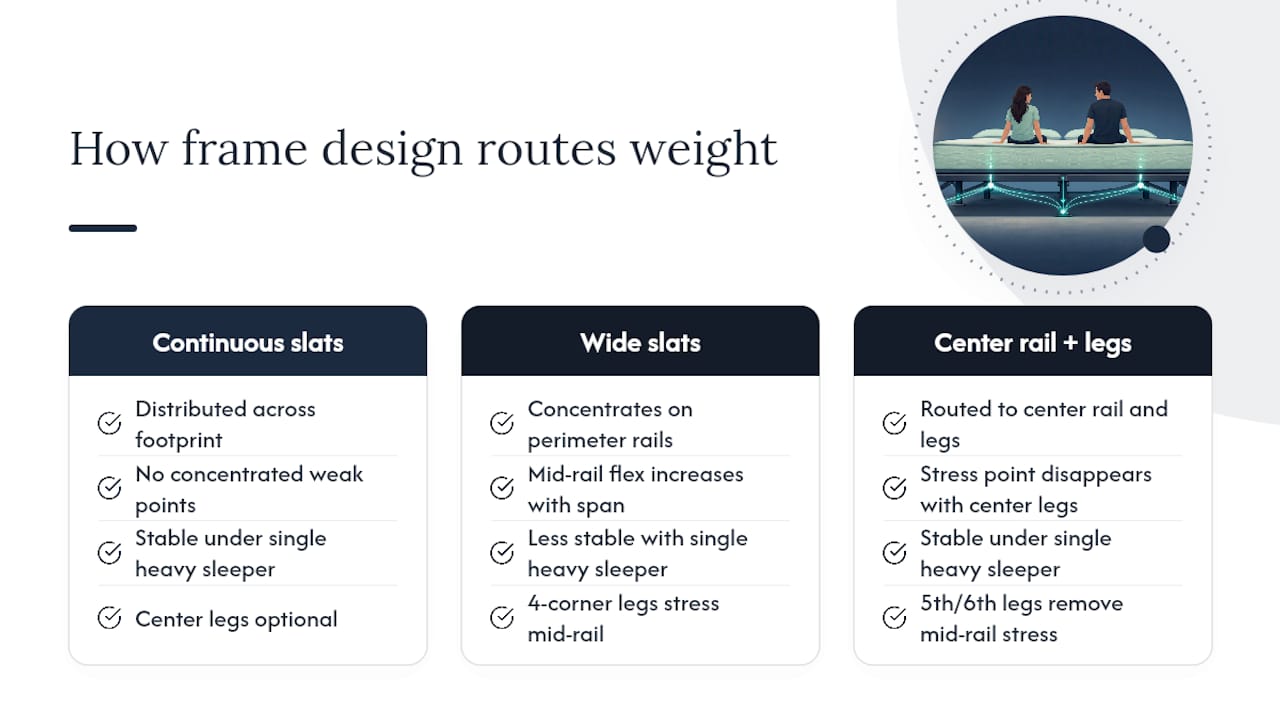
Leg placement matters just as much as rail strength. A frame with four corner legs and no center support puts the most stress on the middle of each long rail, exactly where mattresses see the most consistent nightly weight. Add a fifth or sixth leg under a center rail and that stress point disappears, since the load now has a shorter, stiffer path down to the floor.
Headboard and footboard attachments can help or hurt stability depending on how they’re mounted. A footboard bolted directly into the side rails adds rigidity to the whole frame; one that’s just decoratively attached adds nothing structural. For anyone assembling a frame themselves, torquing every bolt to the manufacturer’s spec, rather than just snug, is often the difference between a frame that stays quiet for years and one that starts creaking within months.
Safety Standards And Regulations For Bed Frames
Bed frames don’t fall under a single mandatory federal weight-capacity standard the way, say, car seats or cribs do. Instead, manufacturers typically test against voluntary industry guidelines and their own internal engineering benchmarks, then publish whatever capacity number they’re comfortable standing behind for warranty purposes.
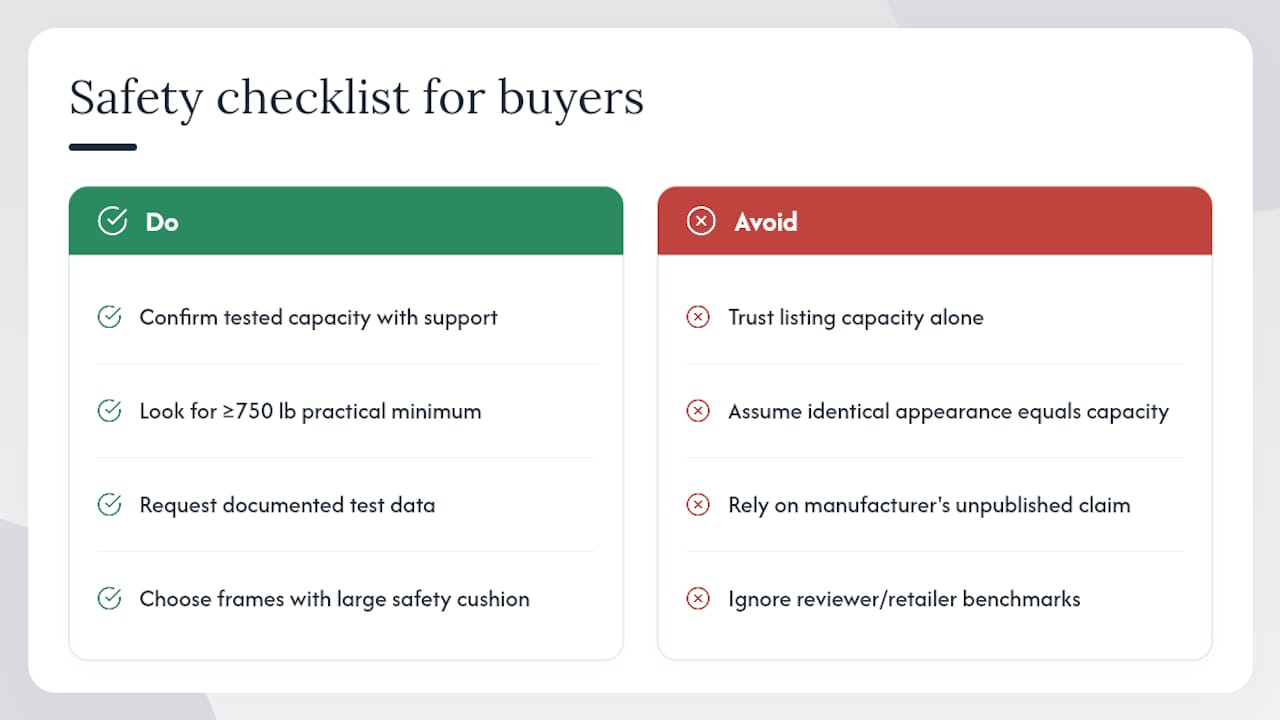
That’s part of why capacity claims vary so much between brands selling nearly identical-looking frames. A company that tests conservatively and builds in a large safety cushion will publish a lower number than a competitor testing closer to the actual failure point, even if the two frames are structurally similar. This is exactly why calling customer support to confirm a tested figure, rather than trusting the listing alone, is worth the five minutes it takes.
Retailers and reviewers who specialize in frames for heavier sleepers treat 750 pounds as a practical minimum threshold worth looking for, with some specialty frames tested well above 2,000 pounds for buyers who want a wide margin. Until a unified mandatory standard exists, that kind of documented, support-confirmed testing is the closest thing consumers have to a reliable benchmark.
A Quick Checklist Before You Buy
Before checkout, confirm the listed capacity includes mattress weight and check whether a center support rail comes standard or costs extra. Count the legs. Get warranty terms in writing, not just a sales rep’s verbal assurance. And send one email to customer support asking for the tested capacity figure, then save that reply. It’s the cheapest insurance policy in the entire buying process.
Find A Mattress And Frame Pairing That Actually Fits
Guestly Sleep sells fiberglass-free mattresses built without the harmful fillers found in a lot of budget options, organized by sleep position and comfort tier so you’re not guessing which one matches your frame’s capacity needs. Every mattress ships free, backed by a 60-night trial, so you can confirm the fit before committing.

Pairing the right mattress with the right frame is where most of the capacity math above actually pays off, and Guestly Sleep’s installation service can assemble everything correctly on delivery day. That single step catches the mismatches this article just walked through, before they turn into a warranty problem. Browse the mattress collections and add installation at checkout to get the whole setup handled in one visit.
Sources
- Mattress weight limit: Why it matters Tom’s Guide
- Everything you need to know about mattress weight limits. - Reviewed
- Best bed frames for heavy people (Sleepopolis)
- Rize Steel Deluxe Bed Frame (BedPlanet)
- Best bed frames for heavy people (SleepAdvisor)