

Adjustable Base Compatibility: Verify Approval and Measure First
Most foam, latex, and pocket-coil hybrid mattresses work with an adjustable base, but only when the specific model is explicitly approved and its profile and frame clearance allow it to flex. The fastest way to find out is to identify your exact mattress and base models, check written manufacturer approval, then measure your frame’s interior dimensions and your mattress profile before you ever plug the base in.
TL;DR:
- Memory foam, latex, and pocket coil hybrids usually flex, but linked Bonnell or offset coils and reinforced edges need explicit model level approval.
- A model approved at 11.5 inches may be restricted at 14.5 inches, so compare your measured mattress height with the base’s stated profile limit.
- Measure the frame’s interior width, depth, rail height, and head and foot clearance; a zero clearance base may solve limited vertical space, not bad dimensions.
- Check the mattress specifications and warranty, then get written confirmation for the exact model and profile; when instructions conflict, follow the more restrictive one.
Table of Contents
- 1. Which mattress types typically work with adjustable bases
- 2. How mattress profile and rigidity affect compatibility
- 3. Will an adjustable base fit inside my existing bed frame?
- 4. Split configurations: single unit, full-split, and split-head
- 5. Attachment systems and bedding fit you need to verify
- 6. How to verify manufacturer approval in writing
- 7. Installation and compatibility test checklist
- 8. How Guestly Sleep reduces compatibility risk
- 9. Why verification beats assumption when upgrading
- 10. Guestly Sleep: mattresses, installation, and compatibility support built in
- FAQ
- Sources
1. Which mattress types typically work with adjustable bases
Material matters, but it’s not the whole story. Memory foam and latex mattresses tend to flex well because their construction has no rigid internal frame, yet that doesn’t mean every model is cleared for use. A manufacturer can still restrict a specific foam mattress if its edges are reinforced in a way that resists bending, so checking the model’s own spec sheet remains the deciding factor rather than the material alone.
Hybrid mattresses built with pocketed coils generally articulate well because each coil moves independently instead of pulling on its neighbors the way older interconnected systems do. Most foam, latex, and pocket-coil hybrid mattresses are compatible with adjustable bases, while traditional interconnected innerspring builds typically are not unless a manufacturer has specifically engineered them for flexibility. Look for pocketed coils and flexible transition foam layers above the coil system: these two features are the clearest signs a hybrid was designed with adjustable bases in mind.
Traditional Bonnell and offset coil systems link every coil to its neighbors with helical wire, so lifting one section strains the whole unit. These constructions usually fail on an adjustable base and can develop permanent sagging or wire damage over time. Exceptions exist when a manufacturer has reinforced the coil system or added a flexible foam encasement, but that should be confirmed in writing rather than assumed from the mattress category.
Air-chamber mattresses and feature-rich options with built-in massage units or multi-zone firmness controls often need a matched base from the same manufacturer, or may be incompatible with third-party bases altogether. If your mattress falls into this category, check the product page before buying a base from a different brand.
- Memory foam and latex: generally flexible, but confirm the specific model is rated for adjustable use.
- Pocket-coil hybrids: usually compatible, especially with flexible foam transition layers.
- Bonnell or offset innerspring: typically incompatible unless specifically engineered otherwise.
- Air-chamber and multi-feature mattresses: often require a matched base or carry restrictions.
If you’re shopping for a new mattress with a base in mind, our mattress comparison chart breaks down construction and profile options across our fiberglass-free lineup so you can see which builds suit articulation before you buy.
2. How mattress profile and rigidity affect compatibility
Thickness is the first thing people check, but profile alone doesn’t guarantee a mattress will bend the way you need it to. A tall mattress with soft foam layers can flex more easily than a shorter one with a reinforced edge system or a high-density support core, because stiffness, not height, determines how a mattress responds to articulation.
Tufting and quilted top panels can stiffen a mattress’s surface just enough to resist a sharp incline angle, and reinforced perimeter edges, while great for seating support, often reduce how far the head or foot section can rise before the mattress buckles instead of bending smoothly. High-density foam at the base of a mattress serves the same stabilizing purpose but can work against articulation if the base’s hinge points don’t line up with where the foam naturally flexes.
Two profiles of the same mattress model can differ in adjustable-base compatibility. Guides document cases where an 11.5-inch version of a model is approved for adjustable use while a 14.5-inch version of the identical model is not, which means model family alone tells you nothing. Always check the exact profile height against the manufacturer’s stated limit.
Manufacturers usually flag compatibility in one of two ways on a product page or spec sheet: language like “adjustable-base compatible” or “suitable for use with a motorized base,” or a stated “maximum profile for adjustable use” that caps how tall a mattress can be on that particular base. When you see a profile limit listed, compare it directly against your mattress’s actual measured height, not the marketing thickness, since some brands round up.
- Check for tufting or quilting that could stiffen the sleeping surface.
- Note any reinforced edge system and how far it extends around the perimeter.
- Compare your mattress’s exact profile against the base manufacturer’s maximum stated limit.
- Confirm the product page uses explicit “adjustable-base compatible” language rather than silence on the topic.
3. Will an adjustable base fit inside my existing bed frame?
Frame geometry decides whether a base will physically sit inside your current setup, and this step trips up more buyers than mattress material does. Sleigh beds and solid low-profile platforms are the most common culprits because their side rails and footboards are often built with little to no interior clearance for a bulky motorized unit, and some platforms have center support beams running the wrong direction for a base’s legs.
Measure before you buy, not after the base arrives. Here’s the order that avoids wasted returns:
- Measure the interior width of your frame between the side rails, then compare it to the base’s listed width for your mattress size.
- Measure interior depth from the headboard-side rail to the footboard-side rail, accounting for any inward curve in a sleigh-style frame.
- Check head and foot clearance, meaning the open space above the frame’s rail height where the base’s head and foot sections need room to rise.
- Measure the height of the rails or slats themselves, since a base with legs needs enough internal frame depth to sit level without rubbing the headboard or footboard.
- Look for center support brackets, cross-beams, or built-in storage drawers that could block the base’s legs or motor housing from seating flush.
Pro Tip: Bring a tape measure and the base’s spec sheet to bed stores before buying either piece, since return shipping on a bulky adjustable base often costs more than the item is worth.
If your frame has obstructing brackets or integrated storage, a zero-clearance base, one designed to sit flush against the floor on very short or removable legs, often solves the problem without replacing the frame. Some bases also ship with legs that detach entirely, letting the unit rest directly on existing slats inside a platform frame that has enough width and depth but not enough vertical room for standard legs. For a closer look at platform-specific fit issues, our guide on fitting an adjustable base into a platform bed walks through the most common obstacles and fixes.
4. Split configurations: single unit, full-split, and split-head
Adjustable bases come in three common configurations, and each one changes what mattress you need and how your bedding behaves. Consumer Reports outlines single-unit, full-split, and split-head systems as the three standard types, each carrying its own mattress and bedding requirements.
A single-unit base is one continuous frame under a single mattress, the simplest setup and the one with the fewest fit concerns beyond the checks already covered. A full-split, most often sold as a split king, uses two separate Twin XL bases under two separate Twin XL mattresses, letting each side move independently. The tradeoff is a seam down the center of the bed, and if the two mattresses aren’t closely matched in height, you can end up with an uneven sleeping surface that bedding alone won’t hide.
Split-head configurations keep a single mattress across the full width of the bed but split only the head-lifting mechanism into two independently controlled sections. This requires a mattress flexible enough to bend along two separate hinge lines instead of one, so not every mattress rated for a standard single-unit base will perform the same way on a split-head system. Confirm this specifically with the manufacturer rather than assuming standard approval carries over.
- Single unit: one base, one mattress, straightforward fit and the fewest compatibility questions.
- Full-split (split king): two Twin XL mattresses on two independent bases, watch for height mismatches and a center seam.
- Split-head: one mattress, two independently moving head sections, requires confirmed two-hinge flexibility.
- Syncing: some split bases pair wirelessly so both sides rise together on command, though independent operation is usually still available, and not all base pairs support syncing.
Split systems solve independent comfort preferences but introduce their own tradeoffs, including the center gap and added bedding complexity that a matched-profile mattress pair and a bed bridge can help minimize. For a full walkthrough of sizing, syncing, and bedding for this setup, see our split king adjustable base buyer’s guide.
5. Attachment systems and bedding fit you need to verify
Once the mattress and base are the right dimensions, the hardware holding them together matters just as much. Most adjustable bases rely on one of three attachment methods: a retainer bar mounted at the foot of the base, adjustable straps that wrap around the mattress corners, or built-in magnets along the frame’s perimeter. Standard documentation across manufacturers describes retainer bars and straps as the common systems, and each should be installed according to the base’s manual rather than improvised.
Sheets, mattress protectors, and bed skirts can all interfere with a base’s moving parts if they’re cut too generously or anchored in the wrong place. Deep-pocket fitted sheets sometimes bunch at the hinge points during articulation, and a bed skirt attached with pins or Velcro can catch in the mechanism when the foot section rises. Choosing bedding sized specifically for your mattress profile, rather than oversized “fits most” options, avoids most of these snags.
- Retainer bars: mount at the foot of the base and should sit flush against the mattress edge with no gap.
- Straps: wrap securely around mattress corners and should hold tension without stretching loose during articulation.
- Magnets: built into some base frames and require correct mattress alignment to engage properly.
- Bedding: choose fitted sheets and skirts sized to your exact mattress profile to avoid catching in moving parts.
Guides caution against improvised hardware, since makeshift fixes can damage the mattress or the base’s motor assembly, so stick to the attachment parts included with your specific base or approved replacements from the manufacturer.
Pro Tip: After installing any retainer hardware, raise the head section partway and check that the mattress edge stays flush against the bar instead of lifting or sliding, a quick visual test that catches most attachment problems immediately.
6. How to verify manufacturer approval in writing
Written approval is the single most reliable safeguard against a denied warranty claim. Start on the mattress’s own product page and look for phrases like “adjustable-base compatible,” “suitable for use with a motorized frame,” or a specific maximum profile listed for adjustable use. These phrases usually sit in the specifications section rather than the marketing copy, so you may need to scroll past the lifestyle description to find them.
Warranty PDFs are the next place to check, since many manufacturers spell out base requirements there instead of on the sales page. Restrictive language often reads like “use with a solid foundation or slats no more than X inches apart” and makes no mention of adjustable use at all, which should be read as a restriction rather than an oversight.
- Check the product page’s specifications section for explicit adjustable-base language.
- Download and search the warranty PDF for foundation and base requirements.
- Contact support directly and ask them to confirm compatibility with your exact model and profile in an email you can save.
- When a mattress and a base come from different manufacturers and their instructions conflict, follow whichever instruction is more restrictive, or get written confirmation from both before proceeding.
If support confirms compatibility over chat or phone, ask them to follow up with the same answer in writing. That email becomes your documentation if a warranty question ever comes up later.
7. Installation and compatibility test checklist
Once you’ve confirmed approval and measured your frame, the actual install is where small mismatches tend to surface. Running through a short checklist before you sleep on the new setup catches most problems early.
- Pre-install: measure your frame’s interior dimensions one more time, confirm a power outlet is within reach of the base’s cord, and arrange help or white-glove delivery for a heavy base and mattress.
- Install: position the base inside the frame, attach legs if the model includes them, fasten retainer bars or straps according to the manual, then place the mattress squarely on top.
- Test: power on the base and raise the head and foot sections slowly to partial angles, watching closely for catching fabric, a bridging gap at the hinge, or the mattress sliding out of the retainer.
- Post-test: confirm your sheets and protector still fit cleanly at full incline, sync split bases if your pair supports it, and verify the stated weight limit matches your household’s needs before regular use.
Running the mattress through slow articulation on the installed base is the recommended final verification step, since this is the point where catching, bridging, or shifting becomes visible in a way measurements alone can’t predict.
| Checklist stage | What to confirm | Why it matters |
|---|---|---|
| Pre-install | Frame interior measurements, outlet access, delivery help | Avoids a base that arrives but won’t fit or power on |
| Install | Legs, retainer hardware, mattress placement | Prevents slippage or hardware damage later |
| Test | Slow articulation, watching for catching or bridging | Surfaces compatibility issues before daily use |
| Post-test | Sheet fit, split-base syncing, weight limit | Confirms the whole system works as one |
8. How Guestly Sleep reduces compatibility risk
Checking compatibility yourself is doable, but it takes time and a tape measure. We built our product line and installation services around removing that guesswork for customers who’d rather not do it alone. Every mattress we sell is fiberglass-free and made in the United States, organized into Essential Comfort, Enhanced Comfort, and Premium Comfort tiers, alongside our own adjustable bases, so pairing a mattress and base from the same source already eliminates one layer of uncertainty.
For customers who want the measurement and installation handled for them, our Install Adjustable Base service and our combined Install Mattress and Adjustable Base service cover the physical setup, including secure attachment of retainer hardware and a movement test before we leave. We also offer haul-away add-ons for customers replacing an old frame or mattress, so the old setup doesn’t become a separate project.
- Mattresses sold in Essential, Enhanced, and Premium Comfort tiers.
- Adjustable bases sold alongside mattresses to simplify pairing decisions.
- Installation services cover measurement, secure attachment, and a post-install movement check.
- Haul-away options are available for customers replacing an existing mattress, frame, or base.
Every mattress we sell comes with a sleep trial and free shipping, giving customers room to confirm comfort and fit without rushing the decision.
9. Why verification beats assumption when upgrading
The biggest mistake I see is buyers working backward: they buy a base, then a mattress, then hope the two cooperate. Flip that order. Start with written manufacturer approval for both pieces, confirm the physical fit against your frame, and only then schedule delivery or installation.

Flexible constructions, pocket coils, foam, latex, are a safer starting point than older innerspring builds, but construction type is a filter, not a guarantee. The model-specific profile limit is what actually decides compatibility, and that number lives in the spec sheet, not the category name.
If measuring frames and chasing down warranty PDFs sounds like more effort than you want to spend, a provider that handles measurement and installation removes that burden entirely. That’s a reasonable trade for a lot of people, and it’s worth weighing against the hours a DIY check can take.
— Justin
10. Guestly Sleep: mattresses, installation, and compatibility support built in
We make the compatibility question easier to answer by selling mattresses and adjustable bases that are designed to work together, plus installation services that handle the measuring and testing for you. If you’ve read this far and still aren’t sure your current mattress or frame will cooperate, that uncertainty is exactly what our Install Adjustable Base and Install Mattress and Adjustable Base services exist to remove.
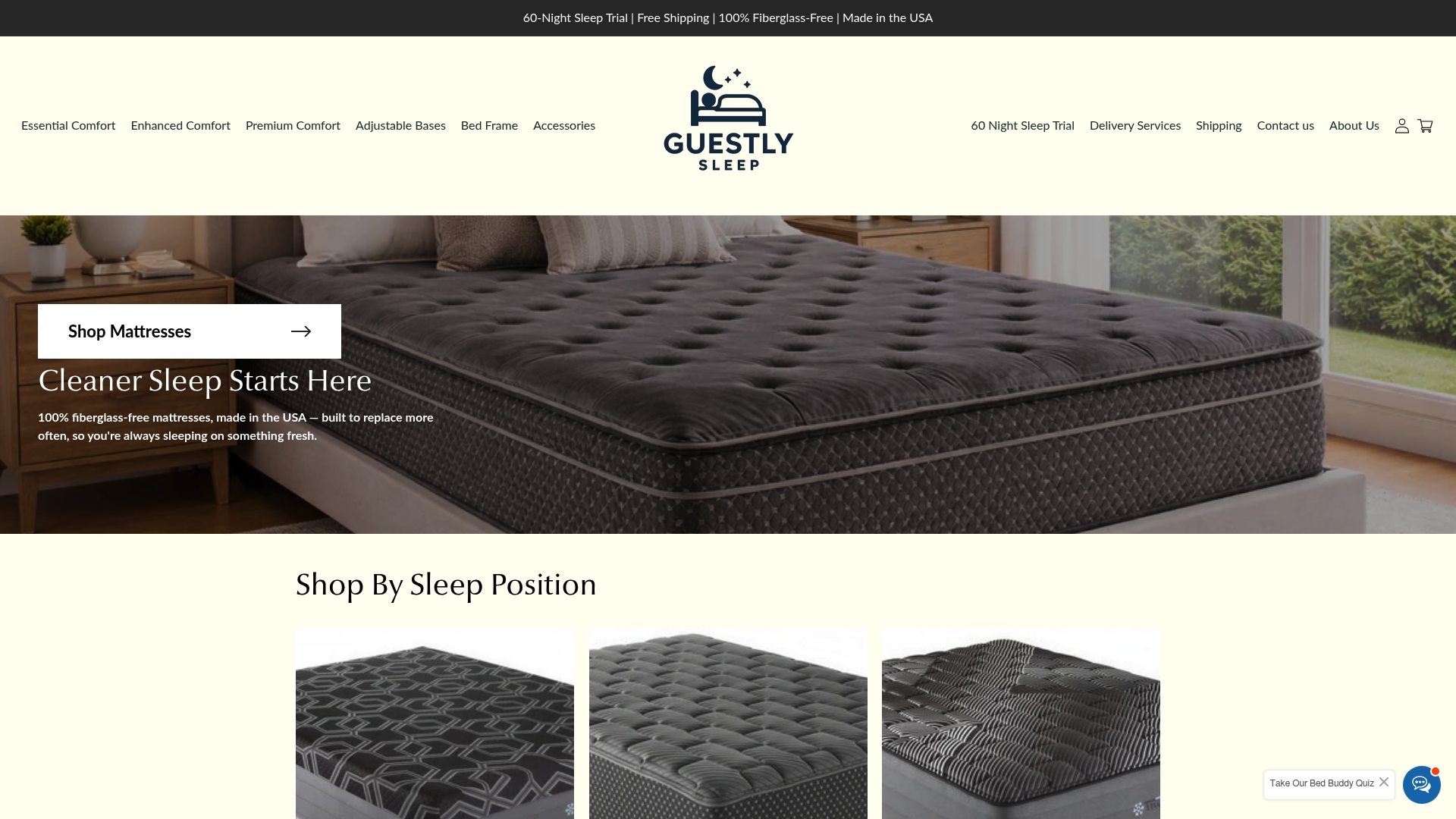
- Browse our mattress collections to compare Essential, Enhanced, and Premium Comfort tiers before you buy.
- Use our mattress comparison chart to match a construction type to your adjustable base.
- Schedule an installation service and we’ll measure, attach, and test the setup before we leave.
If you’re also rethinking your sleep position setup alongside the base itself, this guide to personalized comfort and support covers position-specific adjustments worth considering at the same time.
Ready to stop guessing and get a setup confirmed to work? Check our mattress and adjustable base options and book an installation that includes the fit check for you.
FAQ
What bed frame can I use with an adjustable base?
Most slatted platform frames, metal frames, and frames with wide, open interiors work well, as long as the interior width and depth match the base’s footprint and there’s enough vertical clearance for the base’s legs. Sleigh beds and solid low-profile platforms are the most likely to cause problems, since their rails often leave little room for the base to sit level. Measuring the frame’s interior before buying is the only reliable way to confirm fit.
What is a complete clearance adjustable base?
A zero-clearance, or complete-clearance, adjustable base is designed to sit very low to the floor, often on short or removable legs, so it fits inside frames with limited vertical interior space. This style solves the common problem of a platform frame that has the right width and depth but not enough height for standard base legs. It’s a practical fix rather than a universal substitute for measuring your specific frame.
What are some drawbacks to weigh before choosing an adjustable bed?
Adjustable bases can limit which mattresses you’re able to use, since stiff innerspring constructions and some reinforced-edge mattresses don’t articulate well. Split configurations also introduce a center gap and bedding fit challenges that a single-unit base doesn’t have. Checking manufacturer approval and frame fit in advance, as outlined above, addresses most of these concerns before they become a problem.
What type of mattress is best for an adjustable bed base?
Flexible constructions like memory foam, latex, and pocket-coil hybrids generally perform best, since they bend at the hinge points without resisting the motion the way rigid interconnected innersprings do. Even within those categories, the specific model needs explicit manufacturer approval and a profile height within the base’s stated limit. Our fiberglass-free mattress lineup is built with these flexible constructions in mind across all three comfort tiers.
Can any mattress work on an adjustable base?
No, compatibility depends on both the mattress’s internal construction and its specific profile height, not just its general category. A mattress with the same model name can be approved in one profile and restricted in a taller version, so checking the exact model and height against the manufacturer’s documentation is necessary every time.
Sources
- Best Adjustable Bed Frames of 2026, Lab Tested and Reviewed - Consumer Reports
- Which Mattresses Work With Adjustable Bed Frames?
- Best Adjustable Bed Frame 2026: Amerisleep Guide
- Best Mattress for Adjustable Beds of 2026: Expert Tested